
International Research Journal of Engineering and Technology (IRJET) e-ISSN: 2395-0056
Volume: 13 Issue: 01 | Jan 2026 www.irjet.net p-ISSN: 2395-0072
International Research Journal of Engineering and Technology (IRJET) e-ISSN: 2395-0056
Volume: 13 Issue: 01 | Jan 2026 www.irjet.net p-ISSN: 2395-0072
Dr. K.L. Senthilkumar1, S.Vignesh(2003)2, S.Vidhya3, S.Vignesh(2004)4
1 Principal, Sri Vijay Vidyalaya College of Pharmacy, Dharmapuri, Tamil Nadu (India) 2, 3, 4, B. Pharm, Students, Sri Vijay Vidyalaya College of Pharmacy, Dharmapuri, Tamil Nadu (India) ***
Abstract- Herbal medicines play an important role in the management of skin infections due to their efficacy and minimal adverse effects Euphorbia hirta Linn., a well-known medicinal plant, has been traditionally used for its antimicrobial potential. In this study, a herbal antimicrobial ointment incorporating a hydro alcoholic leaf extract of Euphorbia hirta was formulated and evaluated. Three ointment formulations (F1–F3) containing different concentrations of the plant extract were prepared and subjected to physicochemical characterization and stability studies. Preliminary phytochemical analysis revealed the presence of flavonoids, phenolics, alkaloids, and saponins. The antimicrobial efficacy of the formulations was assessed against selected bacterial pathogens using the agar well diffusion technique. Among the formulations, F3 exhibited the highest zone of inhibition, indicating superior antimicrobial activity. The findings suggest that Euphorbia hirta–based ointment has promising potential as a topical antimicrobial agent for the treatment of skin infections.
Euphorbia hirta Linn. (Family Euphorbiaceous) is a small annual herb widely found in tropical and subtropical regions, especiallyinIndiaandAsia.Ithaslongbeenusedintraditionalmedicinetotreatskininfections,wounds,gastrointestinal and respiratory disorders, and inflammatory conditions. Phytochemical studies show that the plant contains flavonoids, tannins, alkaloids, phenolic compounds, glycosides, and triterpenoids, which contribute to its antimicrobial, antiinflammatory,antioxidant,antimalarial,andantiviralactivities.
Theantimicrobialpotentialof Euphorbiahirta hasattractedinterestforherbaltopicalformulations.Herbalointmentsare preferred due to their safety, low cost, and minimal side effects. Ointments provide prolonged skin contact, ease of application,andlocalizeddrugaction. Euphorbiahirta ointmentiscommonlyusedforwounds,cuts,boils,skininfections, minorburns,eczema,andinflammatoryskinconditions.
Theointmentcontainsanextractoffreshordried Euphorbiahirta leavesincorporatedintoa suitableointmentbase.Itis applied externallyonce or twice daily.Properstorage ina cool,dry placeis necessary,anduseshouldbe discontinuedif irritation or allergic reactions occur. This topical formulation allows localized antimicrobial and wound-healing effects whileminimizingsystemicsideeffects.
Advantage:
Naturalantimicrobial–fightsbacteria&fungi
Reducesredness,swelling&pain
Boostswoundhealing
Cheap,easytofind&eco-friendly
Lessriskofantibioticresistance
Disadvantage:
Maycauseskinirritationorallergies
Effectivenessvariesbyextraction
Limitedhumanclinicaltrialstofullyconfirmitssafetyandefficacy
Shortershelflifethansyntheticointments
Highdosesmaybetoxic
Actslowerthansyntheticantibiotics,especiallyinsevereskininfections.
International Research Journal of Engineering and Technology (IRJET) e-ISSN: 2395-0056
Volume: 13 Issue: 01 | Jan 2026 www.irjet.net p-ISSN: 2395-0072
Paraffinwaxpelletsactasastiffeningagentandincreasethehardnessandmeltingpointoftheointment.
Whitebeeswaxisusedasaconsistencyenhancerandstabilizerandalsoactsasanaturalstiffeningagent.
Petroleumjellyservesastheointmentbaseandemollientandprovidessmoothnessandocclusiveproperties.
Liquidparaffinfunctionsasasofteningagent,improvesspreadability,andactsasalevitatingagent.
Methylparabenisusedasapreservativetopreventmicrobialgrowthandincreasetheshelflifeoftheointment.
The microorganisms employed for the evaluation of antimicrobial activity of Euphorbia hirtaincluded selected bacterial strains commonly associated with skin and wound infections. The test organisms used in the present study were Enterobacter cloacae, Enterococcus faecalis, Streptococcus pyogenes, and Proteus vulgaris. These pathogenic bacteria are frequently implicated in cutaneous infections and delayed wound healing. The antimicrobial efficacy of the plant extract andformulatedointmentswasassessedbydeterminingthezoneofinhibitionusingtheagarwelldiffusionmethod,which providesareliablemeasureofantibacterialactivity.
1.3 ANTIMICROBIALACTIVITY
Euphorbia hirtais a well-known medicinal plant extensively utilized in traditional medicine for the treatment of wounds, skin infections, and microbial diseases. The antimicrobial potential of the plant is attributed to the presence of various bioactive constituents, including flavonoids, tannins, alkaloids, phenolic compounds, and terpenoids. These phytochemicals exhibit significant antibacterial properties by disrupting the microbial cell wall, interfering with cellular metabolism,andinhibitingbacterialgrowth.
Several studies have reported that Euphorbia hirtaextracts are effective against abroad range of pathogenic bacteria, including Staphylococcus aureus, Escherichia coli, and Pseudomonas aeruginosa. The ability of the plant extract to inhibit both Gram-positive and Gram-negative bacteria highlights its broad-spectrum antimicrobial potential. Owing to these properties, Euphorbia hirtais considered a promising natural source for the development of herbal antimicrobial formulations,particularlytopicalpreparationssuchasointmentsforthemanagementofskinandwoundinfections.
2. PLANTBIOGRAPHY
2.1 TAXONOMICAL CLASSIFICATION:
Kingdom:Plantae.
Sub-kingdom:Viridiplantae
Infra-kingdom:Streptophyta
Division:Tracheophyta.
Sub-division:Spermatophyta
Infra-division:Angiosperms
Class :Magnoliopsida
Superorder :Rosane
International Research Journal of Engineering and Technology (IRJET) e-ISSN: 2395-0056
Volume: 13 Issue: 01 | Jan 2026 www.irjet.net p-ISSN: 2395-0072
Order:Malpighiales
Family:Euphorbiaceae
Genus:Euphorbia
Species:Euphorbiahirta
2.2 VERNACULARNAME:
English:Asthmaplant,Snakeweed
Tamil:Ammanpacharisi
Hindi:Dudhi
Telugu:Paleru
Kannada:Halusoppu
Sanskrit:Dugdhika
Malayalam:Chittappal
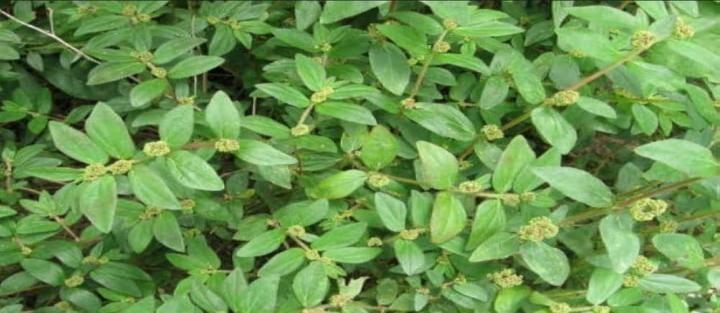
2.3 PLANTDESCRIPTION:
Leaves: Theleavesarepresentinoppositepairsonthestemleaveshaveacurvedbaseandaresimple, ellipticaltoslightly rhombichairy,withajauntilydentatemargin.
Stem:Stemof the plantare small hairy andlongwith monopodial branchingpattern.Internodes of the plant are 2.5-3 cm in length,stipulespresent.
Flowers: Flowersareunisexual,seasonofthefloweristhroughhouttheyear.
Fruits: The plant has allomorphic pistillate fruits. fruit of the plan exerted a3-lobed capsule, three seeded, covered with shorthairs.Greencoloredfruitwithfleshyprickles.1-2mmindiameter.
Root: Ithasdevelopedanddifferentdistinctprimaryroot,i,e.taprootsystem.
3. MATERIALSANDMETHODS
3.1 MATERIALSREQUIRED
Driedpowdered Euphorbiahirta
Ethanol(70%or90%)
Beaker(500ml)
Magneticstirrerwithhotplate
Magneticbead
Measuringcylinder
Filterpaper
Waterbath
3.2 PRELIMINARY WORK
3.2.1COLLECTIONANDDRYINGOFLEAVES
Collection and Preparation of Plant Material Fresh and healthy Euphorbia hirta plants were collected from areas of Dharmapuri and Krishnagiri Districts, and thoroughly washed to remove surface contaminants. Leaves were rinsed with distilledwater
3.2.2 DRYING METHOD
a) Shade Drying (Preferred for Herbal Drugs)
The cleaned leaves were spread in a single thin layer on drying trays. The trays were kept in a well-ventilated, dust-free areaawayfromdirectsunlight.Leaveswereturnedoccasionallytoensureuniformdrying.Dryingwascontinuedfor7–10 daysuntiltheleavesbecamecrispandbrittle.
International Research Journal of Engineering and Technology (IRJET) e-ISSN: 2395-0056
Volume: 13 Issue: 01 | Jan 2026 www.irjet.net p-ISSN: 2395-0072
b) Oven Drying (Rapid Method)
Leaves were placed on trays and kept in a hot air oven at 40–45°C.Drying was carried out for 6–8 hours.Leaves were allowedtocooltoroomtemperature.
The dried Euphorbia hirta plant leaveswere powdered and passed through sieve no.40.The quantity 50 gpowdered drug was transferred into a clean 500 mlbeaker.500 ml of solvent (water and ethanol)1: 10 ratio was added to the beaker to completely immerse the powder. A magnetic bead was placed in the beaker and the beaker was kept on themagnetic stirrer. The mixture was stirred at 200–300 rpm for 6–8 hours at room temperature without heating. After stirring, the mixturewascoveredandallowedtostandfor24hoursforcompletemaceration.ThemixturewasfilteredusingWhatman filter paper. The filtrate was concentrated on a water bath to obtain a semi-solid extract. The extract was stored in an airtightcontainerforfurtherformulation.
3.3 PHYTOCHEMICALSCREENING
Theextractafter obtained are subjected to phytochemical screening to determine the presence of following various phytochemicalspresentintheextracts.
1. Test for Alkaloids:
a) Wagner reagent test: 3ml conc. Extract + 1ml HCL heat for 20 min cooled and filter. Filtrate treated with Wagnerreagent.Formationofbrownreddishprecipitateindicatespresenceofalkaloid.
b) Dragendroff’s Test: 1mlofDragendroff'sreagentwasaddedto2mloftheextractalongthetesttube'sedge. Alkaloidswerepresentwhenanorangeororangereddish-brownprecipitateformed.
c) Mayer reagent test: When Mayer's reagent is added to a sample containing alkaloids, a cream-colored precipitateforms,indicatingapositiveresult.
2. Test for Phenols:
a) Ferricchloride test: Test extract + 4 drops alc. Fecl3solution , formation of bluish black color indicates the presenceofphenol.
b) Lead Acetate Test: Add a few drops of lead acetate solution to 2 mL of the extract. There is a Formation of a whiteoryellowishprecipitate,indicatethepresenceofphenols
3. Test for Flavonoids:
a) Shinoda Test: 2ml oftheextractwasmixedwith1ml ofa1%ammoniasolution. Theeasiest waytoidentify whetherflavonoidsarepresentvisuallyisbythecoloryellow.
b) Alkaline Reagent Test : Addafewdropsofsodiumhydroxide(NaOH)solutiontotheextract.Thenadddilute HCl,intenseyellowcolourthatbecomescolourlessafteraddingacid,indicatethepresenceofflavonoids.
4. Carbohydrate Test:
a) Fehling’s Test: Equal amounts of Fehling A and B reagents were added, and the mixture was then heated slightlybeforeadding2mlofcrudeextract.Becauseabrick-redprecipitatedevelopedatthetesttube'sbottom, reducingsugarswerediscovered.
b) Benedict’s test: 1mlofcrudeextractand2mlofBenedict'sreagentwerecombinedandheated.Carbohydrates werepresentbecauseareddish-brownprecipitateformed
5. Protein Test:
a) Biuret test: TocheckthepresenceofproteininplantextractAdd4-6dropsofcoppersulphatesolutionand2ml of sodium hydroxide to the plant extract, mix the contents well by gently shaking the test tube, and allow the mixturetorestforabout4-5minutes.Abluish-violetcolorindicatesthepresenceofprotein
International Research Journal of Engineering and Technology (IRJET) e-ISSN: 2395-0056
Volume: 13 Issue: 01 | Jan 2026 www.irjet.net p-ISSN: 2395-0072
b) Xanthoproteic test: To 2 ml of extract, add few drops of conc. HNO3 and heat gently. After cooling, add NaOH , formationofyellowtoorangecolourindicatethepresenceofproteins
6. Saponin Test:
a) Foam Test: 2mlofextractand5mlofdistilledwaterweremixedandagitatedvigorouslyinatesttube.Add someoliveoildrops.Theformationofsteadyfoamwasthoughttoindicatethepresenceofsaponins.
b) Froth test: 2 ml of extract add 5 ml of distilled water and shake well. Honeycomb-like froth persists for 10 mines
7. Tannins Test:
a) Ferric chloride test : 2mlextractisplacedintesttube,asmallamountofFeCl₃solutionwasintroduced.Ifa deepordarkgreencolorappears,thisindicatesthepresenceoftannins.
b) Lead acetate test: 2 ml of extract, add few drops of lead acetate solution. Formation of white or yellow precipitate,indicatethepresenceoftannins.
8. Amino Acid Test:
a) Millon’s Test: 1 ml of crude extract and 2 ml of Million’s reagent are combined to generate a white precipitate.Thisprecipitateturnsredwhenitisslowlyheated,signifyingthepresenceofprotein.
b) Ninhydrin Test: 1mlofthenaturalextractand2mlofNinhydrin0.2%solutionwerecombinedandheated. Thepresenceofproteinsandaminoacidswasindicatedbythevioletprecipitatethatappeared.
9. Glycoside Test:
a) Keller-killianitest : To detect the presence of glycosides in a plant extract solution, 1 ml of the paste was mixed with 2 ml of H₂SO₄ and 2 ml of chloroform in a test tube. The solution was thoroughly mixed, and a reddish-browncolourringoccasionallyappeared,indicatingthepresenceofglycoside.
b) Salkowski test: 2mlofextract+chloroform,addconcentratedH2SO4,redorbrowncoloratinterfaceindicate thepresenceofglycosides
3.4 PREPARATIONOFOINTMENT:
3.4.1 PREPARATIONOFHERBALOINTMENT
a) Initially ointment base was prepared by weighing accurately grated hard paraffin which wasplacedinevaporatingdishonwaterbath.Aftermeltingofhardparaffinremainingingredientswereaddedandstirredgently toaidmeltingandmixinghomogeneouslyfollowedbycoolingofointmentbase.
b) Herbal ointmentwaspreparedbymixingaccuratelyweighedeuphorbia extracttotheointmentbasebyLevi gation methodtopreparea smoothpastewith2or3timesitsweightof base,graduallyincorporatingmore bases until toform homogeneousointment,finallytransferredinasuitablecontainer.
3.4.2 PROCEDURE FOR OINTMENT
Melting of Waxy Materials
Weighparaffinwaxpelletsandwhitebeeswax.Meltthemtogetheronawaterbathat6570°C.Thisensurescompletemeltingwithoutdecomposition
Addition of Base Components
Reducetemperatureto60–65°C.Addpetroleumjellyandstiruntil uniform andaddliquidparaffin(heavy)at 55–60°C
Maintaingentlestirringtoformaclearmoltenbase
International Research Journal of Engineering and Technology (IRJET) e-ISSN: 2395-0056
Volume: 13 Issue: 01 | Jan 2026 www.irjet.net p-ISSN: 2395-0072
Preservative Incorporation
Dissolvemethylparabeninasmallquantityofwarmliquidparaffinat50–55°C.Addthissolutiontothemoltenbasewith continuousstirring.
Herbal Extract Incorporation
Allowthebasetocoolto40–45°C.Preventsdegradationofactiveconstituents,Addherbalextractslowlywithcontinuous stirring,mixuntilasmoothandhomogeneousointmentisobtained
Cooling& Packing
Continuestirringwhilecoolingtoavoidcrystallization Allowtocooltoroomtemperature(25–30°C)transferintoaclean containerandlabel
Precautions
Do not exceed 70 °C → prevents wax degradation Add herbal extract below 45 °C → protects heat-sensitive phytochemicals,Continuousstirringtopreventsgrainytexture.
3.4.3 FORMULATION OF HERBAL ANTIMICROBIAL OINTMENT USINGEUPHORBIA HIRTAEXTRACT
TABLE 1: FORMULATION OF HERBAL ANTIMICROBIAL OINTMENT
S.No INREDIENTS
1. Paraffinwaxpellets 15g 15g 15g
2. Petroleumjelly 59g 57g 55g
3. Whitebeeswax 10g 10g 10g
4. Liquidparaffine 15g 15g 15g
5. Methylparaben
6. Herbalextract
4. EVALUATIONOFOINTMENT
Theevaluationswerecarriedoutontheointmentbyusingthefollowingparameters.
1. Colour and odour:
The color of the ointment is evaluated by visual inspection under natural light. The odour of the ointment is assessedbysmellingasmallquantityoftheformulation
2. Loss on drying:
1 g of ointment was placed in the Petri dish and heated in the water bath at 105 °C every 30 min until it gets constantweight.
3. pH:
The pH of ointment was determined by digital pH meter. 1 g of ointment was dissolved in 50 ml of distilled waterandthepHwasmeasured.
4. Stability study:
Thestabilitystudiesarecarriedoutforthepreparedointmentattemperatureof37oCfor2months.
5. Spread ability:
Thespreadabilityofointmentwasdeterminedbytheparallelplatemethod.Twoglassslidesof20/20cmwere selected.About1gmoftheointmentformulationwasplacedoveroneoftheslides.Theotherslidewasplaced upon the top of the ointment such that the ointment was sandwiched between the slides and 125 gm weight placedupontheupperslidesothatointmentbetweenthetwoslideswaspresseduniformlytoformathinlayer. Theweightwasremovedandthespreaddiameterwasmeasured.
International Research Journal of Engineering and Technology (IRJET) e-ISSN: 2395-0056
Volume: 13 Issue: 01 | Jan 2026 www.irjet.net p-ISSN: 2395-0072
6. Wash ability:
The prepared formulation is applied on the skin then wash with water and result is observed. Ointment not easily washes out with water. Water soluble ointment is easily washable; while oleaginous (greasy) types of ointmentarenoteasilywashout.
7. Homogeneity:
Take a small quantity of ointment, spread on the clean glass slide. Observe visually and by gentle rubbing betweenfingersforthepresenceoflumps,grittyparticles,phaseseparation,orcolorvariation
8. Solubility:
Take a small quantity of ointment; spread it on a glass slide. Add a drop of suitable solvent and observe the dispersionofextract.
5.1 TESTMICROORGANISMS
A total of four bacterial strains were used for the evaluation of antimicrobial activity throughout the study. All bacterial cultureswereprocuredfromtheMicrobialTypeCultureCollection(MTCC),InstituteofMicrobialTechnology,Chandigarh, India.TheselectedtestorganismsincludedEnterobactercloacae,Enterococcusfaecalis,Streptococcuspyogenes,andProteusvul garis,whicharecommonlyassociatedwithskinandwoundinfections.
5.2 ANTIBACTERIALASSAY
PreparationofInoculum
Stock cultures of the bacterial strains were maintained on nutrient agar slants at 4°C. Forexperimentaluse,aloopfulofeachbacterialculturewasasepticallytransferredintotest tubes containing Mueller–Hinton broth (MHB) and incubated at 37°C for 24 hours without agitation to obtain actively growing cultures. The bacterial suspensionswerethendilutedwithfreshMHBtoachieveastandardizedinoculumdensitycorrespondingtoapproximately 2.0×10⁶colonyformingunits(CFU/ml),asdescribedbySmithandDoe(2018).
Preparation of Sterile Swabs
Sterile cotton swabs mounted on wooden or plastic applicators were used for inoculation. The swabs were packed in culturetubesorwrappedinsuitablematerialsdsterilizedbyautoclaving.Inthecaseofwoodenswabs,sterilizationbydryheat wasalsoemployed.
Sterilization of For caps
Forcepsusedduringtheexperimentweresterilizedbydippinginalcoholfollowedby flaming to burn off the alcohol, ensuring aseptichandlingduringtheassay.
The agar well diffusion method was employed to evaluate the in vitro antibacterial activity of the formulated ointments. Mueller–Hintonagar(MHA)mediumobtainedfromHiMedia(Mumbai)waspreparedandsterilized,andapproximately15 ml of moltenmediumwaspouredintosterilePetridishes.Aftersolidification,theagarplates were uniformly swabbed with 0.1 mlofthestandardizedbacterialinoculumandallowedtodryfor5minutes.
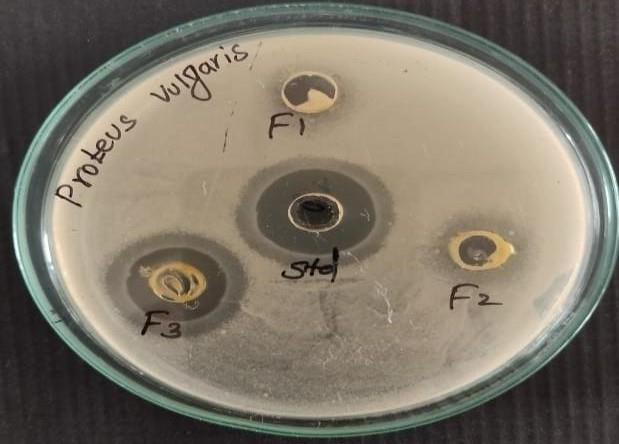
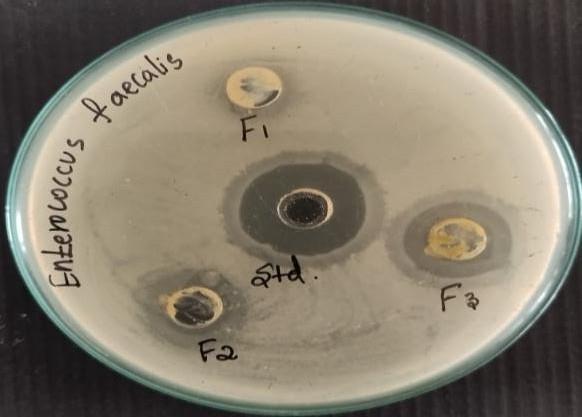
Wells were aseptically punched into the agar using a sterile cork borer, and 20 µl of different concentrations of the test formulations(F1,F2,andF3)wereintroducedinto pectivewells.Theplateswerethenincubatedat37°Cfor24hours.Antibacterial activity was assessed by measuring the diameter of the zone of inhibition formed aroundeachwellinmillimeters,followingtheguidelinesoftheNationalCommitteefor Clinical Laboratory Standards (NCCLS, 1993).Achloramphenicoldiscwasusedasthepositivecontrolforcomparison.
International Research Journal of Engineering and Technology (IRJET) e-ISSN: 2395-0056
Volume: 13 Issue: 01 | Jan 2026 www.irjet.net p-ISSN: 2395-0072
The present study focused on the formulation and evaluation of herbal ointments containing hydroalcoholic extract of Euphorbiahirta.Theplantmaterialwasauthenticatedandsubjectedtoextractionusingthemacerationmethodtoobtain bioactivecompounds.Theantimicrobialpotentialoftheextractanformulatedointments(F1,F2,andF3)wasevaluatedagainstsele ctedbacterialstrains,includingEnterobactercloacae,Enterococcusfaecalis,Streptococcuspyogenes,andProteusvulgaris
The prepared extract was found to contain various phytoconstituents responsible for antimicrobial activity. The formulatedointmentswerefurtherevaluatedforysicochemicalparameterssuchaspH,viscosity,andspreadabilitytoensureprod uct quality and stability. The results indicated that the ointment formulations exhibitedappreciable antibacterial activity, supporting the potential of Euphorbia hirtaas a natural antimicrobial agent. The incorporation of the extract into an ointment dosage form demonstratedits efficacyandsafety for topical application in themanagement of skin and wound infections
6.1 PHYTOCHEMICAL SCREENING
TABLE 2: PHYTOCHEMICALSCREENINGOFHYDROALCOHOLIC EXTRACTOFEUPHORBIAHIRTALEAVES
S.NO: PARAMETERS
1 TEST FOR ALKALOIDS
i)Wagnerreagenttest
ii)Dragendroff'stest
iii)Mayer'sreagenttest
2 TEST FOR PHENOLS
i)Ferricchloridetest
ii)Leadacetatetest
3 TEST FOR FLAVONOIDS
i)Shinoda test
ii)Alkalinereagenttest
4 TEST FOR CARBOHYDRATE i)Fehling'stest
ii)Benedit'stest
5 TEST FOR PROTEINS i)Biurettest
Xanthoproteictest
6 TEST FOR SAPONIN i)Foamtest
ii)Frothtest
7 TEST FOR TANNINS
i)Ferricchloridetest
ii)Leadacetatetest
8 TEST FOT AMINO ACIDS
i)Million'stest
ii)Ninhydrintest
9 TEST FOR GLYCOSIDES
i)Keller-killanitest
ii)Salkowskitest
International Research Journal of Engineering and Technology (IRJET) e-ISSN: 2395-0056
Volume: 13 Issue: 01 | Jan 2026 www.irjet.net p-ISSN: 2395-0072
6.2 PHYSICOCHEMICAL EVALUATION OF ANTIMICROBIAL OINTMENT USING EUPHORBIA HIRTA EXTRACT
TABLE3: PHYSICO CHEMICAL EVALUATION OF FORMULATED OINTMENT S.NO: PARAMETERS
6.3 STABILITY STUDY OF ANTIMICROBIAL OINTMENT USING EUPHORBIAHIRTA EXTRACT
Theformulationswerestoredat37°Cfor2monthsandobservedperiodically,allformulationsremainsstablethroughthe period.
TABLE 4 : STABILITY STUDY OF FORMULATED OINTMENT
6.4ANTIMICROBIAL ACTIVITY OF EUPHORBIA HIRTA OINTMENT
TABLE 5 : ZONE OF INHIBITION OF EUPHORBIA HIRTA OINTMENT WITH STANDARD
FIGURE 2 : COMPARATIVE ZONE OF INHIBITION
EUPHORBIA HIRTA OINTMENT
International Research Journal of Engineering and Technology (IRJET) e-ISSN: 2395-0056
Volume: 13 Issue: 01 | Jan 2026 www.irjet.net p-ISSN: 2395-0072



ANTI MICROBIALACTIVITY OFF1, F2,A ND F3 OILMENTS 30 25 20 15 10
Streptococcuspyogenes
Enterococcusfaecalis



Enterobactercloacae
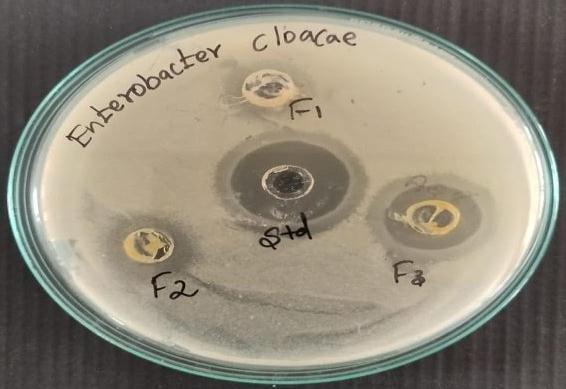
FIGURE3 : ZONE OF INHIBITION OF F1, F2, F3 FORMULATIONS AGAINST BACTERIA ON AGAR PLATE
A) GRAM NEGATIVE BACTERIA
i) Enterobacter cloacae
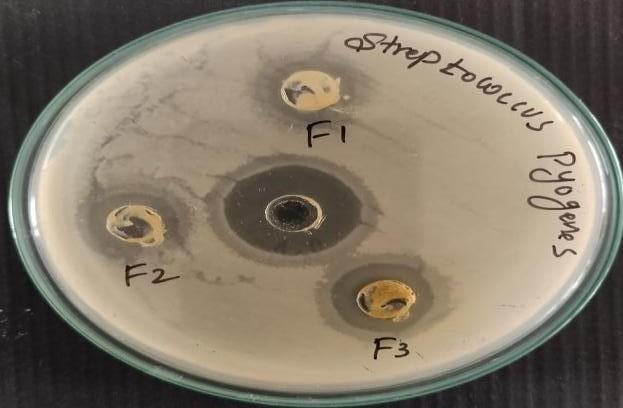
ii) Proteus vulgaris
International Research Journal of Engineering and Technology (IRJET) e-ISSN: 2395-0056
Volume: 13 Issue: 01 | Jan 2026 www.irjet.net p-ISSN: 2395-0072
The present investigation successfully formulated and evaluated a herbal antimicrobial ointment containing Euphorbia hirta extract.Thedevelopedformulationexhibitedacceptablephysicochemicalcharacteristics,includingsuitablepH,good spread ability, uniform drug content, and satisfactory stability. The presence of bioactive phytochemical constituents contributed to the observed antimicrobial activity against common skin-infecting pathogens. These results suggest that Euphorbia hirta–basedointmentrepresentsasafe,cost-effective,andpromisingherbalalternativeforthemanagementof skin infections. However, further clinical and toxicological studies are necessary to confirm its therapeutic efficacy and safetyinhumanuse.
1. RajasreePH,VishwanadV,CherianM,EldhoseJ,SinghR.Formulationandevaluationofantisepticpolyherbal ointment. InternationalJournalofPharmacyandlifesciences2012;3(10):2021-31.
2. PandeyA,JagtapJV,PatilAA,JoshiRN,KuchekarBS.Formulationandevaluationofanti-bacterialandanti-fungal activity of herbal ointment containing Aloe vera, Azadirachta indica and Curcuma lona. Journal of Chemical and PharmaceuticalResearch2010;2(3):182-86.
3. Anjula Patidar*, Suhana Khan Formulation of Antimicrobial Gel using extract of EuphorbiaHirtaLinnINTERNATIONALJOURNALOFPHARMACEUTICALSCIENCESAnujlaPatidar,Int.J.ofPharm.Sci.,2 024,Vol2,Issue1,342-353|Review
4. Asha S, Thirunavukkarasu P, Mani VM, et al.: Antioxidant Activity of Euphorbia hirta Linn Leaves Extracts. EuropeanJournalofMedicinalPlants.2016;14(1):
5. AmuthaR,SudhaAandPandiselviP."Tridaxprocumbens (CoatButtons)–AGiftOfNature4.AnsariAA,Khatun T, Ahmad Md. P, Gupta R S, Ansari M, Madhikarmi N Laxmi, “A review on pharmacological and chemical documentationofEuphorbiaHirtaLinn.(Asthmaherb)JournalofNMC,Birgunj,Nepal,2016,1,
6. Selvamohan T,Ramadas.V,Shibila .S, Selva K,“ Antimicrobial activity ofselectedmedicinal plantsagainstsome selected human pathogenic bacteria , PelagiaResearch Library advanced in Applied science Research , 2012, 3, 3374-3381
7. T. Pavithra * , Saba Noorain, G. Vishwas and J. S. Yogesha A COMPREHENSIVE REVIEW ON PLANT OFEUPHORBIAHIRTALINNPavithraetal.,IJP,2024;Vol.11(9):
8. Tahir J , Mohammad A,Akash .T, Basreen A, Riaz V, M. AbdEIsalam, “Antimicrobial activity of three medicinal plants’’,AfrJTraditComplementAlternMed.,2015,12,.
9. WaseemAhmad,ShilpaSinghandSanjayKumarPhytochemicalScreeningandantimicrobialstudyofEuphorbia hirtaextractsJournalofMedicinalPlantsStudies2017;5(2):20.
10. Wavikar P, Vavia P. Nanolipidgel for enhanced skin deposition and improved antifungal activity. AAPS pharmscitech.2013March.
11. YogeshPounikarL.K.Omray,InternationalJournalOfPharmacyAndPharmaceuticalScience,Vol.4,2012,.
12. Asha S,Thirunavukkarasu P, Mani VM, et al. : Antioxidant Activity of Euphorbia hirta Linn Leaves Extracts. EuropeanJournalofMedicinalPlants.2016;14(1):1-14.
13. Tawaha K, Alali FQ, Gharaibeh M, et al. : Antioxidant Activity and Total Phenolic Content of Selected Jordanian PlantSpecies.Foodchemistry.2007;104(4):1372-8.
14. Gupta C, Prakash D, Gupta S: Studies on the Antimicrobial Activity of Tamarind (Tamarindus indica) and Its PotentialasFoodBio-Preservative.InternationalFoodResearchJournal.2014;21(6):243741.
15. Zhao, J., et al. (2019). Secondary metabolites from endophytic fungi and their biological activities. Molecules, 24(8),1472.
16. Samrot, A. V., et al. (2022). Formulation and evaluation of antifungal herbal cream using plant derived extracts.
International Research Journal of Engineering and Technology (IRJET) e-ISSN: 2395-0056
Volume: 13 Issue: 01 | Jan 2026 www.irjet.net p-ISSN: 2395-0072
JournalofAppliedPharmaceuticalScience,12(7),121–129.
17. Puri, S. C., et al. (2005). Endophytic fungal association with Taxus wallichiana and its biotechnological applications.AppliedMicrobiologyandBiotechnology,69(4),439–449.
18. Dhale, M. A., & Vijay-Raj, A. S. (2017). Extraction and antimicrobial activity of secondarymetabolitesfromendophyticfungiisolatedfrommedicinalplants.JournalofAppliedMicrobiology,123(4), 1014–1024.
19. Asha S,Thirunavukkarasu P, Mani VM, et al. : Antioxidant Activity of Euphorbia hirta Linn Leaves Extracts. EuropeanJournalofMedicinalPlants.2016;14(1):1-14
20. Tawaha K, Alali FQ, Gharaibeh M, et al. : Antioxidant Activity and Total Phenolic Content of Selected Jordanian PlantSpecies.Foodchemistry.2007;104(4):1372-8.
21. Sukanya MK, Shimi, Aruna SR. Phytochemical Analysis Antimicrobial Analysis Antimicrobial careening and AnthelminticpropertiesOfPhyllanthusemblica.InternationalJournalofPharmaandBioSciences.2013;4(4):55 64.
22. Anujla Patidar, Suhana Khan, Formulation of Antimicrobial Gel using extract of Euphorbia Hirta Linn, Int. J. of Pharm.Sci.,2024,Vol2,Issue1,
23. AnsariAA,KhatunT,AhmadMd.P,GuptaRS,AnsariM,MadhikarmiNLaxmi,“Areviewonpharmacologicaland chemicaldocumentationofEuphorbiaHirtaLinn.(Asthmaherb)JournalofNMC,Birgunj,Nepal,2016,1,.31-38.
24. Sunil K, Rashmi M , Dinesh. K , “Euphorbia Hirta : its chemistry , traditional and medicinal uses and pharmacologicalactivities’’,InstituteofKurukshetraPharmaceuticalUniversity,India,2010,4,8-61.
25. Prof.Dr.AliEAl-S,“PharmacologyandtherapeuticpotentialofEuphorbiaHirta’’,Journalofpharmacy,2017,7,.720.
2026, IRJET | Impact Factor value: 8.315 | ISO 9001:2008 Certified Journal | Page607