
International Research Journal of Engineering and Technology (IRJET) e-ISSN: 2395-0056
Volume: 13 Issue: 02 | Feb 2026 www.irjet.net p-ISSN: 2395-0072
International Research Journal of Engineering and Technology (IRJET) e-ISSN: 2395-0056
Volume: 13 Issue: 02 | Feb 2026 www.irjet.net p-ISSN: 2395-0072
Sri Rajesh Rumde1 , Keerthna R. Pillai2 , Nitesh Balram Reddy3, Ashwinkumar Ramasamy4 , Deepali Jagtap5
1234Student, Department of Artificial Intelligence and Data Science, SIES Graduate School of Technology, Navi Mumbai, Maharashtra, India.
5Project Guide, Department of Artificial Intelligence and Data Science, SIES Graduate School of Technology, Navi Mumbai, Maharashtra, India. ***
Abstract - The iterative, high-stakes process of Formula 1 (F1)aerodynamicdesignislimitedbytime-consumingmanual validationandcomputationallycostlysimulations.Inorderto simplifyandspeeduptheF1cardesignanalysisworkflow,this study presents F1 Cadlyze, a revolutionary web-based platform that combines physics-informed neural networks (PINNs), interactive 3D visualization, and artificial intelligence (AI). The system uses a PINN-based solver for the 2D Burgers' equation to provide quick, physics-accurate aerodynamic flow approximations, and it uses a machine learning(ML)modeltoautomaticallydetectgeometricdefects andregulatory noncompliance in 3D CAD models. F1 Cadlyze dramatically lowers manual intervention, computational overhead, and design iteration time by combining CAD visualization, automatic AI validation, and real-time simulation into a responsive React-based interface. The platform'sabilitytobridgethegapbetweenconventionalCAD tools and next generation, AI-driven engineering analytics is validated by experimental findings, which show an 82.3% accuracy in geometric error detection and a working PINN solver
Key Words: F1 Design, CAD Analysis, Machine Learning, Physics-Informed Neural Networks (PINNs), Burgers’ Equation, Computational Fluid Dynamics (CFD), Webbased Simulation, React.
1. Introduction
Marginal improvements in aerodynamic efficiency, which canaccountformorethan90%ofavehicle'sperformance, are frequently what determine success in Formula 1 (F1) engineering.Geometry,materialscience,andfluiddynamics interactintricatelyduringthedesignprocess,whichmostly reliesonsimulationanditerativeprototyping.Themanual, error-prone validation of Computer-Aided Design (CAD) models for geometric and regulatory compliance and the prohibitive cost and time of high-fidelity Computational FluidDynamics(CFD)simulations,whichcantakedayson high-performance computing clusters, are the two main obstaclesthatimpedethisprocess.Agiledevelopmentand innovationarehamperedbythisdisjointedworkflow,which spans many CAD, meshing, and simulation systems. Promising solutions to reduce these inefficiencies are
provided by recent developments in AI and scientific machine learning. Specifically, a mesh-free substitute for conventional CFD that can solve governing partial differentialequations(PDEs)atalowercomputationalcost isPhysics-InformedNeuralNetworks(PINNs)[1].Geometric deep learning has the potential to automate design validationatthesame time. However,there isstill a large research-practice gap: previous studies [1]–[6] only show thesetechnologiesonstandardbenchmarks(suchassmall cavities and 2D domains) and do not integrate them into end-to-end,CAD-drivenengineeringprocesses.Thereisn'ta singlesolutionthattakesaproductionCADmodelasinput, runs a physics-informed simulation, does automated AIbasedgeometricanalysis,anddisplaysintegratedresultsina designengineer-specificinteractiveenvironment.
ThispaperpresentsF1Cadlyze,anintegratedplatformthat directlyaddressesthisgap.Ourcorecontributionsare:
1)An end-to-end web platform that ingests industry standard CAD formats (STEP, STL, IGES) and provides a professional-grade3Dviewerforinspection.
2)An ML-powered geometric validation module that automaticallydetectsandclassifiesdesignerrors,reducing manualrevieweffort.
3)Areact-basedsimulationinterfacefeaturingaPINNsolver for the 2D Burgers’ equation, enabling rapid aerodynamic approximationforinitialdesignscreening.
4)Aunifieddashboardthatcohesivelypresentsvisualization, validation, and simulation results, enabling faster, datadrivendesigndecisions.
5)Ascalableandmodularsystemarchitecturedesignedto supportextensibilityandseamlessintegrationwithexisting engineering toolchains, enabling future incorporation of advancedCFDsolvers,multi-physicssimulations,anddatadriven optimization pipelines while maintaining computationalefficiencyandrobustness.
F1 Cadlyze shows a useful and innovative use of AI and PINNstoreal-worldaerodynamicdesignbyaddressingthe uniquechallengesfacedbyF1engineers,suchasprotracted
International Research Journal of Engineering and Technology (IRJET) e-ISSN: 2395-0056
Volume: 13 Issue: 02 | Feb 2026 www.irjet.net p-ISSN: 2395-0072
validation, sluggish simulation response, and toolchain fragmentation.
The state-of-the-art is based on a fragmented set of instruments.CADprograms(e.g.,SolidWorksandCATIA)lack advanced, AI-driven mistake detection. Even if specialized CFDsoftware(e.g.,ANSYSFluentandOpenFOAM)isaccurate, it is not appropriate for quick iterative testing since it necessitates a great deal of manual meshing, in-depth knowledge, and substantial computational resources [2]. Althoughcloud-basedsimulationplatforms(e.g.,SimScale) makeaccesseasier,theylackintegratedAIfordesignanalysis andarestill reliantontraditionalCFDtechniques[3].This ecosystem leads to high entry hurdles, delayed feedback loops, and a dependence on manual processes exactly the inefficienciesthatourtechnologyaimstoaddress.
PINNshavedemonstratedpotentialinsolvingPDEsrelated to fluid dynamics. Physics-Informed Extreme Learning Machines (PIELMs) and a curriculum learning paradigm, wheretrainingstartswithsimplerPDEsbeforemovingonto more complicated problems like the viscous Burgers' equation, were recently described by [1]. We use this methodology, which enhances convergence and stability. Nevertheless, the validation of [1] is restricted to basic domainsratherthanintricateCADgeometries.Similarly,[2] stays within the domain of mathematical benchmarks but offers a useful empirical evaluation of PINNs to finite differencetechniques.Byapplyingcurriculum-trainedPINNs toflowdomainsspecifiedbycomplexF1CADboundaries,our studyexpandstheseideasintoanengineeringsetting.
Inordertoimproveaccuracyclosetowalls,researchlike[3] suggests hybrid models that combine analytical boundary layer solutions with PINNs for bulk flow. Although informative, it is only used on simplified geometries. Additionally, studies such as [4] do not integrate CAD; instead,theyapplyPINNstoindustriallyrelevantproblems (suchaslubrication).KeyissueswithPINNtraining,suchas spectrumbiasandlossbalance,areidentifiedinthethorough analysis by [6], but it also highlights the absence of interactionwithengineeringdesignplatforms.Bydeveloping a pipeline that converts a complicated CAD model into a simulation-readydomainforaPINNandintegratingtraining techniquesinfluencedby[1],[3],and[6]tohandlereal-world geometriccomplexity,F1Cadlyzedirectlyfillsinthesegaps.
The modular, client-server architecture of F1 Cadlyze is intendedtoprovidescalabilityandasmoothuserexperience. Vite, React 18, and TypeScript were used to create the frontend, a single-page application that uses React Three Fiber(Three.js)for3Drendering.PythonFastAPIisusedby the backend to serve machine learning models and orchestrate simulations. Fig. 1 shows the five main subsystemsthatmakeupthesystem.
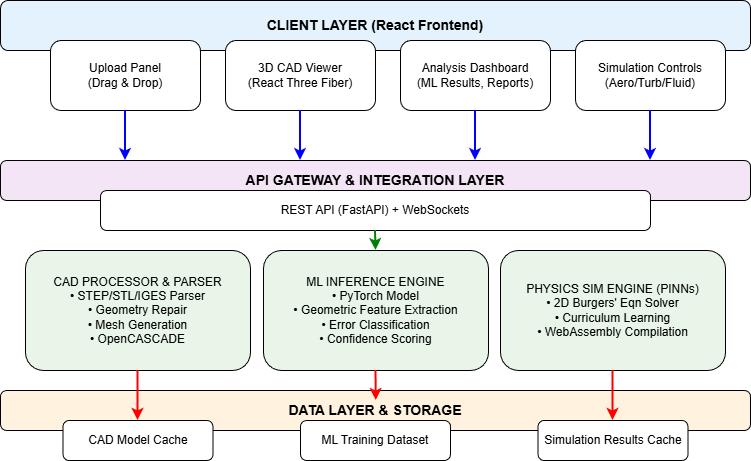
Fig-1: System architecture of the F1 Cadlyze platform, showing the modular client-server design with five integratedsubsystems:3DCADInput&Viewer,MLDesign Error Detection, Physics Simulation Components, PINNs Implementation,andReactFrontendIntegrationLayer.The architecture enablesseamlessworkflowfromCADupload through AI validation and physics-informed simulation to interactivevisualization.
Standard CAD formats (STEP, STL, IGES, and OBJ) are supported by the platform.A geometrycorrection process addresses small discrepancies once uploaded models are analyzed.ReactThreeFiberwasusedtocreatetheintegrated viewer, which offers sophisticated inspection features like orbitcontrols,sectioncutting,hierarchicaltreeselection,and real-time lighting adjustments. This eliminates the requirementforadditionalapplicationsbyprovidingaCAD likeexperiencerightwithinthebrowser.
PINNshavedemonstratedpotentialinsolvingPDEsrelated to fluid dynamics. Physics-Informed Extreme Learning Machines (PIELMs) and a curriculum learning paradigm, wheretrainingstartswithsimplerPDEsbeforemovingonto more complicated problems like the viscous Burgers' equation, were recently described by [1]. We use this methodology, which enhances convergence and stability. Nevertheless, the validation of [1] is restricted to basic domainsratherthanintricateCADgeometries.Similarly,[2] stays within the domain of mathematical benchmarks but
International Research Journal of Engineering and Technology (IRJET) e-ISSN: 2395-0056
Volume: 13 Issue: 02 | Feb 2026 www.irjet.net p-ISSN: 2395-0072
offers a useful empirical evaluation of PINNs to finite differencetechniques.Byapplyingcurriculum-trainedPINNs toflowdomainsspecifiedbycomplexF1CADboundaries,our studyexpandstheseideasintoanengineeringsetting.
Foraerodynamicanalysis,theplatformfeaturesinteractive ReactcomponentsforAerodynamics,Turbulence,andFluid Flow tests. The core innovation is the use of a PhysicsInformedNeuralNetworktosolvethe2DBurgers’equation:
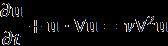
where u isvelocity,tistime,andνiskinematicviscosity.Our PINN implementation uses an 8–10 layer fully connected networkwithSwishactivation.Thelossfunctioncombines PDEresidual,initialcondition,boundarycondition,anddata fidelityterms.Crucially,weimplementcurriculumlearning [1],startingtrainingwithhighviscosity(laminarflow)and progressively reducing it to model turbulent regimes, enhancingstabilityandaccuracyforcomplexflowfeatures relevanttoF1aerodynamics.
3.4 Interactive Frontend & Integration Dashboard
All modules are integrated into a single dashboard by the interface. A multi-panel results presentation area, tabbed navigationforMLresultsandsimulations,anintegratedCAD viewer, and a drag-and-drop upload panel are among the features. Real-time progress updates during simulation execution are made possible by WebSocket connections. Code-splitting and lazy loading are used in the interface's performance and clarity design to effectively handle complicated3Ddata.
4.1 Development and Training Methodology
We used two-week sprints and an Agile-Scrum approach. UsingPyTorchandadata-centricmethodology,themachine learning model was created after more than 500 hours of professional annotation on more than 150 CAD models. TransferlearningandBayesianhyperparameteroptimization (Optuna)wereusedtotrainthemodel,whichproducedan accuracy of 82.3% on the validation set (precision: 0.85, recall: 0.79). Using a curriculum learning approach and residualadaptivesamplingtoconcentrateonhigh-lossareas, thePINNwastrainedinPyTorch
4.2 Technical Demonstrations and Performance
Keyfunctionalitiesweresuccessfullydemonstrated:
1)CAD Processing: Successful upload and rendering of complexF1assembliesinthebrowser.
2)AI Validation:Automateddetectionand3Dhighlightingof geometricerrorsontestmodels.
3)PINN Simulation:ExecutionofaPhysics-InformedNeural Network (PINN) solver for the 2D Burgers' equation with curriculumlearningimplementation,demonstratingstable convergencefromlaminartoturbulentflowregimes.
4)Integrated Workflow: Cohesive display of parsed geometry,ML analysisresults,andsimulationoutputs ina unifieddashboardwithsynchronized2Dand3Dviews.The platform enabled simultaneous visualization of geometric error highlights alongside corresponding aerodynamic performancemetrics,facilitatingdirectcorrelationbetween designfeaturesandflowbehavior.
Accordingtoperformancemeasures,thesystemcanrender complicated models at 60 frames per second with WebGL acceleration and strives for response times under two seconds for the complete ML analysis pipeline. Memory optimizationtechniquesincludinglevel-of-detailrendering and frustum culling ensure smooth interaction even with assembliescontainingthousandsofcomponents.Thebenefits of F1 Cadlyze over current disjointed workflows are presentedinTableI.
Existing Systems Proposed F1 Cadlyze Platform
DisjointedtoolsforCAD, ML,andsimulation.
Unified web environment with seamlessworkflow.
FullCFDrequiresHPC resourcesand hours/days. PINNs provide fast approximations suitablefor designexploration.
Manual,engineerintensivegeometry checking.
Automated ML-driven error detection withcontextual suggestions.
Pre-configuredanalyses withlimited interactivity. Real-time parameter adjustment andinstant visualization.
Expensivelicensesand specializedhardware.
Separatefilesandformats fordifferentanalyses.
Browser-based execution onconsumerhardware.
Unified model representation acrossallanalysismodules.
F1Cadlyzeisdesignedtoaddresstheparticular,real-world challengesthatF1designteamencounter:
1)RemovinghumanValidationBottlenecks:Theplatformcuts a days-long human inspection procedure to minutes by automatinggeometricandregulatoryinspections,reducing
International Research Journal of Engineering and Technology (IRJET) e-ISSN: 2395-0056
Volume: 13 Issue: 02 | Feb 2026 www.irjet.net p-ISSN: 2395-0072
the possibility of expensive errors and possible disqualification.
2)Simulation Feedback Loop Acceleration: Conventional high-fidelityCFDgeneratesacrucialbottleneck.Althoughitis presentlyin2D,ourPINN-basedmethodoffersameshfree, quickapproximationtoolforpreliminarydesignscreening andconceptcomparison,allowingformoreiterationsinthe sameamountoftime.
3)Democratizing Access and Streamlining Workflows: The integrated, web-based platform reduces access barriers. It reducescontext-switchingforengineersandmakesadvanced analysis available to smaller teams and educational institutionsbycombiningseveralexperttoolsintoasingle interface.
4)ClosingtheAI-CADIntegrationGap:Algorithmicinnovation is the limit of previous research [1]-[6]. Our main contribution is the practical integration of these developments(geometricdeeplearning,curriculum-learning PINNs)intoapipelinethatbeginswithaproductionCADfile the real starting point for engineers thereby converting scholarlyresearchintousefulengineeringapplications.
ThisstudyintroducedF1Cadlyze,anintegratedAIpowered platform that combines physics-informed simulation with automated CAD validation to optimize the F1 car design analysis workflow. The technology effectively addresses major industrial inefficiencies associated with manual operations and sluggish simulation feedback by demonstratingafunctionalpipelinefromCADingestionto integratedvisualization.
1) Improving ML model accuracy to over 90% using sophisticated architectures (Transformers) and data augmentation.
2)ScalingthePINNsolverto3DandaddingRANS-informed turbulencemodelingforhigherfidelity.
3)Puttingreal-timecollaborationfeaturesandsophisticated volumerenderingfor3Dflowfieldsintopractice.
4)Improvingthebackendintoamicroservicesarchitecture forproductionscalability.
For the upcoming generation of AI-enhanced engineering designtools,F1Cadlyzecreatesafundamentalframework.It has the potential to significantly speed innovation in motorsportaswellasmoregeneralautomotive,aerospace, and engineering education domains by bridging the gap betweenconventionalCAD/CFDandcontemporaryAI/ML.
Theauthorswouldliketoexpresstheirsinceregratitudeto Prof. Deepali Jagtap, Guide, Department of Artificial Intelligence & Data Science, SIES Graduate School of Technology,forherinvaluableguidance,insightfulfeedback,
andcontinuousencouragementthroughoutthedevelopment of this work. We also wish to thank the Department of ArtificialIntelligence&DataScienceatSIESGraduateSchool of Technology for providing the computational resources andsupportiveresearchenvironment
[1]Dwivedi,V.,Sixou,B.,Sigovan,M.,&CREATIS,INSA-Lyon; Inserm, U1044; CNRS UMR 5220; Universit´e Lyon 1; Universit´e de Lyon; 69621, Lyon, France. (2021). Curriculum Learning-Driven PIELMs for fluid flow simulations.InCurriculumLearning-DrivenPIELMsforFluid FlowSimulations(Vol.1,pp.1–4)[Journalarticle].
[2]Savović,S.,Ivanović,M.,&Min,R.(2023).Acomparative study of the explicit finite difference method and PhysicsInformedneuralnetworksforsolvingtheBurgers’equation. Axioms,12(10),982. https://doi.org/10.3390/axioms12100982
[3]Ortiz,R.D.O.,Núñez,O.M.,&Ramírez,A.M.M.(2024). Solving Viscous Burgers’ Equation: hybrid approach combining boundary layer theory and Physics-Informed NeuralNetworks.Mathematics,12(21),3430. https://doi.org/10.3390/math12213430
[4]Brumand-Poor,F.,Barlog,F.,Plückhahn,N.,Thebelt,M., Bauer, N., & Schmitz, K. (2024). Physics-Informed Neural Networks for the Reynolds Equation with Transient CavitationModeling.Lubricants,12(11),365. https://doi.org/10.3390/lubricants12110365
[5] Akram, W., Gautam, S., Verma, D., Mohan, M. T., DepartmentofMathematics,IndianInstituteofTechnology Roorkee, Uttarakhand,247667, India, & Department of MathematicalandStatisticalSciences,ClemsonUniversity, Clemson,29631,USA.(2025).ErrorEstimatesForViscous Burgers’EquationUsingDeepLearningMethod.
[6]Hassan,M.E.,Mjalled,A.,Miron,P.,Mönnigmann,M.,& Bukharin,N.(2025).MachineLearninginFluidDynamicsPhysics-Informed Neural Networks (PINNs) Using Sparse data:Areview.Fluids,10(9),226. https://doi.org/10.3390/fluids10090226