
International Research Journal of Engineering and Technology (IRJET) e-ISSN: 2395-0056
Volume: 13 Issue: 05 | May 2026 www.irjet.net p-ISSN: 2395-0072
International Research Journal of Engineering and Technology (IRJET) e-ISSN: 2395-0056
Volume: 13 Issue: 05 | May 2026 www.irjet.net p-ISSN: 2395-0072
Dr. P. Loganthurai1, M. Haritha2, P. Venishriabhirami3, S. Kayalvizhi⁴
*¹ Associate professor, Department of EEE, K.L.N College Of Engineering(An Autonomous Institution, Affiliated Anna university )Pottapalayam,Sivagangai, Tamilnadu, India.
*2,3,4Second UG scholars, Department Of EEE,K.L.N College Of Engineering(An Autonomous Institution, Affiliated Anna university )Pottapalayam , Sivagangai, Tamilnadu, India.
Abstract - People who have paralysis because of nerve and muscle problems or spinal cord injuries have a time doing everyday things like using electrical devices at home. This research paper is about an smart control system that uses how long a person closes their eyes to help people with paralysis be more independent. We used a sensor that detects when a person blinks and it sends a signal. This signal is then processed by a computer and turned into a command to control things.
We used this system to control things like lights and fans in a house. It is safe and will not hurt anyone. This way of controlling things is better than using switches or voice commands or joysticks because it does not need the person to touch anything it is easier to use. It is very helpful for people who cannot move very much. This device works very well. It also uses systems that make it work even better.
The experiments we did show that this device is very good at doing what it is supposed to do and it is not expensive. It is also very easy to use. This system does not just help people with paralysis it also helps them to not need others to do things for them. The paralysis patients can use eye closure time to control household devices like people, with paralysis to be more independent and live a life
Key Words: (Arduino UNO, IR sensor, Assistive Technology, Embedded system)
The condition of "paralysis" is caused by damage to the nervous system and may be the result of a spinal cord injury,strokeorneurological disorder;itproducespartial or complete loss of voluntary muscle movement which severely limits an individual's ability to carry out their daily activities within a normal range. Quadriplegic patients experience extensive loss of muscle control and have no ability to utilize their hands, arms, feet or legs to performeverydaytasks,includingmechanicaloperationof devices such as electric lights, fans or kitchen appliances. As a result, individuals who become paralytic will generallyrelyonassistance fromotherpeopletoperform
thesebasictasksandtheywillloseasignificantamountof theirpersonalindependenceanddignity.
The use of home automation systems has grown dramatically in recent years, primarily due to the increasedconvenienceofthesetypesofsystemsandtheir overall efficiency. Most of the home automation systems currentlyinusewereoriginallydesignedforgeneralusers and utilize various types of input methods (i.e., push button switches, mobile device applications and voice commands) to control automated devices. Many of the input methods currently in use are not suitable for paralytic patients, particularly patients with no residual useof theirlimbs,handsand/orvoice. Therefore, there is an urgent need for a new, alternative, simple-to-use, reliable control method that can be used by paralytic patientstooperateautomateddevices.
Eyemovementandblinkingaretwoformsofhumanbody movementusedsuccessfullyasaninputmechanism; both methods have proven to be very reliable, since eye movementandblinkingarebothstillfunctionalinpatients who are in a state of extreme paralysis. Eye blinking has been utilized by numerous researchers as an accepted, natural and controllable form of interactive motion whereby paralytic patients utilize their eye blinks to communicate and/or to execute commands associated with operating automated device and This project introduces an eye-closure duration-based control system that enables paralytic patients to operate electrical appliancesusingtheireyeactivity
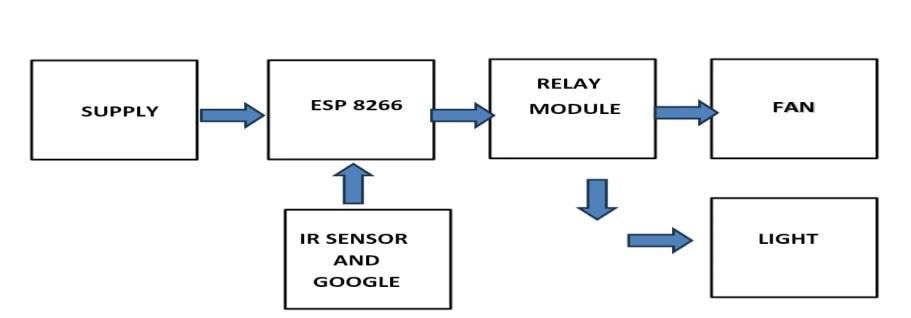
The proposed method uses eye blinking to control electrical appliances. It is designed using the hardware parts of the system. The IR sensor sends infrared rays towardtheeyeandreceivesthereflectedsignal.Whenthe eye is open, the reflection is normal. When the eye is closed, the reflection changes because of the eyelid.This change is converted into a digital signal and sent to the Arduino Uno. The Arduino checks the signal and detects whenthe eye isclosed. Oncethe eye isclosed, the system
International Research Journal of Engineering and Technology (IRJET) e-ISSN: 2395-0056
Volume: 13 Issue: 05 | May 2026 www.irjet.net p-ISSN: 2395-0072
startsmeasuringhowlongtheeyeremainsclosedusingits internaltimer.
Aftertheeyeopensagain,themeasuredtimeiscompared with preset time values. Based on the blinking duration, the system decides the control action. For example,a medium blink duration is used to switch the LED ON or OFF, while a longer blink duration is used to control the DCfan.
The Arduino then sends signals to the relay module through its output pins. The relay works like an electrical switch and helps the Arduino control appliances connectedtothe5Vsupply.Italsoprovidessafeoperation andelectricalisolation.
Thismethodallowscontrol ofmultipleappliancesusing a singleeyeblinkinputwithoutmakingthesystemcomplex.
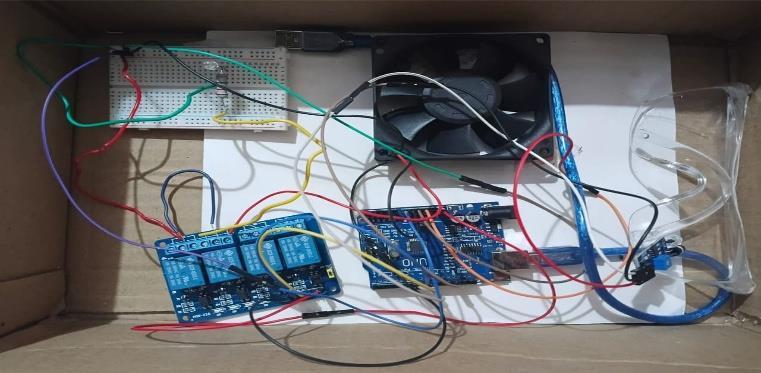
The Arduino Uno is powered by the ATmega328P (microcontroller); This microcontroller is based on 5V power. The Arduino Uno has 14 Digital I/O and 6 analog inputs. Clocked at 16 MHZ, this board features 32 KB of Flashmemory,2KBofSRAM&1KBofEEPROMmemory. Powering the board can be accomplished via USB or an outside supply (7 to 12 VDC). Communication methods supportedbytheArduinoUNOincludeUART,SPI,andI2C. This makes it an ideal candidate for Embedded applications.
Relay Module is a convenient board which can be used to control high voltage, high current load such as motor, solenoid valves, lamps and AC load. It is designed to interfacewithmicrocontrollersuchasArduino,NodeMCU, etc.Therelayisthedevicethatopensorclosesthecontacts to switch ON/OFF other appliances operating at high voltages. It is also used in safety circuits where it detects theundesirableconditionwithanassignedareaandgives
the commands to the circuit breaker to disconnect the affectedareathroughONorOFF.
Anelectricaltoolthatgenerates airflowisknownasafan. A fan generates airflow by turning blades with an electric motor that causes the air to move throughout the space wherethefanislocated.
Inhomes,fanscanbeusedtoreduceheat,circulateairand improvecomfort.Thepowerusedbyfanscanbefrom DC sources.
A light-emitting diode (LED) is a semiconductor device thatemitslightwhenanelectriccurrentispassedthrough it. Its application is everywhere due to its compact size, low consumption of energy, extended lifetime, and flexibilityintermsofuseinvariousapplications.LEDscan beseeninTVBacklighting,SmartphoneBacklighting,LED displays,AutomotiveLightingandDimmingoflights.
An Infrared (IR) Sensor is a type of electronic device designed to monitor objects and detect changes by emitting infrared light emitted by the device and measuring the changes in this light based on how it reflectsoffan object.Ifanobject ispresentinfront ofthe IRsensor(forinstance,thehumaneye),whentheobjectis detected,theamountof reflected IR lightfromthat object will change and therefore create an electrical signal that thedevicecanusetodeterminewhetherornotthatobject isinfrontofit.
Software Specification
Arduino IDE
An Integrated Development Environment (IDE) is software that you use to write, compile and upload programs to your microprocessor board such as an ArduinoUno.TheIDEhasaneasy-to-useinterfacetowrite codewithaprogramminglanguagethat supportsC/C++
International Research Journal of Engineering and Technology (IRJET) e-ISSN: 2395-0056
Volume: 13 Issue: 05 | May 2026 www.irjet.net p-ISSN: 2395-0072
and control the code's downloads to your microcontrollerwithaUSBconnection.
The IDE is composed of a code editor, compiler (to check your code for correctness) and a serial monitor (for testing and debugging). The IDE is free and open source, making it easy to use as well as well-known for creating projectsrelatedtoembeddedsystems.Forthisproject,the IDEwillallowthecontrolofeyeblinksignalsthatwillturn appliancesonandoff.
Step 1: Starttheprogram.
Step 2: Initializetheinputandoutputpins. Setthesensorpinasinput. Settherelaypinsasoutput.
Step 3: Initialize variables for timing and appliance states.
SetLEDandfaninitialstatesasOFF.
Step 4: Startcontinuousexecutionoftheprogram.
Step 5: Readthesignalfromthesensor.
Step 6: Checkwhethereyeclosureisdetected.
Step 7: Ifeyeclosureisdetected,recordthestarttime.
Step 8: Wait until the eye opens again (sensor signal changes).
Step 9: Measurehowlongtheeyeremainedclosedusing thetimedifference.
Step 10: Compare the measured time with predefined ranges.
Step 11: Ifthedurationisbetween2to4seconds,switch theLEDON/OFF.
Step 12: Ifthedurationisbetween5to6seconds,switch thefanON/OFF.
Step 13: Send control signals to the relay module to operatetheselectedappliance.
Step 14: Addashortdelaytoavoidmultipletriggering.
Step 15: Repeattheprocesscontinuously.
Step 16: Stop
2to3seconds LEDwillbeturnedONand another2to3secondsof eyeclosureduration,the LEDwillbeturnedOFF.
5to6seconds
FANwillbeturnedONand another5to6secondsof eyeclosureduration,the FANwillbeturnedOFF.
The developed eye closure duration-based controller has successfully controlled some basic household electrical appliances (fan, light) through IR sensor using a microcontroller. The results demonstrate that the system can detect "Eye Closure" signals with a high level of accuracy and easily differentiate between short and very long closures; therefore, there will be no confusion when controllingmultipledevicesatonetime.
The response time of the controller was very fast, and it operated consistently under regular lighting conditions; thus, the relay module switched ON and OFF the appliances based on received processed signals, thus providingfora safeandeffectiveoperation. The design of the sensing system was designed for user comfort; therefore,itwasalsoverysuitableforusebyparalyticsto operatetheirdeviceshandsfree.
In addition, the controller application had a very high degree of precision when calibrated properly. ln comparison with currently available systems (e.g., Voice Control, Camera-Based Eye Tracking), this proposed approachissimplerandlessexpensive
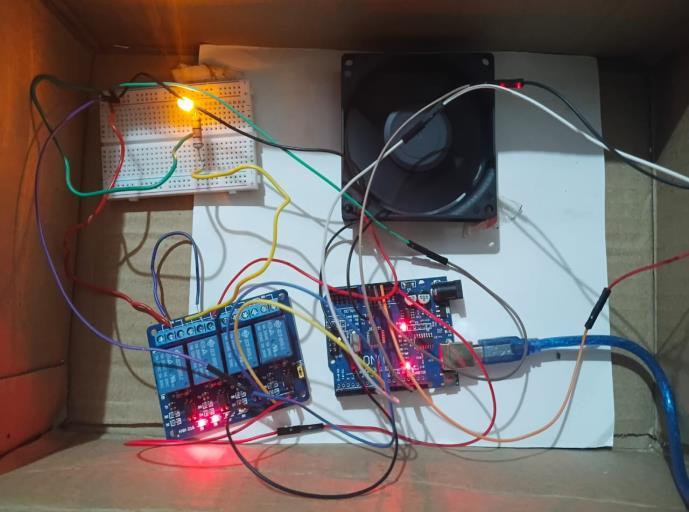
Eye-closure duration control system provides a useful, user-friendly way for paralytic patients to operate householdelectrical devices.The eyeactivity isconverted into useful control commands using an infrared (IR) sensor and a microcontroller, making this a successful alternative to existing systems. This shows that eye movementisa reliableinputmethodforreal-timecontrol ofappliances.
The system is low-cost, compact, and easy to use, which means it is suitable for use in real-life situations when providing assistive technology. Patients will be less dependent on caregivers due to this system, which
International Research Journal of Engineering and Technology (IRJET) e-ISSN: 2395-0056
Volume: 13 Issue: 05 | May 2026 www.irjet.net p-ISSN: 2395-0072
increasestheirindependence,comfort,andoverallquality of life. Compared to existing methods, the proposed method is simpler and easier to access than other similar solutions, is not expensive or complicated to set up, and doesnotusecomplicatedcomponents.
Therearesomeopportunitiesforenhancingthesystemto work better. These include being more accurate, reducing the number of false triggers, and adding features such as remote monitoring through IoT devices. This project showshowembeddingsystemsinhealthtechnologiescan lead to new improvements and to giving everyone the ability to participate fully, especially those who are physicallydisabled
1.Ms. M. Aruna, Ms. U. Dharshini, Ms. D. M. Bavasri, Mr. A. Seenu, “Design and Development of Optic Controller for Domestic Appliances to Assist Paralytic” International Journal of All Research Education and Scientific Methods (IJARESM),2024
2.Zaheer Ahmed Wassan1, Mir Sajjad Hussain Talpur1, AmmarOad2,RaheelSarwar1, Abida Luhrani1, Shakir Hussain Talpur1, Fauzia Talpur3, Taha Nuzhat1, Aneel Oad, “IOT Based Smart Home for Paralyzed Patients through Eye Blink” International Journal of Advanced TrendsinComputerScienceandEngineering,2021
3.Abdul Rahaman Shaik, Ch. V. V. S. Srinivas, K. Kiran, “Electronic Assistance for Paralysed Using Eye Blink Detection”RESEARCHARTICLE,2019
4.S.KumarandR.Priya,“EyeControlledHomeAutomation System for Disabled People,” International Journal of EngineeringResearch&Technology,vol.8,no.6,pp.455–460,2020.
5.P. Sharma and V. Gupta, “Assistive Device Using Eye Blink Sensor for Physically Challenged People,” International Journal of Innovative Science and Research Technology,vol.5,no.8,pp.102–107,2020.
6.R. Karthick and M. Suresh, “Arduino Based Smart Home AutomationforDisabledPersons,”InternationalJournalof ScientificResearchinEngineeringandManagement,vol.4, no.7,pp.1–6,2021.