
International Research Journal of Engineering and Technology (IRJET) e-ISSN: 2395-0056
Volume: 13 Issue: 03 | Mar 2026 www.irjet.net p-ISSN: 2395-0072

International Research Journal of Engineering and Technology (IRJET) e-ISSN: 2395-0056
Volume: 13 Issue: 03 | Mar 2026 www.irjet.net p-ISSN: 2395-0072
Ragi Naga Shabarish1, P Manish Reddy2, N Ajay3, D Bheekya4
1Student, Department of CSE, Sreenidhi Institute of Science and Technology, Hyderabad
2Student, Department of CSE, Sreenidhi Institute of Science and Technology, Hyderabad
3Student, Department of CSE, Sreenidhi Institute of Science and Technology, Hyderabad
4Assistant Professor, Department of CSE, Sreenidhi Institute of Science and Technology, Telangana, India
Abstract - This research introduces an explainable, hybrid natural language processing pipeline designed for resume-job matching. The system integrates symbolic linguistic markers via spaCy with dense semantic representationsderivedfromastreamlinedBERTvariant, specifically all-MiniLM-L6-v2. By parsing documentation in PDF, DOCX, and TXT formats, the framework extracts candidate skills through an EntityRuler and keyword matching against a curated lexicon. A composite score is generated based on semantic similarity, skill overlap, experience alignment, and keyword density. Unlike conventional black-box models, this architecture provides interpretable contribution breakdowns and actionable feedbackforcandidatedevelopment.
The implementation features a FastAPI backend with Redis for embedding caching and PostgreSQL for data persistence, paired with a React and Chart.js dashboard for visualizing score decomposition and ranking. We evaluated the approach against TF-IDF, spaCy-only, and BERT-only baselines using metrics such as Precision@K, Recall@K, Mean Reciprocal Rank (MRR), and NDCG. In testsonsyntheticbenchmarksinvolving240resumesand 48 job descriptions, the hybrid methodology demonstrated superior top-rank performance and consistently outperformed single-encoder variants while maintaining computational efficiency for practical deployment.
The results indicate that explainability and ranking effectiveness can be effectively co-optimized in production-orientedhiring systems. Whileacknowledging the limitations of synthetic data, we provide a humanlabeled benchmarking protocol to support reproducible andfairness-awarefutureresearch.
Key Words: Resume ranking, explainable AI, NLP, spaCy, BERT, sentence transformers, candidate-job matching, information retrieval metrics, recruitment analytics.
Contemporary recruitment workflows increasingly rely upon automated screening instruments to manage extensive candidate pipelines. However, extant systems exhibittwosignificantshortcomings:insufficientsemantic
comprehension regarding resume-job congruence and a lack of transparency in scoring logic. Symbolic keywordbased methods remain vulnerable to linguistic variation, whereasopaquedeeplearningarchitecturesoftenlackthe interpretability required for defensible decision-making. Withinprofessionalrecruitment,explainabilityisacritical requirement, providing recruiters with justifiable insights and candidates with transparent feedback for profile development.
The current research addresses these challenges by introducing a hybrid NLP architecture that integrates symboliclinguisticfeaturesviaspaCywithdensesemantic representations derived from the BERT framework. The objective is to achieve semantic robustness while maintaininghighinterpretabilitythroughexplicitskillgap identification and granular score decomposition. This framework is implemented as an integrated end-to-end pipeline encompassing document parsing, multi-factor scoring, automated feedback generation, and visual analytics.
The primary research inquiry explores whether a hybrid linguistic-semanticapproachcanoptimizerankingefficacy without compromising operational explainability or computational feasibility. To investigate this, a modular backend implementation was evaluated against competitive baselines using rigorousinformationretrievalmetrics.
The architectural framework comprises a modular, endto-end pipeline engineered for automated resume assessment and the generation of granular candidate feedback.
International Research Journal of Engineering and Technology (IRJET) e-ISSN: 2395-0056
Volume: 13 Issue: 03 | Mar 2026 www.irjet.net p-ISSN: 2395-0072
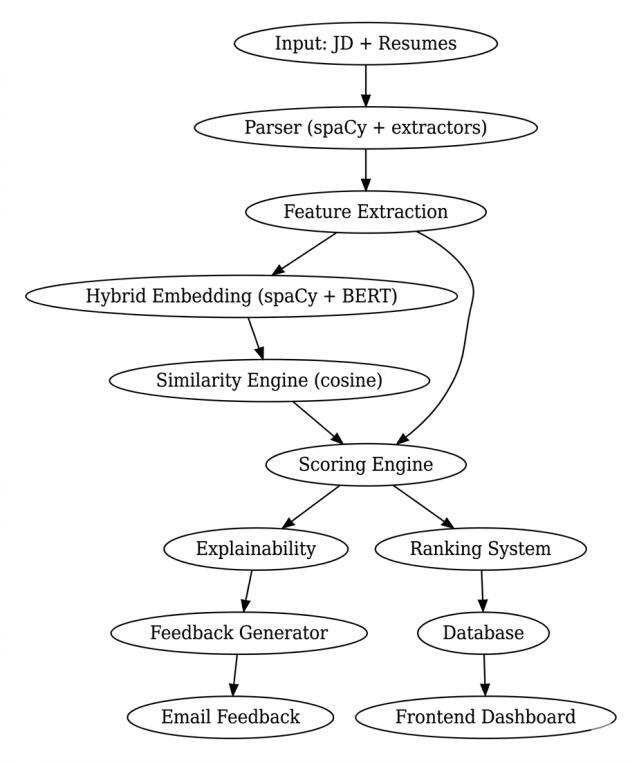
The ingestion module extracts raw textual data from multi-format documentation, specifically PDF, DOCX, and TXT files, via specialized parsers. Subsequently, the linguistic pipeline utilizes the spaCy framework for normalization,encompassingtokenization,lemmatization, andNamedEntityRecognition(NER).
Skill identification employs a hybrid symbolic strategy, integrating spaCy’s EntityRuler with a curated, domainspecificlexicon.
The identification of missing proficiencies is mathematicallyrepresentedas:
Sₘᵢₛₛ=Sⱼd−Sᵣ where Sⱼd denotes the required skill set within the job description and Sᵣ represents the candidate’s extracted skills.
The framework synthesizes symbolic linguistic markers withdensesemanticrepresentationsbyaggregatingspaCy andBERTembeddings: vₕ=norm(0.4×vₛ+0.6×v_b)
Semantic congruence is determined utilizing cosine similarity: sim(r,jd)=(vᵣ·vⱼd)/(||vᵣ||||vⱼd||)
The aggregate ranking score is derived from a weighted combinationofdivergentfeatures:
● Semanticsimilarity(weightedat40%)
● Explicitskilloverlap(weightedat30%)
● Experiencealignment(weightedat20%)
● Keyworddensity(weightedat10%)
3.5 Explain ability and Operational Feedback
The architecture facilitates operational transparency by generatinginterpretableoutputs,including:
1. Granularscorecontributiondecomposition
2. Comparativemissingproficiencyanalysis
3. Actionabledevelopmentalsuggestions
This multi-factor approach ensures defensible decisionmaking and high usability for both recruiters and candidates.
3.6 Longitudinal Improvement Tracking
To facilitate candidate profile development, the framework monitors performance trajectories across sequentialsubmissionsviathedeltametric: Δ=newscore−oldscore
4. EXPERIMENTAL EVALUATION
4.1 Comparative Model Baselines
● ProposedHybridArchitecture(spaCy+allMiniLM-L6-v2+CompositeScorer)
● TF-IDFStatisticalVectorizationBaseline
● spaCy-onlySymbolicSimilarityBaseline
● BERT-onlyDenseSemanticBaseline
4.2 Information Retrieval Metrics
● Precision@K
● Recall@K
● MeanReciprocalRank(MRR)
● NDCG(GradedRelevanceAnalysis)
4.3 Benchmarking Protocol
The system was subjected to rigorous stress testing via dual synthetic benchmarking suites to evaluate performanceatscale:
International Research Journal of Engineering and Technology (IRJET) e-ISSN: 2395-0056
● EvaluationA:120resumesacross24job descriptions(K=5)
● EvaluationB:240resumesacross48job descriptions(K=10)
5. Results
5.1 Evaluation Graph
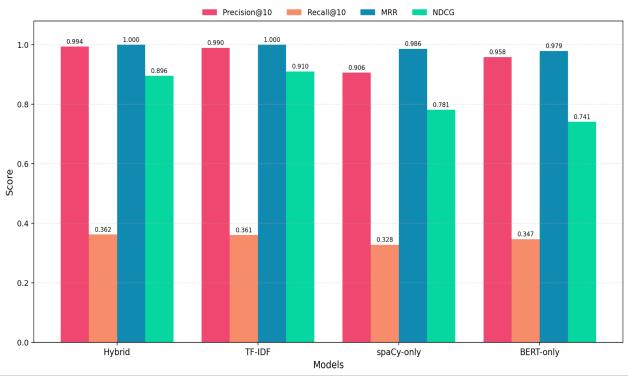
Fig -2:ComparisonofHybridvsBaselinesonRanking Metrics(Precision@10,Recall@10,MRR,NDCG).
5.2 Run A (120 × 24, K=5)
Table -1 :PerformanceComparisonforRunA (120Resumes,K=5)
5.3 Run B (240 × 48, K=10)
Table -2: PerformanceComparisonforRunB(240 Resumes,K=10)
The hybrid approach is consistently stronger than singleencoder baselines and shows near-perfect top-rank retrieval behavior (MRR ≈ 1). TF-IDF remains highly competitive on NDCG in these synthetic settings, suggesting lexical overlap remains a strong signal when synthetic generation includes explicit role keywords. This motivates future evaluation on human-labeled real-world data. This demonstrates that combining linguistic and semanticfeaturesimprovesrankingaccuracycomparedto individualmodels.
6. Discussion
The system demonstrates that explainability features can coexist with high retrieval quality. Practical strengths include modular deployment, caching support, database logging, and recruiter-facing visual analytics. The main empirical risk is over-reliance on synthetic benchmark structure. To support publication-grade claims, humanlabeled relevance judgments and inter-annotator agreementarerequired.
7. Limitations
● Currentreportedbenchmarksaresynthetic,not fullyrepresentativeofrealhiringdistributions.
● Experienceextractionusespatternheuristicsand maymissimplicittenure.
● Skilllexiconqualityaffectsrecallandcan introducedomainbias.
Volume: 13 Issue: 03 | Mar 2026 www.irjet.net p-ISSN: 2395-0072 © 2026, IRJET | Impact Factor value: 8.315 | ISO 9001:2008 Certified Journal | Page 1268
International Research Journal of Engineering and Technology (IRJET) e-ISSN: 2395-0056
Volume: 13 Issue: 03 | Mar 2026 www.irjet.net p-ISSN: 2395-0072
● Theweightedscorercurrentlyusesfixed coefficientswithoutlearnedcalibration.
● Fairnessoutcomesacrossprotectedorproxy attributesarenotfullyauditedyet.
● Resumes may include sensitive personally identifiable information; anonymization and accesscontrolsarenecessary.
● Model outputs should assist human decisionmakers,notreplacefinalhiringjudgment.
● Fairness auditing should be done by subgroup slicesandmonitoredovertime.
● Candidate feedback should be constructive and non-discriminatory.
● Dataset licensing and consent must be validated beforeanypublicrelease.
9. CONCLUSIONS
This paper presents an end-to-end explainable resume ranking platform combining spaCy and MiniLM within a weighted scoring and feedback framework. The approach achieves strong ranking performance at scale while providing transparent decision support through skill-gap and component-level explanations. The system is production-ready in architecture and supports iterative candidate improvement tracking. Future work will focus on human-labeled benchmarking, significance testing, fairnessauditing,andadaptivescoreweighting.
10. REFERENCES
[1] Vaswani,A.,Shazeer,N.,Parmar,N.,etal.“AttentionIs AllYouNeed.”NeurIPS2017. https://papers.nips.cc/paper/7181-attention-is-allyou-need
[2] Devlin, J., Chang, M.-W., Lee, K., Toutanova, K. “BERT: Pre-training of Deep Bidirectional Transformers for Language Understanding.” NAACL 2019. https://aclanthology.org/N19-1423/
[3] Reimers, N., Gurevych, I. “Sentence-BERT: Sentence EmbeddingsusingSiamese BERT-Networks.”EMNLPIJCNLP2019.https://aclanthology.org/D19-1410/
[4] sentence-transformers model card, all-MiniLM-L6-v2. https://huggingface.co/sentence-transformers/allMiniLM-L6-v2
[5] Honnibal, M., Montani, I., Van Landeghem, S., Boyd, A. “spaCy: Industrial-Strength Natural Language Processing in Python.” Zenodo, 2020. https://doi.org/10.5281/zenodo.1212303
[6] spaCyGitHubrepository. https://github.com/explosion/spaCy
[7] Pedregosa,F.,Varoquaux,G.,Gramfort,A.,etal.“Scikitlearn: Machine Learning in Python.” JMLR 12:2825–2830,2011.
https://www.jmlr.org/papers/v12/pedregosa11a.ht ml
[8] Järvelin, K., Kekäläinen, J. “Cumulated Gain-based Evaluation of IR Techniques.” ACM TOIS 20(4):422–446,2002.
https://doi.org/10.1145/582415.582418FastAPI documentation.https://fastapi.tiangolo.com/
[9] CareerCorpus dataset (annotated resumes). https://data.mendeley.com/datasets/wzzwn37gmd/ 1