
International Research Journal of Engineering and Technology (IRJET) e-ISSN: 2395-0056
Volume: 13 Issue: 03 | Mar 2026 www.irjet.net p-ISSN: 2395-0072
International Research Journal of Engineering and Technology (IRJET) e-ISSN: 2395-0056
Volume: 13 Issue: 03 | Mar 2026 www.irjet.net p-ISSN: 2395-0072
Manish
Verma1 , Vivek Kumar2
1Manish Verma, Research Scholar, Department of Civil Engineering, Mewar University, Chittorgarh, Rajasthan
2SAssistant Professor, Department of Civil Engineering, Mewar University, Chittorgarh, Rajasthan
Abstract - The development of road infrastructureiswidely recognized as a key indicator of a nation’s socio-economic progress. In developing countries, road networks play a vital role in supporting economic activities and facilitating overall development. However, the construction of flexiblepavements conventionally relies on natural resources suchasaggregates, soil materials, and bituminous binders, leading to the continuous depletion of these finite resources. This growing concern has created the need to identify sustainable and alternative materials for pavement construction. In this context, the present study investigates the potential use of dimension stone waste, specifically Kota stone and marble waste, in different layers of flexible pavement. Kota stone, abundantly available in the Kota region, and marble, extensively produced in the Kishangarh area, generate significant quantities of waste during mining and processing operations such as cutting, sawing, and polishing. The waste generated from these processes is non-biodegradable and poses serious environmental disposal challenges. The experimental program primarily focused on the utilization of these waste materials in Granular Sub-Base (GSB Grade I and Grade II), Wet Mix Macadam (WMM), and Bituminous Macadam (BM) layers of asphalt pavements. MarbleandKota stone wastes were used as partial to full replacements for conventional fine and coarse aggregates,whilemarblequarry dust was used as filler material. The replacement levels were varied from 20% to 100% at intervals of 20% in order to evaluate their suitability in pavement applications. The engineering performance of the substituted materials was assessed through a series of standard laboratory tests conducted in accordance with relevant Indian Standards and the specifications recommended by the Ministry of Road Transport and Highways (MoRTH).Thestudyaimstoevaluate the feasibility of incorporating dimension stone waste in pavement layers as a sustainable alternative to conventional construction materials. The findings are expected to contribute toward conservation of natural resources,effective utilization of industrial waste, and the promotion of environmentally sustainable road construction practices.
Key Words: Dimension stone waste; Kota stone; marble waste; marble dust; granular sub-base; wet mix macadam; bituminous macadam; Marshall stability; California bearing ratio
Roadconstructionincreasinglyfacesthedual challenge of sustainingmaterialdemandandreducingtheenvironmental burden associated with mining and industrial waste disposal.DimensionstoneindustriesinRajasthangenerate largequantitiesofKotastonewaste,marblestonewaste,and marble dust, much of which is non-biodegradable and commonlydumpednearproductionareas.Thesourcethesis investigated whether these materials can function as technicallyacceptablesubstitutesforconventionalpavement aggregatesandfillerinflexiblepavements.
Thestudyfocusedonthreepavementlayers:granularsubbase(GSBGradeIandGradeII),wetmixmacadam(WMM), andbituminousmacadam(BM).Replacementlevelsranged from20%to100%in20%increments.Theworkisrelevant because it links waste reuse with conservation of natural aggregates, reduced dumping pressure, and potentially lowermaterialcostsinroadconstruction.
S. N o. Author(s) Yea r Materi al Used Layer/Applic ation Key Findings Citati on
1 Ubani et al. 20 25
Quarry dust with cementstabiliz ed tropica l clay Pavement sub-base / base / unpaved roads
The study reported that quarry dust improved compactio n characteri stics, strength, and durability. Properly proportion ed mixes were found suitable for pavement foundation applicatio ns. [1]
International Research Journal of Engineering and Technology (IRJET) e-ISSN: 2395-0056
Volume: 13 Issue: 03 | Mar 2026 www.irjet.net p-ISSN: 2395-0072
Author(s) Yea r Materi al Used Layer/Applic ation Key Findings
2 Bardiniet al. 202 5 Waste foundry sand with sandy soiland hydrate dlime Pavement baseandsubbase
The additionof waste foundry sand produced goodto excellent performanc einterms of compaction ,CBR, compressiv estrength, and resilient modulus. [2]
S. N o. Author(s) Yea r Materi al Used Layer/Applic ation Key Findings Citati on resistance, and resilient modulus. Around 4.5%filler content wasfound suitable.
3 Ohm,Lee, andLe 202 5 Crushe d recycle d marble stone powder with recycle dtire rubber SBS-modified asphalt mixtures
Marble stone powder performed effectively asafiller, and replacemen tupto75% improved stability, dynamic modulus, andrutting resistance. [3]
6 Benjeddou etal. 202 2 Crushe d marble waste Road construction aggregate
The physical, chemical, and mechanical properties ofcrushed marble waste indicated thatitcould beusedas an alternative to convention al aggregate inroad works. [6]
4 de Medeiros etal. 202 4 Marble and granite industr ywaste Hotasphalt mixtures (filler replacement)
Partialand full replacemen tof convention alfillerwas found technically feasible, with performanc e comparable tothe controlmix andlittle changein production cost. [4]
5 Alietal. 202 4 Marble dust Asphalt concrete (filler) Marbledust improved Marshall stability, indirect tensile strength, rutting [5]
7 Ravindra Nagarand P.Kalla
201 8 Quarry waste
8 Pradeep Kumar Gautam and Pawan Kalla 201 8 Kota stone waste
Open-graded friction course/lowtrafficroads
Replaceme ntabove 25%did notsatisfy IRCand MoRTH requiremen ts,whereas upto25% replacemen twasfound feasiblefor low-traffic roadsand parking areas. [7]
DBMGradeII andBCGrade IIinhotmix asphalt
Kotastone wastewas usedat 25%,50%, 75%,and 100% replacemen tlevels.The study concluded that50% replacemen twas feasiblein BCand [8]
International Research Journal of Engineering and Technology (IRJET) e-ISSN: 2395-0056
Volume: 13 Issue: 03 | Mar 2026 www.irjet.net p-ISSN: 2395-0072
Author(s) Yea r Materi al Used Layer/Applic ation Key Findings Citati on 25%in DBM.
9 Arun Pratap Singh Rathore andKaran Parbhakar
201 8 Stone slurry waste
Blackcotton soil stabilization/ subgrade improvement
The additionof stone slurry improved compaction ,direct shear strength, andCBR. Around 15%slurry reduced plasticity and significantl yincreased shear strength. [9]
1 0 Surender Singhetal. 201 7 Bagasse ash with reclaim edroad materia l Roadmaterial /pavement blends Different blends were evaluated, and10% bagasseash replacemen twasfound optimum, showing improved physical properties. [10]
1 1 Virendra Singh Shekhawa tand Bharat Nagar
201 7 Marble dust waste DBMlayeras fillerin asphalt pavement Marbledust wasfound effectiveas filler.The highest densitywas achievedat about5.5% marbledust with4% bitumen content. [11]
S. N o. Author(s) Yea r Materi al Used
Layer/Applic ation
Key Findings Citati on more suitablefor low-traffic roadsdue tohigher flowand VFBvalues.
1 2 AjaySingh Jethooand Harshwar dhanS.C.
201 7 Kota stone waste
BMGradeII replacing naturalfine aggregate Full replacemen toffine aggregate with crushed Kotastone waste improved rigidityand strength, butthemix was considered [12]
1 3 Surender Singh,G.D. Ransinchu ng,and R.N.
201 7 Demolit ion waste and bagasse ash
Asphaltmixes
1 4 S.Faisal and IbrahimA. 201 7 Basalt with limesto nefines Black-top mixes
Theuseof bagasseash improved reinforcem ent behavior and reduced projectcost significantl y.About 10% replacemen twasfound beneficial. [13]
Full replacemen tadversely affected mechanical properties. Thestudy also indicated theneed forantistripping treatment dueto basalt properties. [14]
1 5 Huseyin Akbulut andCahit Gurer
200 7 Marble waste granule s Asphaltmixes /Marshall evaluation Marble waste mixes showed acceptable abrasion andfreezethaw resistance, although someother aggregate combinatio ns exhibited higher Marshall stability. [15]
1 6 Mustafa Karasahin andSerdal Terzi
200 6
Marble waste dust
Bituminous concreteas filler
Lower marbledust contents improved [16]
International Research Journal of Engineering and Technology (IRJET) e-ISSN: 2395-0056
Volume: 13 Issue: 03 | Mar 2026 www.irjet.net p-ISSN: 2395-0072
S. N o. Author(s) Yea r Materi al Used Layer/Applic ation Key Findings Citati on dynamic modulus, whereas higher additive contents increased plastic deformatio n.The mixeswere recommend edfor lightly loaded roads.
3. Materials & Method
WasteKotastone,marblestonewaste,marbledust,natural aggregates, and VG-40 bitumen were used. Aggregate gradations for GSB, WMM, and BM were prepared in accordance with MoRTH recommendations. Compaction behavior was assessed through the Modified Proctor test, bearing resistance through the soaked CBR test, and bituminousperformancethroughMarshallmixdesignand stabilitytesting.
For GSB, the response variables were optimum moisture content (OMC), maximum dry density (MDD), and soaked CBR. For WMM, OMC and MDD were used to assess compactionresponseunderdifferentreplacementlevels.For BM,specimenswerepreparedatmultiplebindercontentsto determineoptimumbindercontent(OBC),Marshallstability, flowvalue,andMarshallquotient.
The thesis examined three substitution patterns in the granular layers: (i) Kota stone waste + marble dust, (ii) marblestonewaste+marbledust,and(iii)combinedKota stone waste + marble stone waste + marble dust. In BM, marblestonewasteandmarbledustreplacedconventional aggregates/filler at 0%, 20%, 40%, 60%, 80%, and 100% replacement.
4. Result & Discussion
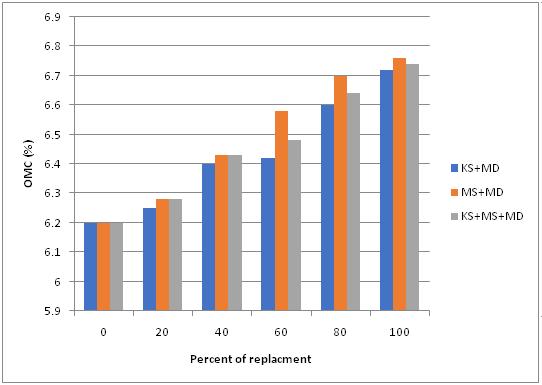
AcrossbothGSBgradations,OMCgenerallyincreasedwhile MDD and soaked CBR decreased as the replacement percentage increased. Even so, the experimental results remainedabovetheminimumsoakedCBRrequirementover a substantial part of the replacement range, indicating practicalpotentialforcontrolledsubstitution.
The thesis conclusions recommend approximate upper practical replacement limits of about 70% for mixes with Kota stone waste plus marble dust, about 60% for mixes dominatedbymarblewasteplusmarbledust,andabout65% for combined Kota stone waste + marble stone waste + marbledust.TheselimitsreflectthepointbeyondwhichCBR lossbecomestoopronouncedforsafefieldadoption.
International Research Journal of Engineering and Technology (IRJET) e-ISSN: 2395-0056
Volume: 13 Issue: 03 | Mar 2026 www.irjet.net
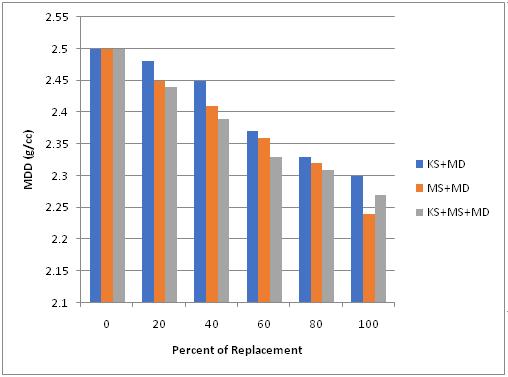
3: Comparative MDD Value of GSB Grade-II with Various Waste
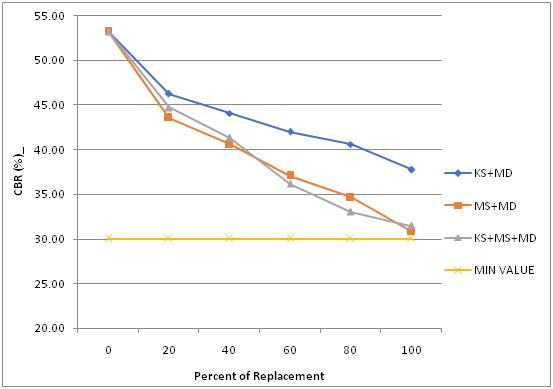
4: GSB G-I Soaked CBR Value Comparison with Various Waste
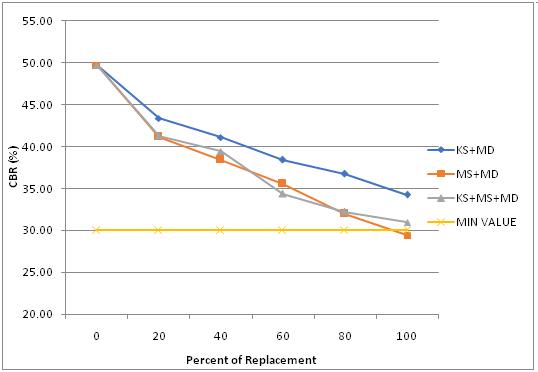
Figure 5: GSB Grade-II Soaked CBR Value Comparison with Various Wastes
Table 1: GSB Grade-I Substitution Results
Table 2: GSB Grade-II Substitution with KS+MD Waste
S. No . Natu ral Mate rial (Perc ent) MW+ KSW (Perc ent) OMC (Perc ent)
S. No . Natu ral Mate rial (Perc ent) MW+ KSW (Perc ent) OMC (Perc ent)
International Research Journal of Engineering and Technology (IRJET) e-ISSN: 2395-0056
Volume: 13 Issue: 03 | Mar 2026 www.irjet.net p-ISSN: 2395-0072
S.
Table 3: GSB Grade-I Substitution with MS+MD Waste
Table 4: MS+MD Waste Replacement in Grade-II GSB
Volume: 13 Issue: 03 | Mar 2026 www.irjet.net
5: KS+MS+MD Waste Substitution in Grade-I GSB
1
2
4
Table 6: KS+MS+MD Waste Substitution CBR of GRADE-II
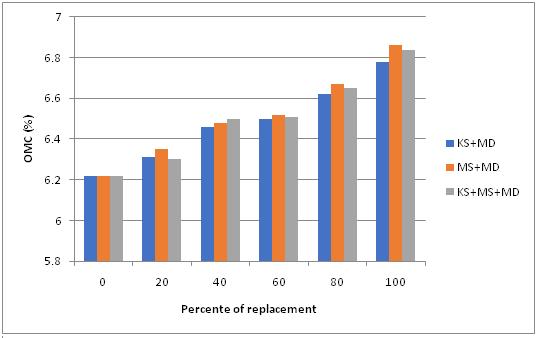
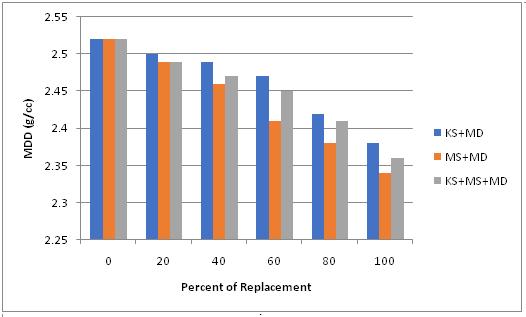
4.2. Wet Mix Macadam (WMM) WMM mixes displayed the same broad compaction trend observed in GSB: OMC increased and MDD declined with increasingreplacementofnaturalmaterialsbystonewaste andmarbledust.Thethesisinterpretsthisasaconsequence of material texture, grading effects, and specific-gravity differencesbetweennaturalaggregatesandwaste-derived particles.
Because the thesis primarily evaluated WMM through compaction rather than direct strength testing, the conclusionsaremoreconservative.Recommendedpractical limitsareapproximately75%forKotastonewaste+marble dust,65%formarblestonewaste+marbledust,and70%for theequalcombinedwastemixture.
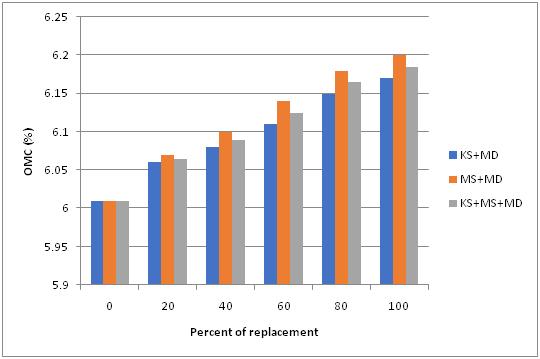
Figure 6: Comparison in OMC Values of WMM with Different Waste
International Research Journal of Engineering and Technology (IRJET) e-ISSN: 2395-0056
Volume: 13 Issue: 03 | Mar 2026 www.irjet.net p-ISSN: 2395-0072
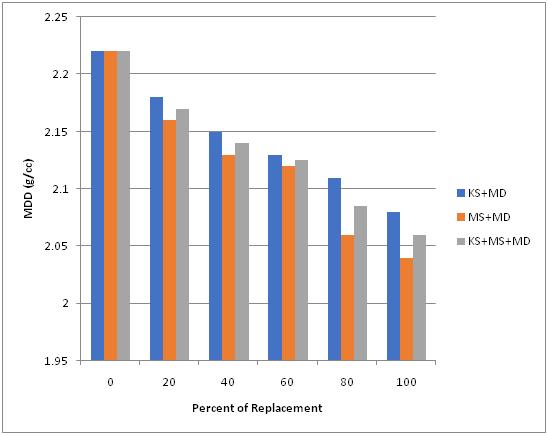
Figure 9: Comparison in MDD Values of WMM with Different Waste
Table 7: Result of WMM Substitution with KS+MD Waste
Table 9: Result of WMM Substitution with KS+MS+MD Waste
Table 8: Results of WMM Substitution with MS+MD Waste
4.3 Bituminous Macadam (BM)
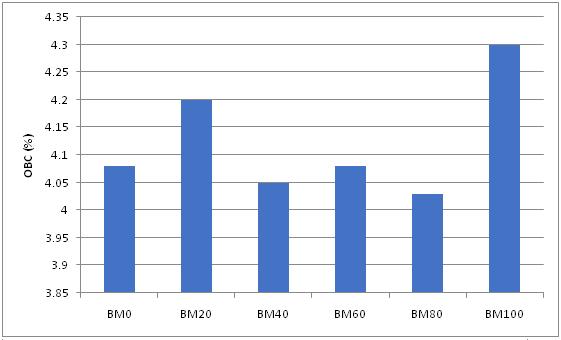
MarshalldesignresultsshowedthatOBCremainedrelatively closetothecontrolmixatmoderatereplacementlevels,but Marshall stability declined and flow increased as marble stone waste and marble dust replacement became more aggressive.Thisindicatesthatthemixesremaintechnically usable up to an optimum range but progressively lose stiffness and load-carrying capacity at higher substitution percentages.
The thesis identifies an approximate feasible replacement window of 60% to 65% in BM. Beyond this range, the reductioninMarshallstabilityandtheriseinflowmakethe mixlesssuitableforsatisfactorypavementperformance.
International Research Journal of Engineering and Technology (IRJET) e-ISSN: 2395-0056
Volume: 13 Issue: 03 | Mar 2026 www.irjet.net p-ISSN: 2395-0072
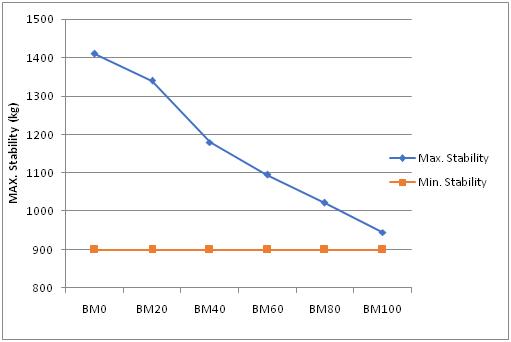
11: Comparison of Marshall Stabiltiy at Different % of Substitution
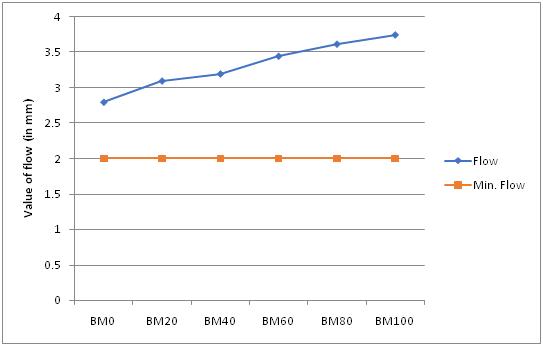
12: Comparison of Flow Value at Different % of Substitution
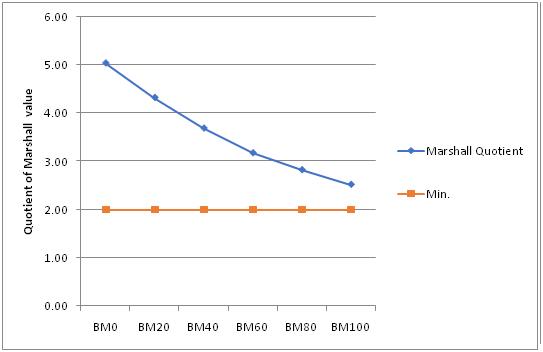
13: Comparison of Marshall Quotient at Different % of Substitution Table 10: Marshall Mix Results at Different Substitution Percentages
Thefindingssupporttheuseofdimensionstonewasteasa partial substituteforconventionalaggregatesinpavement construction, especially in regions where Kota stone and marble waste are generated in large quantities. The most promisingroleispartialreplacementratherthancomplete replacement,withperformance-sensitivelimitsdifferingby pavementlayer.
From a resource and sustainability perspective, the study demonstratesarouteforconvertingadisposalprobleminto aconstructioninput.Thisisespeciallyrelevantforlow-cost or rural road projects where local sourcing can reduce transport demand and improve the circularity of roadbuildingmaterials.
Thepresentstudywasundertakentoexaminethefeasibility ofutilizingKotastonewaste,marblestonewaste,andmarble dust as alternative materials in different layers of flexible pavementconstruction.Theinvestigationwascarriedoutfor Granular Sub-Base (GSB), Wet Mix Macadam (WMM), and BituminousMacadam(BM)layersbyreplacingconventional natural materials at different percentages and evaluating their performance through standard laboratory tests. The resultsoftheexperimentalprogrammeclearlyindicatethat thesewastematerialspossesspotentialforuseinpavement construction,thoughtheirsuitabilitydependsuponthelayer ofapplicationandtheextentofreplacement.
Theuseofsuchwastematerialsissignificantnotonlyfrom the engineering point of view but also from the environmental and economic perspectives. Rajasthan generateslargequantitiesofstonewastefrommarbleand Kota stone industries, and its proper utilization in road construction can help reduce disposal problems, conserve
International
Volume: 13 Issue: 03 | Mar 2026 www.irjet.net p-ISSN: 2395-0072
naturalaggregates,andpromotesustainabledevelopment. However, the test results also show that complete replacement of conventional materials is not always desirable,asexcessivesubstitutionmayadverselyaffectthe engineering properties of pavement materials. The major conclusions drawn from the present investigation are discussedbelow.
TheperformanceofwastematerialsintheGranularSub-Base layer was evaluated primarily through compaction and soaked CBR tests. The results showed that the strength characteristics of the GSB mixes were influenced by the percentage of replacement of natural aggregate and stone dustwithKotastonewaste,marblestonewaste,andmarble dust.
It was observed that the CBR values of both G-I and G-II gradations decreased gradually with the increase in replacementpercentageofconventionalmaterialsbystone waste.Thisindicatesthatalthoughthewastematerialscanbe incorporatedintotheGSBlayer,theirexcessiveusereduces theload-bearingcapacityofthemix.Whenfullreplacement wasadopted,aseverereductioninCBRvaluewasobserved, which clearly indicates that complete substitution is not suitableforGSBapplications.
InthecaseofmixescontainingKotastonewasteandmarble stone waste, the results suggest that replacement may be adopted up to about 70% without causing unacceptable deterioration in performance. Beyond this percentage, the reductioninCBRbecomessubstantialandthemixnolonger remainssuitableforeffectiveuseintheGranularSub-Base layer.
Similarly,formixesinvolvingmarblewasteastheprimary replacementmaterial,theCBRvaluesshowedadecreasing trendwithincreasingreplacement.Thetestresultsindicate thatthepracticalupperlimitformarblewastereplacementis about 60%, as higher percentages result in a considerable lossinstrength.
Forthecombineduseofmarblewaste,Kotastonewaste,and marbledust,theresultswerecomparativelysatisfactoryup to around 65% replacement. Beyond this level, the engineeringpropertiesofthemixdeclinedtoanextentthat makesthematerialunsuitableforpavementuse.Therefore,it may be concluded that controlled use of these waste materials in the GSB layer is possible, but only within optimumreplacementlimits.
ThesuitabilityofwastematerialsintheWetMixMacadam layer was studied mainly through the Modified Proctor Compaction Test. The analysis of results shows that the inclusion of Kota stone waste, marble stone waste, and marble dust has a considerable effect on the compaction characteristicsoftheWMMmixes.
[1] Ubani etal.,2025. Study on quarry dustwithcementstabilizedtropicalclayforpavementapplications.
[2] Bardini et al., 2025. Study on waste foundry sand in pavementbaseandsub-baselayers.
[3] Ohm, Lee, and Le, 2025. Study on crushed recycled marblestonepowderinSBS-modifiedasphaltmixtures.
[4] deMedeiros etal.,2024. Studyonmarbleandgranite industrywasteasfillerinhotasphaltmixtures.
[5] Alietal.,2024.Studyonmarbledustasfillerinasphalt concrete.
[6] Benjeddouetal.,2022.Studyoncrushedmarblewaste asaggregateinroadconstruction.
[7] Ravindra Nagar and P. Kalla, 2018. Study on quarry wasteinopen-gradedfrictioncoursemixes.
[8] PradeepKumarGautamandPawanKalla,2018.Study onKotastonewasteinhotmixasphalt.
[9] ArunPratapSinghRathoreandKaranParbhakar,2018. Study on stone slurry waste in black cotton soil stabilization.
[10] SurenderSinghetal.,2017.Studyonbagasseashwith reclaimedroadmaterial.
[11] Virendra Singh Shekhawat and Bharat Nagar, 2017. StudyonmarbledustwasteasfillerinDBMlayer.
[12] AjaySinghJethooandHarshwardhanS.C.,2017.Study onKotastonewasteasfineaggregateinBMGradeII.
[13] Surender Singh, G.D. Ransinchung, and R.N., 2017. Studyondemolitionwasteandbagasseashinasphalt mixes
[14] S.FaisalandIbrahimA.,2017.Studyonbasaltinblacktopmixes.
[15] Huseyin Akbulut and Cahit Gurer, 2007. Study on marblewastegranulesinasphaltmixes.