

International Research Journal of Engineering and Technology (IRJET) e-ISSN: 2395-0056
Volume: 13 Issue: 05 | May 2026 www.irjet.net p-ISSN: 2395-0072
EXPERIMENTAL INVESTIGATION ON STRENGTH IMPROVEMENT OF RECYCLED COARSE AND FINE AGGREGATE CONCRETE WITH BASALT FIBER AND NANO CaCO₃
Saurabh Vilas Rathod1 , Dr. Suchita. K. Hirde2
1PG Student, Civil Engineering Department, Government college of Engineering, Amravati, Maharashtra, India
2Prof. & Head, Applied Mechanics Department, Government College of Engineering, Amravati, Maharashtra, India ***
Abstract - As the need for more sustainable building materials grows, many engineers are turning to recycled aggregate concrete (RAC) insteadoftraditionalcement-based materials to create new structures. Unfortunately, due to the high porosity of recycled aggregates and the adhered mortar that remains in them, RAC has poorer mechanicalengineering capabilities than that of a comparableregularconcrete,which is something that may impede the Domestication of RAC. This research investigates how basalt fibres and Nano-calcium carbonate (nano-CaCO₃) may be able to improve the performance of recycled aggregates. In particular, we look at M40-grademixescontainingrecycledcoarseaggregates(RCA) and recycled fine aggregates (RFA) along with 0.50% by weight basalt fibres and 2.5% by weight nano-CaCO₃. Workable material samples were tested for compressive strength at 7 and 28 days to assess their overall performance. Our findings indicate that nano-CaCO₃ will increase the compressive strength of RAC by creating a microstructure densification reaction and that basalt fibres will increase the ductility and crack resistance of RAC. Both additives provide complementary benefits that make up for the shortcomings of the individual types of recycled aggregates on their own. Therefore, we conclude that hybrid modified RAC canperform similarly to regular concrete while helping promote sustainability.
Key Words: Recycled Aggregate Concrete, Basalt Fiber, Nano Calcium Carbonate, Compressive Strength, Sustainable Concrete, M40 Concrete
1. INTRODUCTION
The fast growth of infrastructure has led to a lot of aggregates being used up and a lot of construction and demolitionwastebeinggenerated.Recyclingthiswasteinto aggregatesisawaytohelptheenvironment.
Recycled Aggregate Concrete is an alternative. However Recycled Aggregate Concrete has some problems. These problemsare:
*Highwaterabsorption
*Aweakareawheretheoldandnewmaterialsmeet
*RecycledAggregateConcreteisnotasstrong.Doesnotlast aslong
Somenewideassuggestthataddingfibersandreallysmall materialscanmakeRecycledAggregateConcretebetter.This studylooksatwhathappenswhenweaddbasaltfiberand small CaCO₃ to Recycled Aggregate Concrete that is M40 grade.
2. EXPERIMENTAL DETAILS
The following materials were used in the present experimentalinvestigation:
2.1 Cement
OrdinaryPortlandCement(OPC)53GradeconformingtoIS 12269:2013wasused.
PhysicalPropertiesofCement
2.2 Fine Aggregate
NaturalriversandconformingtoIS383:2016wasused
1.SpecificGravity
Observation Table:
Weightofpycnometer +sand+water
International Research Journal of Engineering and Technology (IRJET) e-ISSN: 2395-0056
Volume: 13 Issue: 05 | May 2026 www.irjet.net p-ISSN: 2395-0072
Calculation:
G=W2−W1/(W2−W1)−(W3−W4)
G=1180−650/(1180−650)−(1860−1530) =2.65
Result:SpecificGravity=2.65
2.WaterAbsorptionTest
Observation Table:
2.3 Coarse Aggregate
AsperBureauofIndianStandards(IS2386PartIII)
1.SpecificGravityTest(WireBasketMethod)
Observation Table:
Calculation:
WaterAbsorption=Wssd−Wd/Wd×100 =1012−1000/1000×100 =1.2%
Result:WaterAbsorption=1.2%
3.FinenessModulus(SieveAnalysis)
Observation Table:
Totalcumulative%=265
Calculation: FM=∑Cumulative%Retained/100
Result:FinenessModulus=2.65
Calculation:
G=W4/W3 (W2−W1)
G=2650/2700−(2200−500)
G=2.65
Result:SpecificGravity=2.65
2.WaterAbsorptionTest
Observation Table:
Calculation:
WaterAbsorption=Wssd−Wd/Wd×100
=2583−2550/2550×100
=1.28%
Result:WaterAbsorption=1.28%
3.FinenessModulus(CoarseAggregate)
Observation Table:
International Research Journal of Engineering and Technology (IRJET) e-ISSN: 2395-0056
Volume: 13 Issue: 05 | May 2026 www.irjet.net p-ISSN: 2395-0072
Totalcumulative%=285
Calculation:
FM=∑Cumulative%Retained/100
FM=285/100
FM=2.85
Result:FinenessModulus≈2.8–3.0
FinalSummaryTable
Property Value Specific Gravity 2.65 Water Absorption 1.28 %
Nominal Size 20 mm
2.4 Recycled Coarse Aggregate (RCA)
AsperBureauofIndianStandards(IS2386)
1.SpecificGravityTest(WireBasketMethod)
Observation Table: Sr.
Description Symbol Value (g)
1 Weightofsaturated aggregateinair W₁ 2000
2 Weightofaggregatein water W₂ 1200
3 Ovendryweightof aggregate W₃ 1880
Calculation:
G=W3/W1−W2
G=1880/2000−1200 =1880/800 =2.35
Result:SpecificGravity≈2.30–2.40
2.WaterAbsorptionTest
Observation Table:
1 Ovendryweight Wd 1880 2 SaturatedSurfaceDry weight Wssd 2000
Calculation:
WaterAbsorption=Wssd−Wd/Wd×100 =2000−18801880×100 =6.38%
Result:WaterAbsorption≈6.3–6.5%
3.AggregateImpactValue(AIV)
AIV=W2/W1×100
Observation Table: Sr. No. Description Symbol Value (g)
1 Totalsampleweight W₁ 500 2 Weight passing 2.36 mm sieve W₂ 130
Calculation:
AIV=W2/W1×100 =130/500×100 =26%
Result:AIV=26%
4.AggregateCrushingValue(ACV)
Observation Table: Sr. No. Description Symbol Value (g) 1 Totalsampleweight W₁ 2500 2 Weightpassing2.36mmsieve W₂ 700
Calculation:
ACV=W2/W1×100 =700/2500×100 =28%
Result:ACV=28% FinalSummaryTable
Value
Gravity 2.35 WaterAbsorption 6.4% AggregateImpact Value 26%
AggregateCrushing Value 28%
RCA shows higher water absorption due to adhered mortar.
International Research Journal of Engineering and Technology (IRJET) e-ISSN: 2395-0056
Volume: 13 Issue: 05 | May 2026 www.irjet.net p-ISSN: 2395-0072
2.5 Recycled Fine Aggregate (RFA)
1.SpecificGravityTest(PycnometerMethod)
Observation Table:
Sr.
1 Weightofempty pycnometer W₁ 650
2 Weightofpycnometer+ drysample W₂ 1150
3 Weightofpycnometer+ sample+water W₃ 1850
4 Weightofpycnometer+ wateronly W₄ 1550
Calculation:
G=W2−W1/(W2−W1)−(W3−W4)
Substitutingvalues:
G=1150−650/(1150−650)−(1850−1550)
G=500/500−300
=500/200 =2.50
Result:SpecificGravity=2.40–2.50(approx.)
2.WaterAbsorption
Observation Table:
Sr.No. Description Symbol Value(g)
1 Ovendryweight Wd 1000
2 SaturatedSurfaceDry weight Wssd 1065
Calculation:
WaterAbsorption=Wssd−Wd/Wd×100 =1065−1000/1000×100 =6.5
Result:WaterAbsorption=6.5%
3.FinenessModulus
Observation Table:
Totalcumulative%=245
Calculation:
FM=∑Cumulative%Retained/100
FM=245/100=2.45
Result:FinenessModulus=2.45
Higher absorption affects workability and effective watercementratio.
2.6 Basalt Fiber
Properties
Property Value Length 12mm Diameter 13–20microns TensileStrength 3000–4800MPa
FiberDosage
Fiberwasaddedat:
0.50%(Percentagebyvolumeofconcrete)
2.7 Nano-Calcium Carbonate
Properties
Property Value
ParticleSize 20–80nm
Purity >98%
SurfaceArea High
Color White
Dosage
Nano-CaCO₃ was added at 2.5% by weight of cement (optimumdosageselectedfromliterature)
Replacement Strategy
Natural aggregates were partially replaced with recycled aggregates:
RCA20%30%40%
RFA10%20%30%40%
Remainingarenaturalaggregates.
Volume: 13 Issue: 05 | May 2026 www.irjet.net
Final Mix Proportions
Identification
Table 1: Aggregate Replacement for All Mixes
3. RESULTS
International Research Journal of Engineering and Technology (IRJET) e-ISSN: 2395-0056
Volume: 13 Issue: 05 | May 2026 www.irjet.net p-ISSN: 2395-0072
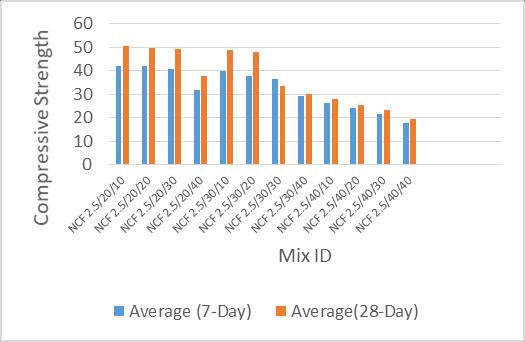
(B) 28-Day Compressive Strength (N/mm²)
4. CONCLUSIONS
Major Findings
Wefoundsomethingsfromourexperiments:
1.RecycledAggregateConcrete(RAC)doesnotperformwell asregularconcretebecauseithasmoreholesabsorbsmore waterandhasaweakerbondbetweenthematerials.
2. Adding Nano-CaCO₃ makes the concrete stronger by makingitsstructureandhelpingitsetfaster.
3.Basaltfiberhelpstheconcreteresistcracks,bendwithout breakingandbehavebetterundertension.
4.UsingbasaltfiberandNano-CaCO₃togethermakesupfor theweaknessesofaggregates.
5. Our special RAC mix performs well as regular M40 concrete.
Workability Conclusions
1. The recycled aggregate we use the harder it is to work withtheconcrete.
2. Adding basalt fiber makes it even harder to work with becausethefibersgettangled.
3. Nano-CaCO₃ needs water because it has a lotof surface area.
4.Eventhoughitshardertoworkwithourconcreteisstill goodenoughforbuildingstructures.
5. We need to add a liquid to make the concrete easier to workwith.
Strength Conclusions
1.Therecycledaggregatesweusetheweakertheconcrete gets.
2. Mixes with recycled aggregate (20% RCA and 10-20% RFA)arestronger.
3.Thestrongestconcretewemadehadastrengthofabout 50.75MPa.
4.Theconcretegetssignificantlyweakerwhenweusethan 30%recycledaggregates.
5.OurspecialmixisstrongerthanRAC.
Optimum Dosage
Fromourexperimentswethinkthebestmixis:
*BasaltFiber:0.50%
*Nano-CaCO₃:2.5%
*RecycledAggregateReplacement:
+RCA:20-30%
+RFA:10-20%
This mix gives us a balance between strength and workability.
Structural Feasibility
1.OurspecialRACcanbeasstrongasM40gradeconcrete.
2. The fibers help the concrete bend without breaking makingitbetterforstructures.
3.It'ssuitableforbuildingbeams,slabsandcolumns(ifwe don'tusemuchrecycledaggregate).
4.Thisshowspromiseforreal-worldconstruction.
International Research Journal of Engineering and Technology (IRJET) e-ISSN: 2395-0056
Volume: 13 Issue: 05 | May 2026 www.irjet.net p-ISSN: 2395-0072
Sustainability Conclusions
1. Using aggregates reduces waste from construction and demolition.
2.Italsosavesresourceslikeriversandandcrushedstone.
3.Thisreducestheimpactandcarbonfootprint.
4. It promotes sustainable. Eco-friendly construction practices.
5.Itsupportsaneconomyintheconstructionindustry.
Limitations of Study
1.WeonlystudiedM40gradeconcrete.
2.Weonlylookedatstrength,notflexuralordurabilitytests.
3.Wedidn'tevaluatelong-termdurabilitybeyond28days.
4.Thiswasalaboratorystudy;wedidn'ttestitinthefield.
5. We only analyzed one fiber dosage (0.50%) and nano percentage(2.5%).
Practical Recommendations
1. Soak recycled aggregates before using them to control waterabsorption.
2.Mixproperlytoavoidfiberballing.
3.Usesuperplasticizerstoimproveworkability.
4.Limitrecycledreplacementto30%forstructuraluse.
5. Make sure nano-materials are dispersed evenly during mixing.
Future Scope
Wecandoresearchintheseareas:
1. Study long-term durability (shrinkage, creep, permeability).
2.Investigateconcretegrades(M50,M60).
3.Optimizefiberdosages(0.25-0.75%).
4.Usenano-materialslikenano-silica.
5.Fieldimplementationandlifestructuralbehavior.
6.Costanalysisandeconomicfeasibilitystudy.
7.StudyTensilestrengthindetail.
8.MicrostructuralanalysisusingSEMandXRDtechniques.
Final Conclusion
Our study shows that using basalt fiber and Nano-CaCO₃ togethermakesrecycledaggregateconcreteperformbetter. This hybrid approach improves both microstructure and crackresistancemakingRACsuitable,forapplications.With mix design and material optimization we can achieve sustainable high-performance concrete contributing to environmental conservation and efficient resource utilization.
REFERENCES
[1] Y. (S. A.) Abera, “Performance of concrete materials containing recycled aggregate from construction and demolition waste,” Results in Materials, vol. 14, p. 100278,2022.
[2] Xiao,J.,Li,W.,&TamV.W.Y.(2012).Recycledconcrete review.ConstructionandBuildingMaterials,27(1)1–12.
[3] Poon, C. S., Shui, Z. H. & Lam, L. (2004). Recycled concrete microstructure affects strength. Cement and ConcreteResearch,34(1)31–40.
[4] Thomas,C.,Setién,J.,Polanco,J.A.,&SánchezdeJuan,M. (2013).Recycledconcretedurability.Constructionand BuildingMaterials,40105–113.
Recycledaggregateconcretehasdurabilityproperties.
[5] Kou,S.C.,&Poon,C.S.(2015).Glassaggregateconcrete properties..ConcreteComposites,27(1)50–59.
BasaltFiberReferences
[6] Sim, J., Park, C., & Moon D. Y. (2005). Basalt fiber characteristics.CompositesPartB,36(6–7)504–512.
[7] Branston,J.,Das,S.,Kenno,S.,&Taylor,C.(2016).Basalt fibre reinforced behaviour. Construction and Building Materials,124878–886.
[8] Ayub, T., Shafiq, N. & Nuruddin M. F. (2014). Basalt fibersinhigh-performanceconcrete.Constructionand BuildingMaterials,5259–67.
[9] Gao, J., Sun, W., & Morino, K. (1997). Steel fiber reinforced recycled properties. Cement and Concrete Research,27(10)1533–1541.
[10] Li,Y.,Mai,Y.W.,&Ye,L.(2000).Sisalfibrecomposites. CompositesScienceandTechnology60(11)2037–2055.
Nano-CalciumCarbonateReferences
[11] Li,G.(2004).High-volumeflyashconcretewithnanomaterials.CementandConcreteResearch,34(6)1043–1049.
[12] Sato,T.,&DialloF.(2010).Nano-CaCO₃seedingeffecton cementhydration.CementandConcreteResearch,40(6) 977–982.
[13] Nazari, A., & Riahi, S. (2011). Nano-CaCO₃ effects on concrete. Materials Science and Engineering A 528(2) 756–763.
[14] Heikal,M.,Ismail,M.N.,Ibrahim,N.S.,&El-Didamony,H. (2008). Nano-CaCO₃ blended cement hydration. ConstructionandBuildingMaterials,22(6)1187–1194.
[15] AliNazari,A.,&Riahi,S.(2010).Nano-CaCO₃concrete microstructural properties. Composites Part B, 41(2) 110–117.