
International Research Journal of Engineering and Technology (IRJET) e-ISSN: 2395-0056
Volume: 13 Issue: 05 | May 2026 www.irjet.net p-ISSN: 2395-0072

International Research Journal of Engineering and Technology (IRJET) e-ISSN: 2395-0056
Volume: 13 Issue: 05 | May 2026 www.irjet.net p-ISSN: 2395-0072
Deependra Singh¹, Sachin Kumar Singh2
1M. Tech Students, Department of Civil Engineering, Institute of Engineering and Technology, Lucknow, 226021, Uttar Pradesh, India.
2 Assistant Professor, Department of Civil Engineering, Institute of Engineering and Technology, Lucknow, 226021, Uttar Pradesh, India.
Abstract - The present study explores the mechanical and durability behavior of M35 grade concrete modified with nano-alumina (Al₂O₃) and glass fiber. Nano-alumina was incorporated as a partial replacement of cement at 1%, 2%, and 3%,while glassfiberswereadded inproportionsof0.2%, 0.3%, and 0.4% by volume of concrete. The experimental program included workability, compressive strength, split tensile strength, and flexural strength evaluated at curing ages of 7, 14, and 28 days. The findings reveal that nanoaluminasignificantlyenhanceshydrationkineticsandreduces pore size due to its nano-scale filler effect, while glass fibers contribute to improved crack resistance and post-cracking behavior. The optimum performance was observed at 2% nano-alumina and 0.3% glass fiber, showing substantial improvements in compressive strength (~22%), split tensile strength (~41%), and flexural strength (~19%) at 28 days. However, excessive fiber content resulted in reduced workability and slight strength reduction due to fiber agglomeration. The study demonstrates that hybrid nanomodificationcombinedwithfiberreinforcementcaneffectively produce high-performance and durable concrete suitable for structural applications.
Key Words: Nano-alumina,Glassfiber,Compressive strength,Tensilestrength,Flexuralstrength
1.INTRODUCTION
Concretecontinuestobethemostwidelyutilizedmaterialin construction due to its versatility and cost-effectiveness. However,itsinherentbrittleness,lowtensilecapacity,and susceptibilitytomicrocrackinglimititsstructuralefficiency. In recent years, the incorporation of nano-materials and fibers has emerged as a promising approach to overcome these deficiencies. Nano-alumina (Al₂O₃), owing to its extremelyfineparticlesizeandhighreactivity,playsacrucial roleinimprovingcementhydration.Itactsasanucleation siteforhydrationproductsandsignificantlyrefinesthepore structure,leadingtoenhanceddensityandstrength.Unlike conventionalmineraladmixtures,nano-aluminaoperatesat
themicrostructurallevel,therebyimprovingtheinterfacial transitionzone(ITZ)betweenaggregatesandcementpaste. On the other hand, glass fibers are known for their high tensile strength and ability to control crack propagation. Whenuniformlydistributedwithintheconcretematrix,they bridge microcracks and delay crack growth, resulting in improvedductilityandtoughness.Thecombineduseofnanoalumina and glass fiber introduces a multi-scale strengtheningmechanism,wherenano-particlesenhancethe matrixqualityandfibersimprovecrackresistance.Although similar hybrid approaches have been studied using nanosilica and basalt fiber, limited research exists on nanoaluminaandglassfiber,particularlyforM35gradeconcrete. Therefore,thisstudyaimstofillthisgapthroughsystematic experimentalinvestigation.
2.1 Material Used
2.1.1 Cement
OrdinaryPortlandCement(OPC)of43gradeconformingto IS: 8112 (2013). Physically tested for fineness, standard consistency, setting time, and specific gravity as per IS: 4031(1996).AllthetestresultsareshowninTable1.
Table-2.1:Cementtestresults
International Research Journal of Engineering and Technology (IRJET) e-ISSN: 2395-0056
Volume: 13 Issue: 05 | May 2026 www.irjet.net p-ISSN: 2395-0072
2.1.2
Riversandwithafinenessmodulus2.8,7.7%siltcontent. Freefromsilt,organicimpurities;confirmingtoZoneIIas perIS:383–2016.Table2representsallthepropertyoffine aggregate.
Table-2.2:Fineaggregateresults
Crushed granite aggregates of 20 mm and 10 mm sizes. Proportioned and graded to conform to IS: 383–2016. Coarse aggregate has specific gravity 2.6 and water absorption0.2%.
2.1.4
Potablewaterisusedformixingandcuring.
Commercially available nano-alumina powder with an averageparticlesizeintherangeof20–50nmwasutilizedas a partial replacement ofcement. The material possessed a highpuritylevelofapproximately99%andaspecificgravity of about 3.2. Due to its ultra-fine particle size and large specificsurfacearea,nano-aluminaexhibitshighreactivity andactsasaneffectivemicro-fillerwithinthecementmatrix. Itistypicallywhiteinappearanceandcrystallineinnature. Theincorporationofnano-aluminaenhancesthehydration process by providing nucleation sites for the formation of hydrationproducts,leadingtoimprovedmicrostructureand strengthdevelopment.
Choppedglassfiberswithanaveragelengthof12mmanda diameterofapproximately10–14μmwereusedinthisstudy. Thefiberspossessatensilestrengthofabout2000MPaanda modulusofelasticityofnearly70GPa.Thespecificgravityof glass fiber is around 2.6. These fibers are non-corrosive, chemically stable, and exhibit good resistance to alkali
environmentswhenproperlytreated.Theywereuniformly dispersed throughout the concrete mix to ensure effective crack-bridging action. The inclusion of glass fibers contributes to improved tensile strength, flexural performance,andductilitybycontrollingcrackinitiationand propagationwithintheconcretematrix.
Table-2.3:PropertiesofGlassfiber
(SP)430 superplasticizer was used as a water-reducing agent.Thedosageusedinthemixerwas1%oftheweightof cementitious material. The specific gravity of superplasticizeris1.316
MixdesignofM40gradeofconcretedoneasperIS10262: 2019 and a target slump of 100 mm. Concrete mix were prepared varying from 1-3% of Nano Silica as cement replacementand0.3-0.5%Basaltfiberrespectively.Themix proportionusedinthestudyisshowninTable2.4.
Table-2.4:Mixproportionusedinthestudy.
3.95(1%byweightof
NanoAl2O3 1-3%asacementreplacement
Glassfiber 0.2-0.4%asadditioninconcrete
International Research Journal of Engineering and Technology (IRJET) e-ISSN: 2395-0056
Volume: 13 Issue: 05 | May 2026 www.irjet.net p-ISSN: 2395-0072
2.3.1
The slump cone test was employed in accordance with IS code1199part2(2018)toverifytheflowabilityofconcrete samples.
• A steel cone (frustum) with dimensions of 300 mm in height,200mminlowerdiameter,and100mminupper diameter was filled with fresh concrete in three equal layers.
• Eachlayerwastamped25timeswithastandardtamping rod.
• The concrete has to be carefully and gently lowered verticallytoremovethemouldassoonaspossible.
• The reduction in height of the concrete specimen is measured as the slump value, which represents the workabilityofthemix.
2.3.2
Thisallowstheconcretetosink,andtheslumpmaybeeasily measuredbyfiguringouthowmuchtheconcretehasrisen overthemould.Theconcretecube'sweightwasdetermined after 28 days. The weight of the test specimen was first ascertained,anditsvolumewasthendividedbyitsweight usingEq.(2.1)tofindthedensity.
2.3.3
A 150 mm cubic specimen that was 28 days old was employedinthewaterabsorptiontest.Afterthewetconcrete cubeswereweighed,theywerestoredat110°Cinanoven. Next, the dried sample weight was ascertained as per Eq. (2.2).
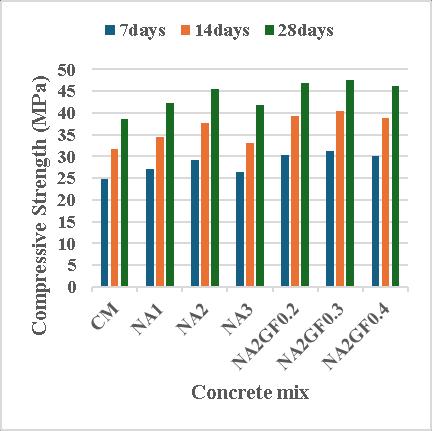
Compressivestrengthistheabilityofamaterialorstructure tobearloadsonitssurfacewithoutbreakingordeflecting.A compression testing machine was used to conduct compression tests on concrete cube specimens measuring 150mmat7,14,and28daysinaccordancewithIS516-part 1standard.Thecompressivetestresultsforthethreecubic specimens were averaged to determine the compressive strengthofeachmixture.
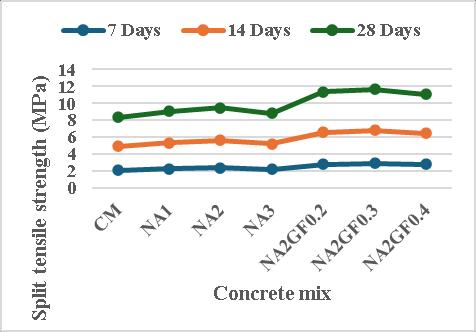
The split tensile test was performed using cylindrical specimenshavingadiameterof100mmandaheightof200 mm,incompliancewiththeIS516-part1standard.Concrete tensile strength is far less than its compressive strength, tension stresses are carried by fibers in the concrete. The threesamplesweretestedatages7,14,and28days,with eachsamplebeingtestedonacompressiontestingmachine accordingtoeq.(2.3).
whereP:maximumappliedload,D:specimendiameterandL: specimenlength.
2.3.6
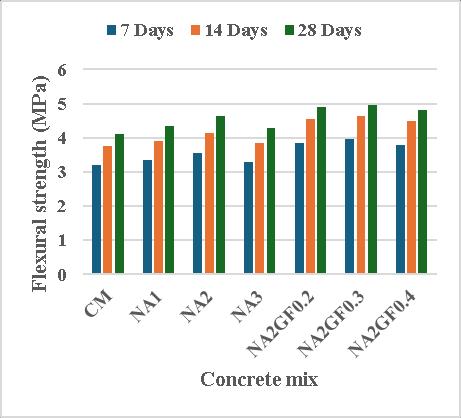
Theconcretebeamspecimensforconcretemixesmeasured 150mm×150mmx700mm. Concrete has a farlowertensile strength than compressive strength, hence steel is usedto bearthetensionforcesinthematerial.Itisbelievedthat10% of compressive strength is equal to tensile strength in concrete.Thespecimens,whichhadaneffectivespanof600 mm,weretestedassupportedstructures.AccordingtoEq.4, theloadwasgiventotwoplacesthatwereeach100mmfrom thecentroidofthebeamaspereq.(2.4).

(2.4)
whereP:maximumappliedload,BandD:specimenlateral diameterandL:specimenlength.
The compressive strength of concrete increases with the addition of nano-alumina up to an optimum level of 2%, primarilyduetoenhancedhydrationandimprovedparticle packing,whichleadstoadensermicrostructure.Thenanoparticlesactasnucleationsites,promotingtheformationof hydrationproductsandreducingporosity.However,aslight decreaseinstrengthisobservedathigherdosages(3%)due toparticleagglomerationandpoordispersion.Theinclusion of glass fibers further improves strength by bridging microcracks and enabling effective stress redistribution withinthematrix.Together,theseeffectsresultinimproved overall mechanical performance when used in optimal proportions.
International Research Journal of Engineering and Technology (IRJET) e-ISSN: 2395-0056
Volume: 13 Issue: 05 | May 2026 www.irjet.net p-ISSN: 2395-0072
Table-3.1-CompressiveStrengthofdifferentconcretemix
3.2 Split Tensile Strength
Table2showsthatthesplittensilestrengthincreaseswith theincorporationofnano-aluminaandglassfibercompared tothecontrolmix.Themaximumtensilestrengthisachieved inthemixcontaining2%nano-aluminaand0.3%glassfiber, indicating the optimum proportion. This improvement is mainlyduetoeffectivecrack-bridgingactionoffibersalong withmatrixdensificationcausedbynano-alumina.Beyond thislevel,aslightreductioninstrengthisobserveddueto fiberclusteringandreducedworkability.Overall,thehybrid
combinationsignificantlyenhancesthetensileperformance ofconcrete.
Table-32:SplittensileStrengthofdifferentconcretemix
:SplittensileStrengthofdifferentconcretemix
3.3 Flexural Strength
Flexural strength of concrete, also known as modulus of rupture,measuresthetensilestrengthofconcreteindirectly orthestressinthematerialcanresistwithoutyieldinginan unreinforced concrete flexure test. Flexural strength of concrete reflects the concrete’s resistance to bending. Understanding the flexural strength of concrete helps to
International Research Journal of Engineering and Technology (IRJET) e-ISSN: 2395-0056
Volume: 13 Issue: 05 | May 2026 www.irjet.net p-ISSN: 2395-0072
predicthowbuildingsbehaveunderbendingloads.Table3.3 representsflexuralstrengthofdifferentconcretemixafter 28 days of testing using a two-point load flexural testing apparatus.
Table-3.3FlexuralStrengthofdifferentconcretemix
4. CONCLUSIONS
4.1 Introduction
Basedonthecomprehensiveexperimentalinvestigation,it canbeconcludedthattheincorporationofnano-aluminaand glass fiber significantly improves the mechanical
performance of M35 grade concrete. The optimum combinationwasidentifiedas2%nano-aluminaaspartial cement replacement along with 0.3% glass fiber addition, which yielded the best results across all strength parameters. At this optimum level, the concrete exhibited substantialimprovementsincompressive,splittensile,and flexural strength at 28 days of curing. The observed enhancementincompressivestrengthismainlyattributedto thefillereffectandacceleratedhydrationinducedbynanoalumina,whichresultsina morecompactandlessporous microstructure. Meanwhile, the increase in tensile and flexural strength is primarily due to the crack-bridging capabilityofglassfibers,whichenhancestheductilityand loadredistributioncapacityofthe material.However,it is important to note that excessive inclusion of either nanomaterial or fiber can lead to reduced workability and potential strength loss due to agglomeration and poor dispersion. Overall, the study confirms that the hybrid approach of combining nano-scale materials with fiber reinforcement is highly effective in producing highperformanceconcretewithimprovedstructuralreliability. Such modified concrete can be considered a promising material for advanced construction applications where strength, durability, and crack resistance are critical requirements.
The present study demonstrates the beneficial effects of incorporating nano-alumina and glass fiber in M35 grade concrete; however, several areas remain open for further investigation.Futureresearchcanfocusonevaluatinglongtermdurabilityunderaggressiveenvironmentalconditions such as chloride ingress, sulfate attack, carbonation, and freeze–thaw cycles to assess field performance. Detailed microstructural analysis using advanced techniques like Scanning Electron Microscopy (SEM), X-ray Diffraction (XRD),andThermogravimetricAnalysis(TGA)canprovide deeper insight into hydration behavior and the interfacial transition zone. Further studies may also explore optimization of fiber length, aspect ratio, and dispersion methodstominimizeclusteringandimproveworkability.In addition,thecombineduseofnano-aluminaandglassfiber withsupplementarycementitiousmaterialssuchasflyash, slag,orrecycledaggregatescanbeinvestigatedtoenhance sustainability.Theapplicationofthishybridconcreteinselfcompacting systems, precast elements, and large-scale structural members also offers promising research opportunities.
International Research Journal of Engineering and Technology (IRJET) e-ISSN: 2395-0056
Volume: 13 Issue: 05 | May 2026 www.irjet.net p-ISSN: 2395-0072
1. Zhang,Y.,Li,X.,&Wang,H.(2023).InfluenceofnanoAl₂O₃ on hydration kinetics and microstructure of cementitious composites. Cement and Concrete Composites,140,105033.
2. Liu, B., Xie, Y., & Chen, Z. (2024). Mechanical performance and pore structure of nano-alumina modifiedconcrete. ConstructionandBuildingMaterials, 430,137065.
3. Zhao, H., Wang, L., & Sun, W. (2023). Effect of nanomaterialsonstrengthanddurabilityofcement-based materials:Areview. JournalofCleanerProduction,384, 135538.
4. Kumar,A.,Singh,R.,&Mehta,P.(2024).RoleofnanoAl₂O₃ in improving durability characteristics of concrete. Materials Today Communications, 39, 104573.
5. Wang, J., Liu, Y., & Zhang, P. (2024). Multi-scale reinforcement of concrete using nano-particles and fibers. Cement and Concrete Research,174,107291.
6. Chen,X.,Li, Q., &Zhao,Y.(2023).Influence of nanoAl₂O₃ on mechanical properties and shrinkage behaviorofconcrete. Materials,16(9),3456.
7. Sun,H.,Zhang,L.,&Liu,G.(2025).Synergisticeffects of nano-materials and fibers on the durability of concrete. Construction and Building Materials, 450, 139210.
8. Patel, V., Sharma, A., & Gupta, R. (2023). Mechanical behavior of glass fiber reinforced concrete under differentcuringconditions. Structures,50,234–245.
9. Ahmed, S., Khan, M., & Ali, M. (2024). Performance evaluationoffiberreinforcednano-modifiedconcrete. Journal of Building Engineering,75,106901.
10. Li, H., Chen, J., & Wang, S. (2025). Nano-enhanced cement composites: Microstructure and durability performance. Cement and Concrete Composites, 152, 105284.
11. Singh, P., Verma, R., & Yadav, S. (2023). Influence of nano-particles on mechanical strength of highperformance concrete. Materials Today Communications,35,105678.
12. Zhou, T., Liu, X., & Zhang, Y. (2024). Effect of nanomaterials on interfacial transition zone of concrete. Construction and Building Materials,418,135993.
13. Rahman, M., Islam, M., & Karim, R. (2023). Fiberreinforced nano concrete for sustainable infrastructure. Journal of Cleaner Production, 378, 134567.
14. Das, S., Ghosh, P., & Roy, B. (2024). Experimental investigation on nano-alumina based concrete. Materials Today Proceedings,91,112–119.
15. Gupta,N.,Sharma,S.,&Singh,A.(2025).Mechanical anddurabilityperformanceofhybridfiber-reinforced nanoconcrete. Structures,62,105421.
16. Zhang, X., Wang, Y., & Li, Z. (2023). Effect of nanoparticles on compressive strength and durability of concrete. CementandConcreteResearch,168,107163.
17. Chen, L., Zhao, H., & Wang, Y. (2024). Hybrid nanomodified fiber reinforced concrete: A review. Construction and Building Materials,410,134789.
18. Kumar,S.,Singh,D.,&Verma,P.(2025).Performance of nano-modified fiber concrete under aggressive environments. Journal of Building Engineering, 80, 107654.
19. Ali, M., Khan, S., & Hussain, A. (2023). Mechanical propertiesofglassfiberreinforcedconcretewithnano additives. Materials Today Communications, 36, 106789.
20. Wang,X.,Liu,J.,&Chen,H.(2024).Microstructureand mechanical behavior of nano-modified concrete. Cement and Concrete Composites,147,105089.