
International Research Journal of Engineering and Technology (IRJET) e-ISSN: 2395-0056
Volume: 13 Issue: 04 | Apr 2026 www.irjet.net p-ISSN: 2395-0072
International Research Journal of Engineering and Technology (IRJET) e-ISSN: 2395-0056
Volume: 13 Issue: 04 | Apr 2026 www.irjet.net p-ISSN: 2395-0072
Simran Alkunte1
1Student, Department of Civil Engineering, Government College of Engineering, Karad, Maharashtra, India
Abstract - Theincreasingaccumulationofplasticwastehas become a major environmental concern worldwide, necessitating the development of sustainable waste management solutions. One promising approach is the utilization of plastic waste as a partial replacement for conventional aggregates in concrete. This study investigates the feasibility of incorporating recycled plastic waste into concreteandevaluatesitsperformanceusingnon-destructive testing(NDT)techniques.Concretespecimenswereprepared with varying percentages of plastic waste replacing coarse aggregate, including 0%, 5%, 10%, and15%. A series of tests were conducted to assess the quality and strength characteristics of the concrete. Non-destructive tests such as the Rebound Hammer Test and Ultrasonic Pulse Velocity (UPV) Test were employed to evaluate surface hardness and internal integrity of the concrete specimens. The results obtained from these tests were analyzed and compared with conventionalconcretetodeterminetheeffectofplasticwaste incorporation. The findings indicate that a limited replacement of coarse aggregate with plastic waste can produce concrete with acceptable strength and durability characteristics.Furthermore,theNDTresultsdemonstrateda correlationwiththeexpectedmechanicalperformanceofthe concrete.Thisstudyhighlightsthepotentialofplasticwasteas asustainableconstructionmaterialwhilealso demonstrating the effectiveness of non-destructive testing methods in evaluating concrete quality.
Keywords: Plastic waste concrete, Sustainable construction, Rebound hammer test, Ultrasonic pulse velocity
Therapidgrowthinurbanizationandindustrializationhas led to a significant increase in the consumption of plastic materialsacrosstheglobe.Plasticsarewidelyuseddueto their lightweight, durability, and cost-effectiveness; however, their non-biodegradable nature poses serious environmental challenges. Improper disposal of plastic wasteleadstolandpollution,blockageofdrainagesystems, andadverseimpactsonecosystems.Asaresult,thereisan urgent need to develop sustainable and eco-friendly methods for the effective utilization of plastic waste. The constructionindustry,beingoneofthelargestconsumersof naturalresources,offersapotentialsolutiontothisproblem through the incorporation of waste materials into constructionproducts.Concrete,whichisthemostwidely
used construction material, requires large quantities of naturalaggregates.
Theexcessiveextractionoftheseaggregateshasresultedin the depletion of natural resources and environmental degradation. Therefore, the partial replacement of conventional aggregates with recycled materials such as plastic waste presents a promising approach toward sustainable construction. In recent years, several studies have explored the use of plastic waste as a partial replacementforcoarseaggregatesinconcrete.Theinclusion of plastic waste not only helps in reducing environmental pollution but also contributes to resource conservation. However,theadditionofplasticmaterialscaninfluencethe mechanicalanddurabilitypropertiesofconcrete,including compressive strength, workability, and bonding characteristics.Hence,itbecomesessentialtoevaluatethe performance of plastic waste concrete to ensure its suitabilityforstructuralandnon-structuralapplications.
Traditionalmethodsoftestingconcrete,suchascompressive strengthtesting,are destructiveinnatureand requirethe specimen to be loaded until failure. While these methods provideaccurateresults,theyarenotalwayspracticalforinsituevaluationofstructures.Inthiscontext,non-destructive testing(NDT)methodshavegainedsignificantimportancein the field of civil engineering. NDT techniques allow the assessmentofconcretepropertieswithoutcausingdamage to the structure, making them highly suitable for quality controlandstructuralhealthmonitoring.Amongthevarious NDT methods available, the Rebound Hammer Test and UltrasonicPulseVelocity(UPV)Testarewidelyuseddueto their simplicity, reliability, and cost-effectiveness. The Rebound Hammer Test provides an estimate of surface hardness, which is related to the compressive strength of concrete,whiletheUPVTestevaluatestheinternalquality anduniformityofthematerialbymeasuringthevelocityof ultrasonic waves passing through it. These methods offer valuableinsightsintotheconditionofconcreteandcanbe effectively used to assess the performance of modified concrete mixtures. The present study focuses on the experimentalinvestigationofconcreteincorporatingplastic waste as a partial replacement for coarse aggregates. Differentpercentagesofplasticwasteareusedtoprepare concrete specimens, and their performance is evaluated usingnon-destructivetestingtechniques.
International Research Journal of Engineering and Technology (IRJET) e-ISSN: 2395-0056
Volume: 13 Issue: 04 | Apr 2026 www.irjet.net p-ISSN: 2395-0072
TheresultsobtainedfromtheReboundHammerandUPV tests are analyzed to understand the effect of plastic incorporationonthequalityandstrengthcharacteristicsof concrete. The study aims to determine the optimum percentageofplasticreplacementthatcanbeusedwithout significantly compromising the performance of concrete. Thisresearchcontributestothedevelopmentofsustainable constructionpracticesbypromotingtheutilizationofplastic wasteinconcreteproduction.Additionally,ithighlightsthe effectiveness of non-destructive testing methods in evaluatinginnovativeconstructionmaterials.Thefindingsof this study are expected to provide useful insights for researchersandengineersworkinginthefieldofsustainable materialsandconcretetechnology.
The growing environmental concerns associated with plastic waste disposal have encouraged researchers to explore its potential utilization in construction materials, particularlyconcrete.Severalstudieshaveinvestigatedthe feasibility of incorporating plastic waste as a partial replacement for conventional aggregates, with a focus on bothsustainabilityandperformance.
Bataynehetal.(2007)examinedtheuseofvariouswaste materials,includingplastic,inconcretemixtures.Theirstudy revealed that while the incorporation of waste materials contributes positively to environmental sustainability, an increaseinreplacementpercentageleadstoareductionin compressive strength. This highlights the importance of identifying an optimum replacement level that balances performanceandsustainability.Choietal.(2005)studiedthe use of waste polyethylene terephthalate (PET) bottles as aggregate in concrete. The results indicated a decrease in densityandcompressivestrengthwiththeinclusionofplastic aggregates;however,improvementsinductilityandimpact resistancewereobserved.Thissuggeststhatplastic-modified concrete may be more suitable for non-structural and lightweightapplications.
Marzouk et al. (2007) investigated the performance of cementitious composites containingpost-consumerplastic waste. Their findings confirmed that plastic waste can be effectivelyutilizedasa partial replacement foraggregates, although a gradual decline in mechanical strength was observed with increasing plastic content. Despite this, the environmental benefits of recycling plastic waste in construction were considered significant. Ramadevi and Manju(2012)exploredtheuseofplasticfibersderivedfrom PET bottles in concrete. Their research demonstrated improvedtensilestrengthandcrackresistanceduetofiber reinforcement, although compressive strength showed a slightreduction.Thisindicatesthattheforminwhichplastic isused(aggregatevsfiber)playsacrucialroleininfluencing concreteproperties.
Neville(2011)emphasizedthatthepropertiesofconcrete are highly dependent on the characteristics of aggregates,
including their shape, texture, and bonding ability. The introductionofplasticmaterials,whicharetypicallysmooth and non-reactive, affects the interfacial bonding between aggregateandcementpaste,therebyinfluencingtheoverall strengthanddurabilityofconcrete.Inadditiontomaterialbasedstudies,non-destructivetesting(NDT)methodshave beenwidelyusedforevaluatingconcretequality.Standards suchasIS13311(Part1andPart2)provideguidelinesfor conducting Ultrasonic Pulse Velocity (UPV) and Rebound Hammer tests. These methods offer reliable and efficient meansofassessingsurfacehardnessandinternalintegrity withoutdamagingthespecimen.
Fromtheabovestudies,itisevidentthatplasticwastecanbe effectively utilized in concrete, particularly at lower replacementlevels(generallybelow10%).However,most research primarily focuses on mechanical properties, with limitedemphasisontheevaluationofplasticwasteconcrete using non-destructive testing techniques. Therefore, the present study aims to bridge this gap by investigating the performanceofplasticwasteconcreteusingbothRebound Hammer and Ultrasonic Pulse Velocity methods. This approach not only contributes to sustainable material development but also provides a practical framework for assessingconcretequalityusingnon-destructivetechniques.
3.1 Materials
Thematerialsusedinthepresentstudyincludecement,fine aggregate, coarse aggregate, plastic waste, and water. All materials were selected in accordance with standard constructionpractices.
OrdinaryPortlandCement(OPC)ofgrade43wasusedfor thepreparationofconcrete.Thecementusedwasfresh,free fromlumps,andstoredindryconditions.Thepropertiesof cement were assumed to conform to relevant Indian Standardspecifications.
Naturalriversandwasusedasfineaggregate.Thesandwas clean,well-graded,andfreefromimpuritiessuchassilt,clay, and organic matter. It was sieved to remove oversized particlesbeforeuse.
Crushedstoneaggregateofnominalsize20mmwasusedas coarseaggregate.Theaggregateswereangularinshapeand freefromdustanddeleteriousmaterials.Propergradingwas ensuredtoachievegoodworkabilityandstrength.
International Research Journal of Engineering and Technology (IRJET) e-ISSN: 2395-0056
Volume: 13 Issue: 04 | Apr 2026 www.irjet.net p-ISSN: 2395-0072
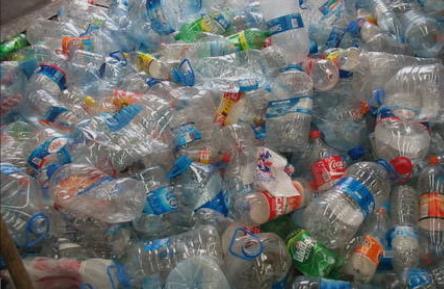
Plasticwasteintheformofdiscardedbottlesandpackaging materials was collected, cleaned, and shredded into small piecesofapproximately5–10mmsize.Theprocessedplastic wastewasusedasapartialreplacementforcoarseaggregate intheconcretemix.
Potable water free from harmful substances such as oils, acids,andsaltswasusedformixingandcuringofconcrete.
3.2
ConcreteofgradeM20wasusedinthisstudy.Anominalmix proportion of 1:1.5:3 (cement: fine aggregate: coarse aggregate) was adopted. Mix design was carried out in accordancewithIS10262:2019guidelines.Plasticwastewas usedasapartialreplacementofcoarseaggregateatdifferent percentagesasshownbelow:
days and 28 days.Propercuringwasensuredtomaintain adequatemoistureconditionsrequiredforhydration.
3.4.1
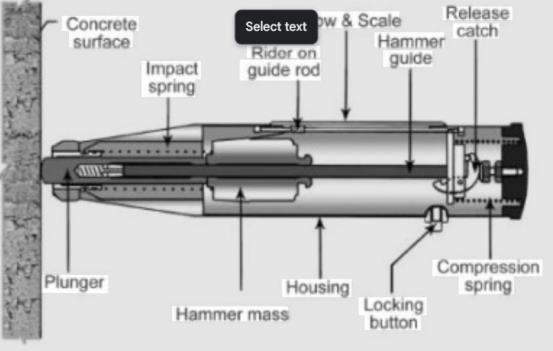
TheReboundHammerTestwasconductedtoevaluatethe surface hardness of concrete. The test was performed by placingthereboundhammerperpendiculartothesurfaceof thecube.Multiplereadingsweretakenatdifferentpointson thesurface,andtheaveragereboundnumberwascalculated foreachspecimen.
TheUltrasonicPulseVelocitytestwascarriedouttoassess the internal quality and uniformity of concrete. In this method, ultrasonic pulses were transmitted through the specimen, and the time taken for the pulse to travel was measured. The pulse velocity was calculated and used to determinethequalityofconcrete.
3.5
Atotalof 12 concrete cubes werecastforthestudy,with3 specimens for each mix proportion. The results obtained from the tests were averaged to ensure accuracy and reliability. All experimental work was carried out in the laboratory under controlled conditions to ensure consistencyinresults.
4.1 Rebound Hammer Test Results
Table 4.1: Rebound Hammer Values
3.3
Concrete was mixed manually by thoroughly blending cement, sand, coarse aggregate, and plastic waste in dry condition.Waterwasthenaddedgraduallyandmixeduntila uniformconsistencywasachieved.Thefreshconcretewas placedincubemouldsofsize 150 mm × 150 mm × 150 mm inthreelayers,andeachlayerwascompactedproperlyto removeairvoids.Thetopsurfacewasleveledandfinished smoothly. After 24 hours, the specimens were demoulded and transferred to a curing tank containing water. All concrete specimens were cured in water for a period of 7
International Research Journal of Engineering and Technology (IRJET) e-ISSN: 2395-0056
Volume: 13 Issue: 04 | Apr 2026 www.irjet.net p-ISSN: 2395-0072
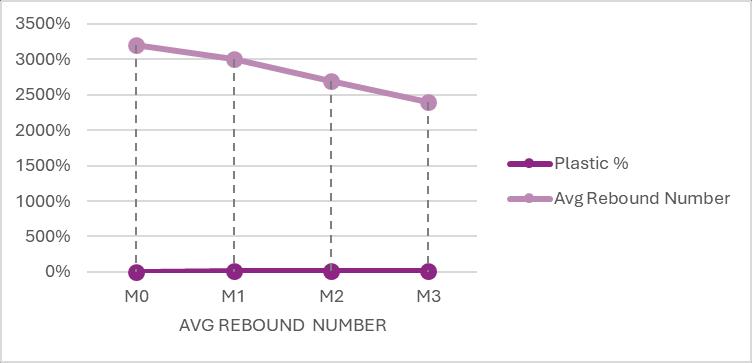
Chart-1: Variation of Rebound Number with Plastic Content
Discussion: The rebound hammer test results indicate a gradual decrease in rebound number with an increase in plasticcontent.Thecontrolmix(M0)exhibitedthehighest reboundvalue,indicatinggreatersurfacehardness.Asthe percentageofplasticwasteincreased,areductioninsurface hardnesswasobserved.Thiscanbeattributedtothelower stiffnessandbondingcharacteristicsofplasticcomparedto naturalaggregates.However,thevaluesobtainedformixes up to 10% replacement remain within acceptable limits, indicatingfeasibleusage.
Ultrasonic Pulse Velocity (UPV) Results
Table 4.2: UPV Test Results
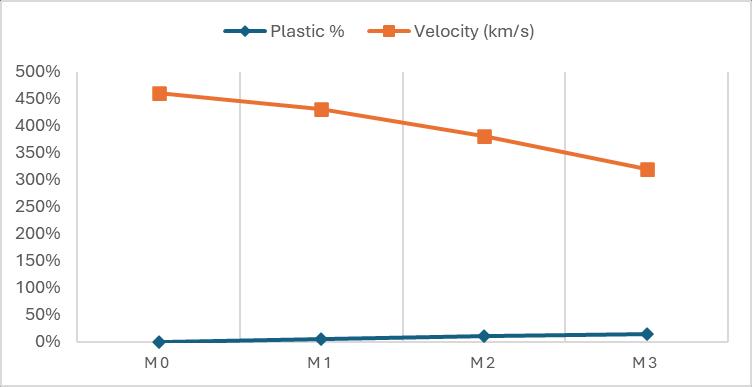
Chart-2: Variation of Ultrasonic Pulse Velocity (UPV) with Plastic Content
Discussion: TheUPVtestresultsshowadecreasingtrendin pulsevelocitywithanincreaseinplasticcontent.Thecontrol mix exhibited excellent quality with the highest velocity, while mixes with plastic replacement showed slightly reducedvalues.Thisreductionisduetoincreasedvoidsand weaker bonding introduced by plastic particles. However, mixes up to 10% replacement still fall under the “good” category, indicating satisfactory internal structure and uniformity.
Table 4.3: Compressive Strength
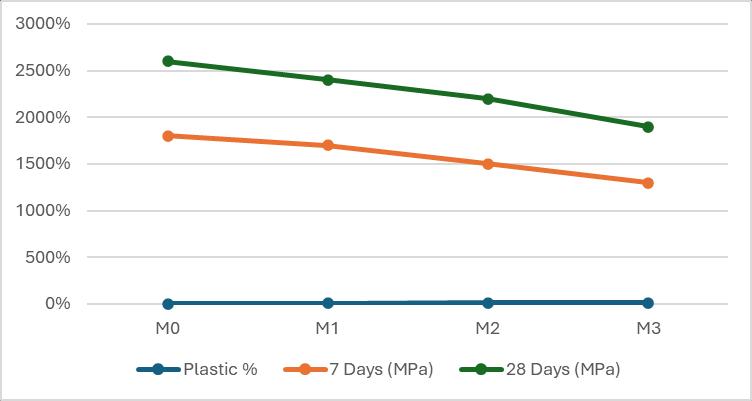
Chart-3: Effect of Plastic Content on 28-Day Compressive Strength
Discussion: The compressive strength results show a decrease in strength with increasing plastic content. The reductionismainlyduetotheweakbondingbetweenplastic particles and cement paste, as plastic is non-reactive and smoothintexture.However,upto5–10%replacement,the strengthremainswithinacceptablelimitsfornon-structural applications.
Based on the experimental investigation carried out on concreteincorporatingplasticwasteasapartialreplacement forcoarseaggregate,thefollowingconclusionsaredrawn:
1. The study demonstrates that plastic waste can be effectively utilized in concrete as a sustainable alternative to conventional aggregates, thereby
International Research Journal of Engineering and Technology (IRJET) e-ISSN: 2395-0056
Volume: 13 Issue: 04 | Apr 2026 www.irjet.net p-ISSN: 2395-0072
contributingtowastemanagementandenvironmental protection.
2. The resultsobtainedfrom theRebound Hammer Test indicate that surface hardness of concrete decreases with an increase in plastic content. However, mixes containing up to 10% plastic replacement exhibit acceptable rebound values, indicating satisfactory surfacequality.
3. UltrasonicPulseVelocity(UPV)testresultsrevealthat the internal quality and uniformity of concrete are slightly affected by the inclusion of plastic waste. Nevertheless, mixes with up to 10% replacement fall within the “good” quality range, confirming their suitabilityforpracticalapplications.
4. A reduction in compressive strength is observed with increasing plastic content due to the weaker bonding characteristicsandlowerstiffnessofplasticmaterials. Despite this reduction, concrete with 5–10% plastic replacement maintains adequate strength for nonstructuralpurposes.
5. Agoodcorrelationisobservedbetweennon-destructive testing results and compressive strength values, indicatingthatNDTmethodssuchasReboundHammer and UPV can be reliably used to assess the quality of plasticwasteconcrete.
6. Theoptimumpercentageofplasticwastereplacementis foundtobeintherangeof 5% to 10%,whereabalance between strength, durability, and sustainability is achieved.
7. The use of plastic waste in concrete is particularly suitableforapplicationssuchaspavements,footpaths, andnon-loadbearingstructures,wherehighstructural strengthisnottheprimaryrequirement.
Inconclusion,theincorporationofplasticwasteinconcrete presents a promising approach toward sustainable construction.Additionally,theapplicationofnon-destructive testing techniques proves to be effective in evaluating the performance of modified concrete, making this approach practical for real-world engineering applications. Further studiesarerecommendedtoevaluatelong-termdurability andfieldperformanceofplasticwasteconcrete.
ACKNOWLEDGEMENT
TheauthorexpressessinceregratitudetotheDepartmentof CivilEngineering,GovernmentCollegeofEngineering,Karad, forprovidingthenecessary infrastructureandfacilitiesto conductthisresearchwork.
Theauthoralsoacknowledgestheacademicenvironmentof theinstitution,whichencouragedindependentresearchand contributedtothesuccessfulcompletionofthisstudy.
[1] M.Batayneh,I.Marie,andI.Asi,“Useofselectedwaste materialsinconcretemixes,”WasteManagement,vol. 27,no.12,pp.1870–1876,2007.
[2] S.Choi,B.Moon,S.Chung,andJ.Cho,“Effectsofwaste PET bottles aggregate on the properties of concrete,” CementandConcreteResearch,vol.35,no.4,pp.776–781,2005.
[3] A. M. Neville, Properties of Concrete, 5th ed., London, U.K.:PearsonEducation,2011.
[4] IS 13311 (Part 1): 1992, “Non-Destructive Testing of Concrete – Methods of Test, Part 1: Ultrasonic Pulse Velocity,”BureauofIndianStandards,NewDelhi,India.
[5] IS 13311 (Part 2): 1992, “Non-Destructive Testing of Concrete–MethodsofTest,Part2:ReboundHammer,” BureauofIndianStandards,NewDelhi,India.
[6] IS 10262: 2019, “Concrete Mix Proportioning –Guidelines,” Bureau of Indian Standards, New Delhi, India.
[7] O. Y. Marzouk, R. M. Dheilly, and M. Queneudec, “Valorization of post-consumer waste plastic in cementitiousconcretecomposites,”WasteManagement, vol.27,no.2,pp.310–318,2007.
[8] K.RamadeviandR.Manju,“Experimentalinvestigation on the properties of concrete with plastic PET bottle fibres as fine aggregate,” International Journal of EmergingTechnologyandAdvancedEngineering,vol.2, no.6,pp.42–46,2012