International Research Journal of Engineering and Technology (IRJET)
e-ISSN: 2395-0056
Volume: 13 Issue: 06 | Jun 2026
p-ISSN: 2395-0072
www.irjet.net
Experimental and Theoretical Analysis of Hourly Yield for a Square Pyramid Solar Still: Effect of Water Depth, Salinity, and Heat Transfer Coefficients Akhilesh Singh Verma1 and Shiv Kumar2 1M. Tech Student, Department of Mechanical Engineering, Goel Institute of Technology & Management, Lucknow
(U.P) – 226028
2Assistant Professor, Department of Mechanical Engineering, Goel Institute of Technology & Management,
Lucknow (U.P) – 226028 ---------------------------------------------------------------------***---------------------------------------------------------------------
Abstract - Freshwater suitable for drinking represents only
incorporation of latent heat storage and phase change materials. Calculations of convective and evaporative heat transfer are performed both mathematically and experimentally. Salinity levels are typically measured using total dissolved solids (TDS), with seawater containing approximately 45,000 ppm and brackish water around 10,000 ppm. Desalination is an energy-intensive process; producing roughly 1,000 m³ of fresh water per day requires nearly 10,000 tons of fossil fuel annually [1].
0.001% of the total water on Earth, with the remainder being saline, brackish, or contaminated. To mitigate the resulting water scarcity, this study investigates a renewable-energybased desalination approach using a square pyramid solar still. The research was carried out at Kamla Nehru Institute of Engineering and Technology, Sultanpur, India (26°15'53.2"N, 82°4'21.7"E). The still was configured with a glass cover inclination of 30° and operated at two water depths: 1 cm and 2 cm. A mathematical model was developed to compute the convective and evaporative heat transfer coefficients for passive operating conditions. The theoretical hourly distillate output was estimated at 2.23 liters, whereas the experimentally obtained yield was 1.54 liters, indicating a loss of 0.69 liters, which corresponds to approximately 30.94%. The findings highlight the dependence of system performance on water depth, feed water salinity, and local climatic variables. This work offers a comparative evaluation between predicted and measured productivities for pyramid-shaped solar stills, thereby contributing to the optimization of solar-powered desalination systems
1.1 Experimental setup
Keywords: Solar Desalination, Pyramid Solar Still, Freshwater Production, Heat Transfer Coefficients, Distillate Yield Analysis.
1. INTRODUCTION Approximately two-thirds of the Earth's surface is covered by water, while the remaining one-third is land. Despite this abundance, only about 1% of the total water is fit for drinking; another 2% is trapped in glaciers, and the vast majority consists of saline or brackish water that is unsuitable for human consumption. Numerous review articles have explored various solar still designs, with researchers conducting mathematical modeling and simulations to analyze performance. These studies discuss technological developments, research findings, and emerging innovations. Data have been collected to assess technical and economic feasibility as well as system performance. In recent years, many solar technologies have advanced toward commercial use and up scaling, with productivity and efficiency improved through the
© 2026, IRJET
|
Impact Factor value: 8.315
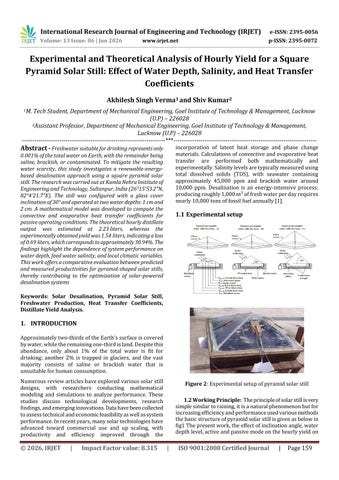
Figure 2: Experimental setup of pyramid solar still 1.2 Working Principle: The principle of solar still is very simple similar to raining, it is a natural phenomenon but for increasing efficiency and performance used various methods the basic structure of pyramid solar still is given as below in fig1 The present work, the effect of inclination angle, water depth level, active and passive mode on the hourly yield on
|
ISO 9001:2008 Certified Journal
|
Page 159