
International Research Journal of Engineering and Technology (IRJET) e-ISSN: 2395-0056
Volume: 12 Issue: 02 | Feb 2025 www.irjet.net p-ISSN: 2395-0072
International Research Journal of Engineering and Technology (IRJET) e-ISSN: 2395-0056
Volume: 12 Issue: 02 | Feb 2025 www.irjet.net p-ISSN: 2395-0072
Dr.M.Haridass1 , V.Rajakumaran2
1 Associate Professor, Department of Mechanical Engineering, Mahendra College of Engineering, Salem, Tamilnadu.
2 Assistant Professor, Department of Mechanical Engineering, Mahendra College of Engineering, Salem, Tamilnadu. ***
Abstract -
Aluminum Metal Matrix Composites (MMCs) are emerging as a new class of materials, especially in aerospace and automotive applications, due to their superior strengthto-weight ratio, wear resistance, and high-temperature performance. The mechanical properties of MMCs can be tailored by adding selected reinforcements. In this study, an aluminium-based composite reinforced with lead (Pb) and boron carbide (B B4C) was developed, with a composition of Al-80%, Pb-10%, and B4C-10%. The composite specimens were fabricated using the stir-casting method. This work investigates the tensile and compressive properties of the developed MMC to evaluate its potential for structural applications.
Keywords: Stir casting, Composite Material, Reinforcement,Aluminium
1. INTRODUCTION
The increasing demand for lightweight, costeffective, energy-efficient, stiff, and strong materials in aircraft,space,defense,andautomotiveapplicationshasled to significant efforts in developing composite materials. Nowadays, Metal Matrix Composites (MMCs) are being seriously considered as replacements for conventional materialsinvariousstructuralapplications.
In Aluminum Metal Matrix Composites (AMCs), aluminium alloy serves as the matrix phase, while The reinforcement phase, typically a non-metallic ceramic material, is embedded within the matrix. Reinforcements such as silicon carbide (SiC), alumina (Al2O3), chromium, lead, zinc, titanium, nickel, and boron carbide (B4C significantlyenhancethestrengthandmechanicalproperties of the aluminium matrix. Due to their low density, aluminiumalloysprovideadditionaladvantagesinseveral applications.
Thesealloysareincreasinglybeingusedassubstitutesfor castironandbronzeinthemanufacturingofwear-resistant components. Particle-reinforced MMCs exhibit enhanced properties and can be processed using conventional manufacturingtechniques.A356/LM25aluminiumalloysare
widely utilized in various industries, including food processing,chemical,marine,andelectricalsectors.Inthe automotiveindustry,thesealloysareusedformanufacturing wheels,cylinderblocks,cylinderheads,enginecomponents, and other body castings due to their excellent mechanical andwearproperties.
Aluminium alloys are widely used in engineering applications due to their lightweight nature, high thermal conductivity, and corrosion resistance. However, pure aluminiumanditsconventionalalloysoftenexhibitlimited mechanical strength and wear resistance, which restricts their use in high-performance applications. To overcome these limitations, researchers have explored hybrid aluminium metal matrix composites (HAMMCs) by incorporatingmultiplereinforcements.
Developanaluminium-basedhybridcompositereinforced withB₄CandPbusingthestircastingtechnique.
Investigatethetensileandcompressivepropertiesofthe composite.Evaluatetheimpactofreinforcementcontenton mechanicalstrength,ductility,andwearresistance
Compare the results with existing aluminium alloys to assessthefeasibilityofusingAl-B₄C-Pbcompositesinrealworldapplications.
AluminumisthemostabundantmetalintheEarth's crust,knownforitslowdensityandlowcorrosionresistance due to the formation of a protective oxide layer. Commercially pure aluminium has a tensile strength of approximately90MPa,whichincreasesto180MPathrough coldworkingandupto570MPainheat-treatablealloys.The coefficient of thermal expansion varies with composition silicon and copper reduce expansion, while magnesium increases it. Aluminium alloys contain copper, zinc,
International Research Journal of
Volume: 12 Issue: 02 | Feb 2025 www.irjet.net
magnesium,manganese,andsilicon,enhancingmechanical properties,especiallyafterheattreatment.
Table - 1: PhysicalPropertiesofAluminium
S.No
1
5
Boroncarbide(B4C)isanextremelyhardboron–carbon ceramic, known for its high hardness, low density (2.52g/cm³),andexcellentchemicalandthermalstability. B4C-reinforcedaluminumcompositesexhibithighspecific strength,highelasticmodulus,superiorwearresistance,and goodthermalstability.However,limitedresearchexistsdue tothehighcostandpoorwettabilityofB4C.Despitethese challenges, B4C -reinforced aluminum composites are gaining attention for their potential in low-cost casting processes.
Table - 2: Propertiesof
K)
5 Boilingpoint 3,500 °C (6,330 °F; 3,770K)
6 Acidity(pKa) 6–7(20°C)
7 Appearance Dark Gray or Black Powder,Odourless
andsystemichealthissues.Despiteitstoxicity,overhalfof thegloballeadproductioncomesfromrecycling.
Table - 3: PropertiesofLead(Pb)
Among various processing techniques for fabricating AMCs, stir casting was chosen for its costeffectiveness, simplicity, and ability to produce near-netshape components. This method enables uniform distribution of reinforcements in the aluminium matrix, enhancing composite properties. The efficiency of the processdependsonparameterssuchas:
Stirringspeedandduration
Preheatingofreinforcements
Vortexformationinmoltenaluminium
Propersolidificationcontrol
A custom-builtstircastingfurnace witha 3-blade graphite stirrer was designed, consisting of a refractorylinedfurnace,crucible,temperaturecontroller,andstirring setup. A 1200 rpm high-torque motor drives the stirrer, creatingavortexforuniformreinforcementdistribution.A boron carbide preheated in furnace 710°C , Stirring is maintained for 10 minutes to ensure homogeneity before castingintomolds.Sampleswith0%,2%,4%,and6%B₄C were prepared and fully heat-treated, including solution treatmentat520-530°Candprecipitationat170°C. S.No
8 Solubilityinwater Insoluble
2.3 Lead
Lead(Pb)isadense,soft,andmalleableheavymetal withalowmeltingpointandhighatomicnumber(82).Itis relativelyunreactive,formingcompoundsprimarilyinthe +2oxidationstateandexhibitingamphotericbehavior.Due to its high density, low melting point, and inertness to oxidation, lead is widely used in batteries, radiation shielding, and alloys. However, lead is a neurotoxin that accumulatesinsofttissuesandbones,causingneurological
International Research Journal of Engineering and Technology (IRJET) e-ISSN: 2395-0056
Volume: 12 Issue: 02 | Feb 2025 www.irjet.net p-ISSN: 2395-0072
4.1 Tensile
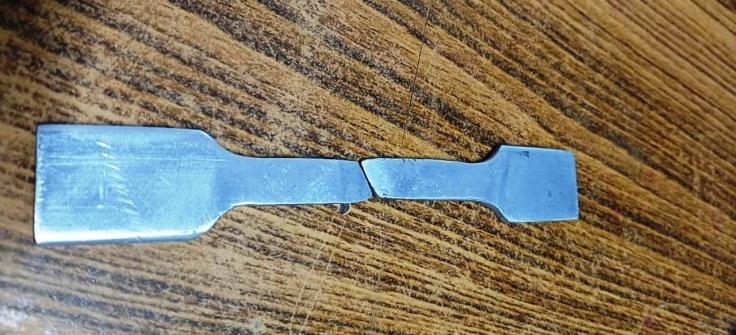
Fig.1 TensileTestSpecimen
Afterspecimenpreparedmaterialtestcontactedfor checkingmaterialdurability.The tensiletestoftheAl-B4C compositewasconductedusingaUniversalTestingMachine (FIE-UTN 40) following ASTM D3039 standards. The maximum operating load of the machine is 400kN. The tensilestrengthofaluminumwithboroncarbide-reinforced mixture composites is presented in the table below. For experimental purposes, a tensile specimen was prepared, and the values were recorded. It was noted that the reinforcementsofhardparticleswidelyimprovedthetensile strengthofthealuminumalloy.Thecompositematerial(AlB4C)wastested,andtheresultsweretabulated.
Table - 4: TensileTest
4.2 Compression Test
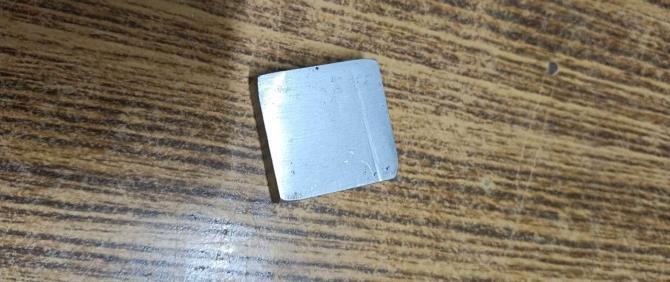
Fig.2 CompressionTestSpecimen
The experiments were conducted using a UTM Machine (INSTRON SATEC 600kN). The 600kN models of INSTRONareidealforhigh-capacitytension,compression, flexural,andsheartesting.Thesemachinesofferversatility by accommodating various specimen sizes, grips, fixtures, and extensometers. They featurea large single test space, ensuring user-friendly and safe specimen loading and unloading.Availablemodelsinclude300kN,600kN,1200 kN,1500kN,2000kN,and3500kN.
Table - 5: CompressionTest
ThemechanicalpropertiesoftheAluminium-Boron Carbide-Lead(Al-B₄C-Pb)compositewereevaluatedusing tensileandcompressiontests,andtheresultswereanalyzed to understand the effect of reinforcement additions. This section discusses the outcomes in terms of strength, ductility, and microstructural features, highlighting key observationsandcomparisonswithexistingmaterials.
5.1 Tensile properties
The tensile test was conducted to determine the ultimatetensilestrength andpercentageelongationofthe compositesamples.TheresultsaresummarizedinTable4
5.2 Compression Properties
Thecompressivestrengthanddeformationbehavior ofthecompositewereevaluatedusingaUniversalTesting Machine(UTM)witha capacityof600kN.Theresultsare presentedinTable4.
A micro structural analysis was performed to examine the distribution of reinforcements, interfacial bonding,andfailuremechanisms.Keyobservationsinclude:
Uniform distribution of B₄C particles was observed, indicatingeffectivestircasting.
No significant porosity or clustering of reinforcements, whichconfirmsgoodwettabilityandpropermixing.
Strong interface bonding between aluminium and B₄C, ensuringeffectiveloadtransferduringmechanicalloading.
Pbwasfoundinlocalizedregions,formingsoft-phaseareas thatcontributedtoimprovedductilityandmachinability.
International Research Journal of Engineering and Technology (IRJET) e-ISSN: 2395-0056
Volume: 12 Issue: 02 | Feb 2025 www.irjet.net p-ISSN: 2395-0072
Table - 6: Comparison
Property
Tensile Strength (MPa) ~90 ~150 1.25 (Limited byPbcontent)
Compressive Strength (MPa)
Hardness (HV)
~50-100 ~180-220 150
~25-30 ~90-120 ~75-100(Est.)
Wear Resistance Low High Moderate to High Ductility(%) ~10-20 ~1-2 0.9%
Application Suitability Generaluse Aerospace, Automotive High-load applications withmoderate ductility
The results indicate that the Al-B₄C-Pb composite offers superior compressive strength and moderate ductility compared to traditional aluminium alloys, making it a promisingmaterialforapplicationsthatrequireabalanceof strength,wearresistance,andsomedeformability.
5.5 Key Findings and Discussions
1. ImprovedStrengthandHardness
2. The presence of B₄C significantly enhanced the mechanicalstrengthofthealuminiummatrix.
3. Thestrengtheningeffectwasmorepronouncedin compressiveloadingthantensileloading.
4. TheinclusionofPbslightlyreducedtensilestrength but improved ductility and machinability Pb facilitated better distribution of stress during loading,preventingcatastrophicfailure.
5. WearResistanceEnhancement
6. ThepresenceofhardB₄Cparticlesimprovedwear resistance
5. CONCLUSIONS
The literature survey highlights advancements in Hybrid Aluminium Metal Matrix Composites (HAMMCs) manufacturing and applications. Various production methods were studied, with stir casting emerging as an effectivetechniqueforuniformdistributionofreinforcement
particlesinthematrix.BoronCarbide(B4C)andleadwere identified as suitable reinforcements for HAMMCs due to theirstrength-enhancingproperties.Thestudyindicatesthat increasing the weight percentage of B4C and lead in aluminiumimprovesmechanicalpropertiessuchastensile strength, impact strength, and hardness. Tribological analysis shows that wear resistance also increases with higher reinforcement content. The adoption of HAMMCs over monolithic materials results in weight reduction, leading to improved fuel efficiency in automotive and aerospaceapplications.
6. References
[1] Blaza Stojanovic, Lozica Ivanovic, Applications of aluminium hybrid composites in automotive industry, Researchgate,Technicki Vjesnik–February2015.
[2]G.SivakarunaandDr.P.SureshBabu,ASurveyonEffects ofReinforcementonAluminiumMetalMatrixComposites, InternationalJournal of Mechanical Engineering and Technology8(9),2017,pp.112–131.
[3] N. Venkat Kishore, Mechanical Properties in MMC of Aluminum Alloy (A356/LM25) Matrix and Boron Carbide (B4C) Reinforcement, International Journal o Engineering Research&Technology,ISSN:2278-0181,Vol.5Issue
02,February-2016.
[4] Keshav singh, R.S. Rana , Anjaney Pandey, Fabrication and Mechanical properties characterization of aluminium alloyLM25/B4Ccomposites,5thInternational Conference of Materials Processing and Characterization (ICMPC 2016).
[5]A.Basithrahman,WearBehaviourofaluminiumHybrid Metal Matrix Composites, International Journal of Engineering Sciences & Research Technology, Volume. 03 Issue.5,May–2016
[6]SiddharthaPrabhakar,Hybridaluminiummetalmatrix composites was fabricated by reinforcing 5 % weight fraction of Boron Carbide (B4C) with aluminium (LM25) using stir casting method, International Journal of MechanicalEngineeringandTechnology8(9),2017,pp.112–131.
[7] V.M.Ravindranath, G.S.Shiva Shankar, S.Basavarajappa, Siddesh Kumar N.G, Dry sliding Wear Behavior of Hybrid aluminum Metal Matrix composite reinforced with Boron carbideandgraphiteparticles,MaterialsToday:Proceedings 4(2017)11163–11167.
[8] T. S. A. Suryakumai, S. Ranganathan, J. Sai Krishna, N. Sanjeev Sai Reddy, K. Loknath Reddy, Development of AluminiumHybridmetalmatrixcomposite,ARPNJournalof Engineering and Applied Sciences, VOL. 11, NO. 12, June 2016.
International Research Journal of Engineering and Technology (IRJET) e-ISSN: 2395-0056
[9] N. Venkat Kishore, Dr. K. Venkata Rao, Mechanical properties in MMC of Al alloy (LM25) matrix & Boron CarbideReinforcement,ijretVol.5Issue02,February2016.
[10]M.Marimuthu,PreparationandCharacterizationofB4C Particulate Reinforced Al Alloy Matrix Composites, InternationalJournalofModernEngineeringResearch,Vol. 3,Issue6,Nov-Dec.2013pp-3723-3729ISSN:2249-6645.
[11] V.Chandramohan, R.Arjun, Preparation of Hybrid AluminiumMetalMatrixCompositesbyUsingStirProcess, International Journal of Engineering Sciences & Research Technology,Chandramohan,3(11):November,2014.
BIOGRAPHIES


Volume: 12 Issue: 02 | Feb 2025 www.irjet.net p-ISSN: 2395-0072 © 2025, IRJET | Impact Factor value: 8.315 | ISO 9001:2008
HaridassM,AssociateProfessor, DepartmentofMechanical Engineering, MahendraCollegeofEngineering, Salem.
RajakumaranVDepartmentof MechanicalEngineering, MahendraCollegeofEngineering Salem.