International Research Journal of Engineering and Technology (IRJET)
e-ISSN: 2395-0056
Volume: 13 Issue: 05 | May 2026
p-ISSN: 2395-0072
www.irjet.net
Evaluation of Physicochemical Characteristics in Packaged Drinking Water: A Case Study Balaraj M K1, Sharath A P2, Yogesh K T3 , Manjunath H S4 1,2,3 Students, Dept. of Civil Engineering, Rajeev Institute of Technology, Hassan
4 Assistant Professor, Dept. of Civil Engineering, Rajeev Institute of Technology, Hassan
---------------------------------------------------------------------***--------------------------------------------------------------------Abstract - This study evaluates the physicochemical 2. Objectives characteristics of packaged drinking water brands available in Karnataka, India. Different bottled water brands such as Bisleri, Kinley, Aquafina, Bindu, Tata Copper+, and Nandini were analyzed for parameters including pH, Total Dissolved Solids (TDS), hardness, alkalinity, turbidity, and dissolved oxygen. The obtained results were compared with Bureau of Indian Standards (BIS) and World Health Organization (WHO) standards. The analysis revealed that most brands complied with acceptable limits, although slight variations were observed due to differences in purification techniques and mineral composition. Graphical analysis was used to compare the physicochemical properties of the selected bottled water brands. The study highlights the importance of regular monitoring and quality control in the packaged drinking water industry.
To analyze and compare the physicochemical properties of different bottled water brands. To determine compliance with WHO/ISI/BIS drinking water standards.
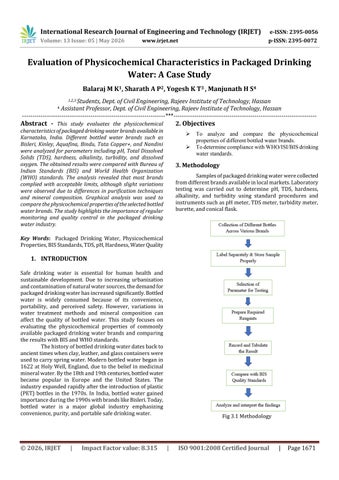
3. Methodology Samples of packaged drinking water were collected from different brands available in local markets. Laboratory testing was carried out to determine pH, TDS, hardness, alkalinity, and turbidity using standard procedures and instruments such as pH meter, TDS meter, turbidity meter, burette, and conical flask.
Key Words: Packaged Drinking Water, Physicochemical Properties, BIS Standards, TDS, pH, Hardness, Water Quality
1. INTRODUCTION Safe drinking water is essential for human health and sustainable development. Due to increasing urbanization and contamination of natural water sources, the demand for packaged drinking water has increased significantly. Bottled water is widely consumed because of its convenience, portability, and perceived safety. However, variations in water treatment methods and mineral composition can affect the quality of bottled water. This study focuses on evaluating the physicochemical properties of commonly available packaged drinking water brands and comparing the results with BIS and WHO standards. The history of bottled drinking water dates back to ancient times when clay, leather, and glass containers were used to carry spring water. Modern bottled water began in 1622 at Holy Well, England, due to the belief in medicinal mineral water. By the 18th and 19th centuries, bottled water became popular in Europe and the United States. The industry expanded rapidly after the introduction of plastic (PET) bottles in the 1970s. In India, bottled water gained importance during the 1990s with brands like Bisleri. Today, bottled water is a major global industry emphasizing convenience, purity, and portable safe drinking water.
© 2026, IRJET
|
Impact Factor value: 8.315
Fig 3.1 Methodology
|
ISO 9001:2008 Certified Journal
|
Page 1671