
International Research Journal of Engineering and Technology (IRJET) e-ISSN: 2395-0056
International Research Journal of Engineering and Technology (IRJET) e-ISSN: 2395-0056
Birhanu Girmaa,* Menbere Asmarea, Lakachew Abitewa,Girum Abebea
a*a Tongji University, UNEP Institute of Environment for Sustainable Development (IESD): College of Environmental Science and Engineering, Shanghai 200092, P. R. China.
Abstract - Accesstocleanandsafedrinkingwaterremains a critical challenge in Injibara, Ethiopia, affecting public health and well-being. The study identified that Injibara's watersystemoperatesata productioncapacityof42liter persecond,servingonly50%ofthewaterneedsdueto50% loss from leaks, inadequate infrastructure, and aging systems.Thisresultsinapercapitasupplyofjust25liters perpersonperdaybelownationalstandardsof50to100 litersperpersonperdayandawateravailabilityscheduleof one dayper week.Affordabilityisa significantissue, with 89% of respondents perceiving tariffs as high, and nearly 29% of the town’s area lacking piped water access. Geographicandeconomicdisparitieshinderequityinwater distribution. Residents in low-pressure and high-altitude areas experience severe shortages, exacerbated by infrastructure limitations. Additionally, water quality is compromised, with microbiological tests revealing contamination by coliform bacteria and E. coli, exceeding WHO and Ethiopian standards. This contributes to waterbornediseases,accountingfor29%ofthetown'stop 10 illnesses over five years. The findings underscore the urgency of expanding infrastructure, improving management, and ensuring equitable access. Key recommendations include investing in new reservoirs, repairing leaks, enhancing chlorination practices, and communityengagementforsustainablesolutions.Without significantinterventions,achievingSustainableDevelopment Goal(SDG)6.1by2030remainsunlikely.Theseinsightsaim to inform policymakers and stakeholders for strategic actionstoaddressInjibara’swaterchallengeseffectively.
Key Words: Keywords:Performance,watersupplysystem, waterquality,SDG6.1,Pipedwatersource,on-spotsource, Andwaterloss.
Lack of sufficient drinking water and poor sanitation services cause the spread of diseases responsible for the deaths of millions of people worldwide, particularly in developingcountrieslikeEthiopia [1].Developingnations haverecentlyencounteredmajorchallengesinmaintaining waterqualitywhileattemptingtoenhancewatersupplyand sanitation[2].AccordingtoTeymouriandDehghanzadeh[3], almost one-third of all deaths in developing nations and
about80percentofthediseasesarewater-related,andeach person spends nearly one-tenth of their productive time tendingtowater-relatedillnesses.
Ethiopia is among the least developing nations in SubSaharaAfrica(SSA)andworldwide.Themainchallengesof urban drinking water system (UDWS) in Ethiopian cities includerapidurbanization,highwaterdemand,shrinkageof water supply sources, mismanagement of water, water qualitydeterioration,lowfunctionalityoftheexistingwater supplysystemcomponents(technicalproblems),limitation in institutional capacity, and lack of efficient and proper planning[4]
Afewresearchershaveattemptedtoassesstheissuesof Challenges in the availability of Drinking Water System of EthiopianCities. Forinstance,Alemu&Dioha[5],AlemuZA and Scholar [6]; Kitessa BD [7] have researched water supplyanddemandinAddisAbabacity;Getachewetal[8], Yimer&Geberkidanonwaterquality/environmentalissues; Berhane & Aregaw [9], Nayak, S. and Sudheer [10], on technicalissuesrelatedtodrinkingwatersystemandnonrevenue water, whereas, (Debela, 2021); (Kayaga et al, 2018),ontheinstitutionandgovernanceissues.Itmaybe noticedthatonlyafewstudieswerecarriedouttofocuson the challenges of availability, access, and affordability aspectsoftheDrinkingWaterSystemofEthiopia
Thisstudyaddressesthecomplexitiesoftheavailability, affordability,equity,andwaterqualityaspectsofUDWSwith possibleinterventionsforsustainability.Themainobjective of this research is to assess the availability, affordability equity, and quality of the water supply system in Injibara town,AmharaNationalRegionalState,Ethiopia.Soensuring accesstosafeandreliabledrinkingwaterisafundamental humanrightandacriticalfactorforpublichealthandwellbeing. By comprehensively assessing the availability, affordability,equity,andqualityofwatertheresearchwill identifyspecificareasforimprovement.Itcancontributeto improvedwaterqualityandincreasedavailability,ultimately leading to better public health outcomes for the local population [11]. The findings of this research can also providevaluableinsightsforlocaldecision-makerssuchas waterutilitiesandgovernmentagencies.Italsocontributes to the broader knowledge base regarding water
Volume: 12 Issue: 02 | Feb 2025 www.irjet.net p-ISSN: 2395-0072 © 2025, IRJET | Impact Factor value: 8.315 | ISO 9001:2008 Certified Journal | Page525
International Research Journal of Engineering and Technology (IRJET) e-ISSN: 2395-0056
Volume: 12 Issue: 02 | Feb 2025 www.irjet.net p-ISSN: 2395-0072
management challenges in developing countries. The researchontheurbanwatersupplyinInjibaraCityprovides crucial insights that are highly relevant to other cities, particularly in developing countries. The challenges identifiedbytheresearch,suchaslimitedaccess,inadequate infrastructure,highleakagerates,inequitabledistribution, and poor water quality, are unfortunately widespread in developingcountries.
Thisresearchservesasavaluablecasestudy,highlighting the complex interplay of factors that contribute to urban water crises. It demonstrates how aging infrastructure, insufficient investment, and weak governance can lead to severe water shortages and jeopardize public health [12]. Thefindingsonthemarginalizationofcertaincommunities, suchasthoseinhillyareasandlow-incomeneighborhoods, emphasize the need for inclusive and equitable water distribution policies. Furthermore, the identification of coliformcontaminationunderscoresthecriticalimportance ofwaterqualitymonitoringandtreatment.
The research's significance extends beyond Injibara. It providesvaluablelessonsforpolicymakers,urbanplanners, and water utilities in other cities across Ethiopia and the developingworld.Byunderstandingthespecificchallenges facedbyInjibara,othercitiescanproactivelyaddresssimilar issues.
2.1.
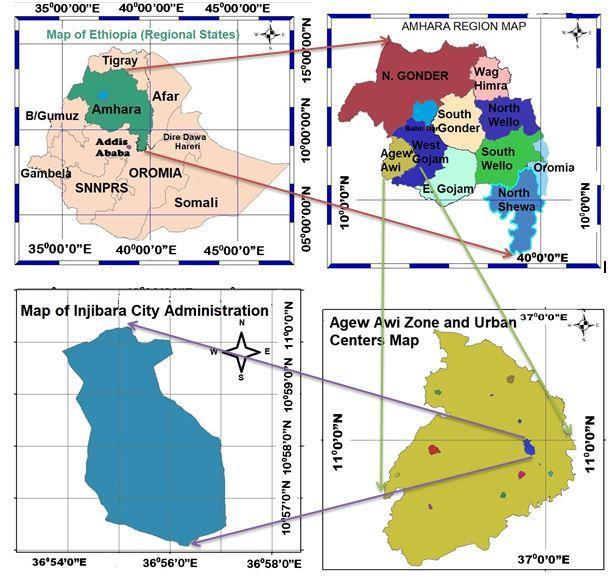
TheresearchwasconductedinInjibaraTown,situatedin theAmharaRegionalStateofEthiopia,inthesouthwestern corner of the region and the northwestern part of the country. Injibara lies approximately 447 kilometers from AddisAbaba,Ethiopia'scapitalcity,and118kilometersfrom Bahir Dar, the capital of the Amhara Regional State. Geographically, Injibara is located at 10°05'N latitude and 36°55'Elongitude.Thetown'selevationrangesfrom3,000 mabovesealevel(masl)atitshighestpointto2,540maslat itslowestpoint[13]
According to the data from the town's administration, the total area of Injibara is 28.3 square kilometers [14]. The town is divided into five urban Kebeles, (smallest administrativeunits)designatedas01,02,03,04,and05. Theprimarydrinkingwatersupplyforthestudytownwas two boreholes and 1 spring source which was referred to locally name as Sutang Spring developed in 1,985. These sourcesaretheprimarysourceofwaterforthetownfora longtimewithgoodquality.However,theproductionisnot enoughtoquenchthethirstofthepresentpopulationsince the city population has alarmingly increased beyond the dischargepotentialofthesesources.
The study introduces an innovative framework for assessingurbandrinkingwatersystems(UDWS)inInjibara. Across-sectionalresearchdesignintegratesquantitativeand qualitativemethodstocaptureacomprehensivesnapshotof water availability, affordability, equity, and quality. The methodology employs structured questionnaires for household data, focus group discussions, and GIS-based spatial analysistoidentifygeographicdisparitiesinwater access.Waterqualityisevaluatedusinglaboratorytestsfor physical,chemicalandmicrobiologicalparametersbyusing instrumentofAquaprobeAP–700,Photometer7500and Membranefiltrationmethodrespectively. Toenhancethe understanding of systemic barriers, indicators like water loss rates (50% leakage), distribution zones, and affordabilitymetricsrelativetoincomearedeveloped.The study proposes predictive models for infrastructure degradationimpactsandequitablewaterdistributionzones based on population density and altitude. These methodologies aim to provide actionable insights for improvingwatermanagementpolicies,supportingprogress towardSustainableDevelopmentGoal(SDG)6.1.
Data was collected from both primary and secondary sourcesusingvariousmethods,focusingonsocio-economic factors, water availability, affordability, equity, infrastructure, governance, and water quality. Structured questionnaires were distributed to a wide range of respondentsfor quantitativedata,whilefocusgroupsand interviews with key stakeholders, like local officials and communityleaders,providedqualitativeinsights.Personal site visits offered direct observations of operations and infrastructure,andwaterqualitywastestedinlabstoensure itmethealthandsafetystandards.
International Research Journal of Engineering and Technology (IRJET) e-ISSN: 2395-0056
Volume: 12 Issue: 02 | Feb 2025 www.irjet.net p-ISSN: 2395-0072
Togainacomprehensiveunderstandingofthewatersupply and distribution issues in the study area, both qualitative and quantitative data analysis methods were used. Quantitative data from questionnaires and secondary sourceswereanalyzedwithdescriptivestatistics,presented through tables, frequency distributions, and percentages, usingSPSSsoftware(V.27.00).Qualitativedatafromfocus group discussions, key informant interviews, and observations were analyzed through narrative and contextual interpretation techniques. These qualitative findings were combined with the quantitative results to strengthen the conclusions. Additionally, GIS was used to tracegeographiclocationsanddistribution,whilelaboratory tests of drinking water parameters were conducted and analyzedinthefindings.
3.1.
3.1.1. Description of the Current Status of the Water Supply System in Injibara
The projected current population of Injibara town is 49,664, with 23,882 females and 25,782 males [15]. The watersourceofInjibaratownincludestwodeepwellsthat collectivelyyieldanoutputof29L/s,andonespringsource contributesanadditional13literspersecond.Thisbrings the total production capacity to 42 L/s of piped clean drinking water available for the residents of Injibara. In addition to the piped system, 3 springs provide on-spot water to the surrounding community within the city. The pipedwatersystemwasinstalledin1986some38yearsago when the town was at its very early stage in terms of population.
Therearetworeservoirsof800m3and200m3capacityinto whichthewaterfromthethreewatersourcespumpedinto. Then, it is distributed to the town by gravitational force. According to the Injibara Water and Sewer Office 2023 report,thepercapitawatersupplywas25L/p/d whereas theyarestrivingtoscaleupitto60L/head.Theyieldofthe threesourcesiflefttosupplycontinuouslyworkingfor24 hours, the per capita production would have been 73lit/capita/day. However, as the report indicates about 50%oftheproductionwaslostduetoleakageandonlyhalf oftheproducedwaterreachedresidents'homes
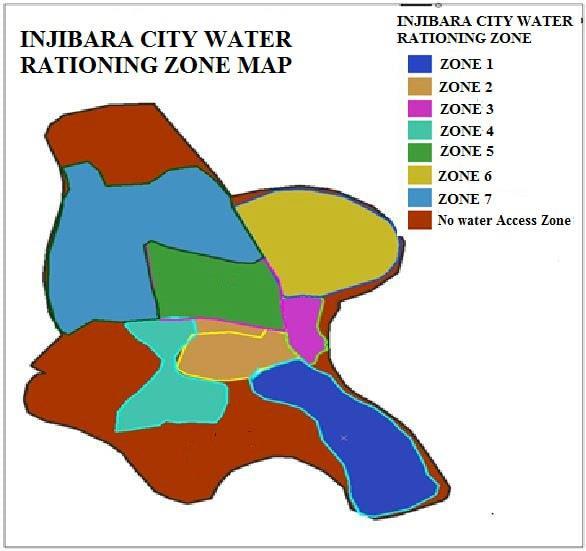
Pumpscan'toperatecontinuouslyduetowearandtear,and the water yield may not support such constant use. The original 42L/s production rate, calculated during system commissioning years ago, may have decreased due to climatechange.Asaresult,thetownisnowdividedinto7 zones,eachreceivingwateronceaweek.However,power outages can disrupt the schedule, causing some zones to misstheirallocatedquota
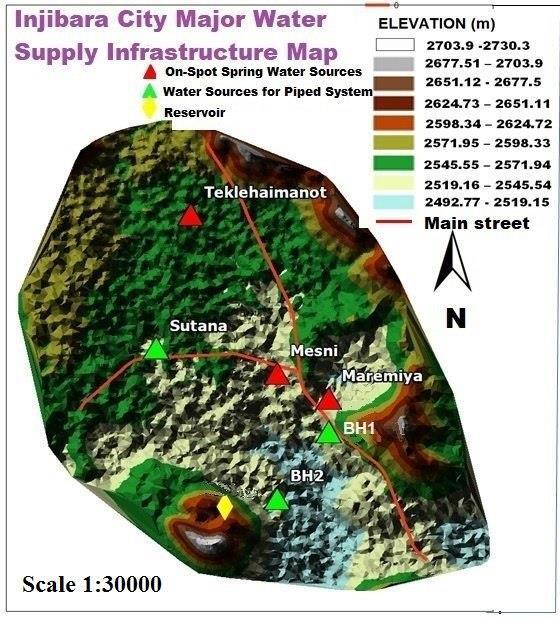
Figure2indicatesthemajorwaterinfrastructureofInjibara Townonanelevationmap.BH1andBH2arethetwoBore Holesand Sutana isthespringaltogetherproduces42L/s. ThewaterfromthesesourcesisdirectlypumpedtoRS1and 2thereservoirsontopofahill.Thenthewaterisdistributed bygravitythroughoutthetown.Thethreetrianglesinred color (Maremia, Mesni, and Teklehaimanot) indicatetheonspotspringsfromwherecommunitiesinthevicinityfetch water.Theyarecappedspringsflowingfreelythroughout,as shownin(Fig-2).
There are about 8029 active customers and 2 community watering points getting water service from the Injibara waterandseweroffice.Amongthem,90.17%aredomestic connectionsofresidentialhouses,asshownin(Table-1).
Source:InjibaraWaterandSewerOffice
Volume: 12 Issue: 02 | Feb 2025 www.irjet.net p-ISSN: 2395-0072
The performance of the water system was evaluated basicallyfromavailabilityaccessandequitypointofview. The current performance of water supply systems within the town reveals significant disparities in access, affordability, and equity, as evidenced by the survey findings.
The survey results highlight significant barriers to accessingwater,with91.74%ofrespondentscitingissues likethelackofwatermetersandotherinfrastructure.This reflects broader research showing that inadequate infrastructurehindersequitableaccess.Approximately95% of respondents felt that water connections or community wateringpointsintheirareaswereinsufficient,indicating majorgapsinthewatersupplysystem.Only4%reported having24/7wateraccess,pointingtoseveredisruptionsin supply.Discussionswithwaterandsewerofficialsrevealed thatthecity'swaterproductionisinsufficient,withaoneday-a-week rationing schedule that is struggling to keep pacewiththecity'sexpansion.Tomanagetheshortage,the townhasbeendividedinto7distributionzones,but28.7% ofthearealackspipedwaterentirely,andfrequentpower outagesfurtherdisruptthesystem,asshownin(Fig - 4).
The issue of water shortage is not only attributed to seasonal variation but also to shortage of production capacity and losses. The 2016/17 Ethiopian fiscal year (2023/24) monthly water production and loss data indicates the heavy loss of water from the meager production.
SepOctNovDecJanFebMarAprMayJunJulyAug
Source:InjibaraTownwaterandSeweroffice
Accordingtointerviewswiththewaterandseweroffice leaders, the main reasons for such a huge loss of scarce wateraremultifaceted.Thewaterloss inJulyapproached 60%asaresultofwinter-relatedmaintenancechallenges,as shownin(Fig-4).Thedeterioratinginfrastructureduringthis timeexacerbatestheconditionscausedbyburstpipes,which resemblearainflood. Theofficerhighlightedthattheaging infrastructure is a primary concern, particularly the extensive use of old metal pipes, which has resulted in frequent leaks throughout the system. The operational challenges posed by numerous gate valves, which are regularlyopenedandclosedduetoongoingwaterrationing measures, further exacerbate the issue, leading to substantialwaterwastage[16]
Aside from infrastructure deterioration, several factors contribute to this loss, including technical issues with the watermeters,unauthorizedusagethatbypassesmetering, andtheinstallationofnon-standardpipingsystems. The regionsofdevelopingcountriesareexperiencingevenhigher percentages of water loss [17]. Global water loss (WL) volumeisprojectedtobe126billioncubicmetersperyear, which is equivalent to around 39 billion USD in annual expenditures [18]. When comparing the water loss in Injibaratowntothatofothertownsandcountries,thereare significantvariations.Forinstance,theannualwaterlossin Injibara is 50%, compared to 37.4% in Muki Turi town (Oromia region, Ethiopia) [17], 18.2% in Ambo town (Ethiopia) [19], 36.42% in Akaki Kality (Addis Ababa, Ethiopia)[20],24.42%inPalestine[21],and18%inSACity in China [22]. The data shows that Injibara's water loss is higher than the other countries mentioned and the water loss in Injibara cities exceeds the World Bank's
International Research Journal of Engineering and Technology (IRJET) e-ISSN: 2395-0056
Volume: 12 Issue: 02 | Feb 2025 www.irjet.net p-ISSN: 2395-0072
recommendedallowablelimitof25%byasignificantmargin [1].
Additionally, while the average cost of water supply in Injibarais0.17USD/m³,inSAcityChinaitis0.16USD/m³. This discrepancy results in commercial losses of up to 47,887USDand857,143USDperyear,respectively.Thelow efficiencyofInjibara'swatersupplysystemhasasignificant impact, largely due to inadequate inspections, technical problemswithwatermeters,insufficientorcarelessrepairs ofthewatersupplyinfrastructure,improperwateruse,and alackofawareness,allofwhichexacerbatethewaterloss issue[23].
Themostbasicandintuitivelevel,wateraffordabilityis the ability to pay for water relative to one’s income[24] Waterfacilitiesandservicesshouldbeaccessibleatacost that is affordable for everyone [25]. The survey results concerningtheaffordabilityofwaterrevealthata notable 89% of participants either disagreed (47%) or strongly disagreed(42%)thatthecurrentwatertariffisfairfortheir families to pay. This suggests a general rejection of the pricingstructure,whichmayindicatethatthewatertariffs areperceivedasveryhighwithinthecontextofhousehold budgets,asshownintable(Table - 2).
Accordingtodiscussionswiththewaterandseweroffice leaders, both access and availability of water are pressing issuesofthewatersystem.Firstofall,theamountofwater producedisnotadequateevenforthosewhoarefurnished with the necessary infrastructure as it is a 1 day a weak phenomenon.Secondly,the smallamountofwaterlostby one-half due to leakage. In contrast to this, the city is expanding both vertically and horizontally outpacing the watersystemexpansion.Aninitialsteptowardprogressively realizing water rights could involve prioritizing efforts to enhancetheaffordabilityofwater[26]
Equitablewatersupplyensuresthatallusers,particularly thosefacingunequalaccess,havesufficientwater.Achieving thisrequireseffectivemanagement[27].Asubstantial89% of participants either agreed (56%) or strongly agreed (34%)thatspecificgroupsinthecommunity,suchaslowincome individuals, marginalized populations living in mountainous areas,andresidentsofsquattersettlements, face special difficulties in accessing water. Regarding fairness of distribution in all corners of the city, 80% of respondents indicated that there is a disparity in the equitabilityofwaterdistribution.Duringthekeyinformant discussions, group discussions, and leaders' interviews, it was confirmed that there is a problem with the equitable water supply [28]. Additionally, through my field observations, I noticed issues of inequity in water distribution,particularlyinmountainousareasandamong low-income individuals who lack access to piped water. Furthermore, the survey results indicated that 86% of respondents agreed with the statement that there is a differenceinwaterqualitybetweendifferentneighborhoods, suggesting a widespread acknowledgment of quality disparitiesamongdifferentlocalities.
4
Source:InjibaraWaterandSewerOffice
Lackofalternativesourcesofwaterotherthanpipedwater is evident as 89% of the respondents indicated no alternativesource.Thisfindingunderscoresarelianceonthe pipedwatersystem,whichisoftentheonlysourceofsafe drinking water in many neighborhoods in the town. Since thecostofbottledwaterishighforhouseholds,only10%of the respondents bought bottled water as an alternative source. When assessing the availability of trucked water supplyduringshortages,94%ofrespondentsrejectedthe notion that there is affordable and safe drinking water supplied by truck when there is a shortage in the piped system.
Sustainable Development Goal 6 (SDG 6) specifically, target 6.1 focuses on achieving universal and equitable accesstosafeandaffordabledrinkingwaterforallby2030. Achievingtheglobalgoalofwaterforallstilllagsfarbehind. Over750millionpeopleindevelopingcountrieslackaccess toreliablewatersources[29]
The global water community remains dedicated to ensuring the sustainable provision of water for everyone, despitepastinitiativesliketheWaterDecadeandtheMDGs fallingshortoffullyachievingtheirobjectives[30].Ethiopia has made some progress towards achieving SDG6.1, but challengesremainandstagnate.Only4%ofruraland38% urban were using safely managed drinking water [31]. At leastbasicdrinkingwaterservicesarestillchallengingand notontracktomeetSDG6.1attheendof2030.Also,access toaffordabledrinkingwaterandsanitationdevelopmentin Ethiopiaisbelowthesub-Saharanandtheworld[32].When compared to Ghana 72% of Ghana citizens have access to
International Research Journal of Engineering and Technology (IRJET) e-ISSN: 2395-0056
Volume: 12 Issue: 02 | Feb 2025 www.irjet.net p-ISSN: 2395-0072
cleanandaffordablewaterandcanachieveSDG6.1by2030 [33].Evenwithapopulationofover1.4billion,Chinafaces significantdifficultyinachievingthisgoal[34].
ThecurrentwatersupplysystemofInjibaraindicatesvery lowwaterproductionof25liter/capita/daywhichisbelow thestandard.Thewateravailabilityisaround1dayofabout 18hrperweek.Eventhisamountmaynotbeavailabledueto frequentpoweroutages.About28.2%ofthetownareahas noaccesstopipedwateratallanditisstillexpanding.The investmentinwaterinfrastructureismeagerandnoreliable donorisavailablefortheexpansionproject.Besides,thecost of imported materials is very high, and currently, the devaluation of the Ethiopian Birr against the USD poses a significant strain on infrastructure investment. The deterioration of the existing infrastructure is very high as leakageamountsto50%oftheproduction.SDG6.1wasset for2030andonly5years remain.Therefore,itisunlikely thatSDG6.1couldbeachievedinInjibaraifthingsaregoing atthecurrentpace.Aninterviewwiththewaterutilityoffice also indicated that SDG 6.1 cannot be achieved unless somethingextraordinaryhappens
3.2.
A substantial majority, 76%, agree that the tap water appears clear and colorless, indicating a favorable visual assessmentofitsquality[35].Watertasteperceptionsare notablymorecritical,with80%ofrespondentsreportinga salty or metallic flavor in the tap water. This can be supplemented by the chemical lab test of water which revealsthatthealkalinitylevelofthewaterwasbeyondthe allowable 200mg/L. Health-related issues associated with tap water consumption are also highlighted in the survey results, with 59% of individuals indicating they have experienceddiarrheaorstomachupsetafterdrinkingit.This notion is supported by the bacteriological test result indicatingallsourcesandwaterlinesampletestsindicated positive for total, fecal coliform, and E.coli which is unacceptablebyboththenationalaswellasWHOstandards.
Thehealthissueconcernofthewaterwascross-checked against the top 10 diseases in Injibara particularly waterbornediseaseincidenceinthetown. The“5-year”top 10diseasesfromInjibarahealthinstitutionsrevealthisfact, asshownin(Table-3).
Table - 3: InjibaraPublicHealthUnit2019-2023A5-Year Top10DiseasesPrevalenceData
Source: InjibaraPublicHealthUnit
Amongthe“5-year”top10diseasesinInjibara,4ofthem areinoneortheotherwayrelatedtowaterbornedisease: unspecifieddiarrhea,bacterialintestinalinfection,functional diarrhea,andtyphoidfever.Theytogetherconstituteabout 19,550(29%)ofthetop10diseasesinthelast“5-year”.The qualityofwaterandsanitationpracticesmighthavecaused thesediseaseincidences.
Inadditiontothis,thetop4waterbornediseasesindicate similarresults.Thedataonthetop4waterbornediseasesin Injibara(2019-2023)indicatesasimilartrendtothatofthe top10diseasedata,asshownin(Table-4).
Table - 4: “5-Year”Top4WaterborneDiseaseCasesin InjibaraHealthCenter(2019-2023)
Grand Total 17,637
Source: InjibaraHealthStationHealthStatisticsdepartment
To further reveal this, a water quality test has been conductedby the researcherthatincludesampleof water fromthewatersource,reservoir,andrandomhouseholdsin differentpartsofthetownandlow-pressureareas,asshown
International Research Journal of Engineering and Technology (IRJET) e-ISSN: 2395-0056
Volume: 12 Issue: 02 | Feb 2025 www.irjet.net p-ISSN: 2395-0072
in. The water quality test included the physical, Chemical, andmicrobiologicalparametersofthewaterquality.
3.2.1.
The physical water quality test conducted taste was conductedbytheInjibaratownwatersupplyserviceofficein thewetseason onSeptember17&18/2024,and the dry seasonon13/4/2024
Higher groundwater temperatures can dissolve more minerals from surrounding rocks, thereby increasing electricalconductivity.Temperaturealsoaffectsspatialand temporalvariations[36],dependingonfactorssuchaswater depth,climaticconditions,andtopographicdifferences.The idealtemperatureofwaterfordrinkingpurposesis(5-12) ℃, above 25℃ is not recommended for drinking because Water temperature directly affects microbial growth rate anddecayofdisinfectantresidualsinthedistributionsystem and this could lead to the development of an unpleasant taste and odors. The results showed that minimum and maximum values of temperature recorded in wet and dry seasonswererangedfrom19.9℃ (atTekelehaymanotonspot spring) to 23.1℃ (at K03 D8) in the wet season and 20.8℃ (at Tekelehaymanot on-spot spring) to 23.8℃ (at BH2)inthedryseasonrespectively,asshownin(Fig - 5). TheincrementvariationbetweenthesamplepointsK03D8 maybeduetotapwaterflowingoverlongdistances,which exposesittogroundtemperatureandsubsurfaceheatisland effect[37],whereasboreholewater,alsomaybeinfluenced by geothermal conditions or deep aquifers, can have significantlywarmertemperatures.Allwatersourcesinboth seasons were within permissible limits of Ethiopian and WHOwaterqualityguidelines. Itdoesnotaffectthegrowth ofmicroorganisms,whichcouldcausechangesintaste,odor, and color, and lead to corrosion issues. In general, the temperatureisambientandgoodforconsumersandsafeat <25℃fordrinkingwater,WHOpreferscooltowarmwater and for the specific desires of the quality of the water for different purposes. A similar study on temperature was conductedby[38]
The abbreviation indicated that: WHO; world health organization, EWQSA; Ethiopian water quality standard Agency,K0D9;Kebele03distribution9,Su;sutana,THOSS; Tekelehaymanot 0n-spot spring, MOSS; Mesne on- spot spring,MA;Maremiyaon-spotspring,R800;reservoir800, R200;reservoir200,BH1;Borehole1,BH2;Borehole2.
K03D9
K03D8
K03D7
K04D6
K04D5
K04D4
K01D3
LabresultofTemprature(0c),WHOandEWQSAvalue.
Fig - 5: LabResultofTemperature(℃)comparedwith WHOandEWQSA
3.2.1.2. Power of Hydrogen (pH. unit)
The pH of water is a crucial quality characteristic used to assess its acidity or alkalinity[39]. The minimum and maximum allowable pH range for portability is 6.5 – 8.5 WHO and Ethiopia are recommended limits [40, 41]. The recordedvaluesfromdifferentsamplesitesinwetanddry seasons ranged from 5.63 (at Reservoir 800) to 6.77 (at HB1)inthewetseasonand6.03(atReservoir800)to7.10 (atBH1)indryandwetrespectively,asshownin(Fig-6). ThesamplinglocationsofBH1hadthehighestpHvaluesin dryseason,whileReservoir800thelowestpHvaluesinwet season.ThepHofa reservoirisoftenlowerthanthatofa borehole due to high chlorine levels, which react to form hypochlorousacid(HOCl)andhydrochloricacid(HCl),both of which are acidic. In contrast, borehole water, being isolatedunderground,interactswithalkalinemineralsthat can raise its pH. Excessive chlorination disrupts water chemistry, leading to increased acidity and a more pronounced pH drop. Also, high acidity in the dry season occursduetoconcentratedpollutantsfromevaporationand reduceddilutionbyrain,increaseddecompositionoforganic matter releasing acidic compounds respectively [42] However, further investigation is required to identify the reasons why acidity is maximum in the dry season. AccordingtoitspHvalue,watercanbecategorizedashigh acidic(3-3.5),acidic(3.5-5.5),lowacidic(5.5-6.7),neutral (6.8-7.2),lowalkaline(7.2-8.5),oralkaline(>8.5).According tothisclassification,thepHlevelsofallsamplesourcewater werelowduetotheiracidiccharacter.
The abbreviation indicated that: WHO; world health organization, EWQSA; Ethiopian water quality standard Agency, K0 D9; Kebele03 distribution9, TOSS;
International Research Journal of Engineering and Technology (IRJET) e-ISSN: 2395-0056
Volume: 12 Issue: 02 | Feb 2025 www.irjet.net p-ISSN: 2395-0072
Tekelehaymanot 0n-spot spring, MOSS; Mesne on- spot spring, MAOSS; Maremiya on-spot spring, R800; reservoir 800,R200;reservoir200,BH1;Borehole1,BH2;Borehole2.
Tekelehaymanot 0n-spot spring, MOSS; Mesne on- spot spring,MA;Maremiyaon-spotspring,R800;reservoir800, R200;reservoir200,BH1;Borehole1,BH2;Borehole2.
K03D9
K03D8
K03D7
K04D6
K04D5
012345
LabresultofTurbidity((NTU),WHOandEWQSAvalues
Turbidity measures water clarity or the amount of suspendedparticlesinthewatersuchassoilparticles(sand, silt, and clay) [43]. Higher turbidity levels are associated with the presence of disease-causing bacteria. Although turbidity itself does not directly cause health issues, it is often an indicator of poor water quality or treatment failures. Additionally, high turbidity can hinder the effectivenessofchlorination,anditsvisualappearancemay beconsideredunacceptablebyconsumers[44].Basedonthe laboratory findings, values of minimum and maximum turbidityinallsourcesofwaterrecordedwereintherange of0.61atBH1to3.24atMaremiyaOn-spotspringduringthe wetseasonandminimumtomaximumturbidityrecordedin 0.01atKO4D4,K04D5K04D6to1.94atMaremiyaOn-spot springduringthedryseasonrespectivelyasshownin(Fig7).Averagevaluesofturbidityinallwatersourcesinboth seasons were within permissible limits of Ethiopian and WHOwaterqualityguidelines.ButMaremiyaOn-spotspring sources had relatively higher recorded turbidity than the other.Thisisbecauseon-spotspringsaregenerallyopento theelementsandmoreexposedtosurfacerunoff,whichcan carry soil, sediment, the intrusion of particles from municipal wastes and organic matter into the water, and inefficientwatertreatment[45].Highturbidityoftencarries pollutants like heavy metals and bacteria, exacerbating waterqualityissuesandharmingaquaticlifefurther.
The abbreviation indicated that: WHO; world health organization, EWQSA; Ethiopian water quality standard Agency,K0D9;Kebele03distribution9,Su;sutana,THOSS;
3.2.1.4. Electric conductivity (µS/cm)
EC denotes the conducting capacity of water which is an excellentindicatoroftotaldissolvedsolids(TDS)[35].Andit dependsupontheionicstrengthofthesolution.Fromthe resultobtainedinthisstudy,conductivityhadaminimumof 103.8 µS/cm (at Sutana Spring) and a maximum of 694 µS/cm(atBH2)inthewetseason.Whileduringdryseason minimum and maximum values of conductivity were 111 µS/cm (at Sutana Spring) and 614 µS/cm (at BH2) values analyzedrespectively.Bothduringthedryseasonandthe wet season, point BH2 recorded a high concentration of electricconductivity,asshownin(Fig-8).Thisvariationmay arisefromthegeologicalcharacteristicsandsoiltypesofthe studyarea.Inorganicsolids,naturallyoccurringinsoilsand rock formations, can contribute to higher electrical conductivity in water. However, all sample Values of conductivityarewithintheWHOpermissiblelimit.
The abbreviation indicated that: WHO; world health organization, K03 D9; Kebele03 distribution9, TSOSS; Tekelehaymanot 0n-spot spring, MOSS; Mesne on- spot spring, MAOSS; Maremiya on-spot spring, R800; reservoir 800,R200;reservoir200,BH1;Borehole1,BH2;Borehole2.
International Research Journal of Engineering and Technology (IRJET) e-ISSN: 2395-0056
Volume: 12 Issue: 02 | Feb 2025 www.irjet.net p-ISSN: 2395-0072
Drys Wets
K03D9
K03D8
K03D7
K04D6
K04D5
K04D4
K01D3
K01D2
LabresultofE.conductivity(µS/cm)andWHOvalues.
- 8: Electricconductivity(µS/cm)comparedwithWHO
3.2.1.5. Total Dissolved Solid (TDS) mg/L
Due to the presence of suspended solids, physical contaminantsaffectthephysicalappearanceofwater[46] TheincreasesinTDSandECincreasethecorrosivenatureof water,unacceptabletaste,andodoralthoughitindicatesthe existenceofdissolvedminerals.Itisdirectlyrelatedtothe qualityofwaterandaffectseverythingthatuseswater[47]
Inthepresentstudy,theminimumandmaximumofTDS recorded from different sampling sites ranged from 93.5 mg/lto557mg/Land67.5mg/Lto450.9mg/Linwetand dryseasonsrespectively,asshownin(Fig-9).TDScontentof 500mg/LwasrecommendedbyWHOasadesirableupper limit.
ThemaximumresultofTDSinthisstudyisBH2wasabove 500mg/L in wet seasons the variation may be due to prolonged underground contact with mineral-rich rocks, increasingdissolvedsolids.Thismaycauseanobjectionable tasteduringdrinking.Theminimumresultswerebelowthe desirablelimitsofWHOaswellasEthiopiandrinkingwater quality guidelines. Generally, this result of TDS is not harmfultohumanbeings,butahighconcentrationofthese mayaffectpersonswhoaresufferingfromkidneyandheart diseases[48].
The abbreviation indicated that: WHO; world health organization, EWQSA; Ethiopian water quality standard Agency, K03 D9; Kebele03 distribution9, TOSS; Tekelehaymanot 0n-spot spring, MOSS; Mesne on- spot spring, MAOSS; Maremiya on-spot spring, R800; reservoir 800,R200;reservoir200,BH1;Borehole1,BH2;Borehole2.
LabrsultofTDS((mg/L),WHOandEWQSAvalues.
3.2.2. The Chemical water quality test
Thefreechlorinetestresultsinallsamplingpointsexcept the inoculation points at the reservoirs were below the allowablelimitof0.5mg/Lasperthenationalaswellasthe WHO standards. That could be the probable cause of the positivecoliformtest in almostall samplingpoints except thereservoir800,reservoir200,andK04D4,K04D5,and K04 D6 sites. These sites have better chlorine levels than others and show zero coliforms in their tests because the sitesarelocatedonandnearchlorinationpoints.
ThetestresultsofKebele01,03,04,BH1,BH2,andreservoir 200 indicate greater than the national allowable value for total alkalinity of 200mg/L. Maybe this is due to factors likenaturalmineralcontent,groundwatercontamination,or impropertreatmentprocessesinthewatersupply[49].
Butfurtherinvestigationisneeded. Whenthealkalinityof drinkingwateristoohigh,thewatercanhaveasalty,sodalike,orchalkytaste,dryyourskin,orbeassociatedwiththe formationorcreationofachemicalscaleorprecipitatethat wouldclogpipingorformascaleonfiltersandotherheat exchangesystems.
Concerning the seasonal variation of the chemical water quality parameters, the CaCO3, NH3, NO₃⁻, and NH4+ concentrationsshowedareductionfromthewetseasonto thedryseasonwithverynegligibleexceptions.Duringthe wetseason,heavyrainfallcausessurfacerunoff,soilerosion, and agricultural leaching, introducing higher levels of minerals and nutrients like CaCO₃, Mn, NO₃⁻, NH₃, HCO₃⁻, NH₄⁺, and residual chlorine into water bodies. Increased organic decomposition, sediment mobilization, and
International Research Journal of Engineering and Technology (IRJET) e-ISSN: 2395-0056
Volume: 12 Issue: 02 | Feb 2025 www.irjet.net p-ISSN: 2395-0072
untreated discharges also contribute to the elevated concentrations.
Municipalwasteisalsoanothercause.However,allofthem arewithintheacceptablelimitaspertheEthiopianaswellas theWHOstandard.Ingeneral,thevariationinthechemical parametersbetweenthedryandthewetseasonwasvery limitedandnosuchsignificanteffecthasbeenobservedasa resultoftheseasonalchange.Wecanseedetailsin(Table5). No
Table - 5: Test Result of the Chemical Water Quality Parameters of Injibara Water supply system (Dry & Wet Seasons)
Theabbreviationindicatedthat:WHO;worldhealthorganization,EWQSA;EthiopianwaterqualitystandardAgency,K0D9;
Kebele03distribution9,Su;sutana,THOSS;Tekelehaymanot0n-spotspring,MOSS;Mesneon-spotspring,MA;Maremiyaonspotspring,R800;reservoir800,R200;reservoir200,BH1;Borehole1,BH2;Borehole2.
International Research Journal of Engineering and Technology (IRJET) e-ISSN: 2395-0056
Volume: 12 Issue: 02 | Feb 2025 www.irjet.net p-ISSN: 2395-0072
Themainparametersformicrobiologicalwaterqualityare three, the total coliform, the fecal coliform, and the E.coli colonyformingunitsper100ml.
The various bacterial species that make up total coliform bacteriaarefoundinsoil,vegetation,andhumanandanimal excrement.[50] Alltestsamplesexceptreservoirs800,200, K04D4,K04D5,andK04D6hadpositiveresultsfortotal coliform,fecalcoliform,andE.coli,whereastheWHOand national standard call for zero or forbid any detection of coliformsindrinkingwater[51] Itshowedthatineffective chlorinationandinadequatewatertreatmentleadtohigher levelsofTCandFCinthedistributionsystem[45] According tothestandard,drinkingwatershouldn'tincludeanyE.coli colony-forming units or total coliform. While the residual chlorine level in Kebele 03 is nil, the contamination level therewasdeterminedtobegreater.Incertainareasofthe samples, the residual chlorine was zero, meaning that the chlorine'sdisinfectingpowerhadalreadybeenusedupasit wasflowingthroughthepipenetwork.Localitieswithzero residual chlorine levels may experience bacterial development in their pipe water and consequently be susceptibletowaterborneillnessesuntilthechlorinedosage isincreased.
4. Conclusions and Recommendations
4.1. Conclusions
Access to water in Injibara is a major challenge, with water available only one day a week for 18 hours, and frequentpoweroutagesdisruptingthisschedule.Thetown providesjust25literspercapitaperday,whichisbelowthe nationalstandard.Thewatersupplyislimitedbyfactorslike insufficientwatersources,productionconstraints,leakage (up to 50%), and power outages, while the system's coverage is limited. Additionally, the high cost of water infrastructureinvestment,combinedwithminimalavailable resources, makes it difficult to achieve the SDG 6.1 goal. Affordabilityisalsoanissue,asresidentsstrugglewithhigh tariffs,whilethewaterofficelacksfundstoexpandservices.
About28.7%ofthecitylackspipedwater,anddemandfor newconnectionsishigh.Areasinhigheraltitudesandslums experience low pressure and poor water quality, with no residualchlorine,increasingtheriskofwaterbornediseases.
The town’s water quality has significant chemical and microbiologicalissues,withtestsshowingcontaminationby fecal coliforms, E. coli, and no residual chlorine in some areas.Thisposesapublichealthrisk,reflectedinthehigh incidenceofwaterbornediseasessuchasdiarrhea,intestinal infections, and typhoid fever, which together account for 29%ofthetop10diseasesinthepastfiveyears.
4.2. Recommendations
ToimproveInjibara'swatersupplysystems,investments, andcommunityinvolvementarecrucial.Keyactionsinclude
expanding networks to underserved areas, building reservoirs, fixing leaks, upgrading infrastructure, and enhancingwaterquality.Alternativewatersources,suchas groundwater extraction and new spring development, should be explored. Geographic disparities and financial barriersshouldbeaddressedtoensureequitablesolutions. Improving water quality in low-pressure areas requires repairing old pipes and introducing chlorine to combat health risks. Policy interventions should prioritize infrastructure upgrades, equitable access, and community participation.
I would like to express my deepest gratitude to my supervisor, Professor Hongtao Wang, for his continuous support,guidance,andinvaluablefeedbackthroughoutthis study. My sincere thanks also go to Professor Nui Dongjie andProfessorJingZhangfortheirunwaveringassistance.I am grateful to the IESD staff at Tongji University for their technicalsupport.
Special thanks to my friends, Menbere Asmare and LakachewAbitew,forhelpingeditthemanuscript,andtothe Water and Sewerage Service staff of Injibara Town particularlyMr.Zelalem,Mr.Andualem,Mr.Haymanote,and myfriendBekaluFered fortheiressentialsupportduring datacollectionandlabtests.Finally,IthankGodforallthe blessingsandguidancethroughoutthisjourney.
Reference
[1] B. A. Beker and M. L. Kansal, "Complexities of the urban drinking water systems in Ethiopia and possible interventions for sustainability," Environ Dev Sustain, pp. 1-31, Jan 5 2023, doi: 10.1007/s10668-022-02901-7.
[2] M.G.Uddin,S.Nash,andA.I.Olbert,"Areviewof water quality index models and their use for assessing surface water quality," Ecological Indicators, vol. 122, 2021, doi: 10.1016/j.ecolind.2020.107218.
[3] P.TeymouriandR.Dehghanzadeh,"Effectofvirtual water trade on freshwater pollution in trading partners: a systematic literature review," Environmental Science and Pollution Research, vol. 28, pp. 1-17, 11/01 2021, doi: 10.1007/s11356021-16434-5.
[4] T. Abraha, A. Tibebu, and G. Ephrem, "Rapid Urbanization and the Growing Water Risk Challenges in Ethiopia: The Need for Water SensitiveThinking," FrontiersinWater, vol.4,2022, doi:10.3389/frwa.2022.890229.
[5] Z.A.AlemuandM.O.Dioha,"Modelingscenariosfor sustainable water supply and demand in Addis
International Research Journal of Engineering and Technology (IRJET) e-ISSN: 2395-0056
Volume: 12 Issue: 02 | Feb 2025 www.irjet.net p-ISSN: 2395-0072
Ababa city, Ethiopia," Environ Syst Res, vol. 9, 2020//2020,doi:10.1186/s40068-020-00168-3.
[6] Z. A. Alemu, K. T. Teklu, T. A. Alemayehu, K. H. Balcha, and S. D. Mengesha, "Physicochemical qualityofdrinkingwatersourcesinEthiopiaandits health impact: a retrospective study," Environmental Systems Research, vol. 4, pp. 1-8, 2015.
[7] B. D. Kitessa, S. M. Ayalew, G. S. Gebrie, and S. T. Teferi, "Assessing the supply for a basic urban service demand-with a focus on water-energy managementinAddisAbabacity," PLoSOne, vol.16, no. 9, p. e0249643, 2021, doi: 10.1371/journal.pone.0249643.
[8] B. G. Tikuye, R. L. Ray, K. Gebeyehu, and M. Teshome,"Assessingtheinfluenceoflanduse/land cover dynamics and climate change on water resourcesinUpperBlueNile,Ethiopia," Journal of Water and Climate Change, vol.15,no.9,pp.47454774,2024,doi:10.2166/wcc.2024.319.
[9] "OptimizationofWaterDistributionSystemUsing WaterGEMS: The Case of Wukro Town, Ethiopia," Civil and Environmental Research, 2020, doi: 10.7176/cer/12-6-01.
[10] S. Nayak, "Non-Revenue Water (NRW)," 05/29 2024.
[11] S. M. Kayaga, W. Kingdom, and A. Jalakam, "Organisationaldesignforimprovedperformanceof urban water utilities in developing countries," Utilities Policy, vol. 50, pp. 49-59, 2018/02/01/ 2018, doi: https://doi.org/10.1016/j.jup.2017.10.001
[12] A. Tekile and Y. Legesse, "Overall performance evaluationofanurbanwatersupplysystem:acase studyofDebreTaborTowninEthiopia," Journal of Water,SanitationandHygieneforDevelopment, vol. 13,03/232023,doi:10.2166/washdev.2023.157.
[13] "Challenges of Domestic Water Supply in Injibara Town,Ethiopia," Civil and Environmental Research, 2020,doi:10.7176/cer/12-3-05.
[14] N.AmsaluWorkineh,E.TarkoKassa,andD.Dagnaw Bogale, "Factors affecting residential land market value: a case study of Injibara Town, Ethiopia," International Journal of Construction Management, vol.25,no.2,pp.215-223,2025/01/252025,doi: 10.1080/15623599.2024.2313813.
[15] "<Population-Size-of-Towns-by-Sex-as-of-July-2023 (1).pdf>."
[16] S. Jerusalem Water Undertaking, V. Wakileh, O. Abuhalaweh, and Z. Mimi, "Evaluation of water losses in distribution networks: Rammallah as a casestudy," WaterSupply, vol.4,no.3,pp.183-195, 2004,doi:10.2166/ws.2004.0053.
[17] S. A. Negese and H. H. Kebede, "Performance evaluation of water supply distribution system: a case study of Muke Turi town, Oromia region, Ethiopia," Water Practice & Technology, vol.18,no. 10, pp. 2211-2222, 2023, doi: 10.2166/wpt.2023.150.
[18] T.Al-Washali,S.Sharma,R.Lupoja,F.Al-Nozaily,M. Haidera, and M. Kennedy, "Assessment of water losses in distribution networks: Methods, applications, uncertainties, and implications in intermittent supply," Resources, Conservation and Recycling, vol. 152, 2020, doi: 10.1016/j.resconrec.2019.104515.
[19] S. K. Bhagat et al., "Evaluating Physical and Fiscal Water Leakage in Water Distribution System," Water, vol. 11, no. 10, 2019, doi: 10.3390/w11102091.
[20] "<WaterSupplyCoverageandWaterLossesinthe DistributionSystem.pdf>."
[21] Z. Mimi, O. Abuhalaweh, V. Wakileh, and J. W. U. Staff, "Evaluation of water losses in distribution networks: Rammallah as a case study," Water Science & Technology: Water Supply, vol.4,pp.183195,2004.
[22] K.-l. 信昆仑,F.Li,T.Tao,N.Xiang,andZ.Yin,"Water losses investigation and evaluation in water distributionsystem–thecaseofSAcityinChina," Urban Water Journal, vol. 12, 07/01 2015, doi: 10.1080/1573062X.2014.916313.
[23] M. R. N. Vilanova, P. Magalhães Filho, and J. A. P. Balestieri, "Performance measurement and indicators for water supply management: Review andinternationalcases," RenewableandSustainable Energy Reviews, vol. 43, pp. 1-12, 2015/03/01/ 2015, doi: https://doi.org/10.1016/j.rser.2014.11.043
[24] R. Martínez-Espiñeira and M. Pérez-Urdiales, "Water affordability challenges in Latin America andtheCaribbean:Accountingforcopingcostsdue to reliance on multiple, non-exclusive sources," World Development, vol. 186, p. 106825, 2025/02/01/ 2025, doi: https://doi.org/10.1016/j.worlddev.2024.106825.
International Research Journal of Engineering and Technology (IRJET) e-ISSN: 2395-0056
Volume: 12 Issue: 02 | Feb 2025 www.irjet.net p-ISSN: 2395-0072
[25] A. Pérez-Foguet, "Broadening the water affordabilityapproachtomonitorthehumanright towater," Cities, vol.143,p.104573,2023/12/01/ 2023, doi: https://doi.org/10.1016/j.cities.2023.104573
[26] A. Pérez-Foguet, "Broadening the water affordabilityapproachtomonitorthehumanright to water," Cities, vol. 143, 2023, doi: 10.1016/j.cities.2023.104573.
[27] B.Etikala,S.Madhav,andS.G.Somagouni,"Urban watersystems:Anoverview,"in UrbanWaterCrisis and Management - Strategies for Sustainable Development,(CurrentDirectionsinWaterScarcity Research,2022,pp.1-19.
[28] S.DickinandS.Gabrielsson,"Inequalitiesinwater, sanitation and hygiene: Challenges and opportunities for measurement and monitoring," Water Security, vol. 20, p. 100143, 2023/12/01/ 2023, doi: https://doi.org/10.1016/j.wasec.2023.100143
[29] G. K. Wainaina and H. Barbosa, "Revisiting the self‐supply model: A foundational, not a complimentary model for water supply in rural households," World Water Policy, vol.10,no.4,pp. 1162-1169,2024,doi:10.1002/wwp2.12222.
[30] E. A. Adams, D. Sambu, and S. L. Smiley, "Urban watersupplyinSub-SaharanAfrica:historicaland emergingpoliciesandinstitutionalarrangements," International Journal of Water Resources Development, vol.35,no.2,pp.240-263,2018,doi: 10.1080/07900627.2017.1423282.
[31] "<water_and_sanitation_sdg_6_and_its_inter linkages_with_sdgs_under_review_by_hlpf_2019_case_study_of_ethiopia__fikrealem_alemu_and_stephen_maxwell_donkor_an d_yodit_balcha(1).pdf>."
[32] D. Baye, "Sustainable Development Goals (SDG) Target 6.2 in Ethiopia: Challenges and Opportunities," OALib, vol. 08, no. 05, pp. 1-28, 2021,doi:10.4236/oalib.1107458.
[33] V.M.Hagan,M.Mohammadnezhad,B.Nwankwo,E. B.Barasa,andC.Garatsa,"Asystematicreviewon water accessibility and safety in Ghana: The plausibility to achieve Sustainable Development Goal6.1by2030," AfricanJournalofHealthSciences, vol. 36, no. 1, pp. 42-52, 2023, doi: 10.4314/ajhs.v36i1.6.
[34] Y.Zhang etal.,"Drinkingwatersafetyimprovement and future challenge of lakes and reservoirs," Science Bulletin, vol. 69, no. 22, pp. 3558-3570, 2024/11/30/ 2024, doi: https://doi.org/10.1016/j.scib.2024.06.018
[35] Y.MerideandB.Ayenew,"Drinkingwaterquality assessment and its effects on residents health in Wondo genet campus, Ethiopia," Environmental Systems Research, vol. 5, no. 1, 2016, doi: 10.1186/s40068-016-0053-6.
[36] E. Ashley Steel, C. Sowder, and E. E. Peterson, "Spatial and Temporal Variation of Water Temperature Regimes on the Snoqualmie River Network," JAWRA Journal of the American Water Resources Association, vol. 52, no. 3, pp. 769-787, 2016,doi:10.1111/1752-1688.12423.
[37] C. Agudelo-Vera et al., "Drinking Water Temperature around the Globe: Understanding, Policies,ChallengesandOpportunities," Water, vol. 12,no.4,2020,doi:10.3390/w12041049.
[38] M. Yasin, T. Ketema, and K. Bacha, "Physicochemical and bacteriological quality of drinking waterofdifferentsources,Jimmazone,Southwest Ethiopia," BMC Res Notes, vol.8,p.541,Oct52015, doi:10.1186/s13104-015-1376-5.
[39] S. Gobiraj, S. Kuganathan, and B. E. Grøsvik, "Physico-chemical properties as a tool for monitoringmarinewaterqualityinselectedcoastal beachesofNorthernSriLanka," VavuniyaJournalof Science, vol. 1, no. 1, pp. 16-25, 2022, doi: 10.4038/vjs.v1i1.3.
[40] A.AyaliewWerkneh,"Physico-ChemicalAnalysisof Drinking Water Quality at Jigjiga City, Ethiopia," AmericanJournalofEnvironmentalProtection, vol.4, no.1,2015,doi:10.11648/j.ajep.20150401.14.
[41] F.B.Asghari,M.Pakdel,A.A.Mohammadi,andM. Yousefi, "Spatial and temporal variation of physicochemicalandmicrobialqualityofdrinking waterforthedistributionnetworkinMaku,Iran," DesalinationandWaterTreatment, vol.142,pp.8289,2019,doi:10.5004/dwt.2019.23365.
[42] B.K.Dessie etal.,"Anintegratedapproachforwater qualityassessmentinAfricancatchmentsbasedon physico-chemical and biological indicators," Sci TotalEnviron, vol.908,p.168326,Jan152024,doi: 10.1016/j.scitotenv.2023.168326.
[43] B. Va, M. Kumar, C. K. Saxena, and A. Gupta, "PredictingTotalSuspendedSolidsfromTurbidity fordifferenttypesofSoilParticles," Acta Scientific
2025, IRJET | Impact Factor value: 8.315 | ISO 9001:2008 Certified Journal | Page537
International Research Journal of Engineering and Technology (IRJET) e-ISSN: 2395-0056
Volume: 12 Issue: 02 | Feb 2025 www.irjet.net p-ISSN: 2395-0072
Agriculture, pp. 30-39, 2023, doi: 10.31080/asag.2023.07.1323.
[44] M.B.AlSawaf,K.Kawanisi,andM.Bahreinimotlagh, "Examining the Relationship between Rainfall, Runoff, and Turbidity during the Rainy Season in WesternJapan," GeoHazards, vol.5,no.1,pp.176191,2024,doi:10.3390/geohazards5010009.
[45] T. Sisay, A. Beyene, and E. Alemayehu, "Spatiotemporal variability of drinking water quality and the associated health risks in southwestern towns of Ethiopia," Environ Monit Assess, vol. 189, no. 11, p. 569, Oct 18 2017, doi: 10.1007/s10661-017-6277-8.
[46] A.Shah,A.Arjunan,A.Baroutaji,andJ.Zakharova, "A review of physicochemical and biological contaminantsindrinkingwaterandtheirimpacts onhumanhealth," Water Science and Engineering, vol.16,no.4,pp.333-344,2023/12/01/2023,doi: https://doi.org/10.1016/j.wse.2023.04.003
[47] D.shukla,"“PhysicochemicalAnalysisofWaterfrom VariousSourcesandTheirComparativeStudies”," IOSR Journal Of Environmental Science, Toxicology And Food Technology, vol.5,no.3,pp.89-92,2013, doi:10.9790/2402-0538992.
[48] G. D. Rani et al., "Assessment of Ground Water Quality and its Impact in and around Mangalam near Tirupathi, Andhra Pradesh, India," Current World Environment, vol. 6, pp. 191-193, 11/30 2011,doi:10.12944/CWE.6.1.30.
[49] K. Karume et al., "Hydrological Systems in the GreaterVirungaLandscape:WaterQualityaround Mikeno Sector," Journal of Water Resource and Protection, vol.08,no.03,pp.382-396,2016,doi: 10.4236/jwarp.2016.83032.
[50] A.AtumoAnte,G.AsefaBogale,andB.Mohammed Adem,"Bacteriologicalandphysicochemicalquality of drinking water and associated risk factors in Ethiopia," Cogent Food & Agriculture, vol. 9, no. 1, 2023,doi:10.1080/23311932.2023.2219473.
[51] B. Sitotaw, E. Melkie, and D. Temesgen, "Bacteriological and Physicochemical Quality of Drinking Water in Wegeda Town, Northwest Ethiopia," J Environ Public Health, vol. 2021, p. 6646269,2021,doi:10.1155/2021/6646269.