
International Research Journal of Engineering and Technology (IRJET) e-ISSN: 2395-0056
Volume: 13 Issue: 05 | May 2026 www.irjet.net p-ISSN: 2395-0072
ENHANCING URBAN PARKING EFFICIENCY THROUGH MACHINE LEARNING MODEL INTEGRATION
C.Nanda
Kumar Reddy 1 , Naga Sravani 2
1student, Mca 2nd Year Kmmips, Tirupati, Affiliated To S.V. University, Tirupati, A.P, India
2 Associate Professor, Dept Of Mca, Kmmips, Tirupati, AffiliatedTo S.V. University, Tirupati, A.P, India
ABSTRACT - An increase in vehicular traffic and a scarcity of parking spaces are creating significant challenges for urban parking management. This study aims to tackle these issues that escalate congestion and pollution and decrease urban productivity, by utilizing machine learning models to accurately predict parking space availability and categorize occupancylevels.
Key Words: Parking management, predictive modelling, random forest model, decision tree, support vector machine, linear regression
I. INTRODUCTION
It is becoming progressively difficult to manage parking in urban settings due to the ever-increasing number of vehicles on the road and the constrained availability of parking spaces. Vehicle ownership has surged with economic growth and urban expansion, intensifying the imbalancebetweentheavailabilityanddemandforparking Drivers typically spend from 3.5 to 14 minutes looking for parking spaces, depending on location and time, which induces stress and delays, increases pollution, and wastes fuel Reducing the amount of time spent searching for parking spots can diminish the circulation of vehicles in parking lots, thereby lowering traffic congestion and noise pollutionaroundthe entrances.Theinefficiencyinparking searches stems from the absence of real-time information onspaceavailability.Providingdriverswithaccesstorealtime parking maps that reveal available spaces via their vehicle’s navigation systems would not only benefit drivers but also aid parking facility operators and urban planners in managing their space more effectively, based onanticipateddemand.Inthepast,methodsforpredicting parking space occupancy were primarily based on static guidelinesandheuristicapproaches,whichlackedaccuracy andflexibility.Thesemethodstypicallydependedondirect observation, a near row scope of past data, or elementary statistical techniques, which are not adequate for the intricate nature of city parking dynamics. However, the emergence advanced technologies for data collection, the accessibility to wide-ranging parking data sets, and the incorporation of machine learning into these processes have marked a significant move towards approaches cantered around data. According to and, this shift has profound implications. Integrating machine learning into parking management has significantly improved the
accuracy of forecasting parking demand, maximized the efficiencyofspaceusage,andprovidedmotorists with rely able information. This, in turn, reduces traffic congestion, enhances the satisfaction of the users, and boosts the overalloperationalefficacy.
1.1. BENEFITS OF PARKING AVAILABILITY PREDICTION MODELS
Research indicates that the availability of parking spaces significantly influences drivers’ decisions regarding where to park, and a lack of information about available parking can lead to increased time spent searching, cruising, and queuing, which is also costly. For example, in the US, drivers annually spend about 17 hours searching for parking,incurringacostofaround$345perperson;inthe U.K. and Germany, these figures are even higher. Conversely, drivers who have access to information on parking availability are less frustrated and are 45% more likely to make effective parking decisions which reduces traffic and energy consumption and enhances transportation management Intelligent parking management systems and related research have shown thatprovidingparkingavailabilityinformationenrichesthe customer’s experience and enables online parking reservations.AnexampleisSFpark,whichwasinitiatedin San Francisco in April 2011 and effectively manages onand off-street parking availability, using intel legend parking meters that adjust pricing based on factors like location, time, and day and aim to keep about 15% of spaces vacant on each city block. The system is equipped withsensorsthattrackspaceavailabilityandallowusersto view prices via SFpark.org and mobile apps. Spark has shown notable results: a 4% reduction in metered parking rates and 12% in city garages, a 43% decrease in time spent searching for parking, and a 30% reduction in daily vehicle miles travelled, leading to safer streets, less con gestion, and reduced neighbourhood pollution. Additionally, Spark has positively impacted local businesses, which have experienced a more than 35% increaseinsalestaxrevenuecomparedtolessthan20%in other city areas. Spark’s achievements underscore the potential of predicting parking occupancy to tackle urban congestion and promote a more efficient, sustainable transportation system. Its use of sophism dictated technologytopredictparkingavailabilityandadjustprices
International
Volume: 13 Issue: 05 | May 2026 www.irjet.net p-ISSN: 2395-0072
has effectively diminished congestion and enhanced the user’sexperience.
1.2. PROBLEM STATEMENT AND OBJECTIVE
While existing literature extensively explores the application of machine learning models in urban parking management, Current studies primarily focus on the technical aspects of model accuracy and efficiency, but oftenoverlookthepracticecallintegrationofthesemodels intoreal-worldurbanparkingsystems.Inaddition,thereis a lack of research on the adaptability of the models to dynamicurbanenvironments,whereparkingdemandsand patterns can vary significantly due to a variety of factors. This study aims to address these shortcomings by developinganintelligentmodelthatcanaccuratelyforecast parking availability and examining the operational integrationandadaptability ofmachinelearningmodels in diverseurbanscenarios.Itseekstobridgethegapbetween theoretical model accuracy and practical applicable ity, ensuring that the developed solutions are robust, scalable, and directly beneficial to urban parking management sys teems. The objectives of the study are to: assess and compare machine learning models that can precisely predicttheavailabilityofurbanparkingspaces,investigate the dual functionality of the chosen model in providing both spa cificpredictions and categorical insights for realtime parking management, and analyse the factors that affect parking demand and behaviour. The findings from this study are of tangible relevance to the operations of parking management systems in urban environments, offering assistance in the development of effective and enduring parking strategies it fails to comprehensively investigateandpromoteunderstandingofthefullspectrum of urban parking challenges. Of machine learning in urban parking solutions, as highlighted by , reflects a growing trend towards the adoption of data-driven strategies in urban planning. Table 1 presents a summary of the literature on this subject. The consistent effectiveness of random forest and decision trees in predicting parking availability and occupancy is a notable trend in the literature.Worksby,andandothershaveshownthatthese modelsoutperformothersintermsofaccuracy,precision, and F1-score, indicating their reliability for urban parking management systems. Decision trees are noted for their computationalEfficogencyinrapidprocessing,whichisan important attribute or real-time parking management applications as highlighted in the study by and makes the impractical choice for optimizing urban parking. Comparing the performance of various models suggests that the efficacy of a particular model can be contextspecific and influenced by factors such as the type of parkingandscaleofdata.Studiesbyandindicatevariations in model performance based on these parameters and emphasize the need for a tailored approach to model selection and implementation that considers the specific characteristicsoftheparkingenvironment.
2. LITERATURE REVIEW
The complexity of urban environments has escalated the need for sophisticated parking management solutions, and a sig indicant body of research has addressed this urban challenge by focusing on the application of machine learning models. Studies such as those by and have been instrumental in exploring the effectiveness of various machine learning algorithms in the context of urban parking, and the integration of machine learning in urban parking solutions, as highlighted by , reflects a growing trend towards the adoption of data-driven strategies in urban planning. Table 1 presents a summary of the literature on this subject. The consistent effectiveness of random forest and decision trees in predicting parking availability and occupancy is a notable trend in the literature.Worksbyand andothershaveshownthatthese modelsoutperformothersintermsofaccuracy,precision, and F1-score, indicating their reliability for urban parking management systems. Decision trees are noted for their computational Effi Cincy in rapid processing, which is an important attribute for real-time parking management applications,ashighlightedinthestudybyandmakesthem apracticalchoiceforoptimizingurbanparking.Comparing the performance of various model suggest state efficacy particular model can be context-specific and influenced by factorssuchasthetypeofparkingandscaleofdata.Studies by and indicate variations in model performance based on these parameters and emphasize the need for a tailored approach to model selection and implementation that considers the specific characteristics of the parking environment.
3. METHODOLOGY
The methodology depicted in figure1 is a structured approach to conducting research on machine learning models for parking prediction. The research methodology began with performing a literature review, in which keywords related to parking predictions and machine learning were identified. Appropriate databases were then searchedforscholarlyarticlass,withafocusonpublication quality and peer-reviewed status. Articles that focused on machine learning modelling techniques for parking predictionwereincluded, whileotherswereexcluded. The last step of the literature review was a content analysis of the selected models. The next step was to collect data and select the variables for development of the machine learning models. Data pro cessing was conducted to prepare the data, then was used to develop two types of models:classifiersandregressors.Evaluationmetricswere used to assess the models’ perform mince, and the results obtained, and conclusions drawn from the model developmentphasewerediscussed
Volume: 13 Issue: 05 | May 2026 www.irjet.net p-ISSN: 2395-0072
3.1. DATA COLLECTION
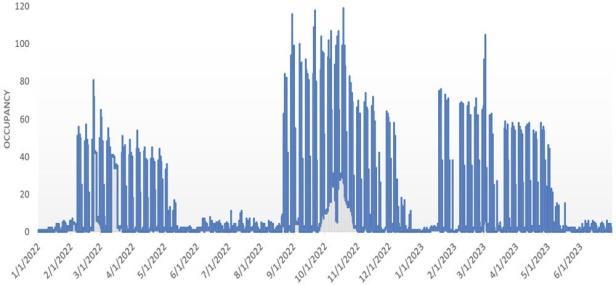
The dataset consisted of 13,104 entries that encompassed the date and hourly occupancy data from January 2022 through June 2023; the hourly occupancy percentages are depicted in figure 2. For assessing previous occupancy levels, a ret respective analysis method was utilized, incorporating a range of inputs that provided the model with information on occupancy rates from an hour before predictionsweremade.
3.2. VARIABLE SELECTIONS
Key features such as the day of the week, time of day, and contextual factors like academic semesters, holidays, and special eventswere chosen for their potential influence on parking occupancy. Figure 3 illustrates the occupancy variations according to these selected variables. The selected features, including the day of the week, time of day,academicsemesters,holidays,andspecialevents,were chosen based on their demonstrated influence on parking occupancy patterns in the specific context of college campus parking. For instance, the day of the week was deemed crucial due to its significant impact on park Ing demand, with weekdays experiencing higher occupancy levels than weekends, driven by class schedules and staff activity. Similarly, the time of day emerged as a key predictor, reflecting temporal variations in parking demand throughout the day, with notable differences observed between peak commuting hours and off-peak periods. Academic semesters were included to capture seasonal variations in parking pat terns, with distinct occupancy levels observed during fall, spring, and summer terms. e.g., occupancy during summer semesters is generally lower than during the fall and spring semesters. Additionally, holidays and special events were incorporated to account for transient disruptions in park ingdemand,ensuringthemodelscanadapttoanomalous.
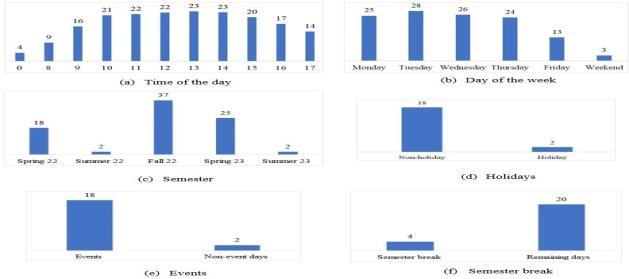
FIGURE 2.Variationsinaveragehourlyoccupancy fluctuations and produce accurate predictions. The study also accounted for semester breaks, as parking occupancy duringtheseperiodsisusuallylowerduetotheabsenceof classes and fewer students on campus. Additionally, the analysisincludedsignificanteventssuchasexams,popular sports events, and concerts, recognizing that these events cancausenotablefluctuationsinstandardparkingpatterns thatoftenresultinoccupancysurges.Overall,thechoiceof features was guided by empirical evidence and domain expertise, aimingto capture the muleticketeddynamicsof parking occupancy and enhance the models’ predictive accuracyandrobustness.
3.3. DATA PREPROCESSING
This study analysed hourly occupancy data, both as a con tenuous and as a categorical variable. The data was classified into three categories (low, medium, and high), acetonitrile distributions, with specific thresholds defined for each group to enhance clarity and improve prediction accuracy. The anal lysis primarily focused on the typical hoursofacollege’soperation,whichisfrom8amto5pm, and data outside these hours were averaged and aligned with the 0-hour mark. This approach was adopted to finetune the analysis by emphasis Ing the most pertinent timeframes. The data for Saturdays and Sundays were combined and treated as a single ‘‘weekend’’ category, simplifying the analysis and acknowledging the different parkingpatternsthataregenerallyseenonthesedays.
3.4. PREDICTION METHODS
Fourmodelswerechosenascontendersforthemodelthat most accurately predicts parking space occupancy at collegecampus:randomforest,SVM,linearregression,and Deci Sion trees. All four possess superior predictive abilities, but the random forest model is particularly distinguished for its robust management of complex variable interrelations and its effectiveness in reducing overfitting, a frequent issue in prediction models. The decisiontreemodeldemonstratesstraightforwardnessand easy interpretability and offers a clear decision-making path based on input features, which makes making it user friendly for non-technical stakeholders and ideal in
International
Volume: 13 Issue: 05 | May 2026 www.irjet.net p-ISSN: 2395-0072
situations where it’s important to understand how the model arrives at decisions. Linear regression is valued for the uncomplicated manner in which it models linear relationships between variables and outcomes, proving effectivewhenthelinearmodelassumptionholdstrue.Itis also simple to use and understand, making it suitable for initialanalysisorlinearlyrelateddata.SVMisknownforits superior handling of nonlinear relationships and is essential in complex situations like parking occupancy forecasts. Its ability to navigate nonlinearity makes it a viable option for intricate predictor-target relations. Table 2 presents a sum Mary of the parameters utilized for each model, along with the values obtained through optimization for each parameter. Python libraries were employed to operationalize these models. To better address the time-sequential characteristics of the dataset, akin to time series data, we implemented k fold cross validation with k = 10 folds. This method not only maintains the temporal sequence of the data during training but also allows for a more comprehensive assessment across different segments of the dataset. By partitioning the dataset sequentially into 10 folds, we ensure that each validation set consists of data points that immediately follow their core sponging training set, preservingthechronologicalintegrityandavoidingleakage of future information. This approach is critical for evaluating the models’ ability to adapt and respond to cyclicalpatterns,providingarebrutalisationofpredictive.
4. PROPOSED HYBRID ALGORITHM
In the proposed methodology which is a structured approach to conducting research on machine learning models for parking prediction. The research methodology began with performing a literature review, in which keywords related to parking predictions and machine learning were identified. Appropriate databases were then searched for scholarly articles, with a focus on publication quality and peer-reviewed status. Articles that focused on machine learning modelling techniques for parking predictionwereincluded, whileotherswereexcluded. The last step of the literature review was a content analysis of the selected models. The next step was to collect data and select the variables for development of the machine learningmodels.Dataprocessingwasconductedtoprepare the data, then was used to develop two types of models: classifiersandrepressors.Evaluationmetricswereusedto assess the models’ performance, and the results obtained, andconclusionsdrawnfromthemodeldevelopmentphase werediscussed.
Fourmodelswerechosenascontendersforthemodel that most accurately predicts parking space occupancy at a college campus: random forest, SVM, linear regression, and decision trees. All four possess superior predictive abilities, but the random forest
model is particularly distinguished for its robust management of complex variable interrelations and its effectiveness in reducing over fitting, a frequent issue in prediction models. The decision tree model demonstrates straightforwardness and easy interpretability and offers a clear decision-making path based on input features, which makes making it user friendly for non-technical stakeholders and ideal in situations where it’s important to understand how the model arrives at decisions. Linear regression is valued for the uncomplicated manner in which it models linear relationships between variables and outcomes, proving effectivewhenthelinearmodelassumptionholdstrue.Itis also simple to use and understand, making it suitable for initialanalysisorlinearlyrelateddata.
5. RESULTS & ANALYSIS
The comparative analysis of the random forest, decision tree, linear regression, and SVR models highlighted each model’s specific advantages and limitations in forecasting parkingspaceavailabilityinacollegecampusgarage.
5.1REGRESSION ANALYSIS
An analysis of the machine learning models that used hourly occupancy as a continuous variable revealed the differ encase in the performance and suitability of each model. Figure 4 presents the average R2 score, MAE and RMSE across all folds in the cross-validation of the models beforepre-processingthehourlyoccupancy
3. Resultsofpredictionmodels
Volume: 13 Issue: 05 | May 2026 www.irjet.net p-ISSN: 2395-0072
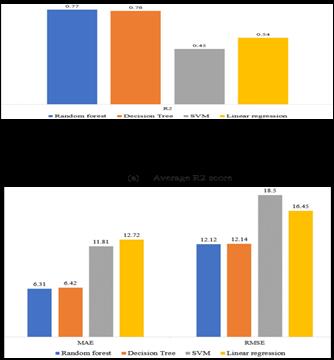
FIGURE 4.Featureimportancescorederivedfrom regressionanalysis.
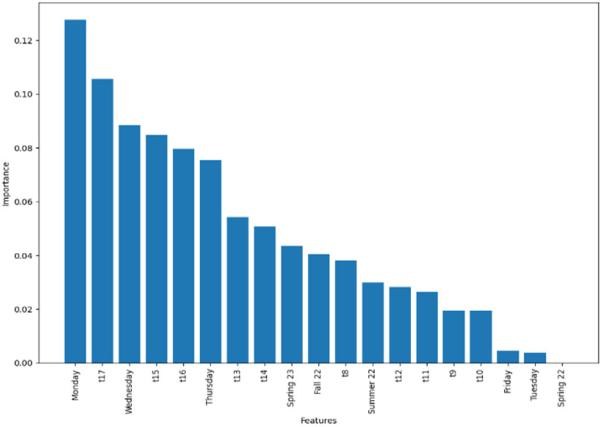
The random forest model stood out for its excellence in predicting hourly parking occupancy, as it exhibited an MAEof6.31,anRMSEof12.12,andanimpressiveR2score of 0.77. The decision tree model was closely aligned with the random forest model in performance, with an MAE of 6.42, a similar RMSE, and an R2 score of 0.76. The linear regress Sionmodel showeda weakerperformancewithan MAE of 12.72, an RMSE of 16.45, and an R2 score of 0.45. The SVR model displayed an MAE of 11.81, an RMSE of 18.5, and an R2 score of 0.54 Figure 5 depicts the importanceoffeaturesandshowsthatthelatterhalfofthe workweek, from Wednesday to Friday, was given greater importance in the regression anal lysis. This suggests that these days are more indicative of high parking usage and may reflect a pattern in which parking demand peaks during the mid-to-late workweek due to increased activities or consistent scheduling pat terns. The seasons also exhibited a clear impact on parking usage, with fall emergingasthemostinfluentialseason,closelyfollowedby spring and winter. This trend could be attributed to the start of the academic year and activities that typically increase parking demand during these times. The significant influence of fall might be due to back-to school periods and new academic sessions, which typically see a surge in campus activity and, consequently, parking demand.
Thetime-of-dayfeatures,denotedasf1throughf17,showa rangeofimportancescoresthatreflectthevaryingpark-ing demands throughout the day. These may correspond to typical daily routines such as morning arrivals, lunchtime exits, and evening departures, which all influence parking space turnover and availability. Holidays and weekends were revealed to be of moderate importance, which indicates their role in the predictability of parking usage and also suggests a more consistent parking pattern on thesedayscomparedtoregularweekdays.
5. 2 CLASSIFICATION ANALYSIS
The bar chart presented in figure 6 shows comparisons of the performances of four machine learning models (randomforest,linearregression,SVM,anddecisiontree), based on four key metrics: precision, recall, F1 score, and accuracy. Inters of Precision, the derived from classification analysis Random Forest model achieved the highest score with 0.99, followed by Linear Regression at 0.97, SVM at 0.95, and the Decision Tree model at 0.71. For Recall, Random Forest led with 0.98, closely followed by Linear Regression and SVM scoring 0.95 and 0.93 respectively, and the DecisionTreeat0.72. InmeasuringF1Score, the RandomForestagaintoppedthechartwithascoreof0.99, with Linear Regression and SVM scoring slightly lower at 0.96,andtheDecisionTreetrailingat0.72.Finally,interms of Accuracy, Random Forest excelled with a score of 0.99 followed by linear regression at 0.96, SVM also performed robustlywithascoreof0.94,andtheDecisionTreeshowed an accuracy of 0.75shows that Monday is the most influentialfactorintheclassificationanalysis,underscoring the impact of the beginning of the workweek on parking trends.Thisiscloselyfollowedbytemporalfeatureslabelled f15, f17, and Widnes-day, all indicating critical periods within the weekly cycle that shape parking behaviours. Thursday, f13, and the spring season are shown to be of moderate importance, suggesting a tangible but less dominant influence on parking dynamics The lesser importance attributed to the fall and summer seasons, as well as specific time slots denoted by f8 through f10 and days like Friday, holidays, and Tuesday reveals that these factors have less impact on the classification of parking patterns.Thisinformationisindicativeofalowervariability in parking behavior or a less acute effect on the differentiation
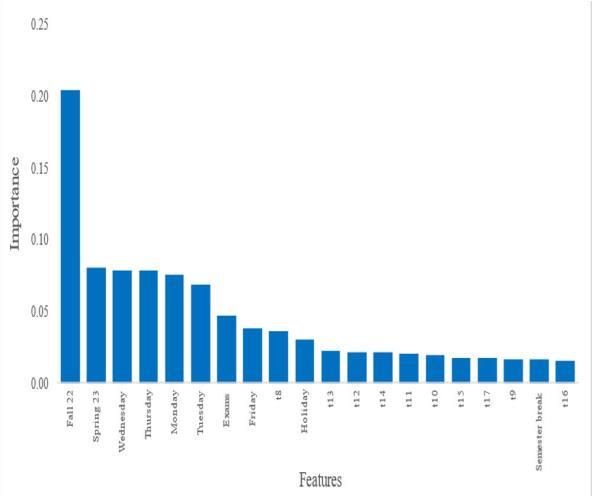
FIGURE 5. Featureimportancescores
Volume: 13 Issue: 05 | May 2026 www.irjet.net
6. CONCLUSION
Parking management in urban areas has become increase ingle challenging due to the rising number of vehicles and limited number of parking spaces. This study employed a comprehensive analysis of machine learning techniques to predict parking occupancy in an urban setting, based on a datasetofhourlyoccupancydatacollectedoveraperiodof 18 months that provided a solid foundation for evaluating the effectiveness of the various models. A comparative analysis was performed of four models (SVM, random forest, Deci Sion tree, and linear regression) to assess the performance of each, utilizing metrics such as MAE, RMSE, and R2 for regression analysis, and accuracy, precision, recall, and F1 score for classification analysis. This study notonlyidentifiesthemosteffectivemodelsforpredicting parking occupancy but also illuminates the various factors that influence parking patterns. The in-depth evaluation of both regression and classic f cation models revealed the exceptional performance of the random forest model, whose perfect or near-perfect scores in classification metrics and remarkable proficiency in regression analysis unequivocally establishes it as the optimal choice for predictingparkingoccupancy.Thisdualstrengthallowsfor both detailed, number-specific predict tons and categorizations that serve the diverse needs of real-time parking management, enabling users to make quick assessments and facility managers to develop effective strata gig plans and allocate their resources wisely. The study’s exploration into feature importance scores for urban park ing optimization revealed that urban parking patterns are influenced by the days of the week, seasonality, and the time of day. The days of the week impact both parking demand and behaviours; seasonality impacts the volume of parking usage, especially in quantitative assessments; and the time of day plays a crucial role in discerning vary oust parking patterns in qualitative analysis. This underlines the intricacy of urban parking management and emphasizes the necessity for a comprehensive strategy that Accom modettes daily, seasonal, and hourly nuances in parking trends. While meticulous attention was given to this detailed study on predicting parking occupancy, it’s crucial to recognize the study’s limitations. While the methodology and findings offer valuable insights applicable to a broad range of park ingscenarios,thedatasetmaynotapplytoothervenues.It should be noted, however, that the success of the random forest model in this environment underscores its potential adaptability to other contexts, albeit with careful consider elation of their unique characteristics. This study lays a strong foundation for future research, which could further enhance the utility of our findings by incorporating real timedata,dynamicallyadjustingmodels,andimplementing these predictive models in diverse parking management systems
7. REFERENCES
[1]Y.Yang,S.Sun,Z.Qiao,andH.Zhu,‘‘Parkingservicesin smartcities:Acomprehensivesurvey,’’IEEE Access,vol.7, pp.64271–64292,2019.
[2] Y. Zheng, S. Rajasekaran, and C. Leckie, ‘‘Parking availability prediction for sensor-enabled car parks in smart cities,’’ in Proc. IEEE 10th Int. Conf. Intell. Sensors, SensorNewt.Inf.Process.(ISSNIP),Apr.2015,pp.1–6.
[3] F. Caicedo, C. Blazquez, and P. Miranda, ‘‘Prediction of parking space availability in real time,’’ Expert Syst. Appl., vol.39,no.8,pp.7281–7290,Jun.2012.
[4] S. S. Chinnamal, S. Kerman Shachi, J. M. Rosenberger, and A. Pamidimukkala, ‘‘Parking occupancy prediction and analysis Acomprehensivestudy,’’Transp.Res.Proc.,vol. 73,pp.297–304,Jan.2023.
[5] A. O. Kotb, Y.-C. Shen, and Y. Huang, ‘‘Smart parking guidance, Moni tiring and reservations: A review,’’ IEEE Intell. Transp. Syst. Mag., vol. 9, no. 2, pp. 6–16, Summer 2017.
6]. time parking occupancy prediction in transportation networks incorporating multiple spatio-temporal data sources,’’Transp.Res.C,Emerg.Technol.,vol.107,pp.248–265,Oct.2019.
[7]A.Pamidimukkala,S.KermanShachi,J.M.Rosenberger, and G. Hladik, ‘‘Barriers to adoption of electric vehicles in Texas,’’ Environ. Sci. Pollute. Res., vol. 31, no. 11, pp. 16735–16745,Feb.2024, Doi: 10.1007/s11356 024-323377.
[8] H. Huang, G. Gartner, J. M. Krips, M. Roubal, and N. Van deWeghe,‘‘Locationbasedservices:Ongoingevolutionand researchagenda,’’ J.LocationBased Services, vol.12, no.2, pp. 63–93, Apr. 2018, Doi: 10.1080/17489725.2018.1508763.
[9]M.Sester,‘‘Analysisofmobilitydata Afocusonmobile mapping sys teems,’’ Geo-spatial Inf. Sci., vol. 23, no. 1, pp. 68–74,Jan.2020,Doi:10.1080/10095020.2020.1730713.
[10] S. S. Chinnamal, V. K. Paavola, S. Kerman Shachi, J. M. Rosenberger, and A. Pamidimukkala, ‘‘Examining parking occupancy prediction models: A comparative analysis,’’ Transp.Res.Proc.,vol.73,pp.281–288,2023.
[11] Z. Liu, Y. Li, Y. Liu, and H. Cai, ‘‘Parking occupancy prediction based on gradient boosting decision tree,’’ in Proc. IEEE 2nd Int. Conf. Inf. Syst. Compute. Aided Educ. (ICISCAE),Sep.2019,pp.358–362.
[12] Y. Sun, Y. Wang, L. Chen, and Y. Gao, ‘‘Short-term parking occupancy prediction based on decision tree and
International Research Journal of Engineering and Technology (IRJET) e-ISSN: 2395-0056
Volume: 13 Issue: 05 | May 2026 www.irjet.net p-ISSN: 2395-0072
random forest,’’ inProc.3rd Int. Conf.Ind.Bus. Eng.,2019, pp.135–139.
[13] R. K. Patel, S. S. Chinnamal, M. A. Khan, S. Kerman Shachi, and A. Pamidimukkala, ‘‘An exploratory analysis of temporal and spatial pat terns of autonomous vehicle collisions,’’PublicWorksManage.Policy,2023
[14] S. Hendricks and M. Outwater, ‘‘Demand forecasting model for park-and ride lots in king county, Washington,’’ Transp.Res.Rec.,J.Transp.Res.Board,vol.1623,no.1,pp. 80–87,Jan.1998.
[15] INRIX Research. (2017). Searching for Parking Costs Americans $73 Billion a Year. Accessed: Aug. 24, 2023. [Online].Available:http://inrix.com/pressreleases/parkingpain-us
[16] F. Caicedo, F. Robusta, and A. Lopez-Pita, ‘‘Parking managementandmodellingofcarparkpatronbehaviourin underground facilities,’’ Transp. Res. Rec., J. Transp. Res. Board,vol.1956,no.1,pp.60–67,Jan.2006.
[17]D.C.Shoup,‘‘Cruisingforparking,’’Transp.Policy,vol. 13,no.6,pp.479–486,Nov.2006.
[18] S. S. Chinnamal, S. Kerman Shachi, J. M. Rosenberger, and A. Pamidimukkala, ‘‘A review of smart parking systems,’’ Transp. Res. Proc., vol. 73, pp. 289–296, Jan. 2023.
[19]T.Lin,H.Rivanno,andF.LeMoule,‘‘Asurveyofsmart parkingsoultons,’’IEEETrans.Intell.Transp.Syst.,vol.18, no.12,pp.3229–3253,Dec.2017.
[20] Feasibility Study of Real Time Parking Information at MetrorailParkingFacilities VirginiaStations,Washington Metro. Area Transit Authority, Wilbur Smith Associates, Bengaluru,India,2009.
[21]N.Adepo,S. KermanShachi,A.Pamidimukkala,andE. Nwankpa, ‘‘An analytical approach to understanding construction cost overruns dur ing COVID-19,’’ Smart Sustain.BuiltEnviron.,Apr.2024.overrunsduringCOVID19,’’SmartSustain.BuiltEnviron.,Apr.2024.
[22]R.Gordon.(2010).High-TechParkingMetersPremiere inS.F.SFGate.[Online].Available:https://www.sfgate.com/ba yarea/article/High-techparking-meters-premiere-in-S-F3257977.php
[23] M. Richtel. (2011). Now, to Find a Parking Spot, Drivers Look on Their Phones. Accessed: May7,2023.[Online].
[24] SFMTA. (2017). San Francisco Adopts DemandResponsive Pricing Program to Make Parking Easier. [Online]. Available: https://www.sfmta. com/blog/San-
Francisco-adopts-demand-responsive-pricing-program make-parking-easier
© 2026, IRJET | Impact Factor value: 8.315 | ISO 9001:2008 Certified Journal | Page482