
International Research Journal of Engineering and Technology (IRJET) e-ISSN: 2395-0056
Volume: 13 Issue: 04 | Apr 2026 www.irjet.net p-ISSN: 2395-0072
International Research Journal of Engineering and Technology (IRJET) e-ISSN: 2395-0056
Volume: 13 Issue: 04 | Apr 2026 www.irjet.net p-ISSN: 2395-0072
Rupendra Jaiswal1 , Sakshi Srivastava2
1 M.Tech. (CSE) Scholar, Department of Computer Science and Engineering, S. R. Institute of Management and Technology Lucknow, Uttar Pradesh, India
2 Assistant Professor, Department of Computer Science and Engineering, S. R. Institute of Management and Technology Lucknow, Uttar Pradesh, India
Abstract- Blockchaintechnologyandsmartcontractshave transformed digital transactions by enabling secure, transparent, and decentralized execution of agreements withoutintermediaries.However,ensuringthereliabilityand securityofsmartcontractsremainsacriticalchallengedueto their immutable nature and potential vulnerabilities. This studyexploressmartcontracttestingwithafocusonmutation testing techniques to evaluate test suite effectiveness. To address limitations such as high computational cost and inefficientmutantselection,anovelapproachnamedSAL-GA (Self-Adaptive Learning Genetic Algorithm) is proposed for automated test case generation. The method integrates heuristic-based initialization and genetic optimization to improve code coverage and vulnerability detection. Experimentalresults demonstrate that SAL-GA achieves high performance with 98.1% code coverage, 98.7% vulnerability detection rate, and reduced execution time compared to existing methods. The findings highlight the effectiveness of the proposed approach in enhancing smart contract security and reliability in decentralized finance applications.
Key Words: Blockchain,SmartContracts,Mutation Testing,TestCaseGeneration,GeneticAlgorithm
Blockchain technology has caused a significant change in howtransactionsarecarriedoutandagreementsareupheld in recent years. The technological revolution is centered aroundsmartcontracts,whichareself-executingcontracts wherethetermsareencodeddirectlyintocode.Envisiona scenario where contractual agreements are automated, transactions are carried out smoothly, and trust is built without intermediaries. This represents the potential of smart contracts and Blockchain technology. Throughimmutabilityanddecentralization,smartcontracts improve blockchain application security, reliability, transparency, and tamper resistance. Smart contract code and logic cannot be altered after deployment, even by its originator. Tampering or malicious updates that could underminetheapplication'sintegrityareeliminated.Users anddevelopersmaytrustthecontracttobehaveasintended. Thisreducesunexpectedchangeexploits.
Satoshi Nakamoto introduced a set of regulations for establishing the blockchain framework in the year 2008. Specifically, he formulated the initial digital currency, a cryptographicformofmoneythatemphasizessecuritylevels [1].TheinceptionofBitcoincryptocurrency occurred in 2009, marking its commencement in market trading. Its widespread acceptance was a direct outcome of utilizing the Bitcoin blockchain infrastructure. Bitcoin stands as the pioneering platform that successfully eliminated centralized authority [2]. In the Ethereum blockchainnetwork,asmartcontractisacomputercode that contains the specifics of an agreement between anonymous individuals [3].Thisagreementdoesnotrequire acentralizedsystemoranexternalenforcementmechanism. It is the smart contract solidity code responsible for executing transactions, and these transactions cannot be undone. To deploy a smart contract on a blockchain, it is necessarytopayforgasinthesamemannerthatisrequired forastraightforwardtransfer.Onesmartcontractcandeploy anothersmartcontract,whichmeansthatsmartcontracts are composable. The development of a smart contract is performedinstagesthatareseparatedfromoneanother.It is their responsibility to ensure that the client's requirementsaresatisfactorilymet,andthattheinnovation meetsthoserequirements.
SmartContracttestingverifiesthecorrectness,securityand functionality of smart contracts deployed over the blockchain network. The evaluation of smart contracts involves verifying the behaviour of the contract under variousconditionsensuringtheintendedfunctionalityand complies requirements. Includes testing like functional testing, security testing, performance testing, integration testing, fault-based testing, gas optimization, regression testingetc.
Oneofthetestingmethodsinunittestingismutationtesting. Mutation testing is a fault-based testing method used to assessthequalityofthetestsuite.Mutationtestingisusedin
International Research Journal of Engineering and Technology (IRJET) e-ISSN: 2395-0056
Volume: 13 Issue: 04 | Apr 2026 www.irjet.net p-ISSN: 2395-0072
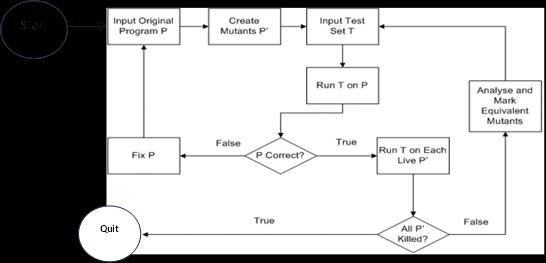
limited quantities by industry because it is both timeconsuming and expensive to compute it [14]. There are research studies that can be conducted to reduce this computationalcostbyreducingthenumberofmutantsthat are generated, among other things. In the process of mutationtesting,errorsareintroducedintothecodethatis beingtested,whichisreferredtoasmutatedcode.Thecode that has been modified is run against the test case that is associatedwiththesourcecode[14].Intheeventthatthe test cases are able to identify the faults that have been injected, the mutants will be in a state of being killed; otherwise,themutantswillbeeithersurvivingoralive.
RegularMutator[81]mutationhappensforeachsourcecode that has test suites and smart contracts using mutants generated.Theregularexpressionslibraryisutilisedforthe implementation of the mutation injection approach. The RegularMutatorexecutesprojecttestsuitesbyrepeatedly replacingtheoriginalfileswithmutantfilesthathavebeen created.Uponexaminationofthetestresults,themutantis assigned one of the following designations: 'killed', 'survived', or 'error'. The experiment analysing the performanceofregularmutatorsutilisedasmartcontract from the POA bridge project. The lines of code coverage metricachievedarateof96%,andatotalof129fileswere employedfortestingby the tool. The achieved mutation score was 18.5%. Upon meticulous analysis of 50 mutants,itwasdeterminedthatthemutantsmostlikelyto endure were those generated by the utilisation of the OperatorReplacementforRelationaloperationstechnique andoperatorsthatareSolidity-specific.Achievedagoodlevel ofcodecoverageandarelativelylowmutationscoreforthe" SmartContracts-POABridge".Byincorporatingtheinsights fromthemutationstudyintothetestsuites,wewereableto enhance their quality. As stated in [10], the POA project utilisesRegularMutatortoassessthequalityoftestsuites, placing greater emphasis on the metric mutation score rather than metric- line coverage. Whencomparingthe mutationadequacyscoretothelinecoveragemeasure,itwas
observedthatthemutationscorehasasubstantiallylower value than the line coverage statistic. Simultaneously, the testsuiteswereenhancedandavulnerabilitywasidentified throughmutationanalysis.RegularMutator'sdevelopment revealedthatthemostefficientmutationoperatorsarethose specific to Solidity and those belonging to the Relational OperatorReplacementclass.Specifically, themutants that survived consisted of 26% Solidity-specific operatorsand 18% ROR operators. It should be emphasised that not all mutants derived from the survivors are beneficial and enhancethequalityofthetestsuite.Asanillustration,itis necessarytogetridofcommentsinthesourcecodebecause anychangesmadetothemwillnothaveanyimpactonthe way the code is executed. Furthermore, the percentage of mutationsresultinginsyntacticalerrorsduringcompilation andthetimeneededtoverifythem were substantial. The experiment was conducted for a duration of approximately50hoursonthemachine.Indeed,mutation analysis poses substantial computational obstacles that restrictitspracticalityinspecificcircumstances.Moreover,a substantial percentage of mutants that successfully completedtheexperimentneedtobethoroughlyexamined andassessed.Giventhefactthatsmartcontractscannotbe changed once they are deployed and the possibility of financiallossesresultingfromvulnerabilitiesintheproject, wecanconcludethatthehighercomputationalexpenseof testingisreasonable.
Deviant [15] intended to generate variations of a specific Solidity project and execute the provided tests on each variation to assess the efficiency of the testing. Deviant processesoneprogramfile atatime,convertingitintoan Abstract Syntax Tree (AST), and generates mutants by applyingmutationoperatorsselectedbytheuser. ASolidity projectanditscorrespondingtestcodehavebeensubmitted to Deviant. Mutation operators are defined based on a comprehensive defect model specifically designed for the Solidity language. The model takes into account the conventional fault categories in traditional programming languages, particular aspects of the Solidity language, and thepublishedfaultsspecifictoSolidity.Afterthecreationof eachmutant,anexactreplicaofitwillbeplacedintheproject directoryandtransformedintoEVMbytecode,maintaining completesimilaritywiththeoriginalformoftheproject.The provided Solidity project will undergo testing against the EVMbytecode.Untileverymutanthasundergonethetests, this procedure is repeated. Deviant records the results of every mutant's test execution and generates a comprehensivetestreportonthemutationtesting,including metrics such as mutation score, number of deceased mutants, and number of alive mutants. Validating the viabilityofeachmutantasafunctional program prior to compilation poses a significant technological challenge in mutantgeneration.Acontractthatcanbebuiltisconsidered to be a valid anomaly. Demands a comprehensive examination into the reasons behind the survival of the majorityofnon-equivalentmutants,evenwhilethetestsfulfil therequirementsofstatementorbranchcoverage.
International Research Journal of Engineering and Technology (IRJET) e-ISSN: 2395-0056
Volume: 13 Issue: 04 | Apr 2026 www.irjet.net p-ISSN: 2395-0072
Vertigo mutation testing tool was designed for truffle and soliditysmartcontract.Mutationtestinginvolveswithtest suite initially and checks for if the test suite fails for the smart contracts. If not, the next step is generation of mutations in which the filter is used to select a random sampleofmutantsfromtheavailablemutantlist.Thenthe mutationsareapplied to the code and is executed against the test suite by the mutation runner.Providestheentire mutationprocess.Themajorlimitationinthisvertigois,it does not support for testing individually the tests and code coverage report are not available.Thevertigotool executestheentiretestsuiteforeachmutantwhichrequires optimization.
The aforementioned tools vary in their methods of generatingmutantsandtheoperatorsemployedbyeachtool differ.Thecreatedmutantsareabundantinnumberandallof themarebeingutilisedtoexecutethemodifiedsourcecode incomparisontothetestingset.Theexecutiontimeofthe mutantsisdirectlyproportionaltothenumberofmutants. The mutant sampling method was employed by certain instrumentstodecreasethequantityofmutations.Thereis no assurance that the mutations that are decreased and utilisedintheexecutionprocessareeffectiveformutation analysis.Theefficacyofmutantsiscrucialintheexamination of mutants. Utilising time on the execution of all the redundantmutantsisunnecessary.
Manyresearchersarecurrentlystudyingtheconstructionof test cases automatically for smart contracts, which is comparablewiththeprocessusedinsoftwareengineeringto create test cases for other software. Current methods for generating test cases continue to face challenges in identifyingvulnerabilities.Mayexperiencechallengeswhen confrontedwiththeuniquecomponentsofEthereumsmart contract’sstatementofcodelikerequire,viewandpure. The primaryobstacleinutilisingthemutationtestingtechnique is the creation of a substantial number of mutants. For mutants’reduction,randomsamplingandobtainingsubset ofmutantsarethestrategiesemployedincurrentmutation testingtechnique.However,thesetechniquesfacechallenges inpickingappropriatemutantstotestthequalityofthetest suite. To make mutation testing practical for experts, it is essentialtoaddress thehigh volumeofmutants produced by current mutation systems, many of which are deemed unproductive according to Samuel et al. The efficacy of utilisingamutantasatestsubjectinmutationtestingrelies onitscapacitytoproduceapertinenttestthatimprovestest coverage.ThisstudypresentsanewmethodcalledtheTest CompletenessAdvancementProbability(TCAP)metricfor assessingtheeffectivenessofmutantusefulness.Thiswork furtherillustratesthatthestaticprogramenvironmentofa mutantcanaccuratelyforecastitsTCAP(TestCaseAdequacy Prediction).Additionally,theselectionofmutantsbasedon their TCAP can serve as a valuable approach to guide mutationtesting.
Blockchain's intrinsic characteristics, which include resistance to assault and independence from a central authority, make it ideal for managing smart contracts, especiallyindigitalmanagement.Complicatedbugscausedby attackers or malicious developers might result in false positive errors. Additionally, autonomous test case generationforsmartcontractsencountersdifficultiesrelated to test generation, test automation, and oracle issues. Symbolicexecutionmodelshavebeenutilisedtocreatetest casesforcodepathsinsmartcontractsconcerningfinancial transactions. However, challenges remain in terms of coverage,adaptability,scalability,diversityofvulnerabilities, automation,andefficiency.Hereprovidesanewautomated way for generating test cases for smart contracts to solve theseissuesusingSAL-GAthatimprovescodecoverageand detectionofvulnerabilities.
The proposed architecture for automated test case generation is depicted inFigure3.1,consistingofsixblocks. At first, various smart contracts are selected with code errors and vulnerable presence within the Decentralized Financialrelatedprojectsencompassinglendingplatforms, synthetic assets and decentralised exchange. The construction of the Application Binary Interface (ABI) provides with the required information for test cases generationandexecutingtestcasesintestingenvironment. The parsing processis createdto analyse the source code writteninSolidity.
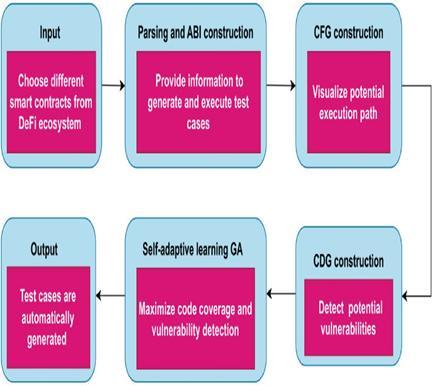
Devisedamethodthatcombinesrandomvaluecreationwith heuristic-based value generation to create an initial population of solutions. In order to generate arbitrary values,arandomizerfunctionwasdevelopedforeachdata
International Research Journal of Engineering and Technology (IRJET) e-ISSN: 2395-0056
Volume: 13 Issue: 04 | Apr 2026 www.irjet.net p-ISSN: 2395-0072
typetoproducerandomvalues.Considerascenariowherea smartcontractfunctionnecessitatesanintegerparameter.In suchcases,therandomizerfunctionoperatesbygenerating anintegerrandomlychosenfromthepermissiblerangeof integersfortheEthereumVirtualMachine(EVM).Similarly, when an argument requires an Ethereum address, the randomizerfunctiongeneratesarandomEthereumaddress as the argument. The process of deriving values based on heuristicsentailsameticulousandsophisticatedapproach.It involves analysing both the functionality and historical transactiondataofthesmartcontracttoinferprobableinput patterns. For instance, if past transactions consistently provided integer arguments within a specific range for a particularfunction,therandomizerfunctionwouldprioritize generatinginitialvalueswithinthesamerange.
3.3. Experimental Setup
ConductedstudiesontestcasecreationusingPython3.10.9. These trials were executed on a Windows 11 operating system,leveragingasystemconfigurationfeaturing16GBof RAM and an Intel(R) Core(TM) i5-1005G1 processor operating at a clock speed of 1.20GHz. The system was equipped with a 64-bit operating system to support the computational demands of the experiments. Test environmentforEthereumisusedwithTruffle and local blockchain with Ganache, and for smart contract compilation usedSolidityv0.5.16,alongwithNodev18.15.0 andWeb3.jsv1.8.2.Thissetupprovidedarobustenvironment forevaluatingtheefficacyandperformanceofvarioustest case generation techniques, allowing for comprehensive analysisandcomparisonofresults.
3.3.1: Parameter Settings
TheSAL-GAparameterswereoptimisedinordertoattain maximum performance andsupremacy.Thesoftwarewas
meticulouslydesignedand adjustedtoincorporatea wide range of parameters, script packages, and methodologies. Table 3.1 is a concise summary of the parameter configurationsutilisedinstudy.
Table 3.1: SAL-GAParameterSettings
4.
Thisstudyevaluatestheefficacyofaproposedmethodby analysing various metrics such as average code coverage rate, vulnerability detection rate, path uniqueness rate, executionrate,falsepositiverate(FPR),falsenegativerate (FNR), test case generation time, total vulnerabilities identified, precision, and recall. Assessed the proposed method’ssuperioritybycomparingitwithseveralexisting approachessuchasReL-GA,SaFReL,aDynaMOSA,GA,and Improved GA. Table 4.1 provides results obtained using proposedSAL-GA.
Table 4.1: TestCaseGenerationusingSAL-GA
EvaluationMetrics PerformanceRanges
Timeofexecution 25seconds
Timetogeneratetestcases 16seconds
Averagecodecoverage 98.1% Totalvulnerabilityidentified 3500
detection
rate
rate
ofPathuniqueness
%
The proposed SAL-GA is compared with various other algorithms that are used to generate test cases. The
International Research Journal of Engineering and Technology (IRJET) e-ISSN: 2395-0056
Volume: 13 Issue: 04 | Apr 2026 www.irjet.net p-ISSN: 2395-0072
comparativeresultsinthissectionareprovidedintermsof execution time, test case generation time, code coverage rate, total vulnerabilities detected and vulnerability detectionrate.
Theanalysisofexecutiontimedependentonthenumberof testcasesthatweregeneratedisdepictedinFigure4.1.The comparisontakesintoaccounttheSAL-GAapproachthathas beenproposedanddeveloped,aswellasReL-GA,SaFReL, aDynaMOSA,GA, and Improved GA. Execution time is the amount of time that is spent on the generation of each individual test case. In especially for smart contracts, the executiontimehasatendencytoincreaseintandemwiththe number of test cases that are generated.According to the findingsoftheanalysis,the SAL-GAmodelproposedhas a duration of execution that is shorter than that of other approachesforthedevelopmentoftestcases.Inparticular, theproposedmodelwasabletoobtainanexecutiontimeof 25secondswhenitwasperformingthe2000thtestcase,it recorded102secondswhenitwasperformingthe10000th test case. This demonstrates that the proposed method is effectiveinproducingtestcasesinashorteramountoftime, which makes it a desirable option for the activities that includethedevelopmentoftestcases.
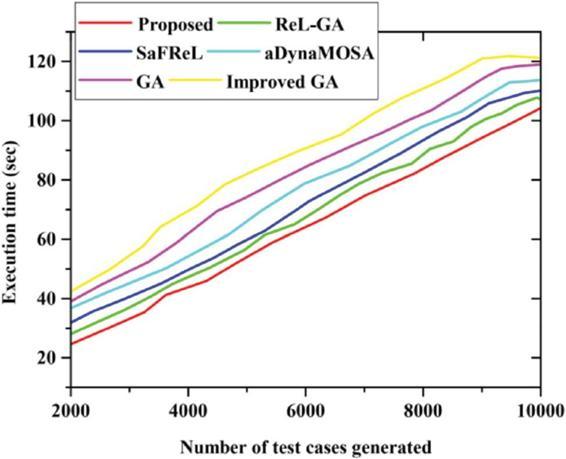
Fig-4.1: ExecutionTimeAnalysis
Figure4.2.displaystheevaluationofthetimetakenfortest case generationusing differentcomparisonmethods:ReLGA,SaFReL,ImprovedGA,aDynaMOSA,GAandtheproposed approach.Testcasecreationtimeisamountoftimeittakes to create test cases. The research demonstrates that the proposedmethodsurpassestheothermethodsintermsof the time required for generating test cases. The proposed methodtook16secondstogeneratetestcasesatthe2000th test case, and 112 seconds at the 10000th test case. Nevertheless,itisimportanttoacknowledgethatthetime requiredfortestcasegenerationtendstoriseproportionally with test cases quantity developed. The results clearly specifies that proposed methodology provides robust test
casesgeneratedwithlowtimewhencomparedwithother methodsbeenconsideredinevaluation.
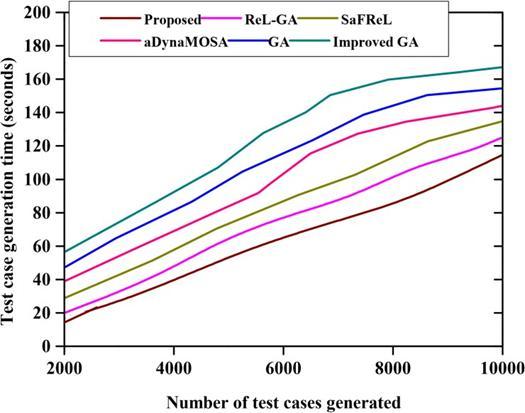
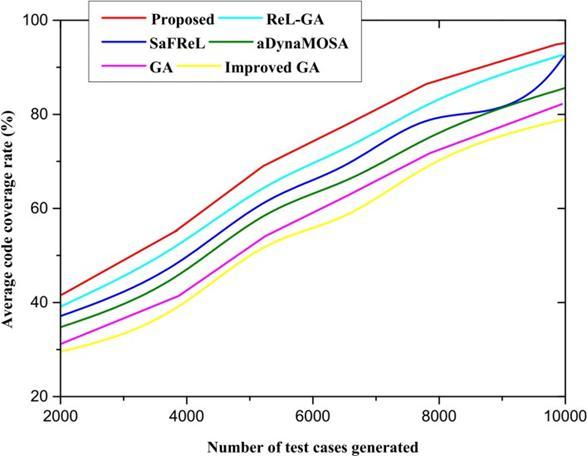
Fig-4.3: AverageCodeCoverageRate
Figure 4.3. illustrates the analysis of the average code coverage rate, which is determined by the number of automaticallygeneratedtestcases.Differentapproachesto the development of test cases are compared in this comparative analysis. These approaches include the proposedmethod,ReL-GA,GA,ImprovedGA, SaFReL,and aDynaMOSA.Thisimpliesthatahighercodecoveragerate offersmorechancestodetectcodingissuesandensurethe properbehavioroftheapplication.Inordertogetaverage codecoveragerate,it’snecessarytoidentifysectionsofcode that are not covered by the test cases that have been developed.Typically,whenmoretestcasesare generated, observed increase in the average code coverage rate.The approach for the production of test cases that has been proposed has highest average rate among all alternatives that have been assessed. In particular, the proposed
International Research Journal of Engineering and Technology (IRJET) e-ISSN: 2395-0056
Volume: 13 Issue: 04 | Apr 2026 www.irjet.net p-ISSN: 2395-0072
techniquewasabletoobtain98.1%ofcodecoveragerateon averagewhenitwasappliedtothetenthousandth testcase. Thefactthatthisisthecasedemonstratesthattheapproach thatwas proposed, effectivelycoversmajor percentage of code, which ultimately results in improved detection of potential programming problems. In general, the findings demonstrate that the proposed model has superior performanceintermsofreachingahighaveragerateincode coveragewhencomparedwithotherapproachesthatwere takenintoconsiderationduringtheanalysis.
Figure 4.4 depicts comparative analysis of the total vulnerabilities detected. Thecomparisoninvolvesvarious approaches for generating test cases, including SaFReL, ImprovedGA,aDynaMOSA,thesuggestedmethod,ReL-GA, and GA. The data demonstrates a positive correlation between quantity of generated test cases and the overall number of vulnerabilities found across all test case generatingmethods
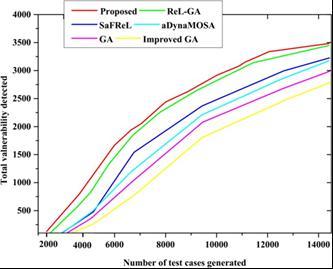
Fig-4.4:.TotalNumberofVulnerabilitiesDetected
Nevertheless, proposed approach exhibits advantages in detectingvulnerabilities. Atthe14000thtestscenario,the suggested method successfully identifies 3500 vulnerabilities, demonstrating its efficacy in detecting potentialvulnerabilities.Yet,theothertestcasegeneration methodsfoundvaryingnumbersofvulnerabilities:3250for SaFReL, 2850 for Improved GA, 3240 for aDynaMOSA, 2490 for ReL-GA, and 3000 for GA.Theresultsshowthat thesuggestedtestcasegenerationprocessishighlyeffective in finding vulnerabilities, outperforming other methods studied.The highernumber ofvulnerabilitiesidentifiedby proposed technique indicates its ability in uncovering potentialweaknessesandenhancesoverallsystemsecurity.
Innavigatingtheintricaciesofautomatedtestcasecreation for Ethereum smart contracts, encountered multifaceted obstacles revolving around code coverage, vulnerability spectrum, and the automation of vulnerability detection. Recognizing the imperative nature of these challenges in ensuring the robustness and security of decentralized finance(DeFi)ecosystems,asophisticatedgeneticalgorithm named SAL-GA was proposed, meticulously designed to refineandenhancetheprocessofEthereumsmartcontract testing.Drawingdatafromadiversearrayofsmartcontracts within the DeFi collection of smart contracts related to Finance,rigorouslyevaluatedSAL-GA'sperformanceusinga comprehensivesetofmetrics.Thesemetricsencompassed crucialaspectssuchasaveragecodecoverage,vulnerability detection rate, path uniqueness rate, execution time, false positive and false negative rates, time taken for test case generation, and the overall efficacy in identifying vulnerabilities. The comparative analysis involved benchmarking SAL-GA against several established methodologies including Genetic Algorithm, adaptive DynaMOSA,ImprovedGeneticAlgorithm,ReL-GA,andselfadaptive fuzzy reinforcement learning (SaFReL). SAL-GA achievedimpressiveresults,generatingtestcasesquicklyin just16seconds,with98.1%codecoverageratebeinghigh onaverageandanoutstandingvulnerabilitydetectionrateof 98.7%. These results underscore SAL-GA's efficacy in surmounting the challenges of Ethereum smart contract testing,therebyfortifyingsecuritymeasuresandresilience withintheDeFiecosystem
[1] Bitcoin Whitepaper. (2008). Bitcoin: A peer-to-peer electronic cash system. Retrieved from https://bitcoin.org/bitcoin.pdf
[2] Bitcoin.org.(n.d.). Bitcoinofficialwebsite.Retrievedfrom https://bitcoin.org/en/
[3] Nakamoto Institute. (n.d.). Micropayments and mental transaction costs. Retrieved from https://nakamotoinstitute.org/static/docs/micropayme nts-and-mental-transaction-costs.pdf
[4] Macrinici, D., Cartofeanu, C., & Gao, S. (2018). Smart contract applications within blockchain technology: A systematicmappingstudy. Telematics and Informatics, 35(8),2337–2354.
[5] Liu,J.,&Liu,Z.(2019).Asurveyonsecurityverification of blockchain smart contracts. IEEE Access, 7, 77894–77904.
[6] Rouhani,S.,&Deters,R.(2019).Security,performance, and applications of smart contracts: A systematic survey. IEEE Access, 7,50759–50779.
[7] Vacca, A., Di Sorbo, A., Visaggio, C. A., & Canfora, G. (2021).Asystematicliteraturereviewofblockchainand smart contract development: Techniques, tools, and openchallenges. Journal of Systems and Software, 174, 110891.
[8] Nanayakkara,S.,Perera,S.,Senaratne,S.,Weerasuriya,G. T.,&Bandara,H.M.N.D.(2021).Blockchainandsmart
International Research Journal of Engineering and Technology (IRJET) e-ISSN: 2395-0056
Volume: 13 Issue: 04 | Apr 2026 www.irjet.net p-ISSN: 2395-0072
contracts:Asolutionforpaymentissuesinconstruction supplychains. Informatics, 8(2),36.
[9] Wang,Y.,He,J.,Zhu,N.,Yi,Y.,Zhang,Q.,Song,H.,&Xue, R.(2021).Securityenhancementtechnologiesforsmart contractsinthe blockchain:Asurvey. Transactions on Emerging Telecommunications Technologies, 32(12), e4341.
[10] Lin, S. Y., Zhang, L., Li, J., Ji, L. L., & Sun, Y. (2022). A survey of application research based on blockchain smartcontract. Wireless Networks, 28(2),635–690.
[11] Barboni, M., Morichetta, A., & Polini, A. (2022). Smart contract testing: Challenges and opportunities. In Proceedings of the 5th International Workshop on EmergingTrendsinSoftwareEngineeringforBlockchain (pp.21–24).
[12] Nzuva, S. (2019). Smart contracts implementation, applications, benefits, and limitations. Journal of Information Engineering and Applications, 9(5),63–75.
[13] Krupa, T., Ries, M., Kotuliak, I., & Bencel, R. (2021). Security issues of smart contracts in Ethereum platforms.In 2021 28th Conference of Open Innovations Association (FRUCT) (pp.208–214).IEEE.
[14] Andrews,J.H.,Briand,L.C.,Labiche,Y.,&Namin,A.S. (2006). Using mutation analysis for assessing and comparingtestingcoveragecriteria. IEEE Transactions on Software Engineering, 32(8),608–624.
[15] Wood, G. (2014). Ethereum: A secure decentralised generalisedtransactionledger (EthereumYellowPaper).
[16] Hassan,M.,Ali,I.,Ahammed,R.,Khan,M.M.,Alsufyani, N.,&Alsufyani,A.(2021).Securedinsuranceframework using blockchain and smart contract. Scientific Programming, 2021,1–11.
[17] Muneeb, M., Raza, Z., Haq, I. U., & Shafiq, O. (2021). Smartcon: A blockchain-based framework for smart contractsandtransactionmanagement. IEEEAccess,10, 10719–10730.
[18] Górski,T.(2021).Towardscontinuousdeploymentfor blockchain. Applied Sciences, 11(24),11745.
[19] Ibrahim,R.,Harby,A.A.,Nashwan,M.S.,&Elhakeem,A. (2022). Financial contract administration in constructionviacryptocurrencyblockchainandsmart contract:Aproofofconcept. Buildings, 12(8),1072.
[20] Investopedia. (n.d.). Smart contracts. Retrieved from https://www.investopedia.com/terms/s/smartcontracts.asp
[21] Taş,R.(2023).Smartcontractsecurityvulnerabilities. Erzincan University Journal of Science and Technology, 16(1),196–211.
[22] Azaria,A.,Ekblaw,A.,Vieira,T.,&Lippman,A.(2016). MedRec:Usingblockchainformedicaldataaccessand permissionmanagement.In InternationalConferenceon Open and Big Data (pp.25–30).
[23] Ribeiro, S. L. I., & Barbosa, A. P. (2020). Risk analysis methodology to blockchain-based solutions. In Conference on Blockchain Research & Applications for InnovativeNetworksandServices(BRAINS) (pp.59–60).
[24] Xu,J.J.(2016).Areblockchainsimmunetoallmalicious attacks? Financial Innovation, 2(1),25.
[25] Wang,S.,Wang,C.,&Hu,Q.(2019).Corkingbyforking: Vulnerabilityanalysisofblockchain.In IEEEConference on Computer Communications (pp.829–837).
[26] Li, X., Jiang, P., Chen, T., Luo, X., & Wen, Q. (2020). A survey on the security of blockchain systems. Future Generation Computer Systems, 107,841–853.
[27] Dey,S.(2018). Securingmajority-attack in blockchain usingmachinelearningandalgorithmicgametheory:A proof of work. In Computer Science and Electronic Engineering (pp.7–10).
[28] Ramezan, G., Leung, C., & Wang, J. Z. (2018). A strong adaptive, strategic double-spending attack on blockchains.In International Conference on Internet of Things, Green Computing and Communications, Cyber, Physical and Social Computing, and Smart Data (pp. 1219–1227).IEEE.
[29] Zhao,X.,Chen,Z.,Chen,X.,Wang,Y.,&Tang,C.(2017). The DAO attack paradoxes in propositional logic. In InternationalConferenceonSystemsandInformatics (pp. 1743–1746).
[30] WIRED. (2016). The $50 million DAO hack explained Retrievedfromhttps://www.wired.com/2016/06/50million-hack-just-showed-dao-human/
[31] Investopedia. (n.d.). Ethereum smart contracts vulnerable to hacks. Retrieved from https://www.investopedia.com/news/ethereum-smartcontracts-vulnerable-hacks-4-million-ether-risk/
[32] FindLaw.(n.d.). Reports: Ethereum smart contracts are far from secure. Retrieved from https://www.findlaw.com/legalblogs/technologist/rep orts-ethereum-smart-contracts-are-far-from-secure/
[33] Zhao,H.,Li,X.,&Gai,K.(2022).Adynamictaintanalysisbasedsmartcontracttestingapproach.In International ConferenceonSmartComputingandCommunication (pp. 403–413).Springer.
[34] Krichen,M.,Lahami,M.,&Al-Haija,Q.A.(2022).Formal methods for the verification of smart contracts: A review. In 2022 15th International Conference on Security of Information and Networks (SIN) (pp. 1–8). IEEE.
[35] Du,J.,Huang,S.,Wang,X.,Zheng,C.,&Sun,J.(2022).Test casegenerationforEthereumsmartcontractbasedon datadependencyanalysisofstatevariable.In 2022IEEE 22nd International Conference on Software Quality, Reliability and Security (QRS) (pp.710–720).IEEE.
[36] Akca, S., Peng, C., & Rajan, A. (2021). Testing smart contracts: Which technique performs best? In Proceedings of the 15th ACM/IEEE International Symposium on Empirical Software Engineering and Measurement (ESEM) (pp.1–11).
[37] Viglianisi, E., Ceccato, M., & Tonella, P. (2020). A federated society of bots for smart contract testing. Journal of Systems and Software, 168,110647.
[38] Bhardwaj, A., Shah, S. B. H., Shankar, A., Alazab, M., Kumar,M.,&Gadekallu,T.R.(2021).Penetrationtesting frameworkforsmartcontractblockchain. Peer-to-Peer Networking and Applications, 14,2635–2650.
[39] Xu,Y.,Hu,G.,You,L.,&Cao,C.(2021).Anovelmachine learning-based analysis model for smart contract vulnerability. Security and Communication Networks, 2021,1–12.