
International Research Journal of Engineering and Technology (IRJET) e-ISSN: 2395-0056
Volume: 12 Issue: 01 | Jan 2025 www.irjet.net p-ISSN: 2395-0072

International Research Journal of Engineering and Technology (IRJET) e-ISSN: 2395-0056
Volume: 12 Issue: 01 | Jan 2025 www.irjet.net p-ISSN: 2395-0072
Ketha Krishna Durga Devi1 , Gajulapally Aishwarya Reddy2, Ms. P. Aswani3
1B-Tech 4th year, Dept. of CSE (DS), Institute of Aeronautical Engineering
2 B-Tech 4th year, Dept. of CSE (DS), Institute of Aeronautical Engineering
3 Assistant Professor, Dept. of CSE (DS), Institute of Aeronautical Engineering, Telangana, India
Abstract - This project introduces a comprehensive system to monitor and assess student engagement during online learning sessions using computer vision and audio processing techniques. The framework captures live video streams via a webcam and leverages MediaPipe’s Face Mesh to identify key facial landmarks for real-time head pose and estimation. The gaze tracking determines the direction of the student’s attention, distinguishing between engaged (”Forward”) and distracted (”Left,” ”Right,” or “Down”) states. Simultaneously, the system incorporates audio analysis through the PyAudio library to detect prolonged noise, markingperiodsofpotential disengagement. By integrating these visual andauditorycues, the model provides a robust evaluation of student attention, enhancing the understanding of engagement in virtual learning environments. This system is designed to run efficiently on devices with limited computational power, making it suitable for broader adoption in online education platforms.
Key Words: StudentEngagement,ComputerVision,Gaze Estimation, Head Pose Detection, MediaPipe Face Mesh, Audio Processing, PyAudio, Real-Time Monitoring, Low ComputationalPower
Theshifttowardsonlineeducationhasbroughtsignificant opportunitiesandchallengestotheeducationallandscape.
While digital platforms enable greater accessibility and flexibility in learning, they also present unique hurdles in maintaining student engagement and ensuring effective instructionaldelivery.Oneofthecriticalchallengesinonline education is the ability to accurately assess and sustain studentattention,akeydeterminantoflearningsuccess.
Traditionalmethodsofattentionassessment,suchasquizzes andparticipationtracking,fallshortinvirtualenvironments wheredirect,in-personobservationisnotfeasible.Thisgap necessitates the development of innovative solutions that can provide real-time insights into student engagement levels.
Recentadvancementsinartificialintelligenceandcomputer vision offer promising avenues to address this challenge. Thisreport explorestheapplicationofreal-timeattention
assessment in online education using the MediaPipe framework, a cutting-edge computer vision solution designed for efficient and accurate tracking of facial landmarksandheadposeestimation.MediaPipe’sabilityto performreal-timefacialrecognitionandgazetrackingmakes it an ideal choice for continuously monitoring student attentionduringonlineclasses.
ThegoalofthisprojectistousetheMediaPipearchitecture to create a real-time attention assessment system in responsetothesedifficulties.Duringonlineclasses,students’ facialcues,suchasheadpositionandgazedirection,canbe continuouslymonitoredthankstoMediaPipe,aninnovative computervisiontoolthatprovideseffectivefaciallandmark detection.
Thesuggestedsystemcanidentifyminutevariationsinfacial expressions and movements that may be indicators of a student’sconcentrationbyutilizingMediaPipe’sfacemesh solution. Compared to more conventional techniques like testsorattendancerecords,thesecuesofferamoredynamic and real-time way to monitoring attentiveness and, when examined, reveal insightful information about student participation.
This study aims to do more than merely measure attentiveness.Thismethodisintendedtoassesshowwellit detectsattentionlapses,orinstancesinwhichstudentsare unfocusedordisengaged,andgivesteacherstimely,useful feedback. Through the integration of this technology into online education platforms, educators can intervene promptly and modify their pedagogical approaches to reengagelearners.
Additionally, the project intends to show how this technologycanbeusedmore broadlytoimprovelearning outcomes by promoting an interactive and adaptable learningenvironment.Theultimateobjectiveistoimprove student engagement by providing real-time feedback and providing a more individualized and adaptable virtual learningenvironment.
The suggested approach has the potential to enhance engagement and provide long-term learning analytics. Through the process of gathering data on student attentivenessthroughoutonlinesessions,thesystemisable
International Research Journal of Engineering and Technology (IRJET) e-ISSN: 2395-0056
Volume: 12 Issue: 01 | Jan 2025 www.irjet.net p-ISSN: 2395-0072
toproducecomprehensivereportsthatillustratetrendsin student involvement over time. Teachers and educational institutions alike can benefit greatly from these findings, whichprovidea deeper knowledgeof the elements like thetimeofday,lessondesign,orteachingstyle thataffect students’abilitytofocus.
Furthermore, by identifying students who might require extra support or modifications to their learning environment,thisdata canbe leveragedtocreatetailored learning experiences. With time, a more data-driven approachtoonlineeducationmaybepossiblethankstothis attentiontrackingtechnologyprovidedbyMediaPipe,which enablesschoolstomakewisedecisionstoimprovestudent performanceandretention.
Thaman,Cao,andCaporussoIntheirpaper“Face MaskDetectionusingMediaPipeFacemesh”,Thaman,Cao, andCaporussointroduceasystemfordetectingfacemasks usingtheMediaPipeframework,focusingoncompatibility across platforms, particularly mobile devices. The system utilizesMediaPipe’sfaciallandmarkdetectiontechnologyto determinewhetherindividualsarewearingfacemasks.The model was evaluated in real-world environments, demonstratingitseffectivenessinmaskdetection,whichwas especiallycriticalduringtheCOVID-19pandemic [1]
Wu,Zhang,andTian In“Simultaneous FaceDetection and Pose Estimation Using Convolutional Neural Network Cascade”, Wu, Zhang, and Tian propose a multi-task convolutional neural network (CNN) cascade for simultaneousfacedetectionandheadposeestimation.The modelbenefitsfrommulti-tasklearningandfeaturefusion, improvingaccuracyandreal-timeperformance.Thesystem wasvalidatedusingdatasetslikeFDDBandAFW.However, while it offers runtime efficiency, challenges such as scalability, reliance on high-performance GPUs, and difficultiesingeneralizationacrossvarieddatasetsremain [2]
Chen,Zhang,Yin,andWangThestudy”TRFH:TowardsRealTime Face Detection and Head Pose Estimation” by Chen, Zhang, Yin, and Wang aims to create a multi-task model combining face detection and head pose estimation into a unified system, eliminating the need for separate face detection processes. The efficiency of the model is tested withmulti-stagefaceattributeanalysisontheAFLWdataset Despite achieving improvements in real-time estimation, especially for single-person scenarios, the model faces limitations in precision and computational complexity, particularlyformulti-personsettings [3]
Yuanin“FaceDetectionandRecognitionBasedon VisualAttentionMechanismGuidanceModelinUnrestricted Posture”,Yuanexploresenhancingfacialocclusionhandling
in face detection and recognition by integrating a visual attention mechanism. The model is designed to simplify detectionintoasemanticfeatureextractiontask,aimingfor highaccuracywhilemaintainingspeed,suitableforsecurity surveillance applications. However, the reliance on simulation-basedevaluationsratherthanreal-worldtesting couldlimitthemodel’spracticaleffectiveness,especiallyin complexenvironments [4]
Wang, Lei, and Qian The research ”Siamese PointNet: 3D Head Pose Estimation with Local Feature Descriptor” by Wang,Lei,andQianfocusesoncreatingaSiamesenetwork for robust 3D head pose estimation, especially under challenging conditions such as occlusions and varying viewpoints.Themodelwasevaluatedusingpublicdatasets to minimize error margins while ensuring real-time performance. However, challenges such as generalization issues,overfitting,andthedependencyonsyntheticdata,as well as the model’s complexity for resource-constrained devices,remainsignificanthurdles [5]
Zhu, Chen, and Gao In ”Improvement of Face Detection Algorithm Based on Lightweight Convolutional Neural Network” , Zhu, Chen, and Gao present a face detection algorithm optimized for mobile platforms, leveraging a lightweight CNN architecture built on MobileNet and deformable convolution layers. Knowledge distillation is used to enhance the model’s performance by training a smallernetworkwiththeguidanceofalarger,morecomplex model. While this approach reduces model size and enhances efficiency, the use of deformable convolution layers increases computational complexity. Additionally, fine-tuning the distillation process to achieve optimal performance across various mobile devices presents challenges.[6]
Accurateheadposeandgazeestimationplaysacriticalrole inreal-timestudentattentiontracking,especiallyinonline education settings. By leveraging MediaPipe, the system utilizesFaceMeshforprecisefacedetectionandheadpose estimation to continuously monitor student engagement duringvirtualclasses.Thisapproachisbothlightweightand efficient, making it ideal for deployment on low-power devicessuchasmobilephones,ensuringaccessibilityfora wide range of users. The system can be seamlessly integrated into existing online learning platforms or used independently as a standalone tool to provide valuable insightsintostudentfocuslevels.Pilottestingacrossdiverse environmentshasdemonstratedthesystem'seffectiveness inassessingandenhancingstudentattention,contributingto improved learning outcomes. Additionally, continuous updates to the technology ensure the system remains adaptabletonewadvancements,furtheroptimizingstudent engagementandprovidingreal-timefeedbacktoeducators.
International Research Journal of Engineering and Technology (IRJET) e-ISSN: 2395-0056
Volume: 12 Issue: 01 | Jan 2025 www.irjet.net p-ISSN: 2395-0072
Thisdynamic,real-timemonitoring enhancesthelearning experience, fosters better classroom management, and empowers educators with actionable data to improve studentparticipationandretention.
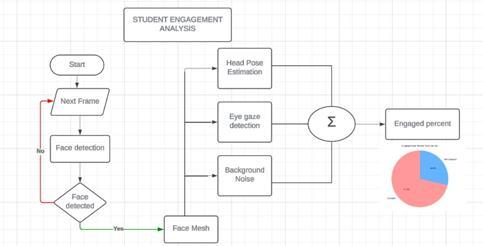
Fig -1:ProposedArchitecture
The Student Engagement Analysis System Architecture processes a real-time video stream to assess student engagement during online learning. The system captures each frame and performs face detection; if no face is detected,itloopstothenextframe.Whenafaceisdetected, theFaceMeshmoduleextractsfaciallandmarks,whichserve as input for three parallel subsystems: Head Pose Estimation, Eye Gaze Detection, and Background Noise Detection. These components analyze the student’s head orientation, gaze direction, and surrounding auditory environment,respectively.Theoutputsofthesesubsystems are aggregated in a summation module to compute the engagementpercentage,whichisthenvisualized(e.g.,apie chart) to classify the student as either "Engaged" or "Not Engaged."Thisarchitectureensuresefficientandreal-time analysis by leveraging modular components to provide insightsintostudentbehaviorandattentionduringonline sessions.
In this area, we offer a thorough rundown of the datasets thatwereusedforthemodel’strainingandtesting.Effective learningofthemodelisensuredbyawell-chosentraining dataset,andtrustworthyevaluationunderavarietyofreal worldscenariosisguaranteedbyastrongtestingdataset.
Thepre-trainedmodelsofMediaPipeareabletogeneralize well across a range of individuals and contexts since they have been trained on extensive, diversified datasets that includeavarietyoffacialphotosandvideos.Comprehensive facialannotationsareincludedinthesedatasets,whichare frequentlyderivedfromopendatasetslike300W,AFLW,and LFW.Thetrainingsetofdataincludesawiderangeofhead positions,facialexpressions,andlightingscenarios,which
improves the model’s real- time recognition of important facetraits.
Becauseofthediversityofthedata,themodelcanfunction wellinreal-worldsettingswithwidelyvaryingfacialangles, lightingconditions,anduserdemographics.Thepre-trained model’sabilitytoidentifyimportantfaciallandmarks,like theeyes,nose,andmouth,isessentialforgazetrackingand attentiveness assessment. These landmarks play a crucial roleinidentifyingaperson’sgazedirection,facialalignment, andminuteshiftsinexpressionthatmayindicatedistraction or attentiveness. The diversity of the training data is essential for enabling real-time processing in a variety of contexts,suchasonlinemeetingsandlivelectures.
Weusedthe300W-LPdatasettotest,aswellastovalidate the model’s accuracy in identifying facial landmarks and headpositions.Inthefieldofcomputervision,thisdatasetis well known for its comprehensive annotations of head positions.The300W-LPdatasetoffersasolidstandardfor assessing the effectiveness of head pose estimation algorithms since it contains thousands of photos with thoroughannotationsoffaciallandmarkstakenwithvarious headpositions.Thedatasetcanbeusedtoassesshowwell theMediaPipemodelholdsupinpracticalsettingsbecauseit includes a variety of facial expressions, occlusions, and lightingconditions.
The images in 300W-LP are captured from a variety of perspectives, including awkward positions, to replicate difficultreal-worldscenarios.Thisguaranteesthatthemodel can accurately identify facial landmarks in challenging scenarios,aswhenthefaceisslantedorpartiallyobscured, in addition to accurately identifying frontal faces. Additionally,thedatasethasavarietyofbackgrounds,which introduces another level of complexity to evaluate the model’sadaptabilitytovarioussettings.Wecanassessthe model’s generalizability and capacity to sustain high performanceinavarietyofscenariosbyusingthisdataset fortesting.Thismakesthemodelsuitableforusageinonline learningenvironmentswherestudentsmayinteractwiththe systeminarangeofscenarios.
Preparing datasets for model training depends on data processingleveragingPandasandKerasDataFrames.Pandas effectivelymanagesmissingvaluesbyimputingordeleting them,thereforeguaranteeingdatasetintegrityandlowering bias. Usually between 0 and 1, normalizing numerical features to a common scalehelps to avoid bigger features controlling the model training process. To reduce dimensionalityandimprovecomputingspeed,unnecessary columns are deleted. Keras DataFrames provide effective data preparation for neural network designs by elegantly interacting with deep learning frameworks. They also preservedataintegritybyhandlingmissingvaluesjustlike Pandasdoes.KerasDataFramesmaximizeresourceuseand
International Research Journal of Engineering and Technology (IRJET) e-ISSN: 2395-0056
Volume: 12 Issue: 01 | Jan 2025 www.irjet.net p-ISSN: 2395-0072
minimize overfitting by normalizing numerical characteristicsand eliminatinguselesscolumns,therefore guaranteeing improved model convergence and performance.
This code initializes MediaPipe’s Face Mesh solution’s settingsforheadposeestimation.Itcreatesvariables(XAXIS CHEATandYAXISCHEAT)totracktheheadposturesonthe X and Y axes, as well as placeholder values for extra modifications. A maximum of two faces with defined detectionandtrackingconfidencelevelscanbedetectedin real-timefromavideofeedusingthe‘mpfacemeshmodule.
A3Darray,‘face3d‘,definesessentialfaciallocations,such asthenosetipandcornersoftheeyesandmouth,whichare crucial for determining head pose orientation. In order to facilitatereal-timeinputforthefacemeshrecognitionand analysis,thecodeadditionallysetsupavideocapturefrom the default camera. The left and right eye corners are designatedastheoriginforgaze-trackingcomputationsby modifyingthe3Dcoordinatesoffaciallandmarks.
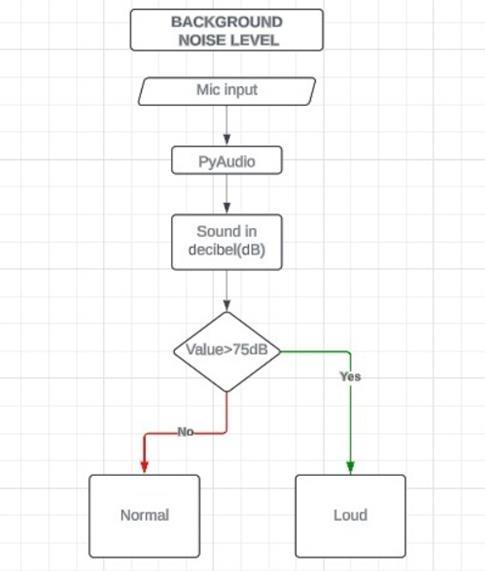
To ensure proper alignment for further analysis, the coordinates of the left eye are adjusted by adding and removing specified values, and the right eye undergoes a similarchange.Inordertofacilitateseamlesstransitionsand the tracking of gaze movements over time, variables are furthersettostorethegazescoresfromthepreviousframe. In order to enable real-time audio input for background noisedetection,thiscodeinitializesthePyAudiolibrary.It usesasinglechannelandabuffersizeof1024framestoset up an audio stream with a sample rate of 44.1 kHz. The programcancontinuallymonitoraudiolevelssincevariables are defined to track the start time of noise detection and whethernoisehasbeendetected.Thisconfigurationmakes itpossibletomonitorambientnoiselevelseffectively,which makes it easier to assess classroom circumstances while analyzingstudentinvolvement.
Promisingoutcomeshavebeenobservedinthemonitoring learning sessions since the real-time attention evaluation systemwasimplementedtoimproveonlineeducation.The system proficiently records and examines a range of indications,includingfacialexpressions,gazepatterns,and interactionbehaviors,bymeansofsmoothintegrationwith widely-usedonlinelearningplatformsandtheutilizationof sophisticated data processing and machine learning techniques.
-3: AnalysisReport
International Research Journal of Engineering and Technology (IRJET) e-ISSN: 2395-0056
Volume: 12 Issue: 01 | Jan 2025 www.irjet.net p-ISSN: 2395-0072
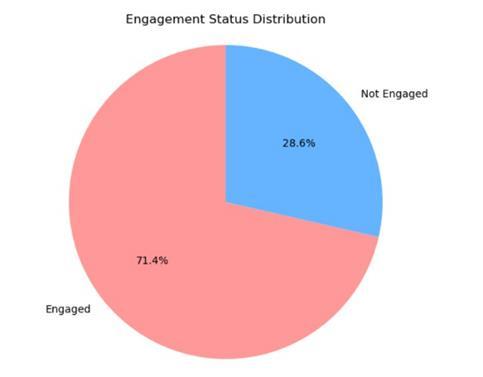
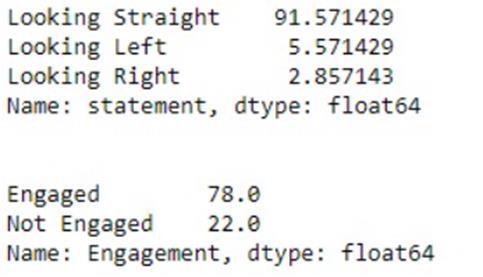
Theoutputdatashowsthatpupilsfocusedprimarilyonthe screen,gazingstraightaheadandenhancementofstudent involvementduringvirtualastounding91.57%ofthetime. Furthermore, the examination of student engagement indicatesthat78%ofthestudentswereclassifiedasengaged duringthesessions,whilstjust22%wereclassifiedasnot involved.Thishighlightstheeffectivenessofthesystemin promoting a more attentive and dynamic learning environment.
In conclusion, the real-time attention evaluation system’s integration of MediaPipe has proven essential in revolutionizingtheonlinelearningenvironment.Celebrated for its effectiveness and real-time processing skills in computer vision tasks, MediaPipe has made it easier to capturefaciallandmarksandgazedirectionwithaccuracy andease.Thesearetwoessentialcomponentsforevaluating studentinvolvement.Teacherscangainvaluableinsightson their students’ attention levels by using MediaPipe’s pretrainedmodelstoexamineavarietyofengagementmarkers. Thisabilityenablespromptinterventionsthatcanimprove learningresultsinadditiontohelpingtodetectwhen kids couldbelosingconcentration.Thesystem’sfunctionalityis furtherenhancedbytheemploymentofsophisticatedgaze estimationalgorithmsinconjunctionwithnoisedetection, enablingeducatorstomodifytheirpedagogicalapproaches to suit the changing needs of their students in virtual settings.
As the system develops via ongoing enhancements and feedback-drivenmodifications,MediaPipecontinuestobea vital component of its success. Real-time alerting systems enableteacherstomakewell-informeddecisionsbasedon up to-date information, creating a virtual learning environment that is more participatory and interesting. Because it promotes active participation, this proactive
strategy to measuring student engagement can enhance academicperformanceandsatisfactionamongstudents.
To further improve the system’s capabilities, future developmentsmightinvolveaddingmorecomplexmachine learning algorithms and broadening the spectrum of observablebehavioralandemotionalsigns.Thereal-time attention assessment system promises to make a big contribution to the future of online education by utilizing MediaPipe’scapabilitiesandkeepingstudentsinterestedand supportedthroughouttheirlearningjourneys.
[1] Hao Wu; Ke Zhang; Guohui Tian. Simultaneous Face Detection and Pose Estimation Using Convolutional NeuralNetworkCascade,IEEE
[2] Li Pengyu, Zhou Zhenkun, Li Haiyan, Zhu Yajing, ”ImprovingCNNModelforResidentialBuildingImage Classification: Enhancing Parameter Estimation Accuracy Through Transfer Learning and Reducing Model Complexity with MobileNet”, 2023 3rd International Signal Processing, Communications and EngineeringManagementConference (ISPCEM),pp.5054,2023.L.Bai,J.
[3] RowleyHA,BalujaS,KanadeT(1998)Neuralnetworkbased face detection. IEEE Trans Pattern Anal Mach Intell20(1):23–38.
[4] Wang, Q.; Qian, W.Z.; Lei, H.; Chen, L. Siamese Neural Pointnet:3DFaceVerificationunderPoseInterference andPartialOcclusion.Electronics2023,12,620.
[5] B.Thaman,T.Cao,N.Caporusso,“FaceMaskDetection usingMediaPipeFacemesh”.
[6] H.Ran,W.Xiang,S.Zhenan,andT.Tieniu,”Wasserstein CNN: learning invariant features for NIR-VIS face recognition,”IEEETransactionsonPatternAnalysisand MachineIntelligence,vol.41,no.7,pp.1761–1773,2018.
[7] Li Pengyu, Zhou Zhenkun, Li Haiyan, Zhu Yajing, “ImprovingCNNModelforResidentialBuildingImage Classification: Enhancing Parameter Estimation Accuracy through Transfer Learning and Reducing Model Complexity with MobileNet”, 2023 3rd International Signal Processing, Communications and EngineeringManagementConference(ISPCEM),pp.5054,2023.
[8] C.Huang,J.Shi,“Real-timeHeadPoseEstimationUsing Deep Neural Networks and Face Landmarks,” IEEE Access,2021.
International Research Journal of Engineering and Technology (IRJET) e-ISSN: 2395-0056
Volume: 12 Issue: 01 | Jan 2025 www.irjet.net p-ISSN: 2395-0072
[9] S. Kumar, A. Sharma, “Efficient Head Pose and Gaze Estimation Using Lightweight CNNs,” arXiv preprint, 2022.
[10] J. Nguyen, T. Pham, “Gaze and Face Detection for AttentionEstimationinOnlineLearningEnvironments,” ACM,2021.
[11] M. Zhou, L. Zheng, ”Real-time Student Engagement DetectionwithGazeEstimation,”IEEETransactionson Education,2022
[12] F.Zhang,Z.Yu,”IntegratingFacialLandmarkDetection andHeadPoseEstimationforReal-TimeGazeTracking,” IETComputerVision,2022.
[13] E.E.Ye,J.E.Ye, J. Ye,J. Ye, R.Ye,”LowcostGeometrybased Eye Gaze Detection using Facial Landmarks GeneratedthroughDeepLearning”.
[14] D. Patel, A. Chattopadhyay, “Real-Time Eye Gaze Estimation for Engagement Tracking in Virtual Classrooms”.
[15] L.Wang,Z.Zhang,Y.Yang,”LightweightFaceandPose EstimationModelsforReal-TimeApplications”.