
International Research Journal of Engineering and Technology (IRJET) e-ISSN: 2395-0056
Volume: 13 Issue: 06 | Jun 2026 www.irjet.net p-ISSN: 2395-0072

International Research Journal of Engineering and Technology (IRJET) e-ISSN: 2395-0056
Volume: 13 Issue: 06 | Jun 2026 www.irjet.net p-ISSN: 2395-0072
Salem Hamdan
1College of Computing, Fahad Bin Sultan University, AIMD Lab, KSA, Tabuk -*** -
Abstract - This project presents a comprehensive and practical Java lab solution aligned with the structure required in soft engineering demands. It covers teamwork, Java GUI development, salary calculation processes, input validation, data presentation, and testing-based output preparation. Once the student adds the required names, IDs, and actual screenshots, the project will be ready for submission as a well-organized and professional course deliverable. It presents promising aspects for enhancements in terms of security, privacy, employing agent software technologytobeeffectiveforsmartcities.
Key Words: Salary, system, method, agent, privacy, smart cities.
An Employee Salary Management System is a software application designed to help organizations manage employee salary information in an accurate, organized, and efficient manner. In many organizations, calculating salariesmanuallycanleadtoerrors,delays,anddifficulties in maintaining employee records. Therefore, using a computerizedsystemhelpssimplifytheprocessofstoringemployeedetails,calculatingsalaries,applyingdeductions or bonuses, and displaying final salary information clearly [1].
This system provides a practical solution for managing basic employee data such as employee name, ID, department,workinghours,basicsalary,allowances,deductions, and net salary. It can also support salary calculations based on predefined rules, reducing the chance of human error and improving the reliability of payroll operations. In addition, the system allows users to view and update salaryrecordseasilythroughasimpleinterface.
From a programming perspective, developing an Employee Salary Management System using Java helps studentsapplyimportantconceptssuchasgraphical user interface design, input validation, conditional statements, calculations, object-oriented programming, and data presentation. The project also provides an opportunity to understand how real-world business applications are designedandimplemented[2]
Overall, the Employee Salary Management System is a useful and practical application that improves salary processing, enhances record management, and supports betterdecision-makingwithinanorganization.
Insmartcities,anEmployeeSalaryManagementSystem plays an important role in supporting efficient, transparent, and data-driven administration. Smart cities depend on digital systems to manage services, institutions, and humanresourceseffectively.Byautomatingsalarycalculation, employee record management, allowances, deductions,andpayroll reports, this system reducesmanual errors and saves time for both employees and administrators. It also supports faster decision-making by providing accurate salary data and organized records. In addition, when connected with other smart city platforms, such as attendance systems, human resource systems, and financialmanagementsystems,itcanhelpimproveinstitutional productivity, accountability, and service quality. Therefore,anEmployeeSalaryManagementSystemisanessential digital tool that contributes to the modernization and efficiencyofsmartcityorganizations[3]
When an Employee Salary Management System is enhanced with advanced technologies such as security mechanisms, big data processing, deep learning, privacy protection, and agent-based software, it becomes more powerful, reliable, and suitable for modern smart city environments. Strong security features protect salary records from unauthorized access, data theft, and manipulation, while privacy protection ensures that sensitive employee information, such as salaries, deductions, and personaldetails,ishandledsafelyandconfidentially.Bigdata techniques allow the system to manage large amounts of employeerecordsacrossdifferentdepartmentsorinstitutions, making payroll analysis and reporting faster and more accurate. Deep learning can support intelligent prediction and decision-making, such as detecting unusual salary transactions, predicting payroll costs, and identifying errors or fraud patterns. In addition, agent-based softwaretechnologycanautomatetaskssuchascollecting attendance data, updating salary records, generating reports,andcommunicatingwithothersystems.Asaresult, theenhancedsystemimprovesefficiency,accuracy,transparency,andtrustinsalarymanagementwithinsmartcity organizations[4]
If these enhancements are ignored in smart cities, an Employee Salary Management System may become weak, unsafe,andunabletomeettheneedsofmodernorganizations.Withoutstrongsecurityandprivacyprotection,sensitive employee data such as salaries, personal information, deductions, and bank details may be exposed to unauthorizedaccess,misuse,orcyber-attacks.Withoutbig datacapabilities,thesystemmayfailtohandlelargenumbersofemployeerecordsacrossdifferentsmartcityinsti-
Volume: 13 Issue: 06 | Jun 2026 www.irjet.net
tutions,leadingtodelays,inaccuratereports,andpoordecision-making.Ignoringdeeplearningmayalsoreducethe system’s ability to detect abnormal salary transactions, payroll fraud, or repeated calculation errors. In addition, withoutagent-basedsoftwaretechnology,manyprocesses mayremainmanual,slow,anddifficulttocoordinatewith othersmartcitysystems.Asaresult,theorganizationmay face financial losses, low employee trust, administrative inefficiency,andseriousprivacyrisks.
The project solves a practical administrative problem. In many small offices, salary information is handled manually using paper forms or basic spreadsheets, which increases the probability of calculation mistakes and duplicate work. This application provides a cleaner interface, validates user input, and stores the added employees inside a table so that the user can review the results immediately.
The implemented system contains a graphical user interface,salaryprocessinglogic,summarystatistics,sample data loading, and row deletion. These features demonstrate the use of Java GUI programming, object-oriented design, arrays or collections, conditional logic, eventdrivenprogramming,anddatapresentationintables.
The project is technically feasible because it is implementedusingstandardJavalibrariesthatareavailableina typical educational environment. No external paid software or database server is required. The system can be compiled and executed through any online Java compiler that supports Swing or through a desktop IDE such as IntelliJIDEA,Eclipse,orNetBeans.
The project is economically feasible because the development cost is very low. It mainly requires students’ programmingeffortandanormalcomputer.Forasmallcompany or laboratory setting, the system can reduce manual salarycalculationtimeand decreasehumanerrors, which provides clear value without additional infrastructure cost.
The project is operationally feasible because the interface is simple and understandable. A staff member only needs to type four input values and click the add button. The result appears directly in the table, and the overall salarystatisticsareupdatedautomatically.Thismakesthe system suitable for demonstration during the project presentation and easy for non-technical users to understand.
The project is academically feasible as well because it maps directly to course learning outcomes: team collaboration,Javacoding,testing,anddocumentation.Itisarealistic lab-scale problem that still demonstrates several importantprogrammingconceptsinoneintegratedsolution
The program is organized around a main class called Employee Salary Management System that extends JFrame. This class creates the application window and all interfacecomponentssuchastextfields,labels,buttons,a combo box for position selection, a table model for displayingemployees,andasummarylabelforlivestatistics.
The Employee inner class is responsible for representing one employee object. It stores the employee name, basic salary, allowance, position, and calculated bonus. A dedicated method computes the total salary by summing the basic salary, allowance, and bonus. This is a good example of encapsulating related data and behavior inside oneobject.
TheaddEmployeemethodisoneofthemostimportant code sections. It reads the user input, checks whether fieldsareempty,convertssalaryvaluesfromtexttonumbers, prevents negative entries, calculates the bonus according to the selected position, and then adds the result to both the internal employee list and the visible JTable. This method also updates the summary and clears the formaftersuccessfulinsertion.
The calculate Bonus method implements the business rule of the project. Different positions receive different bonuspercentages.Thispartdemonstratestheuseofconditional branching through a switch expression. It also makes the program easier to extend later if the company addsnewjobcategoriesorbonuspolicies.
TheupdateSummarymethodcomputesthegrandtotal of all salaries and the average salary for the currently listed employees. This gives the program additional analyticalvaluebeyondonlystoringrows.Theusertherefore obtainsimmediatemanagerial information fromthesame interface.
The load Sample Data method was added to simplify project presentation. During the live demo, students can populate the system quickly with predefined employees andshowhowthetableandsalarysummarychangeinreal time.Thisimprovesdemonstration qualityandreduces theriskoftypingerrorsduringpresentation.
International Research Journal of Engineering and Technology (IRJET) e-ISSN: 2395-0056
Volume: 13 Issue: 06 | Jun 2026 www.irjet.net p-ISSN: 2395-0072
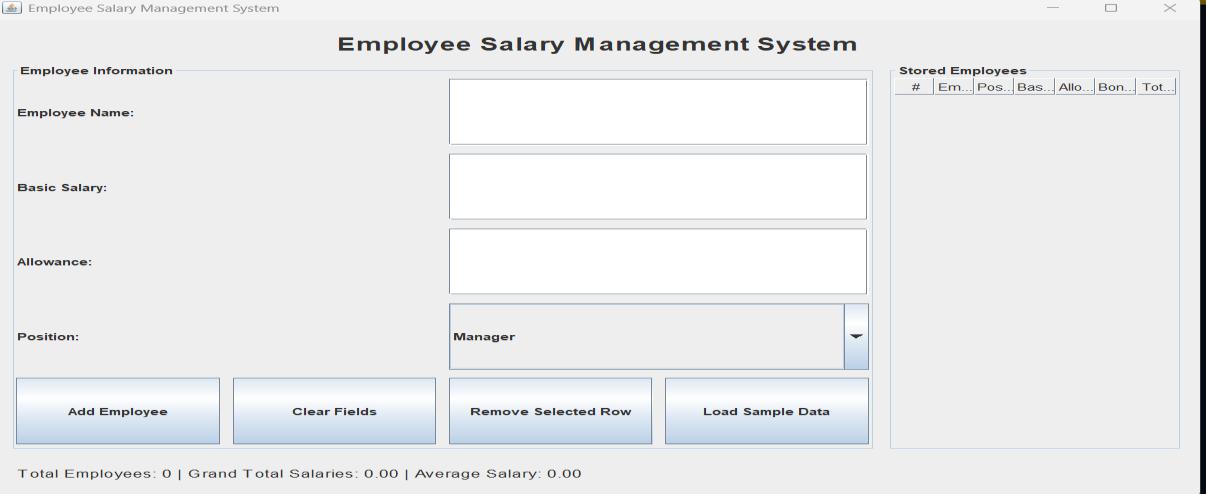
Whentheprogramstarts,theuserseesacleandesktop window withinputcontrols ontheleftsideanda data tableontherightside.Thetitleclearlyidentifiesthesystem asanEmployeeSalaryManagementSystem.
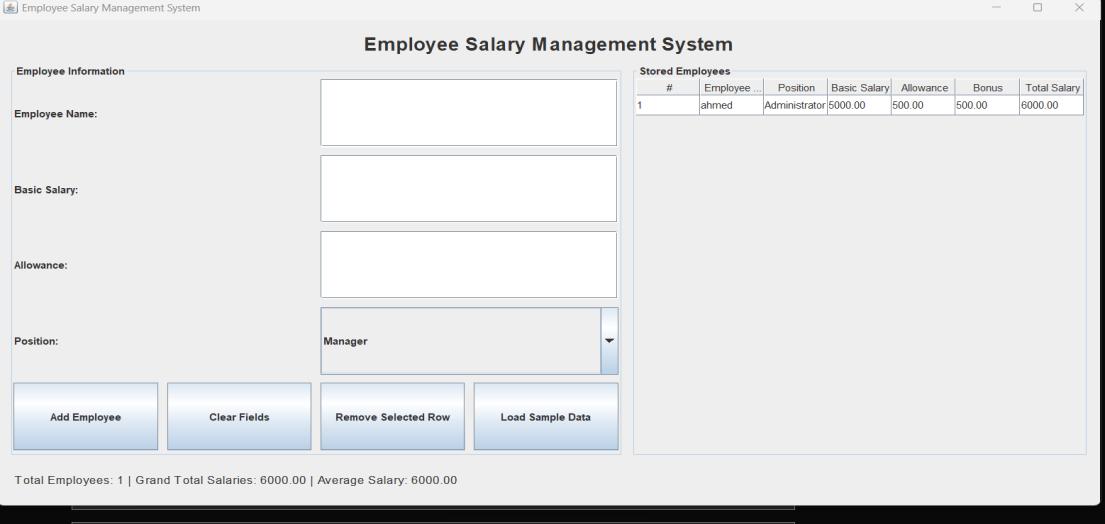
After entering an employee name, basic salary, allowance, and position, the user clicks Add Employee. The applicationcalculatesthebonuspercentagebasedontheposition and inserts a new row into the table. Each row showstheemployeenumber,name,position,basicsalary, allowance,bonus,andtotalsalary.
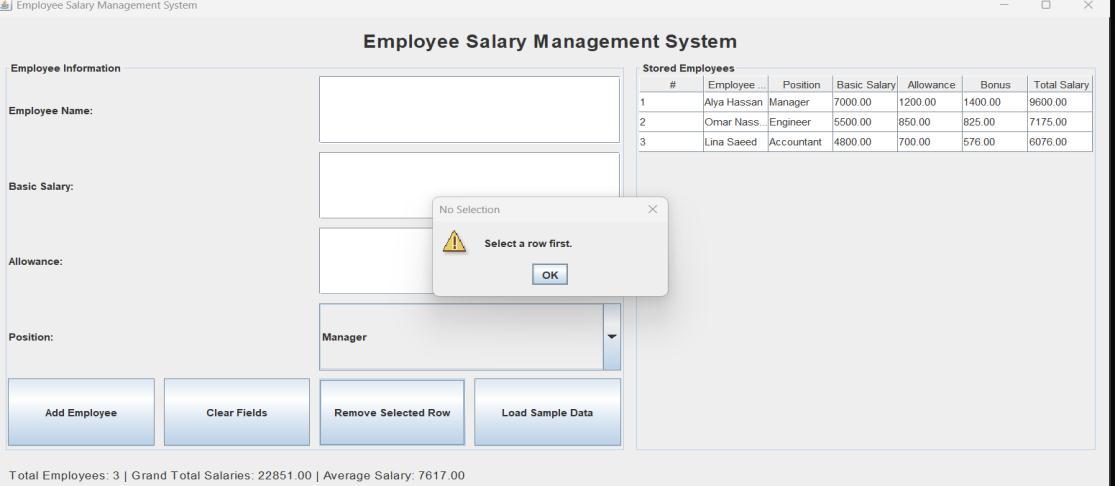
Thesummarylabelatthebottomofthescreendisplays three important outputs: the total number of employees, the grand total of all salaries, and the average salary. If a
row is selected and removed, the system recalculates the summary values automatically. This proves that the systemisdynamicandresponsive.
The following spaces are intentionally prepared so the student can paste real screenshots from execution before final submission. The following figures illustrates the interfacesofthesystem.
Volume: 13 Issue: 06 | Jun 2026 www.irjet.net p-ISSN: 2395-0072
Thereare manychallengesrelatedtothissystem when integrating with smart cities. In smart cities, the sensory dataareconsideredasbigdata,wherespecialdatamining methodshavetobeemployedtoendfunctionalitiesofthe system [5]. In addition, most of systems are supported with AI and deep learning techniques. In this context, whenintegratingthesystemintomedicalsystems,suchas [6,7,8],manyfunctionalitieshavetobetrainedandtested accordingtothebasicstepsofAIdomain.Moreover,security of this system can be enhanced to be of high level of reliabilityinsmartcities,wheresecurityofwebsitesmust be considered in the system will be available for onlineusage[9].Furthermore,thesystemcanbeenhancedusing location based services [10]. In this context, privacy issue mustbeensuredbecauseuserscansearchforthenearest companiestheuserwantstoexplorebasedonhis\herreal location.Actually,manyworksaddressedtheprivacyissue inlocationbasedservices,suchas[11,12,13,14,15].Beyondprivacyprotectionissue,thereisanothersecurityissuerelatedtoenhancethesystembasedonagentsoftware technology. Indeed, agents are common in smart cities to enddailyactivities.Managingsalaryofemployeesinterms ofcollectingtaxes andotherfinancialaspectsrequiresusing mobile agent, which is a mobile code that can travel through all functionalities of the system to collect the desiredreports.Inthiscontext,securityofagentsarecritical duetoattacksthatmaybeappliedbydestinationmachine orbymaninthemiddleattackers.Manyworksaddressed securityofagents,suchas[16,17,18].
Inthefuture,theprojectcanbeenhancedbyconnecting the application to a database such as MySQL so employee recordsremainsavedaftertheprogramcloses.Thiswould maketheprojectmorerealisticforpracticalbusinessuse.
Another improvement would be generating salary reportsinPDForExcel format.Suchreportswouldhelp HR or accounting staff share salary summaries with managementmoreefficiently.
The system can also be extended with user authentication,searchfunctionality,updatefunctionalityforexisting records,taxdeductioncalculations,anddepartment-based filtering. These extensions would transform the current lab project into a more complete payroll management solution.
This project provides a complete and realistic Java lab solution that satisfies the structure requested in the uploaded course template. It demonstrates teamwork, Java GUIprogramming,salarycalculationlogic,validation,data display,andtesting-orientedoutputpreparation.Afterthe student fills in names, IDs, and real screenshots, the projectcanbesubmittedasapolishedcoursedeliverable.
The author take help of ChatGPT to present illustrative figures as well as for proof reading. However, the basic scientificcontentispresentedbytheauthor.
[1] Hao, Zhang, et al. "Salary management system for small and medium-sized enterprises."Physics Procedia24(2012):2255-2260.
[2] Wang,Tianqi,NingLi,andHouranLi."Designanddevelopmentofhuman resourcemanagementcomputer system for enterprise employees."Plos one16.12 (2021):e0261594.
International Research Journal of Engineering and Technology (IRJET) e-ISSN: 2395-0056
Volume: 13 Issue: 06 | Jun 2026 www.irjet.net p-ISSN: 2395-0072
[3] Kaluarachchi, Yamuna. "Implementing data-driven smart city applications for future cities."Smart Cities5.2(2022):455-474.
[4] Berendt, Bettina. "AI for the Common Good?! Pitfalls, challenges, and ethics pen-testing."arXiv preprint arXiv:1810.12847(2018).
[5] Mohamad Shady Alrahhal and Adnan Abi Sen, "Data mining, big data, and artificial intelligence: An overview,challenges,andresearchquestions,"2018.
[6] MonaAlfifi,MohamadShadyAlrahhal,SamirBataineh and Mohammad Mezher, "Enhanced Artificial Intelligence System for Diagnosing and Predicting Breast Cancer using Deep Learning," International Journal of AdvancedComputerScienceandApplications,vol.11, no.7,2020.
[7] MohamadShadyAlrahhalandEftkharAlqhtani,"Deep learning-basedsystemfordetectionoflungcancerusing fusion of features," International Journal of ComputerScienceandMobileComputing,vol.10,no.2,pp. 57-67,2021.
[8] Mohamad Shady Alrahhal and Majed Abdullah Albarrk, "A Survey of the COVID-19 Epidemic Through the Eyes of Artificial Intelligence and Deep Learning: ChallengesandResearchQuestions,"2020.
[9] Majed Abdullah Albarrk and Mohamad Shady Alrahhal, "Web Applications Security: More Collaboration,"2020.
[10] Mohamad Shady Alrahhal, Maher Khemakhem and Kamal Jambi, "A Survey on Privacy of LocationBased Services: Classification, Inference Attacks, and Challenges," Journal of Theoretical and Applied InformationTechnology,vol.95,no.24,2017.
[11] Mohamad Shady Alrahhal, Maher Khemakhem and Kamal Jambi, "Agent-Based System for Efficient kNN Query Processing with Comprehensive Privacy Protection," International Journal of Advanced ComputerScienceandApplications,vol.9,no.1,2018.
[12] Mohamad Shady Alrahhal, Muhammad Usman Ashraf, Adnan Abesen and Sabah Arif, "AES-Route Server Model for Location Based Services in Road Networks," International Journal of Advanced ComputerScienceandApplications,vol.8,no.8,2017.
[13] Hosam Alrahhal et al., "A symbiotic relationship based leader approach for privacy protection in location based services," ISPRS International Journal of Geo-Information,vol.9,no.6,p.408,2020.
[14] Abdullah S. Alyousef, Karthik Srinivasan, MohamadShadyAlrahhal,MajdahAlshammariandMousaAlAkhras, "Preserving Location Privacy in the IoT against Advanced Attacks using Deep Learning," International Journal of Advanced Computer Science andApplications,vol.13,no.1,2022.
[15] Mohamad Shady Alrahhal, Maher Khemekhem and Kamal Jambi, "Achieving load balancing between privacyprotectionlevelandpowerconsumptioninlocationbasedservices,"InternationalResearchJournal of Engineering and Technology, vol. 5, no. 3, pp. 619625,2018.
[16] Bandar Alluhaybi, Mohamad Shady Alrahhal, Ahmed Alzhrani and Vijey Thayananthan, "A Survey: Agent-based Software Technology Under the Eyes of Cyber Security, Security Controls, Attacks and Challenges," International Journal of Advanced Computer ScienceandApplications,vol.10,no.8,2019.
[17] Bandar Alluhaybi, Mohamad Shady Alrahhal, Ahmed Alzhrani and Vijey Thayananthan, "Dummybased approach for protecting mobile agents against malicious destination machines," IEEE Access, vol. 8, pp.129320-129337,2020.
[18] Bandar Alluhaybi, Mohamad Shady Alrahhal, Ahmed Alzhrani and Vijey Thayananthan, "Achieving self-protection and self-communication features for securityofagent-basedsystems,"2020
Install JDK 17 or any recent JDK version that supportsSwing.
Save the source file as EmployeeSalaryManagementSystem.java.
Compile the file using: javac EmployeeSalaryManagementSystem.java
Run the program using: java EmployeeSalaryManagementSystem
For online execution, use a Java environment that supports graphical Swing applications; otherwise,runitlocallyinanIDE.
This appendix provides some details related to implementationstageandhowtorunthesystem.
International Research Journal of Engineering and Technology (IRJET) e-ISSN: 2395-0056
Volume: 13 Issue: 06 | Jun 2026 www.irjet.net p-ISSN: 2395-0072
Component / Method
JTextFieldandJComboBox
DefaultTableModelandJTable
addEmployee()
calculateBonus()
updateSummary()
loadSampleData()
removeSelectedEmployee()
Purpose in the Program
Collectemployeedatafromtheuser.
Displayallinsertedemployeesintabularformat.
Validateinputs,calculatebonus,createemployee object,andappendanewtablerow.
Applysalarypolicybasedonjobposition.
Computetotalemployees,grandtotalsalaries, andaveragesalary.
Insertdemorecordsquicklyforlivepresentation.
Deleteoneselectedrecordandrefreshnumbering andsummary.