
International Research Journal of Engineering and Technology (IRJET) e-ISSN: 2395-0056
Volume: 12 Issue: 04 | Apr 2025 www.irjet.net p-ISSN: 2395-0072
International Research Journal of Engineering and Technology (IRJET) e-ISSN: 2395-0056
Volume: 12 Issue: 04 | Apr 2025 www.irjet.net p-ISSN: 2395-0072
Mowadah Abdulmawlay1 , Salahedin Rehan1,‡ , Sana Ghallab1 , Mahmud Ammar2
‡Advanced Technology and Communication Research Group
1Dept. Electrical and Electronic Engineering, Faculty of Engineering, University of Zawiya, Libya 2Dept. Computer Engineering, Faculty of Engineering, University of Zawiya, Libya ***
Abstract - This paper presents a comprehensive empirical studyofenergyconsumptionwithinanoperationalurbanLTE Radio Access Network (RAN). Using both site-level measurementsandaggregatedmulti-eNBdatacollectedover a typical workweek, the study analyses traffic trends, PRB utilization, and base station power draw across a 24-hour cycle. Results reveal a clear temporal mismatch between network load and energy use, with minimal reduction in power consumption despite significant drops in user activity and PRB utilization during off-peak hours. A linear relationshipbetweenPRButilizationandpowerconsumption is established, exposing a baseline energy overhead largely independent of traffic load. Additionally, component-level measurements from a live site highlight that Remote Radio Units (RRUs) and baseband modules account for most of the energy use, while also uncovering key operational dependencies and startup sequences between network elements. These insights underscore the importance of realworld profiling to support the development of energy-aware RAN designs and optimization strategies grounded in operational realities.
Key Words: RANEnergyProfiling,BaseStationPower,PRB Utilization,UrbanCellularNetworks,GreenCommunications
Theexponentialgrowthinmobiledatademand,drivenby ubiquitous smartphones and bandwidth-intensive applications, has led to a dramatic expansion in cellular infrastructure worldwide. Among the components of a mobilenetwork,theRadioAccessNetwork(RAN)isbyfar the most energy-intensive, with base stations (BSs) alone responsible for up to 80% of the network's total energy consumption [1]. This presents a major sustainability challenge, particularly in urban LTE deployments where densesitelayoutsarecommon,andenergyusageremains largelystaticdespitefluctuatingtrafficloads[2] Inresponse, majorindustryallianceshaveoutlinedstrategicroadmapsto reduce energy consumption in mobile networks, with particular focus on RAN efficiency, hardware modularity, and real-time energy management frameworks [3]. In principle,theenergyconsumptionofabasestationshould vary with user activity and service demand. In practice, however, BSs typically operate at nearly constant power
levelsthroughouttheday,regardlessoftrafficvolume[4]. This inefficiency has spurred considerable interest in developingenergy-savingmechanismssuchascellswitchoff, component-level sleep modes, and AI-driven traffic predictiontoreduceunnecessaryenergyusageduringlowload periods [5–7]. Recent advances in AI-powered RAN optimization have demonstrated promising results in dynamic energy management, allowing base stations to adapt power usage in near real-time based on traffic patterns and environmental conditions [8]. In parallel, standardizationefforts suchasthoseoutlinedby3GPPin TR 36.927 Release 16 have proposed enhancements for energy efficiency in E-UTRAN, including sleep-mode operation, component-level scaling, and intra-/inter-eNB coordinationtechniques[9].
Much of the existing literature has relied heavily on simulations or theoretical modelling to evaluate such energy-savingstrategies.Whilevaluable,theseapproaches often lack real-world validation, particularly in live LTE deployments where network configurations, user distributions, and operational policies may differ significantlyfromtheoreticalassumptions.Recentworkin the 5G and beyond-5G domain has explored numerous energy efficiency frameworks at both the network and component level [10], yet empirical analysis in 4G LTE environments remains sparse. This gap underscores the importanceofempiricalstudiesthatmeasureactualenergy consumptionanditscorrelationwithnetworkload.
Thispapercontributestothisspacebypresentingadetailed energyprofilingstudyofanoperationalLTERANinaNorth African capital city. The analysis is based on two complementary data sources: (1) live power readings collectedon-sitefromamonitoredmacroeNB,whichallow for component-level breakdown of energy usage, and (2) aggregated performance metrics obtained from multiple base stations in the same urban area, capturing trends in usercount,PRButilization,throughput,andinstantaneous powerconsumptionovera24-hourcycle.
Unlikepurelysimulation-basedwork,thisstudygroundsits analysisinreal-worldmeasurements.Keyinsightsinclude the temporal misalignment between traffic demand and powerdraw,thedisproportionateenergyusagebyspecific hardware components, notably RRUs and baseband units,
International Research Journal of Engineering and Technology (IRJET) e-ISSN: 2395-0056
Volume: 12 Issue: 04 | Apr 2025 www.irjet.net p-ISSN: 2395-0072
andaquantifiablelinearcorrelationbetweenPRButilization and total power consumption. In addition, the analysis uncovers critical operational dependencies and startup sequencesbetweennetworkelements,suchastheactivation order of MMUs, BBUs, and RRUs, which are essential considerations when developing practical, energy-aware controlstrategies.Thesefindingsareessentialfordesigning deployment-awareoptimizationmechanismsthatalignwith theoperationalrealitiesofexisting4Gnetworks.
Theremainderofthispaperisorganizedasfollows:Section 2describesthedatasourcesandmethodologyusedinour analysis. Section 3 presents the energy profiling results, includingcomponent-levelandtemporalenergytrendsand discusseskeyfindingsandtheirimplicationsforgreenRAN operations. Finally, Section 4 concludes the paper and outlinesfutureresearchdirections.
Thisstudyisbasedonatwo-foldempiricaldatasetgathered fromaliveLTEnetworkoperatinginaNorthAfricancapital city.Theaimwastoanalysereal-worldenergyconsumption behaviours across urban macro base stations (eNBs), including both temporal usage patterns and internal component-levelpowerdistribution.
2.1.
The analysis covers a cluster of 13 macro-LTE eNBs deployedinadenselypopulatedurbandistrict.TheseeNBs are part of a commercial-grade LTE network and serve a wide range of users under varying daily load conditions. Each site employs typical configurations found in 4G deployments, including multi-sector antennas and standardizedradio/basebandequipment.
2.2.
Twodistinctdatasourceswereused.Thefirstisan aggregatedoperationaldataprovidedbythenetwork operator;thisdatasetincludes:
o Hourlyuserequipment(UE)countspercell
o PRB(PhysicalResourceBlock)utilization
o Throughputmetrics
o Instantaneous power consumption for each eNB. Thesevaluesspanafull24-houroperationalperiodacrossa typical week, enabling temporal analysis of traffic–energy correlation.
The second dataset comprises of site-level power measurements. Livemeasurementswerecollectedduringa field visit to one selected eNB. Using internal monitoring tools and power sensors integrated within the site infrastructure, we recorded the component-wise power
consumption, including Remote Radio Units (RRUs), Baseband Units (BB), and other supportive modules (e.g., MMUs,fans,powerconverters).Thesereadingsformedthe basisforcomponent-levelenergyprofiling.
In line with institutional and operator data-sharing agreements,noproprietaryidentifiers,siteIDs,orinternal namingschemescanbedisclosedinthispaper.Allinsights are reported at an abstracted level and reflect aggregate behaviourpatternsratherthandevice-specificrecords.
The collected data was processed to extract usage trends, visualizecorrelations,andestimatecomponent-wiseenergy contributions.Thefollowingsubsectionspresentthefindings intermsoftemporalpatterns,hardware-levelconsumption, andtraffic–energyrelationshipsobservedacrosstheurban LTERAN.
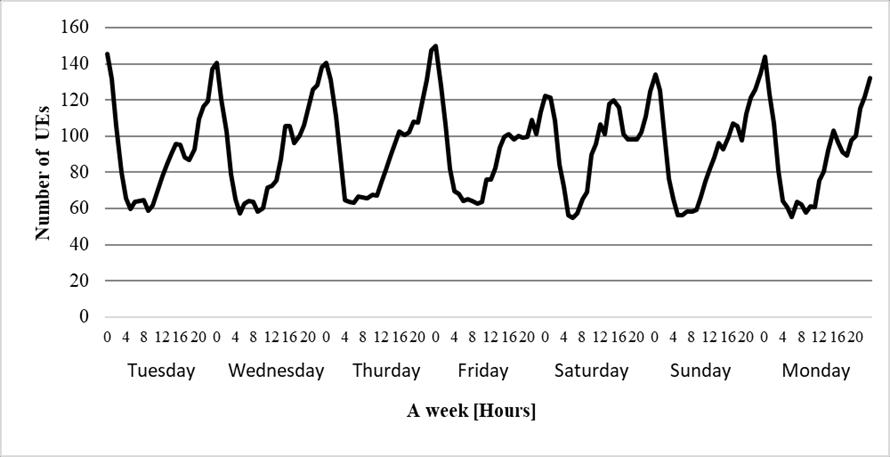
Figure1showsthenumberofuserequipment(UEs)inthe RRC_CONNECTEDmodeoveraperiodofaweekacrossthe 24-hourcycle.Asexpected,networkactivityfollowsadaily trend, with minimal load between4:00 AMand11:00AM andpeakusageoccurringintheeveninghours.Basedonthis behaviour,thenetwork’soperationaltimelinecanbedivided intothreedistinctregions:(i)averylowtrafficperiodfrom 4:00AMto11:00AM,(ii)amoderate-loadperiodfrom11:00 AMto8:00PMandagainbrieflyfrom2:00AMto4:00AM, and(iii)ahigh-demandperiodextendingfrom8:00PMto 2:00 AM. These regions reflect fundamentally different servicedemandsandconstraintsandshouldnotbetreated uniformly in energy management schemes. The early morningwindow(4:00AMto11:00AM),characterizedby network underutilization and abundant idle resources, presents the most viable target for implementing energyefficient mechanisms. In such conditions, a trade-off favouringreducedpowerconsumptionoverpeakspectral efficiency becomes both feasible and beneficial for LTE deployments.
International Research Journal of Engineering and Technology (IRJET) e-ISSN: 2395-0056
Volume: 12 Issue: 04 | Apr 2025 www.irjet.net p-ISSN: 2395-0072
Figure2presentstheaveragePRButilizationacrossthirteen eNBsoverafive-dayweekdayperiod(SundaytoThursday). Weekenddatawasexcludedduetodifferingusagedynamics.
PRButilizationservesasareliableproxyfornetworkload, reflectinghowspectrumresourcesareallocatedovertime. ThetrendhighlightsverylowPRButilizationbetween4:00 AM and 11:00 AM,corresponding to the low-traffic region identifiedearlier.Duringthesehours,averageutilizationfalls to approximately 10%, while in peak hours, particularly between8:00PMand2:00AM,itsurgestoabove80%.This nearly eightfold difference indicates substantial underutilizationofnetworkresourcesduringoff-peakhours.
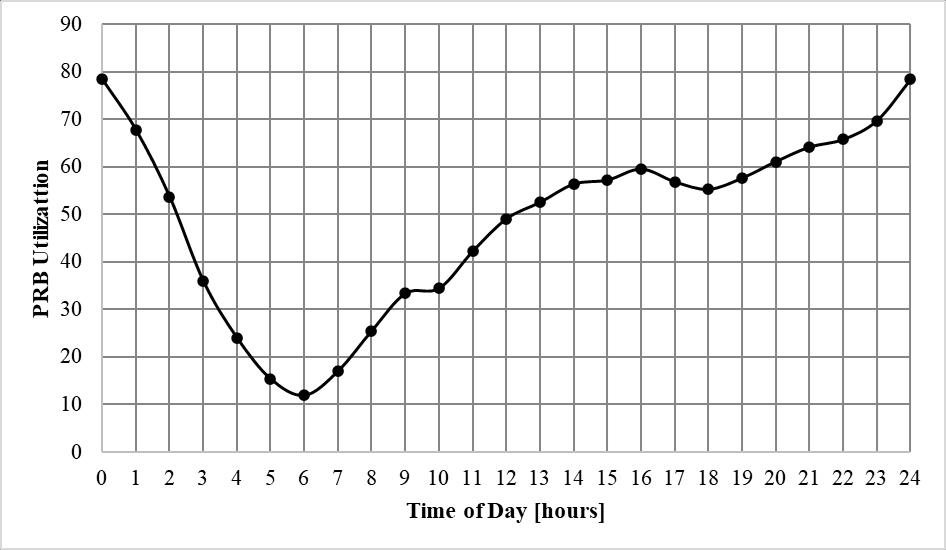
Suchadisparityunderscoresthepotentialforenergy-saving strategies thatalign power usage more closely with actual traffic demand. The early morning window, in particular, presents a compelling opportunity for adaptive energy managementinLTEnetworks.
Figure 3 illustrates the average instantaneous power consumption over working days (Sunday to Thursday). Although network traffic shows significant fluctuation throughouttheday,powerconsumptionremainsrelatively stable, with only about a 25% reduction from peak to offpeakhours.Thisisinstarkcontrasttothe80%dropinPRB utilizationobservedoverthesameperiod.
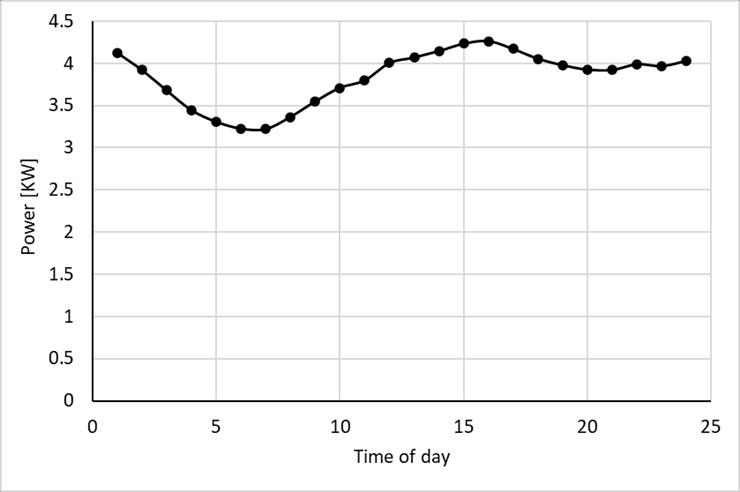
This mismatchclearlyhighlights the inefficiency in energy scaling within the LTE RAN, where hardware components remainfullypoweredevenwhentrafficisminimal.Theearly morningwindow,combininglowPRButilizationwithnearly fullpowerdraw,representsazoneofexcessiveenergywaste and underutilized capacity. These findings emphasize the importanceofunderstandingnotonlyhowtrafficvaries,but also how energy is consumed at the base station level in responsetoload.
The observed relationship between PRB utilization and powersupportstheideathatenergyefficiencyenhancements arebothnecessaryandfeasible,particularlywhenguidedby accurate,real-worlddata.
A correlation analysis was performed between PRB utilizationandinstantaneouspowerconsumptionacrossthe 13eNBsaveragedoverfiveweekdays.AsshowninFigure4,a linear relationship was observed, approximated by the model,where y representspowerconsumptioninkilowatts and x denotesPRButilizationasapercentage.
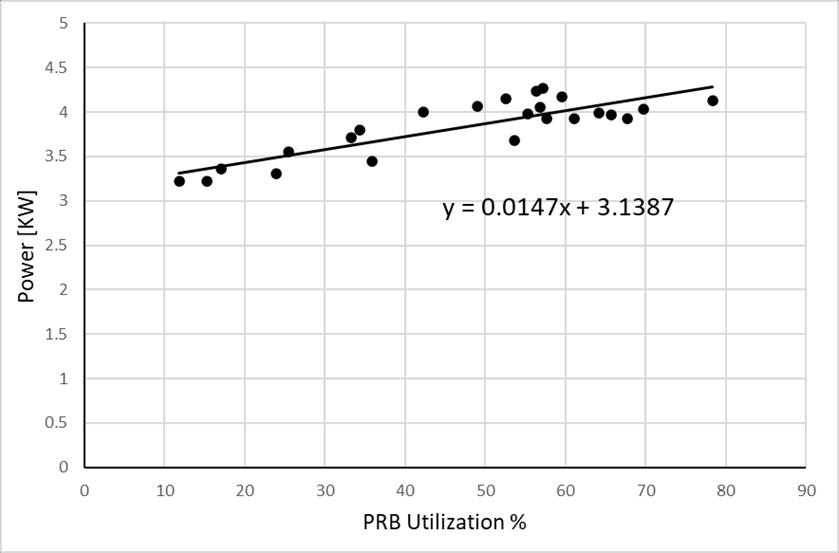
Thismodelindicatesthateach1%increaseinPRButilization contributesonly0.0147kWofadditionalpowerdraw while thebasestationstillconsumesapproximately3.14kWeven whenitisidle,withnouserdatatotransmit.Thishighlightsa structuralenergyinefficiency,wherethemajorityofpower expenditureistiedtobaselineoperationratherthanactive traffic handling. The simplicity and consistency of this correlationmakeitausefulempiricaltoolforestimatingsitelevel energy needs under varying traffic loads, and it reinforcesthepotentialforload-awareenergymanagement inLTEnetworks.
ThestudyincludedadetailedassessmentofalivemacroeNB site operating in a densely populated urban area. The site features standard components found in commercial LTE
International Research Journal of Engineering and Technology (IRJET) e-ISSN: 2395-0056
Volume: 12 Issue: 04 | Apr 2025 www.irjet.net p-ISSN: 2395-0072
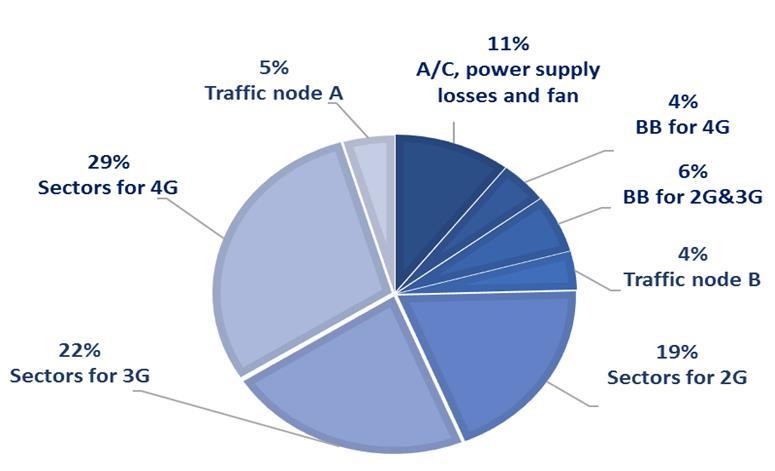
deployments:apowersupplyunit(comprisingrectifiers,a controller,andaDC-UDunit),aMemoryManagementUnit (MMU),twobasebandunits(BBUs)supporting2G–3Gand4G RRUs,RemoteRadioUnits(RRUs)mountedonthetower,and anintegratedcoolingsystem.Thesiteisdesignedtooperate atfullloadusingbothdirectpowerinputandbackupbattery capacity.Innormalconditions,thesystemdrawsaconstant 48 A. The battery bank, consisting of sealed non-spillable batteriesratedat63–100Ah,allowsforoff-gridoperationof upto8hours,withexpansionunderwaytoextendautonomy upto24hours.
Figure5presentsthepowerconsumptiondistributionamong these components. RRUs and BBUs constitute the largest share of energy usage, while the MMU, power conversion system,andcoolingunitconsume relativelyless.The total sitepowerlossduetoheatandmiscellaneousinefficienciesis reportedtobearound2%oftheinput,with98%converted intousableDCoutput.
In addition to quantifying energy distribution, operational startupdependenciesbetweencomponentswereobserved. The MMU is the first component to activate, establishing communication with the core network controller to authenticate and fetch permissions, licenses, and security credentials. It then initiates the boot-up sequence of the BBUs,whichinturnactivatetheirrespectiveRRUs.Thefull startup process, depending on RNC response times and backhaullatency,takesapproximately10to15minutes,with eachstagerequiring3to5minutes.
Whilemanyenergy-savingstrategiesaretypicallyevaluated throughsimulations,real-worldmeasurementsrevealsubtle inefficiencies, static configurations, and component-level dynamics that simulations often overlook. This reinforces recentobservationsintheliteraturethatwhileRANenergy efficiencyisemphasizedinstandardsandacademicmodels, its adoption in operational environments remains inconsistent and highly context dependent [11]. A deep understanding of both energy distribution and startup sequencingisessential notonlyforaccurateprofiling,but also for informing future optimization strategies such as
intelligent scheduling, adaptive resource management, or selectivecomponentscaling.Thisstudycontributestoclosing that gap and provides concrete guidance for data-driven, energy-awareRANdesign.
Thisstudypresentedadetailedempiricalprofilingofenergy consumptioninanoperationalurbanLTERAN,usingboth aggregatednetworkperformancedataanddirectsite-level measurements.Theanalysisrevealedsignificanttemporal mismatchesbetweenuserdemandandenergyuse,withbase stations consuming nearly constant power despite major fluctuationsinPRButilizationandactiveusers.
Bysegmentingthenetworkloadprofileintodistinct operational regions, we identified a clear opportunity for energy optimization during low-traffic hours, particularly between 4:00 AM and 11:00 AM. The observed linear correlationbetweenPRButilizationandpowerconsumption highlightshowminortrafficvariationscontributeminimally toenergysavingsundercurrentconfigurations.Moreover, component-level measurements confirmed that RRUs and baseband units dominate energy use, while also revealing thestartupdependenciesandtimingrequirementsbetween functionalblockssuchasMMUsandRRUs.
[1] M. A. Imran, E. Yaqub, and R. Tafazolli, “Energy Efficiency in 5G Networks: A Holistic Overview,” IEEE Access,vol.9,pp.123105–123124,2021.
[2] ITU-T, “ICTs for e-Environment,” International Telecommunication Union, 2021. [Online]. Available: https://www.itu.int
[3] NGMNAlliance,ARoadmaptoEnergyEfficientMobile Networks, Next Generation Mobile Networks (NGMN) Alliance, July 2024. [Online]. Available: https://www.ngmn.org/wpcontent/uploads/GFN_Energy_Efficiency_Roadmap_V1.0 .pdf
[4] C.Turyagyenda,D.K.Kwayu,andC.A.Shonubi,“Energy Savingin5GNetworksThroughAdaptiveSleepModes: AReview,”IEEEAccess,vol.10,pp.8415–8430,2022.
[5] M. El-Khamy, H. Yoo, and J. Lee, “AI-Driven Network Optimization for Green RAN Operations,” IEEE Communications Magazine, vol. 60, no. 11, pp. 73–79, Nov.2022.
[6] A. Zappone, M. Di Renzo, and M. Debbah, “Understanding, Modeling, and Analyzing Wireless Networks: From Shannon to Machine Learning and Beyond,”IEEEAccess,vol.7,pp.167229–167245,2019.
International Research Journal of Engineering and Technology (IRJET) e-ISSN: 2395-0056
Volume: 12 Issue: 04 | Apr 2025 www.irjet.net p-ISSN: 2395-0072
[7] T.K.Chien,L.C.Wang,andS.C.Lin,“EnergyEfficiency AnalysisofLTESmallCellNetworks,”IEEETransactions onVehicularTechnology,vol.69,no.6,pp.6480–6493, June2020.
[8] P.Sharma,M.Olsson,andH.Kang,“AI-poweredRAN:An Energy Efficiency Breakthrough,” Ericsson Blog, Jan. 2023. [Online]. Available: https://www.ericsson.com/en/blog/2023/1/aipowered-ran-energy-efficiency
[9] 3GPP,TR36.927V16.0.0:EnergySavingEnhancements for E-UTRAN – Stage 2 (Release 16), 3rd Generation PartnershipProject,July2020.
[10] A. Ichimescu, S. Dobrescu, and V. Constantin, “Energy Efficiencyfor5GandBeyond5G:Potential,Limitations, andFutureDirections,”Sensors,vol.24,no.22,p.7402, 2024.
[11] L. Kundu, X. Lin, and R. Gadiyar, “Towards Energy Efficient RAN: From Industry Standards to Trending Practice,”arXivpreprint,arXiv:2402.11993,2024.
2025, IRJET | Impact Factor value: 8.315 |