
International Research Journal of Engineering and Technology (IRJET) e-ISSN: 2395-0056
Volume: 13 Issue: 06 | Jun 2026 www.irjet.net p-ISSN: 2395-0072
International Research Journal of Engineering and Technology (IRJET) e-ISSN: 2395-0056
Volume: 13 Issue: 06 | Jun 2026 www.irjet.net p-ISSN: 2395-0072
Pranay Vallal1 , Devraj Sidral2 , Nayan Falmari3, Prof. V. S. Birajdar4
4Professor, 123Dept. of civil Engineering, SES Polytechnic, Maharashtra, India
Abstract - The construction industry is rapidly transforming with the adoption of advanced digital technologies such as Artificial Intelligence (AI), Machine Learning (ML), and Building Information Modeling (BIM). This project focuses on the application of AI/ML techniques in construction management along with the use of Navisworks modelingforefficientprojectplanning,coordination, and visualization. Artificial Intelligence and Machine Learning help improve construction productivity by analyzing large volumes of project data to predict risks, optimize scheduling, enhance resource utilization, and reduce project delays. AI/ML algorithms assist engineers in decisionmaking processes such as cost estimation, safety monitoring, quality control, andconstruction delay prediction. These technologies enable automated analysis of site conditions, detection of potential conflicts, and improvement in overall project performance. Navisworks, a powerful BIM coordination software, is used for integrating 3D models from various disciplines including architectural, structural, and MEP components. Itallowsclashdetection,4D constructionsimulation, project visualization, and coordination among stakeholders. Navisworks helps identify design conflicts before construction begins, minimizing rework,savingtime, andreducingprojectcosts.The integration of AI/ML with Navisworks modeling creates a smart construction environment where data-driven insights support planning, monitoring, and execution of projects. This combination enhances collaboration, improves safety standards, increases accuracy, and promotes sustainableconstructionpractices.Overall,thestudy demonstrates how digital technologies are revolutionizing traditional construction methods and contributing toward intelligent, efficient, and moderninfrastructuredevelopment.
Key Words: Smart Construction, Sustainable Infrastructure, Construction Automation, Project Management, Smart Cities.
The construction industry is rapidly transforming with the adoption of modern digital technologies. Among these technologies, Artificial Intelligence (AI), Machine Learning (ML), and Navisworks software play an important role in improving construction planning, design coordination, and project management. These tools help engineers complete projects more efficiently, safely, and economically.
ArtificialIntelligencereferstotheabilityofmachines or computer systems to perform tasks that usually require human intelligence. AI systems can analyze data, recognize patterns, make decisions, and solve problems automatically. In civil engineering and construction, AI is used for project scheduling, risk analysis,automateddesign,equipment management, andsafetymonitoring.AIhelpsreducehuman errors and improves productivity by providing intelligent solutionsbasedonreal-timedata.
Machine Learning is a branch of AI that enables computersto learn from historical data and improve theirperformancewithoutmanualprogramming.ML algorithms analyze past construction project data such as cost, duration, weather conditions, labor productivity, and material usage. Based on this information, ML models can predict construction delays, estimate project costs, optimize resource allocation, and enhancequalitycontrol.ML supports data-driven decision-making and helps construction companiesminimizerisks.
Navisworks is advanced project review and coordinationsoftwaredevelopedbyAutodesk,widely used in Building Information Modeling (BIM). It allows professionals to integrate architectural, structural,andMEPmodelsintoasinglecoordinated 3D environment. Navisworks provides features such
International Research Journal of Engineering and Technology (IRJET) e-ISSN: 2395-0056
Volume: 13 Issue: 06 | Jun 2026 www.irjet.net p-ISSN: 2395-0072
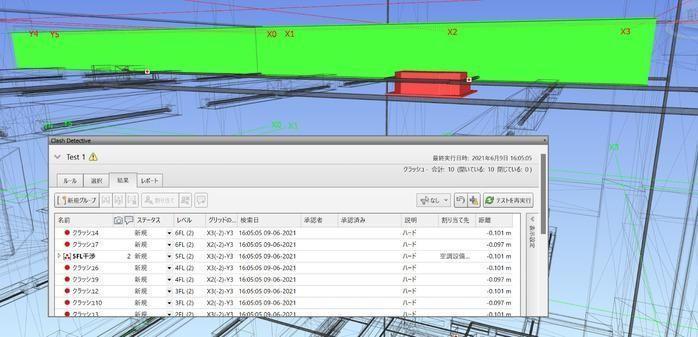
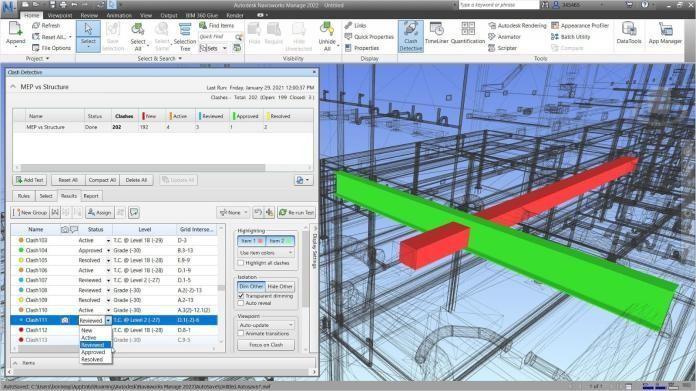
as clash detection, 4D construction simulation, model visualization, and project coordination. Clash detection identifies conflicts between different building components before construction begins, savingtimeandreducingreworkcosts.
The combination of AI/ML with Navisworks enhances construction management by enabling intelligent analysis of BIM models. AI can analyze model data for risk prediction and scheduling optimization, whileML algorithms improve planning accuracy using previous project information. Together, these technologies improve collaboration, increase efficiency, and support smart construction practices.
The construction industry has traditionally faced problems such as design conflicts, poor communication between disciplines, construction delays, cost overruns, and rework. With increasing project complexity, traditional 2D drawings became insufficientforeffectiveprojectcoordination.
To overcome these challenges, Building Information
Modeling (BIM) emerged as a digital approach that integrates architectural, structural, and MEP (Mechanical, Electrical, and Plumbing) information into a unified 3D environment. BIM enables visualization, collaboration, and lifecycle managementofconstructionprojects.
WithintheBIMecosystem,AutodeskNavisworkswas developed as advanced project review and coordinationsoftware.
Navisworks originated as a model aggregation and visualizationtoolandlaterbecamepartofAutodesk’s BIMsolutions.Thesoftwareevolvedtosupport:
Multi-disciplinary model integration
Constructionsimulation
Projectcoordination
Clashdetectionandissuetracking
Today, Navisworks acts as a central coordination platformconnectingmodelscreatedinsoftwaresuch as Revit, AutoCAD, Tekla Structures, and other BIM tools.
Navisworks allows users to combine models from different sources into a single integrated project model, improving communication between project stakeholdersAutodeskHelp
Modern research in construction management focuses on improvingprojectefficiencythroughdigital tools. Navisworks plays a critical role in BIM-based researchbecauseitenables:
a)
Different engineering teams work separately during design. Navisworks integrates all models to create a unified digital environment for coordination and collaboration
b)
OneofthemostresearchedapplicationsofNavisworks isclashdetection.Itidentifiesconflictssuchas:
Pipepassingthroughbeam
HVACductintersectingwall
Electricalsystemblockingstructuralelements
Detectingclashes atthedesignstage preventscostlysitereworkanddelays.
Novatr
Navisworksenables:
4D Simulation → Linking construction schedulewith3Dmodels
5D Simulation → Integration of cost estimationandquantitytake-off These capabilities help planners visualize construction sequences and predict project performancebeforeactualconstructionbegins. AutodeskHelp
d)
ResearchersuseNavisworksfor:
ProjectvisualizationRiskanalysis
SafetyplanningConstructabilityreview
Real-time navigation and review tools help engineers understand design intent clearly andmakeinformeddecisions.
International Research Journal of Engineering and Technology (IRJET) e-ISSN: 2395-0056
Volume: 13 Issue: 06 | Jun 2026 www.irjet.net p-ISSN: 2395-0072
AI and MachineLearning (ML) are revolutionizing construction by automating tasks, enhancing decision-making, and boosting efficiency across the projectlifecycle,frompredictiveplanning(cost,time, risk) and smart scheduling to on-site safety monitoring (drowsiness detection, PPE compliance via computer vision) and structural health monitoring,usingtechniqueslikeDeepLearning(DL) for image analysis, predictive analytics for maintenance, and Generative Design for optimized blueprints, significantly reducing errors and overruns. Key areas for research include BIM integration, advanced computer vision for quality/safety, IoT data fusion, predictive maintenance models, and sustainable resource management.
Navisworks is powerful project review software developed by Autodesk that is widely used in the architecture, engineering, and construction (AEC) industry. It allows professionals to combine 3D models from different design software into a single integrated model for better visualization, coordination, and analysis of construction projects. Navisworks plays a key role in Building Information Modeling (BIM) workflows by helping teams review designs before construction begins. It supports files from various software such as AutoCAD, Revit, and other 3D modeling tools, making it easier to collaborate across different disciplines like civil, structural, and MEP (Mechanical, Electrical, and Plumbing).
Thescopeofthisprojectistostudyandunderstandthe role of modern technologies in civil engineering, mainlyBuildingInformationModelling(BIM),Artificial
Intelligence (AI), and Machine Learning (ML). The projectfocusesonexplainingtheirbasicconcepts,uses, and importance in the construction industry. This projectincludesthe study ofBIM asa digital toolused for creating 3D models of buildings and structures. It covers how BIM helps in planning, designing, cost estimation, scheduling, and overall management of construction projects. It also explains how BIM improvescoordinationbetweendifferentprofessionals likeengineers,architects,andcontractors,whichhelps in reducing errors and saving time. The scope also covers the study of AI and ML in construction. It explainshowthesetechnologiesareusedforanalyzing data, predicting risks, improving safety, and maintaining quality in construction work. The project also looks at how AI and ML help in decision-making and increase efficiency on construction sites. Another importantpartofthescopeistounderstandhowBIM, AI, and ML can be used together. The combination of these technologies makes construction work more advanced, accurate, and reliable. It also helps in better use of materials and reduces wastage, which is beneficial for the environment. This project is mainly based on theoretical study and general understanding. It does not include detailed practical work, software training, or real-time project implementation. However,itprovidesastrongbasicknowledgeofthese moderntechnologies.
The integration of Artificial Intelligence (AI), Machine Learning(ML),andNavisworksrepresentsasignificant advancementinmodernconstructionmanagementand Building Information Modeling (BIM). AI and ML technologies enhance construction processes by enabling intelligent decision-making, automation, and predictive analysis, while Navisworks serves as a powerful platform for project coordination, 3D model integration,andclashdetection.
AI/ML techniques improve project efficiency by analyzinglargeconstructiondatasetstopredictdelays, optimize scheduling, enhance safety monitoring, and reduceprojectrisks.WhencombinedwithNavisworks, these technologies allow engineers and project managers to visualize construction workflows, detect conflicts before execution, and improve collaboration amongstakeholders.
The adoption of AI/ML with Navisworks leads to reduced construction costs, improved accuracy, minimizedrework,andbetterresourcemanagement.It also supports digital transformation in civil engineering by enabling smart construction practices and data-driven project management. In conclusion, thecombinationofAI/MLandNavisworksplaysavital
International Research Journal of Engineering and Technology (IRJET) e-ISSN: 2395-0056
Volume: 13 Issue: 06 | Jun 2026 www.irjet.net p-ISSN: 2395-0072
role in the future of the construction industry, promoting smarter planning, efficient execution, and sustainable infrastructure development. As technology continues to evolve, their integration will become essential for achieving higher productivity, safety, and quality in construction projects. In conclusion, the combination of BIM and AI/ML is revolutionizing the construction industry by making it more smart, efficient, and data-driven. Tools like Autodesk Navisworks demonstrate how intelligent systems can improve clash detection and provide smart solutions. This integration not only enhances productivity and reduces errors but also supports sustainable and future-ready construction practices. As adoption increases, BIM with AI/ML will become an essential partofmodernconstructionprojects.
REFERENCES
[1] Integrating Artificial Intelligence and BIM in Construction:ASystematicReviewBuildingsand CivilEngineeringWorksusingBIM.
[2] Applications of Machine Learning to BIM: A SystematicReview
[3] Application of Artificial Intelligence Tools with BIMTechnologyinConstructionManagement
[4] Filtering Clashes Using Machine Learning + Navisworks
[5] BIM Techniques for Clash Detection Using Navisworks(2023)
[6] BIM Clash Detection in Residential Complex (CaseStudy).
BIOGRAPHIES



PranayVallalDept:-CivilEngg
DevrajSidralDept:-CivilEngg
NayanFalmariDept:-CivilEngg