
International Research Journal of Engineering and Technology (IRJET) e-ISSN: 2395-0056
Volume: 13 Issue: 05 | May 2026 www.irjet.net p-ISSN: 2395-0072
International Research Journal of Engineering and Technology (IRJET) e-ISSN: 2395-0056
Volume: 13 Issue: 05 | May 2026 www.irjet.net p-ISSN: 2395-0072
Shivani Tatyaso Patil1, Rohan Jayawant Patil2, Sujal Pratap Anugade3, V. A. Mali4
123Department of Electronics and Computer Science Engineering
Padmabhooshan Vasantraodada Patil Institute of Technology, Maharashtra, India Guide: Prof. V. A. Mali.
Abstract - Attendance in classrooms and workplaces is usually recorded manually, which can be time-consuming and prone to errors such as proxy attendance. To overcome theseissues,thisprojectpresentsaSmartAttendanceSystem based on IoT and embedded technology using face recognition.
The system is built using a Raspberry Pi connected to a camera module, which captures images and detects faces in real time. Once a person is recognized, their attendance is automatically recorded within a defined time period. The data is then stored in Firebase, enabling real-time updates and easy access through a web or mobile dashboard. The proposed system reduces manual effort, improves accuracy, and provides a faster and more reliable way of managing attendance. It is suitable for use in schools, colleges, and workplaces. Overall, this solution offers a practical approach to modernizing traditional attendance systems using low-cost and efficient technology.
Key Words: Face Recognition, Smart Attendance System, InternetofThings(IoT),RaspberryPi,Firebase,Real-Time Database, OpenCV, LBPH Algorithm, Haar Cascade Classifier,EmbeddedSystem.
In educational institutions and workplaces, maintaining attendanceisanessentialtaskthathelpstrackparticipation and discipline. Traditionally, attendance is recorded manuallyusingregistersorspreadsheets.Althoughsimple, thismethodistime-consuming,pronetohumanerror,and can easily be manipulated through proxy attendance. As organizations move towards digital solutions, there is a growing need for a more efficient and reliable attendance managementsystem.
With the advancement of Internet of Things (IoT) and embedded systems, automation has become more accessible and cost-effective. At the same time, face recognition technology has gained popularity as a secure and contactless method of identification. Combining these technologies makes it possible to develop an intelligent system that can automatically mark attendance without requiringmanualinput.
ThisprojectproposesaSmartAttendanceSystemthatuses aRaspberryPiandacameramoduletocaptureandprocess facial data in real time. The system detects and recognizes individuals using image processing techniques, and once a match is found, attendance is recorded automatically. To ensurereal-timeaccessanddatasynchronization,Firebase is used as a cloud-based database, allowing attendance recordstobeviewedthroughawebormobileinterface.
Themainobjectiveofthissystemistoreducemanualeffort, improve accuracy, and prevent proxy attendance. It is designedtobesimple,cost-effective,andsuitableforusein classrooms,offices,andothersmall-scaleenvironments.By integrating IoT, embedded systems, and face recognition, this project demonstrates a practical approach to modernizingtraditionalattendancemethods.
Traditional attendance systems in schools and workplaces aremostlymanual,makingthemtime-consumingandprone to errors such as proxy attendance. Existing automated methods like RFID and fingerprint systems also have limitations, including misuse, hardware dependency, and lackofreal-timeaccess.
Therefore, there is a need for a smart, contactless, and reliable attendance system that can automatically identify individualsandrecordattendanceaccuratelywithminimal human intervention. This project addresses these challengesbyusingfacerecognitionandIoTtechnologyto provideanefficientandsecureattendancesolution.
Themainobjectiveofthisprojectistodevelopasmartand automated attendance system using face recognition and IoTtechnologies.Thespecificobjectivesareasfollows:
• Todesignandimplementafacerecognition-based systemforautomaticattendancemarking.
• TointegrateaRaspberryPiwithacameramodule forreal-timeimagecaptureandprocessing.
• To develop a system that records attendance accurately within a defined time period without manualintervention.
International Research Journal of Engineering and Technology (IRJET) e-ISSN: 2395-0056
Volume: 13 Issue: 05 | May 2026 www.irjet.net p-ISSN: 2395-0072
• To store and manage attendance data using Firebaseforreal-timeaccessandsynchronization.
• To reduce proxy attendance and improve the reliabilityofattendancerecords.
• To create a cost-effective and easy-to-use solution suitableforclassroomsandworkplaces.
Various methods have been developed to automate attendancesystemsandovercomethelimitationsofmanual processes. RFID-based systems are commonly used due to their simplicity, but they are prone to proxy attendance as cardscanbeshared.Biometricsystems,suchasfingerprint recognition, provide better accuracy but require physical contactandadditionalhardware.
QRcode-basedsystemsofferaneasyandlow-costsolution; however, they depend on user participation and can be misused. More advanced approaches use face recognition technology, which allows contactless and automated attendancemarking.Thesesystemstypicallyusetechniques like Haar Cascade for detection and LBPH for recognition, but their performance may be affected by lighting conditions.
Based onthese observations, thereisa need fora reliable, contactless,andreal-timeattendancesystem.Theproposed system addresses these challenges by integrating face recognition with IoT and cloud-based storage for efficient andautomatedattendancemanagement.
System Technology Used Limitations
RFIDAttendance System RFIDCards Proxy attendance possible
Fingerprint System Biometric Sensor Requires physicalcontact
QRCodeSystem QRScanner Easytomisuse
FaceRecognition System OpenCV+LBPH Sensitiveto lighting
Proposed System IoT+Face Recognition Improved automation
5.
The proposed system is an Embedded IoT-based Face Recognition Attendance System designed to automate the attendancemarkingprocessineducationalinstitutions.
The system uses facial recognition technology to identify students and mark attendance automatically without manualintervention.
The system consists of a Raspberry Pi, camera module, OpenCV library, LBPH face recognition algorithm, and FirebaseRealtimeDatabase.Thecameracapturesreal-time images of students, and the Raspberry Pi processes the capturedimagesforfacedetectionandrecognition.
Initially, the system detects faces using the Haar Cascade Classifier.Afterdetection,theLBPHalgorithmcomparesthe detectedfacewiththetraineddatasetstoredinthesystem. Ifthefacematchessuccessfully,thestudentisidentifiedand attendanceismarkedautomatically.
The attendance details, including student ID, name, date, and time,arestoredin the FirebaseRealtimeDatabase for real-timeaccessandmonitoring.Thesystemalsoprevents duplicateattendanceentriesforthesamesession.
The proposed system reduces manual effort, minimizes proxy attendance, improves accuracy, and provides a fast and efficient attendance management solution using embeddedandIoTtechnologies.
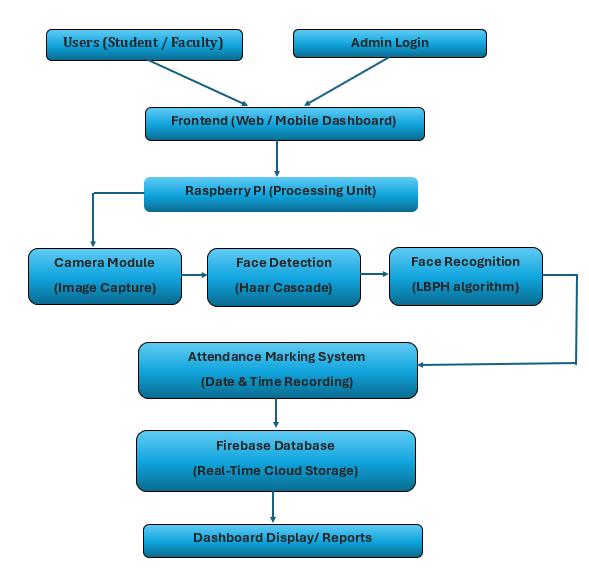
1: ProposedSystem
The proposed system is an Embedded IoT-based Face RecognitionAttendanceSystemdevelopedtoautomatethe attendance process. The system uses a camera module to capturereal-timeimages,whiletheRaspberryPiactsasthe mainprocessingunit.
The captured images are processed using the OpenCV libraryforfacedetectionandrecognition.TheHaarCascade algorithmisusedtodetectfaces,andtheLBPHalgorithmis
International Research Journal of Engineering and Technology (IRJET) e-ISSN: 2395-0056
Volume: 13 Issue: 05 | May 2026 www.irjet.net p-ISSN: 2395-0072
used to recognize registered students by comparing facial featureswiththestoreddataset.
Onceastudentisrecognizedsuccessfully,theattendanceis marked automatically. The attendance details such as studentname,ID,date,andtimearestoredintheFirebase RealtimeDatabaseforreal-timeaccessandmonitoring.
The system helps reduce manual effort, prevents proxy attendance, and provides an efficient and automated attendancemanagementsolution.
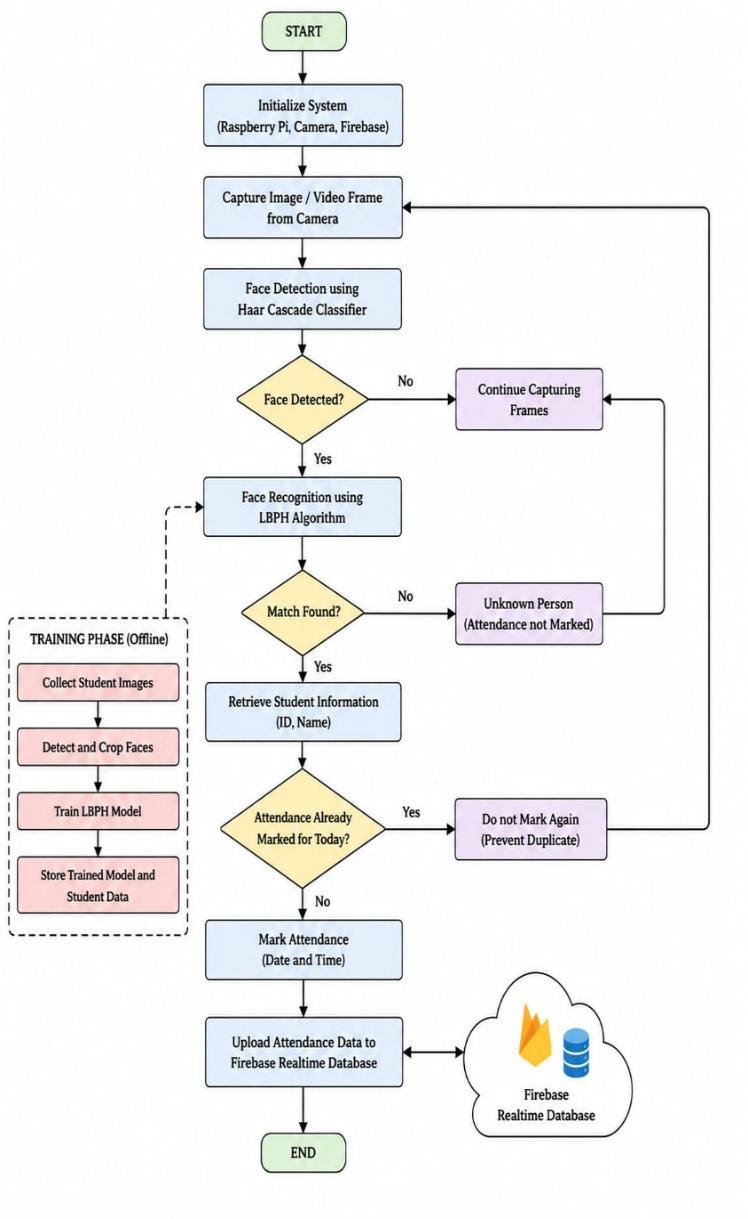
2: SystemFlowchart
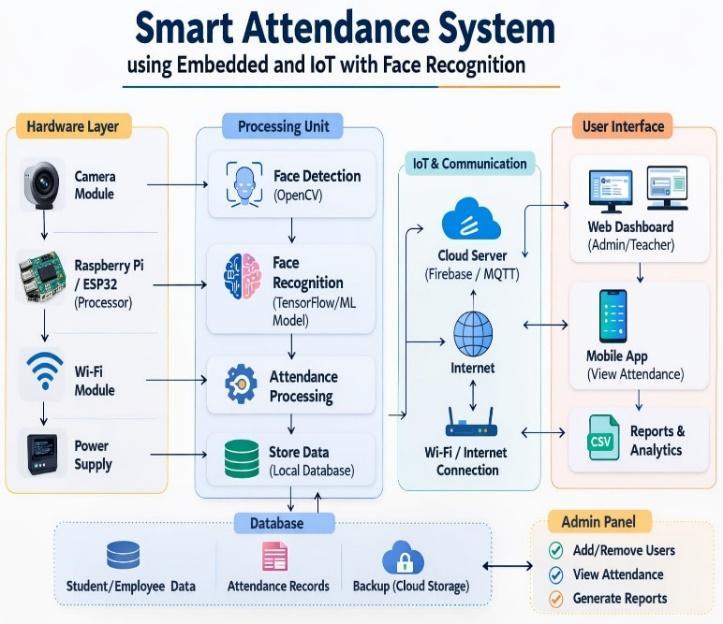
The architecture of the proposed Embedded IoT Face Recognition Attendance System consists of hardware and software components that work together to perform automated attendance marking. The main components of thesystemincludeacameramodule,RaspberryPi,OpenCV library, face recognition algorithm, and Firebase Realtime Database.
Thecameramoduleisusedtocapturereal-timeimagesand videoframesofstudents.Thesecapturedimagesaresentto theRaspberryPi,whichactsasthecentral processingunit ofthesystem.TheRaspberryPiprocessesallcamerainputs andcontrolstheoveralloperationofthesystem.
The OpenCV library is used for image processing, face detection,andfacerecognition.Initially,thesystemdetects faces from the captured images using the Haar Cascade Classifier. After face detection, the LBPH algorithm comparesthedetectedfacewiththetraineddatasetstored inthesystemtoidentifythestudent.
Oncethestudentisrecognizedsuccessfully,theattendance information such as student ID, name, date, and time is generated automatically. The attendance data is then uploaded to the Firebase Realtime Database through internetconnectivity.
Firebase provides real-time cloud storage and allows attendancerecordstobemonitoredremotely.Thecomplete system works in an integrated manner to provide secure, automatic,andreal-timeattendancemanagement.
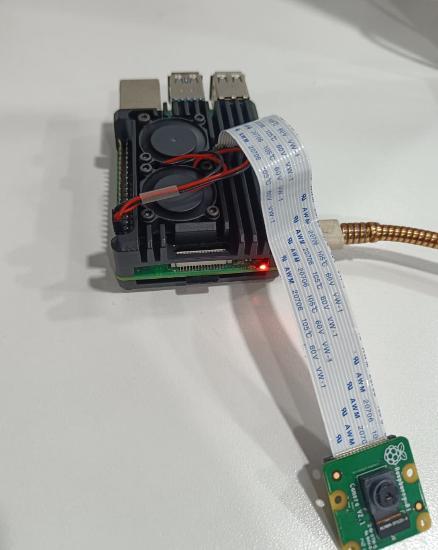
The implementation of the proposed Embedded IoT Face RecognitionAttendanceSystemwascarriedoutusingboth hardware and software components. The system was developedusingRaspberryPiasthemainprocessingunit,a cameramoduleforcapturingliveimages,OpenCVlibraryfor face detection and recognition, and Firebase Realtime Databaseforcloudstorage.
Initially,studentfaceimageswerecollectedandstoredasa dataset for training the recognition model. The Haar Cascade Classifier was used for face detection, while the LBPHalgorithmwasimplementedforfacerecognition.The
International Research Journal of Engineering and Technology (IRJET) e-ISSN: 2395-0056
Volume: 13 Issue: 05 | May 2026 www.irjet.net p-ISSN: 2395-0072
trained model was stored in the Raspberry Pi system for real-timeidentification.
During execution, the camera continuously captures live videoframes.TheRaspberryPiprocessestheseframesand detects faces using OpenCV. Once a face is recognized successfully,thesystemretrievesthecorrespondingstudent detailsandautomaticallymarksattendance.
The attendance information, including student ID, name, date, and time, is uploaded to the Firebase Realtime Database through internet connectivity. The stored attendancerecordscanbemonitoredremotelyinrealtime.
The complete implementation was tested under different lighting conditions and multiple face samples to improve systemaccuracyandreliability.
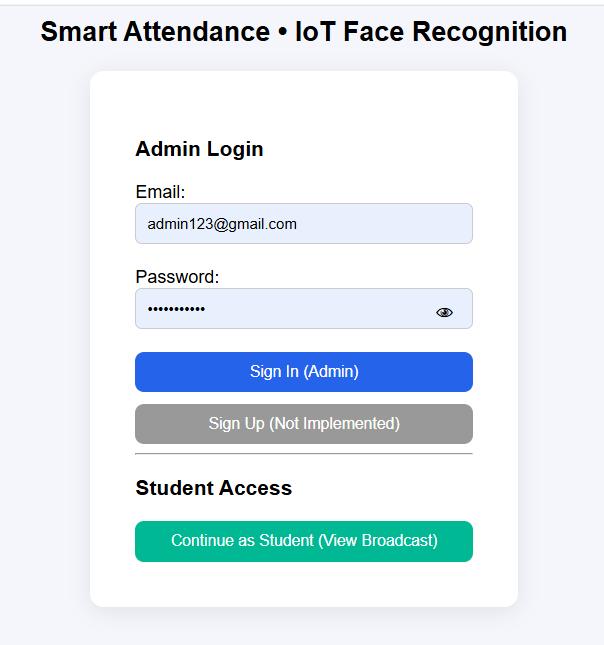

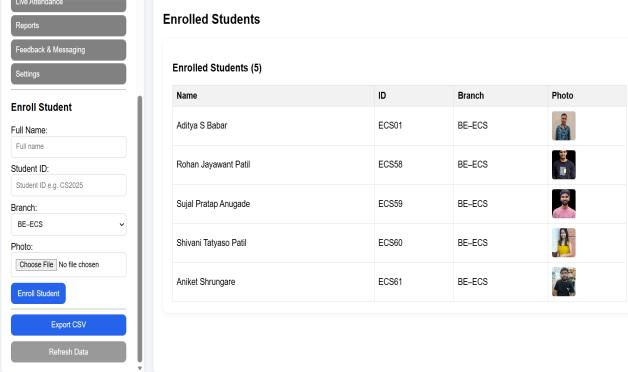
International Research Journal of Engineering and Technology (IRJET) e-ISSN: 2395-0056
Volume: 13 Issue: 05 | May 2026 www.irjet.net p-ISSN: 2395-0072
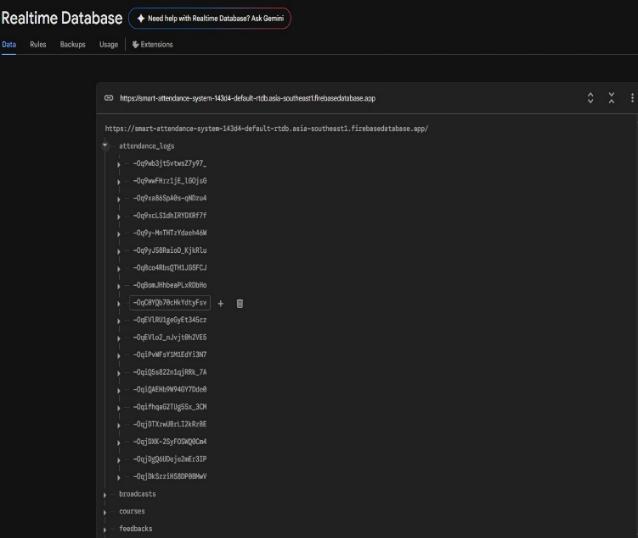
8.5 Realtime Database:
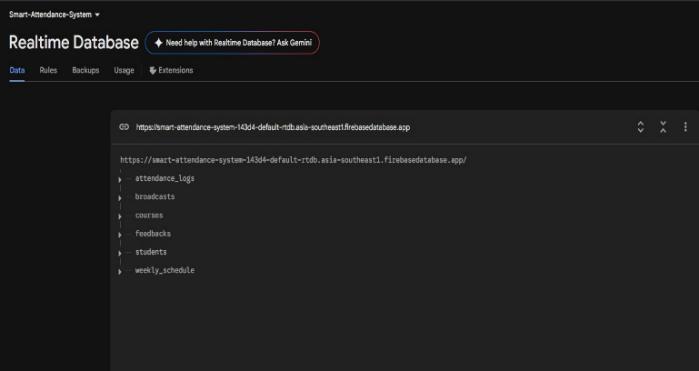
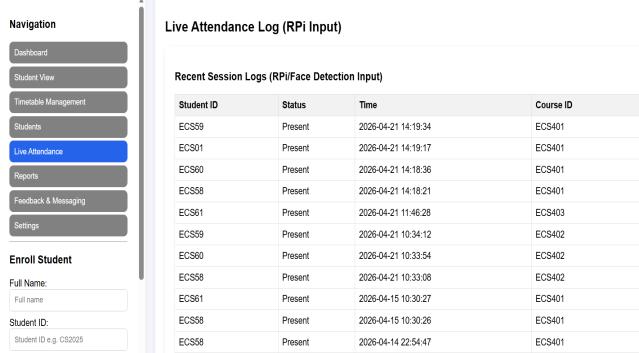
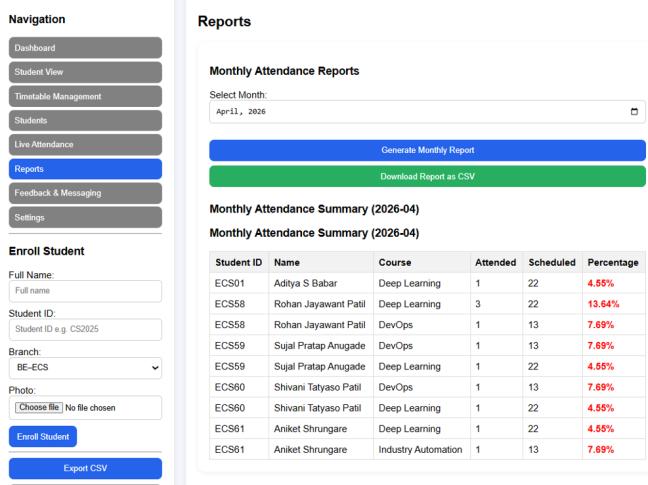
TheproposedEmbeddedIoTFaceRecognitionAttendance System was implemented and tested successfully using Raspberry Pi, camera module, OpenCV, and Firebase Realtime Database. The system was able to detect and recognize registered student faces in real time and automaticallymarkattendancewithdateandtime. During testing, the system accurately identified students whose facial data was stored in the trained dataset. Once recognized, the attendance details were uploaded successfully to the Firebase Realtime Database, allowing real-time monitoring and remote access to attendance records.
The use of Raspberry Pi provided a low-cost and portable embedded solution, while Firebase enabled fast cloud synchronization of attendance data. The system reduced manual effort and minimized the possibility of proxy attendancecomparedtotraditionalattendancemethods.
Theperformanceofthesystemdependedonfactorssuchas lightingconditions,cameraquality,andfacialvisibility.The system showed better accuracy under proper lighting conditions and clear facial images. However, recognition accuracydecreasedslightlyincasesofpoorlighting,unclear facialorientation,orpartiallycoveredfaces.
Overall, the proposed system providedan efficient,secure, and automated attendance management solution suitable foreducationalinstitutionsandIoT-basedsmartclassroom applications.
9.1 Attendance Marked Successfully:
International Research Journal of Engineering and Technology (IRJET) e-ISSN: 2395-0056
Volume: 13 Issue: 05 | May 2026 www.irjet.net p-ISSN: 2395-0072
9.4. Performance Analysis:
Parameter Result
FaceRecognitionAccuracy 92%
AverageRecognitionTime 1.5second
AttendanceUploadTime 2second
PerformanceinProper Lighting HighAccuracy
PerformanceinPoor Lighting ModerateAccuracy
TheproposedEmbeddedIoTFaceRecognitionAttendance System provides an efficient and automated solution for managing student attendance. The system successfully integratesRaspberryPi,cameramodule,OpenCV,LBPHface recognition algorithm, and Firebase Realtime Database to performreal-timefacerecognitionandattendancemarking. The system reduces manual effort, minimizes proxy attendance, and improves the accuracy and reliability of attendancemanagement.TheuseofFirebaseenablesrealtime cloud storage and remote monitoring of attendance records.
The experimental results show that the system performs effectively under proper lighting conditions and is capable ofrecognizingregisteredstudentswithgoodaccuracy.The proposedsystemiscost-effective,user-friendly,andsuitable forsmartclassroomandeducationalapplications.
Infuture,thesystemcanbeenhancedbyimplementingdeep learning techniques, anti-spoofing methods, and mobile applicationintegrationtoimprovesecurityandrecognition accuracy.
[1] Sanjana Dongare et al., “Smart Attendance System,” International Journal for Research in Applied Science and Engineering Technology (IJRASET), vol. 12, no. 3, March 2024. The study proposed an IoT-based attendance system using NodeMCU ESP8266, OLED display, and R608 fingerprint sensor for automated attendancemanagement.
[2]Nuhi,Asri,AgonMemeti,FlorindaImeri,andBetimCico. “Smartattendancesystemusingqrcode.”In20209th Mediterranean Conference on Embedded Computing (MECO),pp.1–4.IEEE,2020.
[3] Mishra, Shubham, Chandan Kumar, Ahmad Ali, and Jeevan Bala. “Online Attendance Monitoring System Using QR Code (OAMS).” In2021 2nd International Conference on Intelligent Engineering and Management(ICIEM),pp.379–384.IEEE,2021.
[4] Khan, S., Akram, A. Usman, N. Real Time Automatic Attendance System for Face Recognition Using Face API and Open CV.Wireless Pers Commun113, 469–480(2020).
[5] Neha Kumari Dubey, Pooja M.R., K. Vishal, Dhanush Gowda H.L., Keertiraj B.R., 2020, Face Recognition based Attendance System,International Journal of Engineering Research Technology, Volume 09, Issue 06,June2020.
[6] F. P. Filippidou, and G. A. Papakostas, “Single Sample Face Recognition Using Convolutional Neural Networks for Automated Attendance Systems,” 2020 FourthInt.Conf.Intell.Comput.DataSci.(ICDS),