
International Research Journal of Engineering and Technology (IRJET) e-ISSN: 2395-0056
Volume: 13 Issue: 06 | Jun 2026 www.irjet.net p-ISSN: 2395-0072

International Research Journal of Engineering and Technology (IRJET) e-ISSN: 2395-0056
Volume: 13 Issue: 06 | Jun 2026 www.irjet.net p-ISSN: 2395-0072
Chetna Chandrakar
Assistant Professor, Department of Civil Engineering Krishna's Vikash Institute of Technology Raipur, Chhattisgarh
Abstract - The compressive strength of concreteis a critical parameter governing its structural performance, and the incorporation of industrial and natural waste materials as partial replacements has gainedsignificant researchattention in recent years. This study presents a systematicmeta-analysis investigating the effect of three composite materials IronSlag, Wood Wool, and Expanded Polystyrene (EPS) Beads on the compressive strength of concrete. A total of 52 data points extracted from 54 peer-reviewed research papers published between 2003 and2025 were analyzed. Themeta-analysis was conducted by comparing the 28-day compressive strength of modified concrete mixes against their respectivecontrolmixes, and the percentage change in strength was computed for each data point. Results indicate that Iron Slag, when used as a partial replacement for fine or coarse aggregate, consistently improves compressive strength with an average increase of +15.98%, reaching a maximum improvement of +32.34% at optimal replacement levels typically ranging from 25% to 50%. In contrast, EPS Beads significantly reduce compressive strength by an average of -53.55%, with reductions as high as -89.12% at higher replacement volumes, confirming their suitability primarily for lightweight and non-structural concrete applications. Wood Wool-based studies reported limited quantitative MPa data, indicating a research gap in this area. The findings of this meta-analysis provide a consolidated reference for researchers and practitioners seeking to utilize sustainable and waste-based materials in concrete mix design.
Key Words: Meta-analysis, Compressive Strength, Iron Slag, EPS Beads, Wood Wool, Sustainable Concrete, CompositeMaterials
Concrete isthe most widelyusedconstructionmaterial in theworld,owingtoitshighcompressivestrength,durability, andversatilityinstructural applications[1].However,the large-scale production of concrete poses significant environmentalchallenges,particularlyduetotheextensive consumption of natural aggregates and the high carbon dioxideemissionsassociatedwithcementmanufacturing[2]. Inrecentdecades,researchershaveincreasinglyfocusedon identifyingsustainablealternativesthatcanpartiallyreplace conventionalconcreteconstituentswithoutcompromising structuralperformance.
Industrial by-products and natural waste materials have emergedaspromisingcandidatesforpartialreplacementin concretemixdesign.Amongthese,IronSlagaby-productof steel manufacturing has demonstrated considerable potential as a replacement for fine or coarse aggregate in concrete.WoodWool,derivedfromprocessedwoodfibers, hasbeenexploredasalightweightandbio-basedadditive.
ExpandedPolystyrene(EPS)Beads,asyntheticlightweight aggregate, have been widely investigated for producing lightweight concrete with improved thermal insulation properties[3].
Despite the availability of individual studies on these materials, a comprehensive and quantitative synthesis of their collective effect on compressive strength remains limited.Mostexistingreviewsarequalitativeinnatureand do not provide statistically consolidated findings across multiple studies. This gap necessitates a systematic metaanalysisthataggregatesdatafrommultiplepeer-reviewed studiestoderivereliableandgeneralizedconclusions.
Meta-analysisisawell-establishedstatisticalmethodology thatcombinesresultsfrommultipleindependentstudiesto increasestatisticalpowerandresolveinconsistenciesamong individual findings [4]. In the context of construction materials research, meta-analysis has been successfully applied to evaluate the effects of fly ash, silica fume, and recycledaggregatesonconcreteproperties[5].
Thepresentstudyconductsasystematicmeta-analysisof54 peer-reviewedresearchpaperspublishedbetween2003and 2025,extracting52valid28-daycompressivestrengthdata points to evaluate the effect of Iron Slag, Wood Wool, and EPSBeadsascompositematerialsinconcrete.Theprimary objectivesofthisstudyare:
Toquantifythepercentagechangeincompressive strengthrelativetocontrolmixes.
Toidentifytrendsandoptimalreplacementlevels foreachmaterial.
International Research Journal of Engineering and Technology (IRJET) e-ISSN: 2395-0056
Volume: 13 Issue: 06 | Jun 2026 www.irjet.net p-ISSN: 2395-0072
Authornameandyearofpublication
To compare the performance of Iron Slag, EPS Beads,andWoodWool.
To identify research gaps, particularly regarding WoodWoolcompressivestrengthdata.
2.1 Search Strategy
Asystematicliteraturesearchwasconductedusingonline academicdatabasesincludingGoogleScholar,ResearchGate, and ScienceDirect. The search was performed using keywordssuchas"IronSlagconcretecompressivestrength", "EPS Beads lightweight concrete", "Wood Wool cement composite", "expanded polystyrene concrete mechanical properties",and"steelslagaggregateconcretestrength".The search was limited to peer-reviewed journal articles and conferencepaperspublishedbetween2003and2025.
2.2 Inclusion and Exclusion Criteria
Toensurethequalityandrelevanceoftheselectedstudies, thefollowingcriteriawereestablished:
Inclusion Criteria:
Studies reporting 28-day compressive strength valuesinMPa
ConcretemixesincorporatingIronSlag,WoodWool, orEPSBeadsaspartialreplacementmaterials
Studies providing both control mix and modified mixcompressivestrengthdata
Experimentalresearchpaperswithclearlydefined mixproportionsandpercentagereplacementlevels
Exclusion Criteria:
Studies reporting compressive strength in units otherthanMPa
Review papers and theoretical studies without experimentaldata
Papersfocusingonsoilstabilizationorgeotechnical applications
Studieswherecompressivestrengthdatawasnot clearlyreported(NR)
Duplicatestudiesandnon-peer-reviewedsources
Materialtypeandpercentagereplacementlevel
Water-cement(W/C)ratioandconcretegrade
Compressive strength of control mix at 28 days (MPa)
Compressive strength of modified mix at 28 days (MPa)
The data was systematically organized in a structured Excel database with color-coded categoriesforeachmaterialtype.
Theprimarymetricusedforcomparisonwasthepercentage changein28-daycompressivestrength,calculatedusingthe followingformula:
% Change = [(Strength with Material − Control Strength) / Control Strength] × 100
Apositivevalueindicatesanimprovementincompressive strength,whileanegativevalueindicatesareduction.The average percentage change, maximum improvement, and maximum reduction were computed for each material category.Materialswereclassifiedintothreegroups Iron Slag,EPSBeads,andWood
Wool and analyzed independently to identify materialspecifictrends.
Out of the initial pool of papers collected, papers were screened based on title and abstract relevance. Papers focusingonsoilstudies,non-concreteapplications,andthose lacking quantitative MPa data were excluded. The final dataset comprised:
IronSlag:22datapointsfrom20studies
EPSBeads:30datapointsfrom17studies
Wood Wool: 0 valid MPa data points (data not reportedincollectedstudies)
Total:52validdatapointsfrom54studies
2.3
Atotalof54researchpaperswereinitiallyscreened,from which 52 valid data points containing complete 28-day compressivestrengthvalueswereextracted.Foreachstudy, thefollowingparameterswererecorded:
2026, IRJET | Impact Factor value: 8.315 |
International Research Journal of Engineering and Technology (IRJET) e-ISSN: 2395-0056
Volume: 13 Issue: 06 | Jun 2026 www.irjet.net p-ISSN: 2395-0072
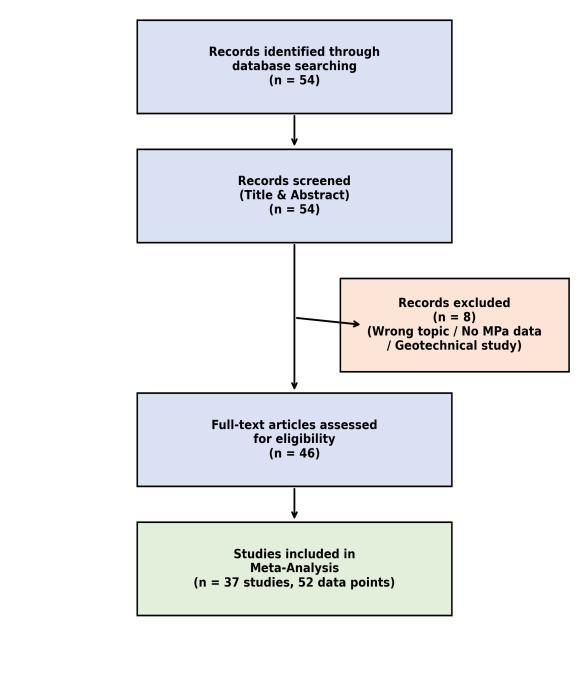
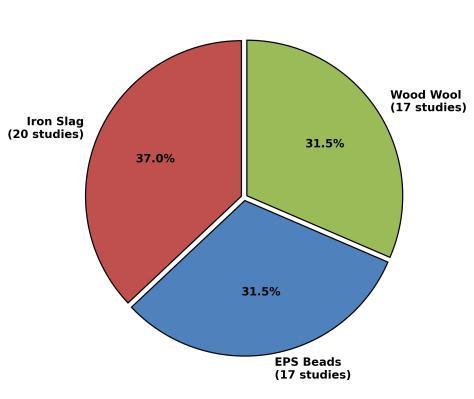
Chart-2.: DistributionofReviewedstudiesbyMaterialtype (n=54)
3.1 Overview of Dataset
Atotalof52validdatapointswereextractedfrom54peerreviewedresearchpapers(2003–2025),categorizedintoIron Slag(22datapoints,20studies),EPSBeads(30datapoints, 17studies),andWoodWool(17studies,0validMPadata). The overall average control mix strength was 42.24 MPa, comparedto30.34MPawithmaterialincorporation.
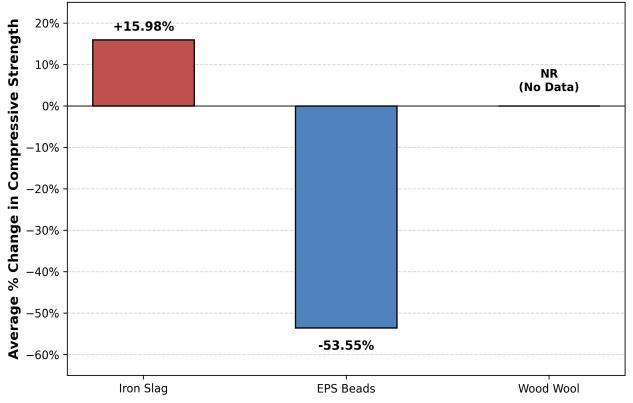
Chart-3 : Average%changein28dayCompressive strengthbyMaterialtype
3.2 Effect of Iron Slag
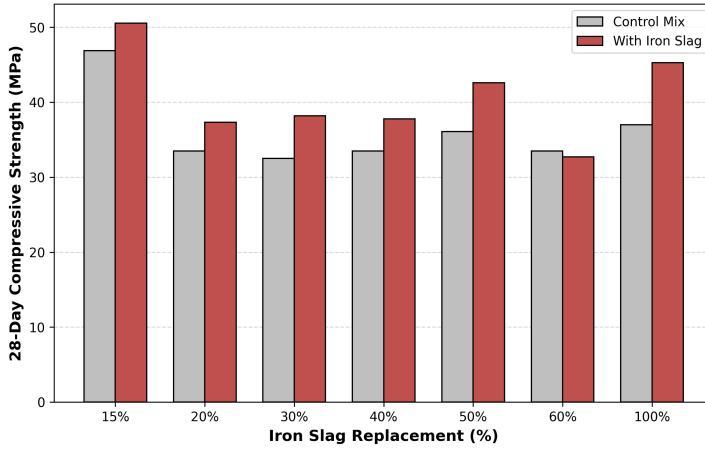
IronSlagincorporationshowedanaverageimprovementof +15.98%in28-daycompressivestrength,withamaximum increaseof+32.34%atoptimalreplacementlevels(25–50%). Thisisattributedtotheangulartextureandhigherdensityof IronSlag,whichimprovesbondingwiththecementmatrix.A minimumvalueof-8.57%indicatesthatbeyond~35–45% replacement, strength may decline due to reduced workability.
Chart-4: EffectofIronslagReplacement%on28day Compressivestrength
3.3 Effect of EPS Beads
EPS Beads showed an average reduction of -53.55%, with reductions as high as -89.12% at higher replacement volumes.Thisisduetothelow-density,void-formingnature ofEPSparticleswithinthecementmatrix.Amaximumvalue of+1.94%wasobservedonlyatverylowreplacementlevels combinedwithsuperplasticizers.EPSBeadsaretherefore bestsuitedforlightweight,non-structuralapplications.
International Research Journal of Engineering and Technology (IRJET) e-ISSN: 2395-0056
Volume: 13 Issue: 06 | Jun 2026 www.irjet.net p-ISSN: 2395-0072
Chart-5: EffectofEPSBeadsReplacement%on28day Compressivestrength
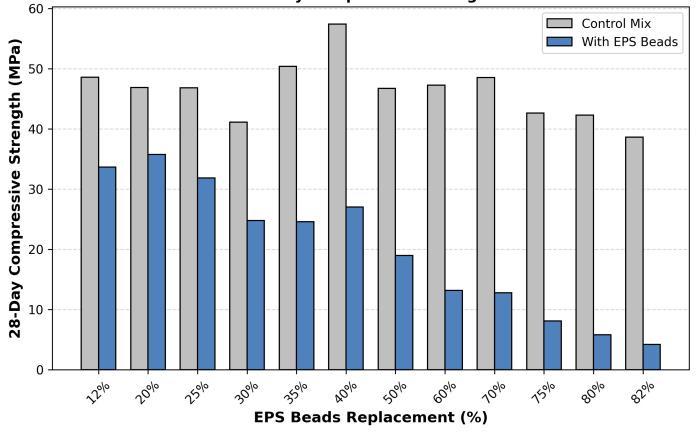
Noneofthe17WoodWoolstudiesreportedquantitative28dayMPavalues,withmostfocusingonflexuralstrengthand thermal/acousticinsulationinstead.Thishighlightsaclear research gap for Wood Wool in compressive strength applications.
3.5 Comparative Summary
Parameter Iron Slag EPS Beads Wood Wool Studies 20 17 17
DataPoints 22 30 0
Iron Slag emerges as the most promising material for structural applications, while EPS Beads suit weightreductiongoals,andWoodWoolneedsfurthercompressive strengthresearch.
4. CONCLUSIONS
This systematic meta-analysis evaluated the effect of Iron Slag,WoodWool,andEPSBeadsonthe28-daycompressive strengthofconcrete,basedon52validdatapointsextracted from54peer-reviewedstudiespublishedbetween2003and 2025.Thefollowingconclusionscanbedrawn:
1. Iron Slag consistently improves compressive strength,withanaverageincreaseof+15.98%anda maximumimprovementof+32.34%atoptimal replacementlevelsof25–50%.Itisrecommended as a viable sustainable replacement for structural concreteapplications.
2. EPS Beads significantly reduce compressive strength,withanaveragedecreaseof-53.55%and reductions as high as -89.12% at higher replacement volumes. These materials are best suited for lightweight, non-structural concrete applicationssuchasinsulationpanelsandpartition walls.
3. WoodWoolbasedstudiesshowedacriticalabsence of quantitative compressive strength data, with most research focusing on flexural, thermal, and acoustic properties instead. This represents a significantresearchgapthatfuturestudiesshould address.
4. Overall, among the three materials studied, Iron Slagdemonstratesthemostfavorableperformance for enhancing compressive strength while contributingtosustainableconstructionpractices throughindustrialwasteutilization.
5. Future research should focus on conducting standardized compressive strength testing for Wood Wool composites and exploring hybrid combinations of these materials to optimize both mechanicalperformanceandsustainability.
[1] A. A. Sharba, "The Efficiency of Steel Slag and Recycled Concrete Aggregate on the Strength Properties of Concrete," KSCE Journal of Civil Engineering,vol.23,no.11,pp.4846-4851,2019.
[2] A. Jalil, A. Khitab, H. Ishtiaq, S. H. Bukhari, M. T. Arshad,andW.Anwar,"EvaluationofSteelIndustrial Slag as Partial Replacement of Cement in Concrete," Civil Engineering Journal, vol. 5, no. 1, pp. 181-189, 2019.
[3]D.Raharjo,A.Subakti,andTavio,"MixedConcrete OptimizationUsingFlyAsh,SilicaFumeandIronSlag on the SCC's Compressive Strength," Procedia Engineering,vol.54,pp.827-839,2013.
[4] D. Meena, M. K. Agwan, and H. K. Sain, "An Experimental Study on the Behavior of Concrete by PartialReplacementforRiceHuskAsh,SilicaFume& Iron Slag with Cement," International Journal of Engineering Trends and Applications, vol. 10, no. 6, 2023.
[5]A.KumarandN.Singh,"Mechanicalperformanceof steelandironslagconcretes:Abriefreview,"Materials Today:Proceedings,2023.
International Research Journal of Engineering and Technology (IRJET) e-ISSN: 2395-0056
Volume: 13 Issue: 06 | Jun 2026 www.irjet.net p-ISSN: 2395-0072
[6]M.Heikal,M.A.Ali,S.M.Ibrahim,andH.I.Bendary, "Sustainable composite cement prepared by two differenttypesofironslag,"JournalofMaterialCycles andWasteManagement,vol.26,pp.331-345,2024.
[7]I.K.Ibrahim,M.Rady,N.M.Tawfik,M.Kassem,and S.Y.Mahfouz,"Enhancingstrengthandsustainabilityof concretewithsteelslagaggregate,"ScientificReports, vol.15,17068,2025.
[8]I.Netinger,D.Bjegović,andG.Vrhovac,"Utilisation ofsteelslagasanaggregateinconcrete,"Materialsand Structures,vol.44,pp.1565-1575,2011.
[9] K. P. P. Bharathi, S. K. Adari, and U. Pallepamula, "Mechanical properties of self-compacting concrete usingsteelslagandglasspowder,"JournalofBuilding PathologyandRehabilitation,vol.7,no.46,2022.
[10]R.S.Alhnifat,M.Abdel-Jaber,andR.N.Al-Dala'ien, "Behavior of Lightweight Concrete Incorporating Pozzolana Aggregate and Expanded Polystyrene Beads,"EngineeringScience,vol.25,no.934,2023.
[11] B. Chen and J. Liu, "Mechanical properties of polymer-modified concretes containing expanded polystyrene beads," Construction and Building Materials,2005.
[12] F. Lo Monte, P. Bamonte, and P. G. Gambarova, "Physicalandmechanicalpropertiesofheat-damaged structural concrete containing expanded polystyrene synthesizedparticles,"2013.
[13]K.Miled,K.Sab,andR.LeRoy,"Particlesizeeffect on EPS lightweight concrete compressive strength: Experimentalinvestigationandmodelling,"Mechanics ofMaterials,vol.39,pp.222-240,2007.
[14]S.VeisehandA.A.Yousefi,"TheUseofPolystyrene in Lightweight Brick Production," Iranian Polymer Journal,vol.12,no.4,pp.323-329,2003.
[15] B. Vakhshouri and S. Nejadi, "Review on the mixture design and mechanical properties of the lightweightconcretecontainingexpandedpolystyrene beads," Australian Journal of Structural Engineering, 2017.
[16]K.Kochova,K.Schollbach,andH.J.H.Brouwers, "UseofalternativefibresinWoodWoolcementboards and their influence on cement hydration," in 19th InternationalConferenceonBuildingMaterials(Ibausil 2015),pp.1375-1382,2015.
[17]N.Hemmati,R.Mirzaei,P.Soltani,U.Berardi,M.J. S. Mozafari, H. Edalat, E. Rezaieyan, and E. Taban, "Acousticandthermalperformanceofwoodstrandsrock wool-cement composite boards as eco-friendly construction materials," Construction and Building Materials,vol.445,137935,2024.
[18]M.Ardanuy,J.Claramunt,andR.D.ToledoFilho, "Cellulosicfiberreinforcedcement-basedcomposites:a reviewofrecentresearch."
[19]Z.Ahmad,L.S.Wee,andM.A.Fauzi,"Mechanical Properties of Wood-wool Cement Composite Board Manufactured Using Selected Malaysian Fast Grown TimberSpecies,"ASMScienceJournal,vol.5,no.1,pp. 27-35.
[20]N.Buch,O.M.Rehman,andJ.E.Hiller,"Impactof Processed Cellulose Fibers on Portland Cement ConcreteProperties,"TransportationResearchRecord, no.1668.
[21]H.SavastanoJr.,P.G.Warden,andR.S.P.Coutts, "Potential of alternative fibre cements as building materialsfordevelopingareas,"CementandConcrete Composites,vol.25,pp.585-592,2003.
[22] M. A. S. Mohamed, E. Ghorbel, and G. Wardeh, "Valorization of micro-cellulose fibers in selfcompacting concrete," Construction and Building Materials,vol.24,pp.2473-2480,2010