
International Research Journal of Engineering and Technology (IRJET) e-ISSN: 2395-0056
Volume: 13 Issue: 03 | Mar 2026 www.irjet.net p-ISSN: 2395-0072
International Research Journal of Engineering and Technology (IRJET) e-ISSN: 2395-0056
Volume: 13 Issue: 03 | Mar 2026 www.irjet.net p-ISSN: 2395-0072
Srushti Sanjay Sathe¹, Prajakta Sunil Shinde², Komal Pravin Waghamare³, Samrudhi Sharad Zadbuke⁴, Prof. Shalu Saraswat⁵
¹ PDEA’s College of Engineering, Manjari, Pune, Maharashtra, India
² PDEA’s College of Engineering, Manjari, Pune, Maharashtra, India
³ PDEA’s College of Engineering, Manjari, Pune, Maharashtra, India
⁴ PDEA’s College of Engineering, Manjari, Pune, Maharashtra, India
⁵ Professor, Department of Information Technology, PDEA’s College of Engineering, Manjari, Pune, Maharashtra, India
Abstract - India has a large student population, making it difficult to monitor and predict their performance. Each educational institute has its own criteria for evaluating students, and there is no standard way of analyzing students’ performance. Moreover, existing systems do not take into account significant external factors.
The proposed system, EduMate AI, aims to analyze and predict students’ performance based on academic as well as nonacademic factors, including geographical location, parental education, health conditions, and stress levels. Machine learning algorithms, Random Forest and XGBoost, are used to perform performance prediction and stressanalysis.
The experimental results show that the inclusion of academic as well as non-academic factors enhances the accuracy of performance prediction, thus emphasizing the importance of data-driven approaches to improve academic performance monitoring systems.
KeyWords: Artificial Intelligence (AI), Machine Learning (ML), Student Performance Prediction,XGBoost, Stress Detection.
Educationisacontinuousanddynamicprocess,andidentifyingtheacademicstrengthsandweaknesses ofstudents at the earliest is crucial to improving their performance. In higher education institutions, improving the quality of educationisclosely linked to the effective monitoring, analysis, and prediction of studentperformance.
The performance of students is affected not only by internal and external examination results but also by various personal and environmental factors. Factors like geographical location, education level of parents, family background, health, and stress levels are crucial in determining student performance. However, most existing systems are limited to academic performanceandoverlooksuchsignificantexternalfactors.
Theproject aimsto develop anAI-poweredacademicassistant, EduMate AI, toassistin academicmanagement and student well-being. The proposed system will utilize facial recognition technology to enable efficient and securedlogin and Optical CharacterRecognition(OCR)to extract marksand attendance(to beimplementedin thefuture). Forpredictionanalysis,RandomForestandExtremeGradientBoosting(XGBoost) are employed to increase the accuracy of predicting student performance and stress levels due to their efficiency in handling structured data. For the purpose of experimental analysis, data was collected from around700studentsfrom theInformationTechnologydepartment. Thedatasetconsistsofbothacademicand non-academic data, which akesitpossibletoanalyzetheperformanceandstressofstudentsinacomprehensivemanner.
Therest ofthispaperisdividedintothefollowing sections: Section II isdedicatedtoliteraturereview, while SectionIIIcoversmethodology,andSectionVcoverstheconclusionwithfuturescope.
Theobjectives ofthisprojectareto designanintelligentsystem thatiscapable of predicting student performance withhighaccuracybasedonbothacademicandstress-relateddata.
International Research Journal of Engineering and Technology (IRJET) e-ISSN: 2395-0056
Volume: 13 Issue: 03 | Mar 2026 www.irjet.net p-ISSN: 2395-0072
The objectives of this project are:
1. To collect data related to academic and stress parameters of students.
2. Topre-processandcleanupthedataforfurthermachinelearning.
3. TodesignRandomForestandXGBoostmodelsforperformanceprediction.
4. To compare models and analyze their performance.
The overall aim of this project is to design a system that is useful in improving academic monitoring and studentstressinareliablemanner.
The proposed system aims to bridge the gap between performance analysis and stress detection by incorporatingbothinasingleintelligentsystem.
A comprehensive literature survey of recent literature reveals various approaches for monitoring student performance and stress, mainly based on machine learning approaches. In previous studies, algorithms such as Random Forest and XGBoost were implemented to classify student performance. Even though good accuracy was obtained, manual input was required, andnoautomatedprocesswasimplemented.
In another study based on stress prediction, research work was conducted utilizing smartphone sensordata along with the I-HOPE framework to estimate mental health. Even though good accuracy was obtained in the study, only behavioral patterns were considered. Moreover, academic performance variables were not included. Inanotherstudy,mentalstresswasconsidered,but only survey data was used. Even though goodaccuracy was obtained in identifying stress levels, no relationship was established between stress levels and academic performance.
Further research was conducted on detecting mental stress based on questionnaire-based data. Even though good accuracywasobtainedinthestudy,valuableinsightswereobtainedaboutpsychologicalconditions.
However, no relationship was established between academic performance and stress. This literature survey reveals that two separate approaches were implemented: one for stress prediction and another for academic performance analysis.
Other research, such as in [5], was conducted to predict academic performance based on demographic and external variables using Logistic Regression methods. This research emphasized the significance of nonacademic factors in determining student performance. Nevertheless, this method was limited to general performanceclassification,withouttakingintoaccountanysubject-specificorpsychologicalanalyses.
In another research, various supervised machine learning algorithms were tested using data from two years of academic performance in the University of Basra. As per this research, Logistic Regression was found to have an accuracy of 68.7% forpassedstudentsand88.8%forfailedstudents,asmentionedin[6].
In conclusion, from the literature review, it is evident that considerable research has been carried out in predictingstudentperformanceandstressdetectionusingvariousmachinelearningalgorithms.
Nevertheless, most of this research is limited to individual analyses of both aspects, indicating a need for a comprehensivesystemthatconsidersbothaspectssimultaneously.
The proposed system is based on a systematic approach to measure student performance and stresslevel by applyingvariousmachinelearningalgorithms. Theentireframeworkconsistsofdatacollection,preprocessing, featureselection,modeldevelopment,andperformancecomparison. Bothacademicandnon-academicdataare consideredtoobtainpreciseandaccuratepredictions.
International Research Journal of Engineering and Technology (IRJET) e-ISSN: 2395-0056
Volume: 13 Issue: 03 | Mar 2026 www.irjet.net p-ISSN: 2395-0072
For experimental purposes, data was collected from around 700 students of the Information Technology department.Bothacademicand non-academicdataareconsideredin thisstudy,andbothofthemareincluded in the dataset.
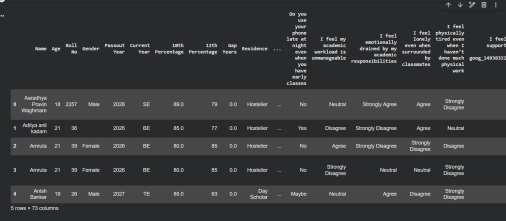
Oncethedatahasbeencollected,preprocessingisdonetotakecareofmissingvaluesandmakethedatasuitablefor analysis. The appropriate operations such as data cleaning, normalization, and encoding are applied to the data. Featureselectionis
done using correlation analysis to determine the most significant features that impact student performance.Data preprocessingisusedfortrainingthemodelandprediction.
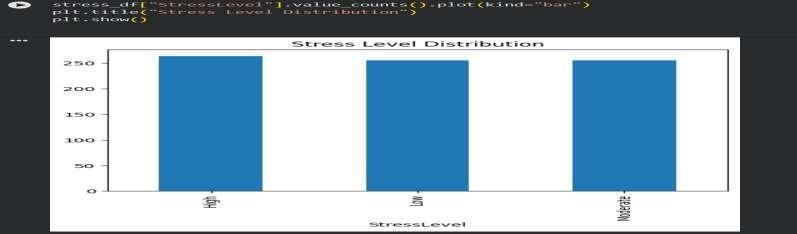
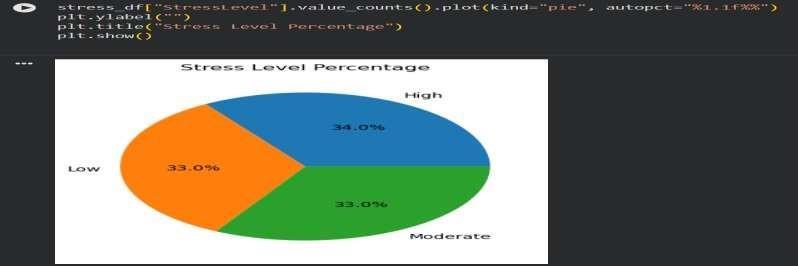
Data visualization is used for analyzing the relationship between various attributes in the dataset. Graphical representations are used to determine the dependency between academic and non-academic factors. Categorical dataisconverted into numericalform for analysis. Figures below represent examples of data visualizationused in this study.
International Research Journal of Engineering and Technology (IRJET) e-ISSN: 2395-0056
Volume: 13 Issue: 03 | Mar 2026 www.irjet.net p-ISSN: 2395-0072
Two supervised machine learning algorithms, Random Forest and Extreme Gradient Boosting (XGBoost), areimplementedforclassificationandprediction.
a)RandomForestAlgorithm
The Random Forest algorithm is a supervised ensemble machine learning algorithm. It is mainly used for classification and regression problems. It creates multiple decision trees and combines their results to make predictions.
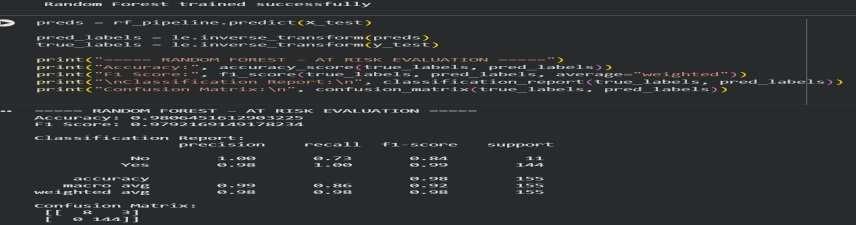
For this research, the Random Forest model has been implemented to classify students according to their performancelevels.
Theperformance levels include:
• High
• Medium
• Low
Theuseofthisalgorithmhasreducedtheproblemofoverfittingandimprovedtheaccuracyofthemodel. Ithasachievedanaccuracylevelof98%.
International Research Journal of Engineering and Technology (IRJET) e-ISSN: 2395-0056
Volume: 13 Issue: 03 | Mar 2026 www.irjet.net p-ISSN: 2395-0072
XG Boost, also known as Extreme Gradient Boosting, is another supervised ensemble machine learning algorithm. It is considered one of the best algorithms for building decision trees. It creates decision trees sequentially. EachdecisiontreeinXGBoosttriestocorrecttheerrorsmadebythepreviousdecisiontrees.
For this research, the XGBoost algorithm has been implemented to classify student performance and predict stress. Thisalgorithmhasimprovedtheaccuracyofthemodelbyminimizingthelossfunction. Ithasachieved anaccuracylevelof94%.
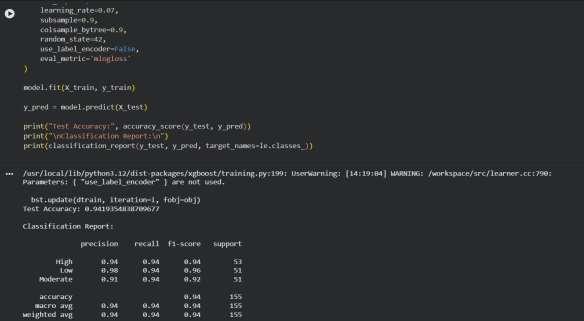
Theperformanceoftheproposedmodelshasbeenevaluatedusingvariousparameterssuchasaccuracy,recall, andF1-score.
ThecomparisonoftheRandomForestandXGBoostmodelsisasfollowsin
Table I. TABLE I: COMPARISON BETWEEN RANDOM FOREST AND XGBOOST MODELS

As per the results in Table I, the accuracy of the Random Forest model is higher at 98%, whereas the accuracy of the XGBoost model is 94%. However, the performance of the XGBoost model is higher in terms of recall and F1-score compared to the Random Forest model. This indicates that the XGBoost model has a higher potential for critical situations such as high stress levels. Moreover, the generalization ability of the XGBoost model is higher compared to the Random Forest model in handling complex situations. Therefore, even though the accuracy of the XGBoost model is slightly lower compared to the Random Forest model, the XGBoost modelismoreappropriateforreal-timeimplementation. Tofurtherevaluatetheclassificationperformance of the models, confusion matrix analysis is performed. 82–85%
International Research Journal of Engineering and Technology (IRJET) e-ISSN: 2395-0056
Volume: 13 Issue: 03 | Mar 2026 www.irjet.net p-ISSN: 2395-0072
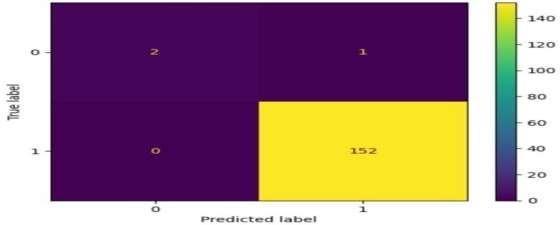
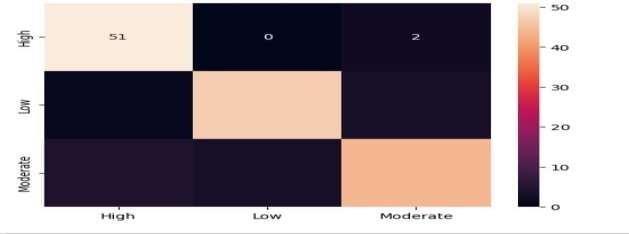
TheconfusionmatricesofthetwomodelsareshowninFig.VIandFig.VII.
The confusion matrix of the Random Forest model indicates correct classification, but there are also misclassifications in the identification of at-risk students. However, the XGBoost model indicates better performanceinclassifyingthestudents,withhightruepositiveratesandfewermisclassifications.
ThisimpliesthatXGBoostisbetteratdetectingstudentsatriskanddealingwithcomplexdatapatterns.
5. FUTURE SCOPE
The future scope of the project includes the improvement of the intelligence and automation level of thesystem.
The XGBoost model can be trained with larger real-time data for better prediction accuracy and performance of the system.Basedonthepredictedacademicresultsandstresslevels,thesystemcanbeextendedtoprovideastudyplan for thestudentindividually to improve their performance in the subjects in which they score low marks.
Moreover, the Optical Character Recognition technique can be implemented and integrated into the system for automaticextraction of marks and attendance from the uploaded document.
Thesystemcanbeextendedwithadditionalfeaturessuchasdashboardsandtheabilitytopredictthestresslevels ofthe
International Research Journal of Engineering and Technology (IRJET) e-ISSN: 2395-0056
Volume: 13 Issue: 03 | Mar 2026 www.irjet.net p-ISSN: 2395-0072
studentforabetteracademicsupportsystem.
Moreover, the system can be integrated with Learning Management Systems (LMS) for automatic synchronizingoftheacademicdataforacompleteacademicsupportsystem.
Advanced predictive models can be integrated into the system for prediction of academic performance for a longer academic period and for the student individually for better academic support. These enhancements will transform EduMateAIintoacomprehensiveintelligentacademicecosystem.
In this study, the researchers employed various machine learning methods to analyze and predict the performance of students by utilizing structured data related to academics. The data was preprocessed and visualized, and two ensemble learning methods, Random Forest and XGBoost, were implemented for classification purposes.
The experimental results revealed that Random Forest had higher accuracy at 98%, while XGBoost had an accuracy of 94%. However, it was also revealed that XGBoost had significant advantages in terms of generalization and scalability, as well as the ability to handle complex data. Additionally, the model reduces the chances of overfitting.
Hence, even though the accuracy of the XGBoost model was slightly lower, it can be considered to be more appropriateforreal-world applications due to its adaptability and consistency in all situations.
Ingeneral,thestudyrevealedtheeffectivenessofensemblelearningmethodsinpredictingstudent performance and also emphasized the importance of incorporating various advanced machine learning models in data analysis systems.
[1] Gupta, S., & Agarwal, J. (2022, October). Machinelearning approaches forstudent performance prediction. Paper presented at the2022 10th International Conference onReliability,Infocom Technologiesand Optimization (Trends andFuture Directions)(ICRITO),AmityUniversity,Noida,India
[2] N. T. M. Sagala, S. D. Permai, A. A. S. Gunawan, R. O. Barus, and C. Meriko, “Predicting Computer Science Students’ Performance using Logistic Regression,” Proc. 5th Int. Seminar on Research of Information Technology and IntelligentSystems(ISRITI),2022
[3] Anand Tripathi dept. of Artificial Intelligence and Data Science Datta Meghe Institute Of Higher Education and Research. Paperpresentedatthe2025,Dept.ofArtificialIntelligenceandDataScienceDattaMegheInstituteOfHigherEducation andResearch.
[4] Predicting and Understanding College Student Mental Health with Interpretable Machine Learning (2025) Citation: Meghna Roy Chowdhury et al., “Predicting and Understanding College Student Mental Health with Interpretable Machine Learning,”CHASE’25,ACM/IEEEInternationalConference,2025.
[5] Machine Learning Algorithms for Detecting Mental Stress in College Students (2024) Citation: Ashutosh Singhet al.,“MachineLearningAlgorithmsforDetectingMental StressinCollegeStudents,”2024.
[6] StudentPerformancePredictionApproachBasedonEducationalDataMining(2023, IEEEAccess)-ZilingChen, GangCen,YingWei,ZifeiLi
[7] Y. Wang, “Artificial Intelligence in Student Management Systems to Enhance Academic Performance Monitoring andIntervention,” Scientific Reports,vol.15,p.35122,2025.
[8] H. Nellore, “Data Analytics and Machine Learning Approaches for Predicting Academic Stress and Enhancing StudentWellbeing,” International Journal of Advance Research and Innovation,vol.13,no.4,pp.23–29,2025.