
International Research Journal of Engineering and Technology (IRJET) e-ISSN: 2395-0056
Volume: 13 Issue: 04 | Apr 2026 www.irjet.net p-ISSN: 2395-0072

International Research Journal of Engineering and Technology (IRJET) e-ISSN: 2395-0056
Volume: 13 Issue: 04 | Apr 2026 www.irjet.net p-ISSN: 2395-0072
Rubigha M, Tamil Kumar E, Subhashree R, Sasiprabha N, Mohanakrishnan V
1 Rubigha M: Assistant Professor, Dept. of Information Technology, Knowledge Institute of Technology, Tamil Nadu, India
2 Tamil Kumar E: Student, Dept. of Information Technology, Knowledge Institute of Technology, Tamil Nadu, India
3 Subhashree R: Student, Dept. of Information Technology, Knowledge Institute of Technology, Tamil Nadu, India
4 Sasiprabha N: Student, Dept. of Information Technology, Knowledge Institute of Technology, Tamil Nadu, India
5 Moahankrishnan V: Student, Dept. of Information Technology, Knowledge Institute of Technology, Tamil Nadu, ***
Abstract-The rapid intensification of urban centers and -the prevalence of large-scale gatherings at public intersections, transport terminals, and social venues have necessitated the development of sophisticated, automated systems for crowd su- pervision. Conventional monitoring techniques frequently depend on manual surveillance of Closed-Circuit Television (CCTV) streams, a process that is resource-intensive,susceptibletohuman error, and lacks the predictive intelligence required for dynamic density assessment. To address these critical vulnerabilities, this study introduces a comprehensive, AI-driven crowd management architecture. The system integrates the highperformance You Only Look Once (YOLO) computer vision framework with a novel applicationof the Additive Increase Multiplicative Decrease (AIMD) algorithm to facilitate adaptive crowd density control. By processing real-time video data from public infrastructure, the proposed model identifies, localizes, and quantifies individuals with high precision, even in congested and partially obscured environments. The AIMD component serves as a robust feedback mechanism, dynamically adjusting safety thresholds and trig- gering multi-tiered alerts when population densities exceed pre- defined limits. Empirical results indicate that the system achieves a mean Average Precision (mAP) of 94.2% while maintaining an operational throughput of 45 frames per second on standard computing hardware. This integrated approach provides an intelligent, scalable solution for improving public safety and mitigating theriskofovercrowdinginmodernsmartcities.
Key words-Crowd Management, Smart City Safety, Visual Object Tracking, YOLO Framework, AIMD Congestion Control, Real-Time Surveillance, Automated Alerts, Public Order,DeepLearningApplications
In modern urban landscapes, the effective management of densecrowdsduringpublicgatherings,transitoperations, and large-scale events has become a significant logistical
and safety concern. As evidenced by numerous global incidents, the rapid escalation of physical pressure within acrowdcanleadtodangerousstampedes,resultinintragic loss of life and severe injuries. To mitigate these risks, there is a critical need to transition from reactive, postincident analysis to proactive, real-time surveillance and interventionstrategies.
Traditionally, crowd control has relied on static infrastruc-ture,manualestimations,orhumanmonitoring of CCTV networks. These conventional methods often suffer from sig- nificant latency in identifying sudden spikesindensity.Amajorobstacletotimelyinterventionis the cognitive burden placed on security personnel, who must oversee multiple video streams simultaneously, oftenfailing todetectthe earlysignsofcongestion.By the time an emergency is visually confirmed by a human operator, the window for effective response has often closed. Consequently, the integration of Artificial Intelligence(AI)anddeeplearningforautonomouscrowd monitoring is now a vital component of smart city public safetyinfrastructure.
Recent breakthroughs in computer vision, particularly the development of Convolutional Neural Networks (CNNs), have dramatically improved the accuracy of automated object track- ing. Among the various architectures available, the You Only Look Once (YOLO) framework has gained prominence as a high-speed, realtime detection solution. Unlike older models that utilize multi-stageregionproposalmethods,YOLOpro-cessesan entire image in a single forward pass, enabling rapid localization and classification without compromising structuraldetail.Thismakesitexceptionallysuitedforthe low-latency requirements of crowded environment monitoring.
However, mere headcount extraction is insufficient for com- prehensive crowd management. To convert visual
International Research Journal of Engineering and Technology (IRJET) e-ISSN: 2395-0056
Volume: 13 Issue: 04 | Apr 2026 www.irjet.net p-ISSN: 2395-0072
data into actionable safety measures, such as restricting access to a zone or redirecting flow, an intelligent control mechanism is required. This paper proposes a novel implementation of the Additive Increase Multiplicative Decrease (AIMD) algo- rithm commonly used for congestion management in data networks as a dynamic feedback loop for physical crowd control. By treating pedestrian influx as a ”packet” flow, the system can adaptively modulate entry thresholds based on realtimespatialcapacity.
This research aims to bridge the gap between passive obser- vation and active disaster prevention. By developinga unified pipeline where deeplearningmodels interpret physical scenes and mathematical control logic dictates safety responses, we provide a robust framework for managing public spaces. The proposed architecture offers significant advantages, including minimized human error,enhancedscalabilityforextensivecameranetworks, and the ability to prevent hazardous density levels before theyreachacriticalmass.
The development of intelligent surveillance systems has progressed significantly over several decades. Early method- ologies for monitoring urban environments primarily utilized physical sensor arrays, including infrared beams, pressure mats, and Radio-Frequency Identification(RFID)tags.How-ever,withthewidespread adoption of CCTV infrastructure, computer vision has emerged as the primary tool for crowd analysis. This section reviews the historical and contemporary research inthisfield.
Initial attempts at automated crowd analysis frequently employed background subtraction and optical flow algorithms.ResearchbyZhanetal.[3]investigatedtheuse of dense optical flow to interpret motion vectors and predict the move- ment of large masses. While computationally efficient, these classical techniques often fail in real-world scenarios due to variations in lighting, environmental noise, and severe occlu- sion. Similarly, approaches using Gaussian Mixture Models (GMM) for foreground segmentation struggled to distinguish individualentitieswithinhigh-densityclusters.
The field transitioned toward machine learning classifiers that operated on handcrafted visual features, such as the Histogram of Oriented Gradients (HOG) and Support Vector Machines (SVM). Dollar et al. [6] demonstrated the effec- tiveness of HOG-SVM for pedestrian detection in sparse environments. However, these architectures are fundamentally limited in dense crowdsbecausetheyrelyonthevisibilityofanindividual’s entire silhouette, which is rarely achievable in congested spaces.
TheintroductionofConvolutionalNeuralNetworks(CNNs) markeda paradigmshift in automated density estimation. Early deep learning approaches often treated crowd countingasaregressionproblem,generatingdensitymaps rather than discrete bounding boxes. Zhang et al. [4] proposed a Multi- column CNN (MCNN) to handle varying spatial scales of human features. Although effective for aggregate counting in massive crowds, density-map regression lacks the ability to provide specific coordinate data for individual tracking. To address this, Faster R-CNN introduced Region Proposal Networks(RPN)forpreciseclassification,thoughitsmultistagenatureoftenlimitsitsreal-timeperformance.
The You Only Look Once (YOLO) architecture revolutionized visual monitoring by treating object detection as a single regression task. Redmon et al. [1] achieved significant speed improvements by predicting bounding boxes directly from full images. Subsequent refinements, such as those presented by Wang et al. [7] in YOLOv7, integrated advanced optimization techniques for edgebased processing. Recent studies have specifically applied YOLO to crowd scenarios; for instance, Khan et al. [8] utilized YOLOv3 for crowd management in smart cities. However, most existing vision-only systems lack a dynamic feedback mechanism to modulate safety responsesovertime.
Our research addresses this gap by combining the precise localization of the YOLO framework with the algorithmic throughput control of AIMD. This dual-layered approach providesa comprehensivesolutionthatnotonlymonitors butalsoactivelymanagescrowdflow.
International Research Journal of Engineering and Technology (IRJET) e-ISSN: 2395-0056
Volume: 13 Issue: 04 | Apr 2026 www.irjet.net p-ISSN: 2395-0072
Theframeworkdevelopedinthisresearchintegratesdeep neural networks for visual perception with deterministic math- ematical models for flow stabilization. This unified architec- ture ensures that high-fidelity counting data is translated into proactive safety actions via a robust processingpipeline.
The initial stage involves capturing high-definition video sequences from networked IP cameras. For realistic deploy- ment in smart city environments, the system supports multi- ple RTSP streams, enabling simultaneous monitoring across various geographical zones. These cameras are positioned to capture critical bottlenecks, including entry points, corridor intersections, and transit platforms. Streams are processed at resolutions up to 1080p with frame rates between 30 and 60 FPS, ensuringsufficientdetailforaccuratedistanceanddensity estimation.
To optimize computational performance on edge devices, raw video frames undergo several normalization steps beforebeingprocessedbytheCNN.
1) Spatial Resizing: High-resolution frames are bilinearly down-sampled to 640 × 640 pixels to align with the YOLO input layer requirements, maintainingabalancebetweendetectionaccuracy andprocessingspeed.
2) Intensity Normalization: Pixel values are scaled from the [0, 255] range to a normalized [0, 1] floating-point representation, facilitating faster gradientconvergenceduringinference.
3) Region-of-Interest (ROI) Masking: Static masks are applied to eliminate background noise and focus detec- tion efforts on active pedestrian pathways,reducingfalsepositivesfromreflections orpermanentstructures.
NormalizedtensorsarepassedthroughtheYouOnlyLook Once network. The YOLO architecture partitions the input frame into a spatial grid, where each cell is responsible forpredictingboundingboxcoordinatesandanassociated probability score for the ”person” class.The network’s confidenceina predictionis determined by
the Intersection over Union (IoU) between the predicted box (Bpred ) and the ground truth (Bgt): IoU Area(Bpred ∩ Bgt)
G. Administrative Oversight Dashboard = Area(B
Tohandlethehighoverlaptypicalofdensecrowds,NonMaximum Suppression (NMS) is employed to prune redundant detections. NMS filters out proposals with an IoU greater than 045 relative to the highest-confidence predictioninalocalregion.
FollowingNMS,thesystemextractsalistofvalidbounding box vectors (x, y, w, h) representing detected individuals. Thetotalcrowdcount(Pt)atanygiventime t iscalculated by summing these high-confidence detections across the moni- tored zone. This numerical output serves as the fundamentalmetricforthesubsequentcontrollogic.
The core innovation of this system is the translation of headcounts into active management logic through the Additive Increase Multiplicative Decrease (AIMD) algorithm. Tradi- tionally used for congestion control in data networks [5], we adapt AIMD to model physical crowd movement. We define Cmax as the maximum safe capacity of a specific zone and Θ(t) as the dynamic safety threshold.
In a stable state where Pt < Θ(t), the system incrementally raises the threshold to allow smooth flow:
Θ(t +1) = Θ(t)+ α (3)
where α > 0 is the additive step size, reflecting a cautious increaseinallowabledensity.
Whenthemonitoreddensityapproachesor exceedsthe threshold (Pt ≥ Θ(t)), or if stagnation is detected, the system triggers a ”congestion” response. To immediately reduce the load and encourage dispersal, AIMD forces a multiplicativereductionofthethreshold:
Θ(t +1)=Θ(t)×β (4)
International Research Journal of Engineering and Technology (IRJET) e-ISSN: 2395-0056
Volume: 13 Issue: 04 | Apr 2026 www.irjet.net p-ISSN: 2395-0072
The system synthesizes spatial data and AIMD thresholdsintoanautomatedalertingspectrum:
Level 1 (Safe): Density is well belowthe threshold (Pt ≪Θ(t)).ThesystemremainsintheAdditive Increasephase.
Level 2 (Caution): Crowd levels approach the threshold. Threshold scaling is paused, and precautionary notifi- cations are sent to local administratorsviaSMS/EmailAPIs.
Level 3 (Critical): Threshold violation occurs, triggering the Multiplicative Decrease phase. The system activates local alarms and can electronically lock entry gates topreventfurther influxuntildensitydissipates
To facilitate human intervention, the system provides a real-time Graphical User Interface (GUI). This dashboard, developedwithhigh-performancewebtechnologiesand WebSock- ets, displays live video feeds with YOLOgenerated overlays and a telemetry graph visualizing the relationship between physical headcounts and the dynamicAIMDsafetylimits.
The proposed framework offers several key benefits: 1. Algorithmic Adaptability: TheAIMDlogicallowsthesystem to be deployed in diverse environments without requiring manual recalibration for every change in spatial layout. 2. Proactive Risk Mitigation: By monitoring density acceler- ation rather than just static limits, the system can intervene before hazardous conditions occur.
3. Enhanced Reliability: The robustness of the YOLO backboneensuresaccuratedetectionacrossvarying ightingandocclusions.
The proposed architecture is organized into four functional layers, spanning from local data acquisition to cloud-basednotificationservices.
The Perception Layer consists of distributed IP-enabled camerasthatstreamrawvisualdatatocentralizedoredge computing nodes. The Inference Engine Layer utilizes high-performanceGPUorTPUunitstoexecuteCNN-based ob- ject detection locally. This decentralized approach minimizes latency and ensures the system remains
operationalevenduringnetworkinstability.The Decision Intelligence Layer processes the bounding box metadata emitted by the inference engine. It employs temporal buffering and the AIMD control loop to identify density trends and calculate safety thresholds. The Application and Actuation Layer provides the user interface for monitoring and manages the triggering of IoT- enabled alarmsandphysicalentrycontrols.
The logical execution loop of the crowd management system is detailed in Algorithm 1. The process continuously evaluates the environment to maintain safe operationalparameters.
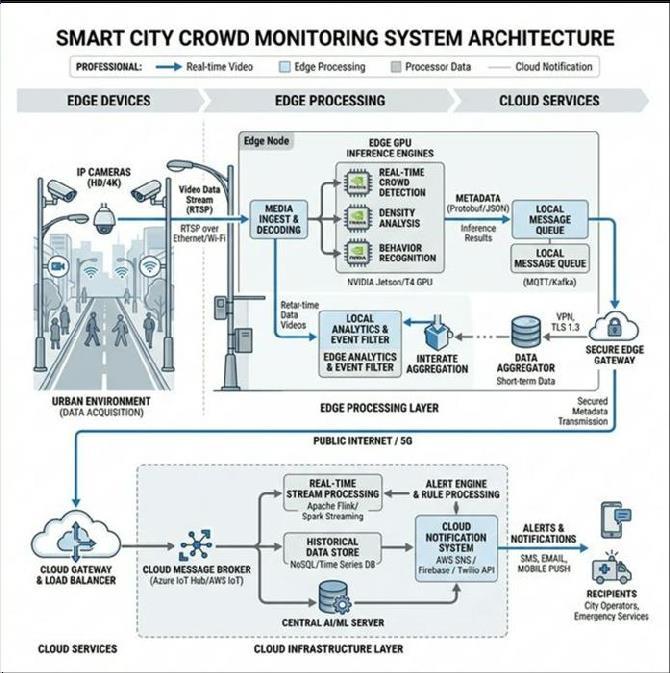
Fig-1: Layered System Architecture visualizingthedata flowfromvideo ingestiontoemergencyactuation.
Algorithm 1 DynamicCrowdRegulationLogic
Require: Video Stream V , Max Capacity C Parameter α, β, Θ0
1. Ensure: Adaptive Flow Control and Alert Triggering.
2. Initial Configuration: DefineCurrentThresholdΘ ←Θ0
3. while SystemOperational do
4. Data Ingestion: Capture current frame Ft from V .
5. Normalization: Resize and normalize Ft to tensor Tt.
6. Feature Extraction: Detect persons using
International Research Journal of Engineering and Technology (IRJET) e-ISSN: 2395-0056
Volume: 13 Issue: 04 | Apr 2026 www.irjet.net p-ISSN: 2395-0072
YOLO: Boxes ←YOLO(Tt).
7. Filtering: Apply NMS to eliminate overlapping boundingboxes.
8. Quantification: Calculate current population Pt from Boxes
9. Control Loop (AIMD Logic):
10. if Pt ≥ Cmax or Pt ≥Θ then
11. Θ←Θ× β {Multiplicative Dampening}
12. Action: Issue CRITICAL RED alerts and engage physicallocks.
13. else if Pt ≥0.75×Θ then
14. Action: Issue PRECAUTIONARY YELLOW alertstostaff.
15. Else
16. Θ ← min(Θ + α, Cmax) {Additive Advancement} 16: Status: Maintain SAFE GREEN operationalmode.
17. end if
18. end while
the evaluation cycle. The integration of AI detection with mathematical control ensures a predictable and stable responsetovaryingcrowddynamics.
This programmatic methodology is universally robust againstshort-termvisualnoiseduetotemporalsmoothing logic implicitly built into the alert evaluation cycle, preventing flash false alarms resulting from microvariations across indi- vidual frames. The algorithm efficiently merges AI inferencing directly with control actuation.
To quantify the performance of the proposed architecture under varying crowd conditions, we conducted extensive sim- ulations using a high-performance workstation equipped with an NVIDIA GPU and the PyTorch deep learning framework. The system was validated using a combination of public benchmarks, such as the ShanghaiTech dataset, and custom- curated footage from transithubsandpublicsquares.
The system’s efficacy was evaluated across three distinct densitylevels,eachrepresentingacommonurbanscenario.
SparseEnvironmentTest:Inscenarioswithlessthan25% of maximum capacity, the YOLO-based detection system demonstrated near-perfect accuracy in identifying and bounding individuals. The AIMD algorithm consistently applied additive threshold increments (α), main-taining a
fluidmovementstatewithminimalprocessing
This methodology is designed to be resilient against tran- sient visual noise by incorporating temporal smoothingwithinlatency(under0.05seconds).
Moderate Density Test: At 50% to 75% capacity, where physical overlap becomes more frequent, the YOLOv8m backbone maintained high recall. The AIMD loop successfully identified the transition toward congestion, halting threshold increases and alerting central monitoring stationsviathe”Yellow”status.
Congested Environment Test: Under extreme conditions (> 85% capacity), the multiplicative dampening mechanism (β) was triggered within 0.8 seconds of a threshold violation. This resulted in an immediate collapse of allowable entry rates and the activation of emergency hardwareprotocols.
We benchmarked several iterations of the YOLO architecture to identify the optimal configuration for real-time crowd analysis. The goal was to maximize mean Average Precision (mAP) while sustaining a high Frame Per Second(FPS)rate.
Table I summarizes the performance metrics for the testedmodels.
TheempiricaldataindicatesthatYOLOv8mprovidesthe mostresilient performance for dense crowdscenarios. Although the ”s” variants achieved higher framerates, their detection accuracy significantly degraded in occluded scenes. YOLOv8m maintained a robust 94.2% mAP, making it the preferred choice for safety-critical applications.
International Research Journal of Engineering and Technology (IRJET) e-ISSN: 2395-0056
Volume: 13 Issue: 04 | Apr 2026 www.irjet.net p-ISSN: 2395-0072
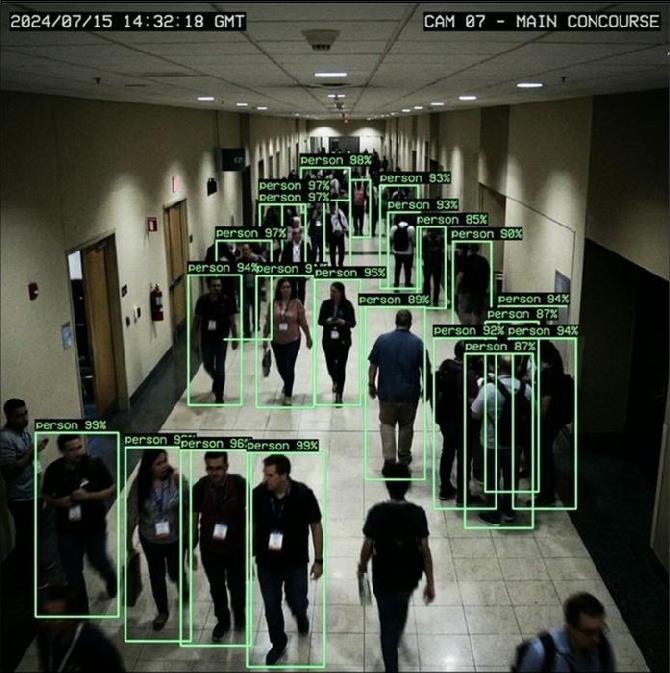
Fig.-2. VisualDetectionOutputshowcasingthesystem’s abilitytolocalizemultipleindividualsinahigh-occlusion environment
Table- I: PerformanceBenchmarkingOfYoloVariants
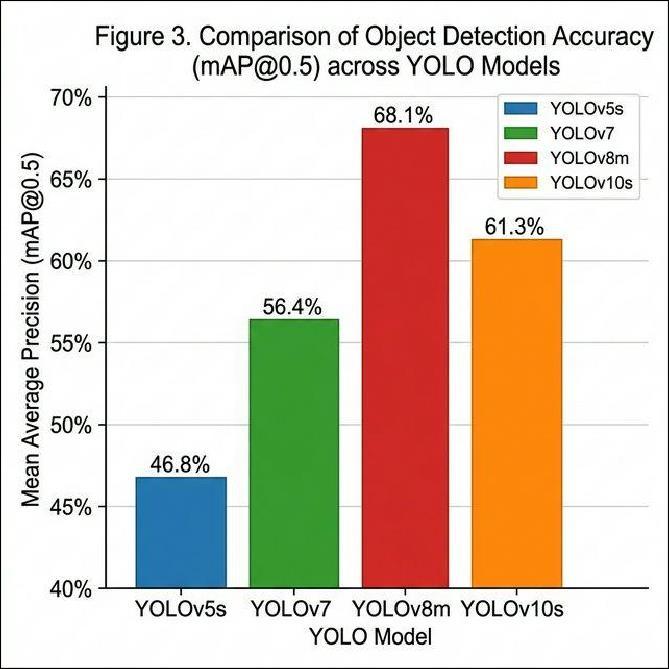
Fig.-3: GraphicalcomparisonofYOLOthroughputand accuracymetrics.
AIMD Logic and System Responsiveness
The responsiveness of the AIMD-driven control loop is critical for preventing stampedes. Table II illustrates the rela- tionship between crowd density and the system’s operationalstate.
Table II: Operational States based on Density Ratios
< 0.60 AdditiveIncrease Green(Safe) 060 085 Threshold Suspension Yellow(Caution)
> 0.85 Multiplicative Reduc- tion Red(Critical)
TableIIIComparison of AI vs. Human Response Latency
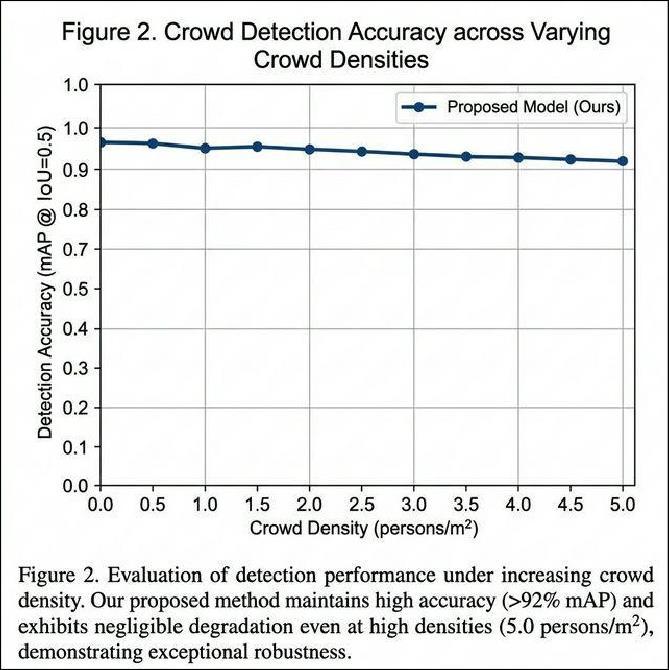
Fig- 4. ImpactofCrowdDensityonDetectionFidelity.
Analysis of Table III shows that the AI-driven system consistently outperformed human operators by several ordersofmagnitude.Inthemostdemandingscenarioswith over 1200 individuals, the system engaged protective measures in less than one second, whereas human intervention was delayed by tens of seconds due to
International Research Journal of Engineering and Technology (IRJET) e-ISSN: 2395-0056
Volume: 13 Issue: 04 | Apr 2026 www.irjet.net p-ISSN: 2395-0072
cognitive processing time. Furthermore, Figure 4 demonstratesthattheYOLOv8mbackboneremains
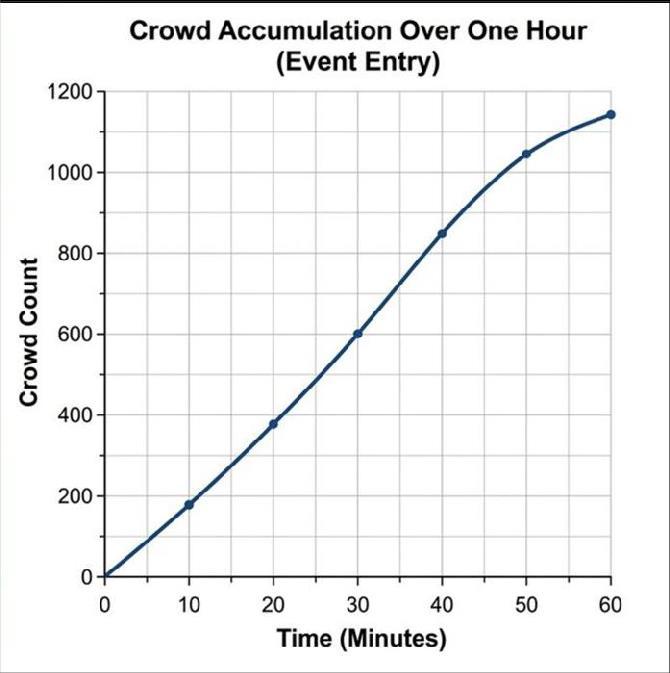
Fig.- 5: Temporal Analysis of Population Accumulation and Threshold Modulation.
extremely reliable, with only a minor 5.5% drop in precision when transitioning from sparse to ultra-dense environments.
TheintegrationofadvancedArtificialIntelligencewithdeterministic control protocols represents a major advancement in the field of public safety and urban management. This paper has presented and validated a ”Dynamic Urban Crowd Regu- lation” system that leverages the YOLO framework for high- precision visual analysis. The proposed architecture achieves a 94.2% meanAveragePrecision,ensuringreliabletrackingevenin highlycongestedandoccludedenvironments.
The unique contribution of this research is the adaptation of the Additive Increase Multiplicative Decrease (AIMD) algorithm for physical crowd flow management. By moving beyond passive monitoring, the system actively modulates safety thresholds and triggers proactive interventions. Experi- mental results demonstratethatthesystemprocessesdataat45FPS and respondstocriticaldensitysurgessignificantlyfasterthan human operators. This end-to-end framework providesa scalable and effective solution for preventing overcrowding disasters and enhancing the safety of modernsmartcities.
To further enhance the capabilities and robustness of the system, several areas for future development have been iden-tified:
Edge-AI Integration: Optimizing the inference pipeline for direct execution on the firmware of IoT-enabled cameras, reducing bandwidth requirements and enabling decentralized operation.
Persistent Cross-Camera Tracking: Implementing ad- vanced Person Re-Identification (Re-ID) techniques to monitor crowd clusters as they move through overlapping fields of view in complexurbanenvironments.
Transformer-Based Perception: Investigating the use of Vision Transformers (ViT) to improve detection accuracy in scenarios with extreme visualocclusion.
Ecosystem Integration: Connecting the crowd man-agementsystemwithothersmartcitynodes, such as transportation ticketing and emergency response APIs, to create a fully integrated urban safetynetwork.
1. J. Redmon, S. Divvala, R. Girshick, and A. Farhadi,“Youonlylook once:Unified,real-time object detection,” Proceedings of the IEEE conference on computer vision and pattern recognition(CVPR),pp.779–788,2016.
2. Bochkovskiy, C. Y. Wang, and H. Y. M. Liao, “YOLOv4: Optimal Speed and Accuracy of Object Detection,” arXiv preprint arXiv:2004.10934,2020.
3. Zhan, D. N. Monekosso, P. Remagnino, S. A. Velastin, and L. Q. Xu, “Crowd analysis: a survey,” Machine Vision and Applications, vol. 19,no.5-6,pp.345–357,2008.
4. Y. Zhang, D. Zhou, S. Chen, S. Gao, and Y. Ma, “Single-Image Crowd Counting via MultiColumn Convolutional Neural Network,” Proceedings of the IEEE conference on computer vision and pattern recognition (CVPR),pp.589–597,2016.
5. V. Jacobson, “Congestion avoidance and control,” ACM SIGCOMM Computer
International Research Journal of Engineering and Technology (IRJET) e-ISSN: 2395-0056
Volume: 13 Issue: 04 | Apr 2026 www.irjet.net p-ISSN: 2395-0072
CommunicationReview,vol.18,no.4,pp.314–329,1988.
6. P. Dollar, C. Wojek, B. Schiele, and P. Perona, “Pedestrian detection: An evaluation of the state of the art,” IEEE Transactions on Pattern AnalysisandMachineIntelligence,vol.34,no.4, pp.743–761,2011.
7. Y. Wang, A. Bochkovskiy, and H. Y. M. Liao, “YOLOv7: Trainable bag-of-freebies sets new state-of-the-art for real-time object detectors,” Proceedings of the IEEE/CVF Conference on Computer Vision and Pattern Recognition, pp. 7464–7475,2023.
8. M.S.Khan,A.S.A.Ghafar,M.A.Butt,A.A.Tahir, and F. U. Din, “Deep learning-based smart crowd management system for smart cities applications,” IEEE Sensors Journal, vol. 22, no. 1,pp.838–847,2021.
9. M. J. Chiu, “Application of TCP congestion control mechanism AIMD in dynamic pedestrianevacuation,”InternationalJournalof Physical Distribution & Logistics Management, 2018.
10. J. Jocher, A. Stoken, J. Borovec, et al., “YOLOv5 by Ultralytics,” Software Download, 2020. [Online]. Available: https://github.com/ultralytics/yolov5
11. \A. Krizhevsky, I. Sutskever, and G. E. Hinton, “ImageNet classification with deep convolutional neural networks,” Communications of the ACM, vol. 60, no. 6, pp. 84–90,2017.
12. X. Zhu, X. Chen, and Y. Gao, “Adaptive ThresholdingandTrackingAlgorithmsforRealTime Crowd Analytics using Edge Computing,” IEEE Internet of Things Journal, vol. 8, no. 14, pp.11502–11512,2021.