
International Research Journal of Engineering and Technology (IRJET) e-ISSN: 2395-0056
Volume: 13 Issue: 06 | Jun 2026 www.irjet.net p-ISSN: 2395-0072
International Research Journal of Engineering and Technology (IRJET) e-ISSN: 2395-0056
Volume: 13 Issue: 06 | Jun 2026 www.irjet.net p-ISSN: 2395-0072
Mepani Chandresh1 , Aakash Suthar 2 , Kishan Pala3
1ME, Student, Professor, Dept. of Civil of Engineering, LJ University, Ahmedabad, Gujarat ***
Abstract-This study focuses on the development of hybrid concrete using basalt fibers and Recron 3s fibers to improve the strength and durability of normal concrete. Basalt fibers are used for increasing strength, while Recron 3s fibershelp in reducing cracks and improving resistance to shrinkage.Inthis work, different percentages of fibers are addedtotheconcrete mix, such as basalt fibers (0.2% to 0.5%) and Recron 3s fibers (0.1% to 0.3%). Various tests like compressive strength, split tensile strength, and flexural strength are carried out and compared with plain concrete.The expected results show that hybrid concrete gives better performance than normal concrete. Compressive strength may increase by about10%to 20%, split tensile strength by 15% to 25%, and flexural strength by 20% to 30%. Crack formation is reduced significantly, and durability is improved.The optimum fiber content is expected around 0.3% basalt fiber and 0.2%Recron 3s fiber, where maximum strength and good workability are achieved.This hybrid concrete can be effectively used in structures like roads, bridges, and water tanks where high strength, crack resistance, and long life are required.
Key Words: : Hybrid Concrete, Basalt Fiber, Recron 3S Fiber, Compressive Strength, Split Tensile Strength, Flexural Strength, Durability, Crack Resistance
Portland cement is commonly regarded as the main componentofconcrete,whichisamongthemostfrequently utilized construction materials. The widespread use of concrete as a building material is driven by the infrastructure advancements resulting from rampant urbanization and industrial development. Cement productionisexpectedtogrowfromaround1.5billiontons in 1995 to 2.5 billion tons by 2015. Globally, concrete is utilizedintheconstructionofhighways,bridges,buildings, runways,sidewalks,anddams.Giventhenecessityofcement inconstruction,ithasastrongconnectiontotheeconomy.
• Recron3Sfiberisasyntheticpolyesterfiberdeveloped byRelianceIndustriesLimitedtoreducecrackingand improveconcretedurability.
• It consists of fine, lightweight fibers that act as secondary reinforcement, controlling micro-cracks causedbyplasticshrinkage.
• Recron 3S improves concrete quality by reducing shrinkage cracks, bleeding, segregation, and water penetration,therebyenhancingdurability..
• Therecommendeddosageis0.1%–0.3%byweightof cement (about 600–900 g/m³ of concrete), and it is commonlyusedinslabs,pavements,roads,andwaterretainingstructures
•Basaltfiberisanaturalfibermadefromvolcanicbasalt rockandisusedinconcretetoimprovestrengthand durability.
•Ithashightensilestrengthandstiffness,whichincreases thetensileandflexuralstrengthofconcrete.
• Basalt fiber reduces cracking, improves ductility, toughness,andimpactresistance,makingconcreteless brittle.
• It offers excellent fire, heat, corrosion, and chemical resistance,makingitsuitableforharshenvironmental conditions.
Indurabilitystudiesofconcrete,HCl(HydrochloricAcid)is usedtochecktheacidresistanceanddurabilityofconcrete. ConcretespecimensareimmersedinHClsolutionstostudy theeffectofacidicconditionsonstrength,weightloss,and surfacedamage.Thistesthelpstoevaluatehowwellconcrete canresistchemicalattacksinaggressiveenvironmentssuch asindustrialareas,sewageplants,andchemicalindustries
2.1 Fine Aggerate (IS 2386 Part-1)
Table1PropertiesofFineAggerate Properties Sand
Sieveanalysis ZoneII
Finenessmodulus 2.871
SpecificGravity 2.64
WaterAbsorption 1.77
BulkDensity 1.62(Loose) 1.76(Compacted)
International Research Journal of Engineering and Technology (IRJET) e-ISSN: 2395-0056
Volume: 13 Issue: 06 | Jun 2026 www.irjet.net p-ISSN: 2395-0072
2.2 Coarse Aggerate (383-1987)
Table 2 PropertiesofFineAggerate
Properties
2.88 2.99 Water Absorption 1.46% 0.29%
Aggregate ImpactValue 9.81% 9.33%
Aggregate CrushingValue 11.75% 9.98%
FlakinessIndex 10.89% 25.26%
ElongationIndex 6.84% 7.66%
BulkDensity 1.62(Loose) 1.75(Compact) 1.53(Loose) 1.79(Compact)
2.3 Properties of Fly ash
Table 3 Propertiesofflyash
Properties
ForM40GradeConcretemix
Table 6 mix
(per
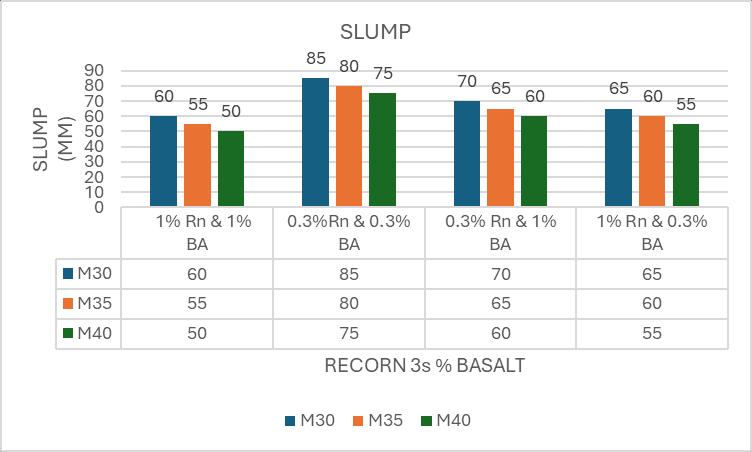
3.1 Workability
• Workability is the property of fresh concrete whichdetermines theeaseofmixing,placing, compacting,andfinishingwithoutsegregation.
• Good workability ensures better strength, durability,andsurfacefinishofconcrete
• Theworkabilityofconcreteistestedaccording toIS1199.
Chart-1 slumpvaluecomparison
Description
FiberLength 6mm/12mm,similar tocement
SpecificGravity 1.30–1.38
WaterAbsorption VeryLow
pHValue Neutral
Flammability Non-inflammable
2.4 Mix Design (10262-2019)
ForM30GradeConcretemix
Table 4 mixproportion(percubicmeter)
ForM35GradeConcretemix
Table 5 mixproportion(percubicmeter)
3.2 Compressive test result
• Bureau ofIndian Standards suggests that the compressivestrengthofconcretebeconsidered asthebasisfordeterminingallpropertiesand studyingresponseofconcrete.
• Compressive Strength Test evaluation @ (7 Days,14Daysand28Days)
• Concretecubesarestandardspecimensusedin thecompressivestrengthtesttodeterminethe strength of concrete. Generally, cubes of size 150mm×150mm×150mmarecast,cured, andtestedinaCompressionTestingMachine
Where, fc=P/A
Fc=Compressivestrength(N/mm²) P=Maximumloadapplied(N) A=Areaofcubespecimen(mm²)
International Research Journal of Engineering and Technology (IRJET) e-ISSN: 2395-0056
Volume: 13 Issue: 06 | Jun 2026 www.irjet.net p-ISSN: 2395-0072
Chart-2 Compressivetestresultof7days
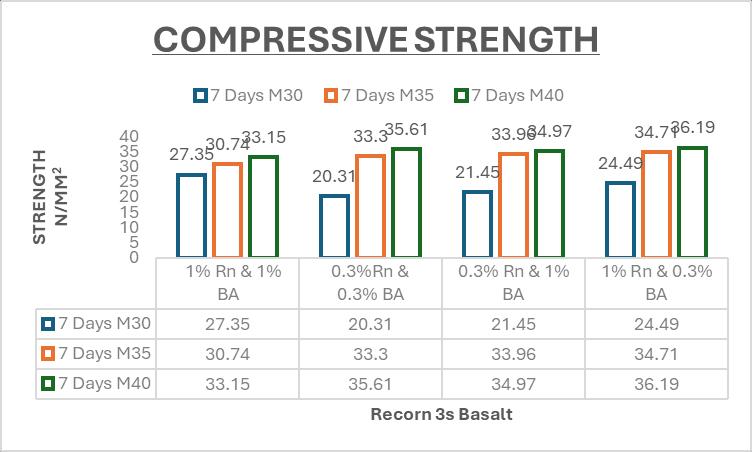
Chart-3 Compressivetestresultof14days
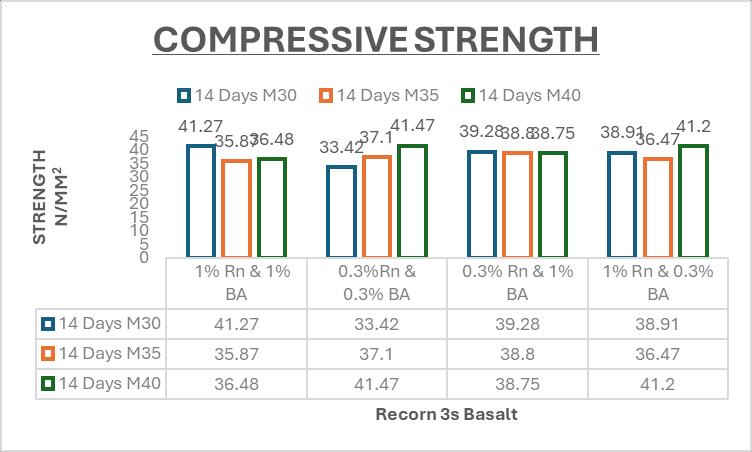
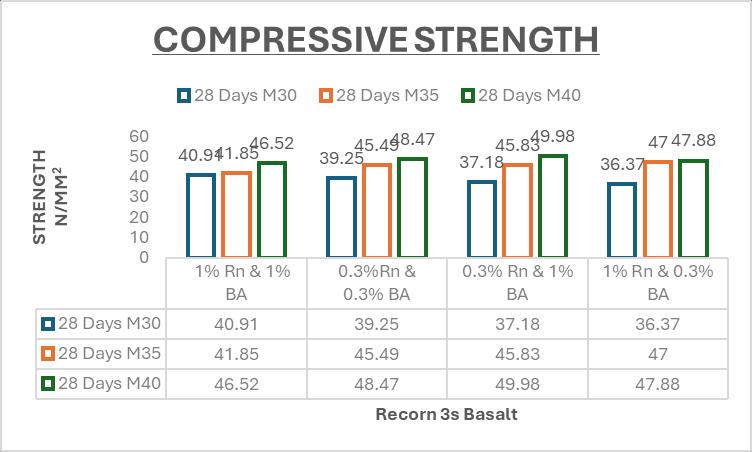
Chart-4 Compressivetestresultof28days
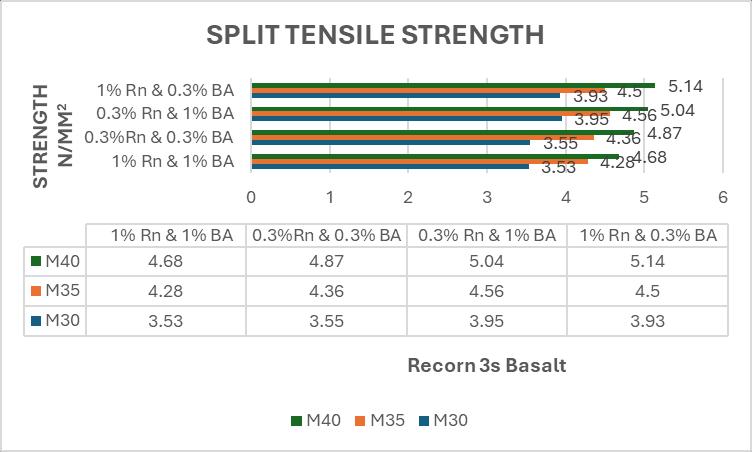
• Concretecylinderswerecasttodeterminesplit tensilestrength.28dayssplittensilestrengthof concrete was determined and results of test shownbelowintabularform.
• Theloadisappliedgraduallyuntilthecylinder splits into two halves due to tensile stress developedalongtheverticaldiameter.
• Cylinders of size 150 mm diameter and 300 mmlengthareused.Thetestisconductedafter curingperiodssuchas7daysand28days
ft=2P/3.14DL
P=Maximumloadapplied(N)
D=Diameterofcylinder(mm)
L=Lengthofcylinder(mm)
Chart-5 SplitTensiletestresult
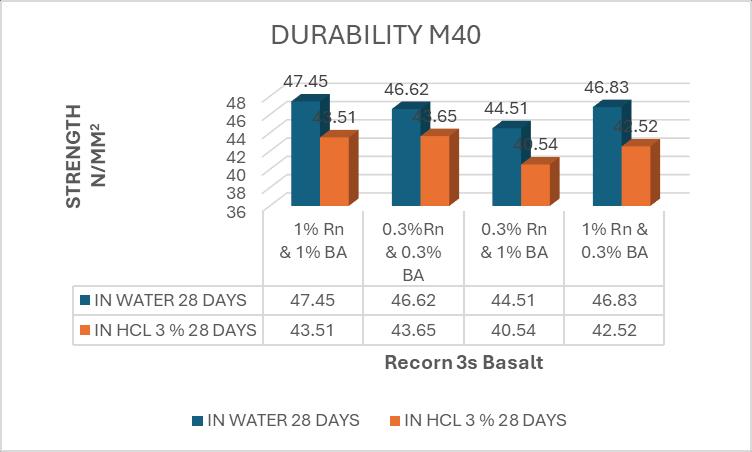
• Durabilityofconcreteistheabilityofconcrete to resist weathering action, chemical attack, abrasion, and other harmful effects while maintainingitsstrengthandstabilityforalong periodoftime.
• Indurabilitytesting, Hydrochloric Acid (HCl) solution is used to study the resistance of concreteagainstacidattack.
• Concrete specimens are immersed in HCl solutionfor28days,andthechangesinweight, surface condition, and compressive strength are observed to evaluate the chemical resistance and long-term performance of concrete.
• ThedurabilityrequirementsarespecifiedinIS 456
International Research Journal of Engineering and Technology (IRJET) e-ISSN: 2395-0056
Chart-6 DurabilitytestresultforM30
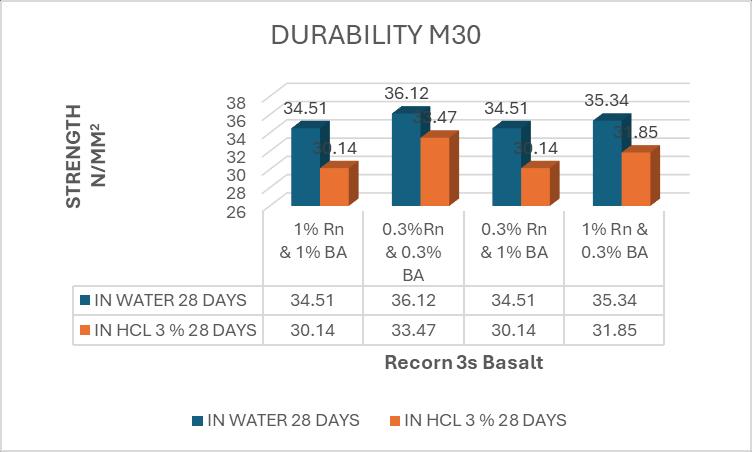
Chart-7 DurabilitytestresultforM35
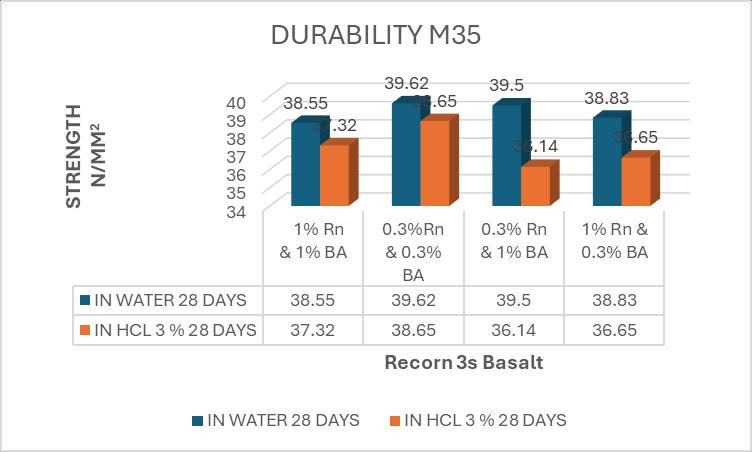
Chart-8 DurabilitytestresultforM40
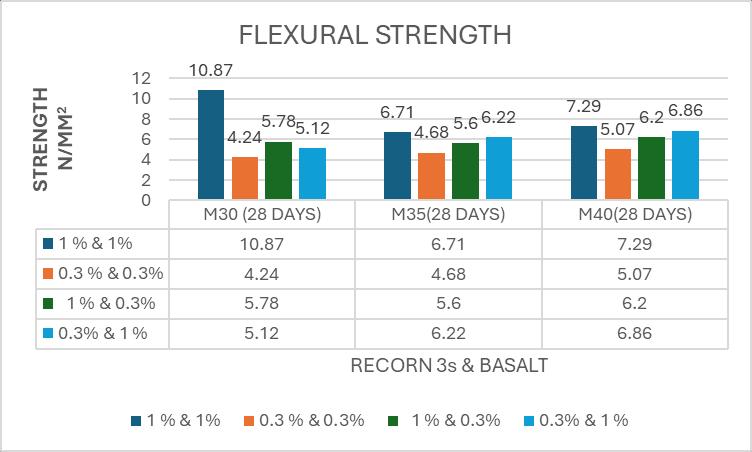
3.5 Flexural Strength test Beam Result of M30, M35, M40 Grade of Concrete
• In this study, 24 beams and 24 cubes were used,totaling48specimensforcontrol.
• Cementwassubstitutedwithflyashatvarying percentagesof1%,1.5%,0.3%,whilesandwas replacedwithstonedustatpercentagesof8%, 1%,0.3%,and1.5%.
• Molds for flexural strength testing of 150x150x600mmbeamswereprepared,with 3specimenstestedateachageusingdifferent mixdesignratios(beamstestedat7daysand 28days).
• All freshly cast specimens were left in molds for 24 hours before being removed and then submerged in water for curing until strength testingwascarriedout.
Chart-9 Comparisonofflexuralstrengthvaluesat 7days
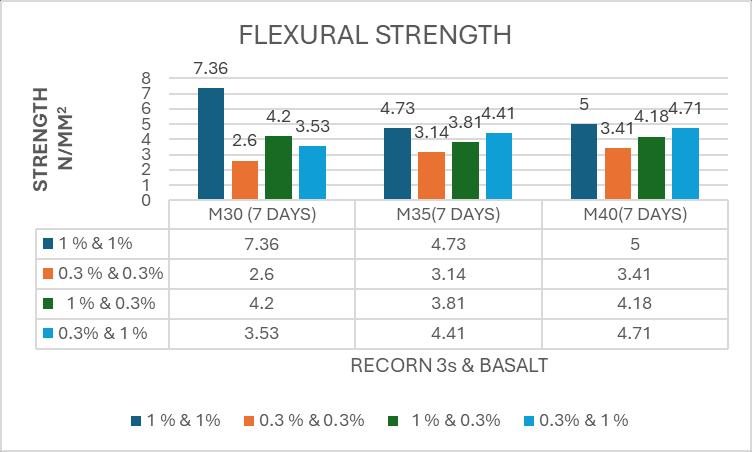
Chart-10 Comparisonofflexuralstrengthvaluesat 28days
Volume: 13 Issue: 06 | Jun 2026 www.irjet.net p-ISSN: 2395-0072 © 2026, IRJET | Impact Factor value: 8.315 | ISO 9001:2008 Certified Journal | Page30
TheincorporationofRecron3sandBasaltfibersin M30concreteresultedinanoticeableenhancement incompressivestrengthcomparedtoconventional concrete.
All fiber-reinforced mixes satisfied the strength requirementsandexhibitedimprovedperformance at28days.
An increasing trend in compressive strength was observedwiththeincreaseintotalfibercontent
International Research Journal of Engineering and Technology (IRJET) e-ISSN: 2395-0056
Volume: 13 Issue: 06 | Jun 2026 www.irjet.net p-ISSN: 2395-0072
Themixwithhigherfiberdosageshowedmaximum strengthdevelopment,indicatingtheeffectiveness ofhybridfiberreinforcement.
Mixes with lower fiber content demonstrated adequate strength along with better workability, makingthemsuitableforpracticalapplications.
Basalt fibers contributed significantly to strength enhancementandload-carryingcapacity,owingto theirhightensileproperties
Recron 3s fibers played an important role in controllingmicro-crackpropagationandimproving ductilityofconcrete.
However, an increase in fiber content led to a reduction in workability, which may affect compactionanduniformityofthemix.
The study confirms that hybridization of fibers provides a synergistic effect, improving both strengthanddurabilitycharacteristics.
Therefore, an optimum proportion of fibers is necessarytoachieveabalancebetweenmechanical performanceandworkability
REFERECENS
IS456:2000–PlainandReinforcedConcrete–Code ofPractice,BureauofIndianStandards,NewDelhi, India.
IS2386:1963(PartItoPartIII)–MethodsofTest for Aggregate for Concrete, Bureau of Indian Standards,NewDelhi,India.
IS 10262:1982 – Guidelines for Concrete Mix Design, Bureau of Indian Standards, New Delhi, India.
IS 12269:2013 – Ordinary Portland Cement, 53 Grade–Specification.
IS 516:1959 – Method of Test for Strength of Concrete.
IS 383:1970 – Specification for Coarse and Fine AggregatesfromNaturalSourcesforConcrete.
IS 5816:1999 – Splitting Tensile Strength of Concrete–MethodofTest.
Banthia, N., and Gupta, R. (2004). “Hybrid Fiber Reinforced Concrete: Fiber Synergy in High Strength Matrices.” Materials and Structures, 37, 707–716.
Sim, J., Park, C., and Moon, D. Y. (2005).
“CharacteristicsofBasaltFiberasaStrengthening MaterialforConcreteStructures.”CompositesPart B,36(6–7),504–512.
Brik, V. B. (1997). “Basalt Fiber Composite Reinforcement for Concrete.” Construction and BuildingMaterials,11(2),93–97.
Li, V. C. (2003). Engineered Cementitious
Composites (ECC): Material, Structural, and DurabilityPerformance.UniversityofMichigan.
Neville, A. M. (2011). Properties of Concrete (5th Edition).PearsonEducation.
Mehta,P.K.,andMonteiro,P.J.M.(2014).Concrete: Microstructure,Properties,andMaterials.McGrawHillEducation.
Recron 3s Fiber Technical Data Sheet. Reliance IndustriesLimited,India.
IS383-1970(Reaffirmed1997),IndianStandard codeofpractice-specificationforcoarseandfine aggregates from natural sources for concrete, SieveAnalysis,BureauofIndianStandards,New Delhi,India.
IS456-2000,IndianStandardcodeofpracticeof PlainandReinforcedConcrete.
IS2386:1963PartIIIforSpecificGravity,Water Absorption&BulkDensityofAggregate.
IS2386:1963PartIVforAggregateImpactValue &AggregateCrushingValue.
IS:2386PartI-1963(Reaffirmed1997),Indian Standard code of practice- methods of test for aggregates for concrete, Flakiness Index & Elongation Index, Bureau of Indian Standards, NewDelhi,India.
IS: 1489 (Part 1) - 1991, Specifications for Portland Pozzolana Cement, Bureau of Indian Standards,NewDelhi,India.
IS2386:1963–MethodofTestingforAggregate for Concrete, Part III Specific Gravity, Density, Voids,AbsorptionandBulking.
IS:516-1959,IndianStandardcodeofpracticemethodsoftestsforstrengthofconcrete,Bureau ofIndianStandards,NewDelhi,India.
IS:5816-1999,IndianStandardcodeofpracticesplitting tensilestrength of concrete-methodof test,BureauofIndianStandards,NewDelhi,India
IS10262:2019forRecommendedGuidelinesfor Concrete Mix Designs, Bureau of Indian Standards,NewDelhi,India
IS 9103:1999 Concrete Admixtures –Specification.