International Research Journal of Engineering and Technology (IRJET)
e-ISSN: 2395-0056
Volume: 13 Issue: 05 | May 2026
p-ISSN: 2395-0072
www.irjet.net
Development of Lightweight Interlocking Bricks Using Fly Ash, Cement, Lime and Soil for Sustainable Construction Samarth Suryawanshi1, Onkar Nanware2, Virat Wadkar3, Vaishnavi Thite4, Sumit Patil5, Aditya Mali6, Parth Kumbhar7, Ankit Patil8, Amit Patil9 1-8B.Tech Students, ⁹ Assistant Professor, Department of Civil Engineering, D.Y. Patil College of Engineering & Technology,
Kasaba Bawada, Kolhapur, Maharashtra, India
---------------------------------------------------------------------***---------------------------------------------------------------------
ABSTRACT-The construction industry consumes a large amount of natural resources and contributes significantly to environmental issues, mainly due to the use of conventional materials like burnt clay bricks and cement. To address this present work focuses on developing lightweight interlocking bricks using locally available materials such as fly ash, soil, cement, and limestone. The bricks are designed with an interlocking (tongue-and-groove) arrangement, which removes the need for mortar during construction. This not only simplifies the construction process but also helps in reducing both time and cost. Experimental tests were carried out to study the compressive strength and water absorption of the bricks. The results show that the developed bricks achieved a compressive strength of around 8 N/mm², which is higher than that of conventional clay bricks. In addition, the water absorption was found to be less than 12% indicating better durability. Another important observation is that the interlocking system completely eliminates the use of mortar and reduces overall material consumption to a significant extent. This makes the construction process faster and economical. Based on the results, it can be said that interlocking bricks made from fly ash and other locally available materials provide a practical, cost-effective, and environmentally friendly alternative for modern construction, especially in low-cost housing. Key Words: Interlocking Bricks, Fly Ash, Mortar less Construction, Sustainable Construction, Water Absorption, Lightweight Bricks.
GRAPHICAL ABSTRACT
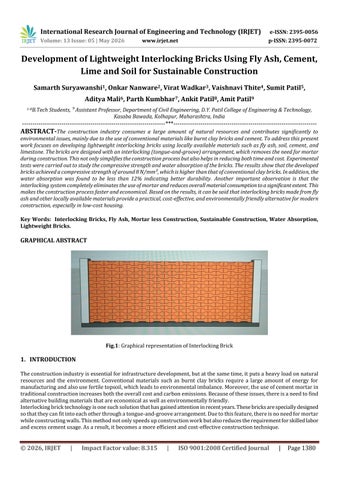
Fig.1: Graphical representation of Interlocking Brick
1. INTRODUCTION The construction industry is essential for infrastructure development, but at the same time, it puts a heavy load on natural resources and the environment. Conventional materials such as burnt clay bricks require a large amount of energy for manufacturing and also use fertile topsoil, which leads to environmental imbalance. Moreover, the use of cement mortar in traditional construction increases both the overall cost and carbon emissions. Because of these issues, there is a need to find alternative building materials that are economical as well as environmentally friendly. Interlocking brick technology is one such solution that has gained attention in recent years. These bricks are specially designed so that they can fit into each other through a tongue-and-groove arrangement. Due to this feature, there is no need for mortar while constructing walls. This method not only speeds up construction work but also reduces the requirement for skilled labor and excess cement usage. As a result, it becomes a more efficient and cost-effective construction technique.
© 2026, IRJET
|
Impact Factor value: 8.315
|
ISO 9001:2008 Certified Journal
|
Page 1380