
International Research Journal of Engineering and Technology (IRJET) e-ISSN:2395-0056
Volume:13Issue:04|Apr2026 www.irjet.net p-ISSN:2395-0072
International Research Journal of Engineering and Technology (IRJET) e-ISSN:2395-0056
Volume:13Issue:04|Apr2026 www.irjet.net p-ISSN:2395-0072
Shivam Karvire1 , Sohan Kumbhar2 , Bhushan Kamble3, Adarsh Managave4, Mr. Swapnil Sajane5
1Department of Mechatronics Engineering, Sharad Institute of Technology, College of Engineering, Yadrav. Maharashtra, India
2Department of Mechatronics Engineering, Sharad Institute of Technology, College of Engineering, Yadrav. Maharashtra, India.
3Department of Mechatronics Engineering, Sharad Institute of Technology, College of Engineering, Yadrav. Maharashtra, India.
4Department of Mechatronics Engineering, Sharad Institute of Technology, College of Engineering, Yadrav. Maharashtra, India.
5 Professor, Department of Mechatronics Engineering, Sharad Institute of Technology, College of Engineering, Yadrav. Maharashtra, India. ***
Abstract - This paper presents the design and development of a Universal Smart ID Card System based on ESP32 microcontroller and RFID technology for efficient and automated attendance management in academicinstitutions. The proposed system replaces traditional paper-based attendance with a wireless, IoT-enabled solution that improves accuracy and reduces manual workload. Each student is assigned an RFID-based unique identification card, which is authenticated by an ESP32 module integrated with a 1.3-inch OLED display for real-time verification. Student details are displayed locally and synchronized with a cloudconnected database through Wi-Fi. A dedicated web portal allows faculty members to manage sessions, add or remove students, and review attendance statistics by date and class. A secondary RFID scanner assists in new student registration by fetching unique UIDs directly into the backend database. The hardware is implemented on a custom-designed PCB, ensuring compactness and power efficiency. Experimental results confirm reliable identification, fast response time, and seamless data transfer between the device and thewebportal. The proposed model can be extended to support other institutional operations such as library management, canteen payment, bus pass verification, and fee payment, achieving a unified UniversalSmart ID platform.
Key Words: IoT, ESP32, RFID, Smart ID, Attendance System,WebPortal,UniversalCard,CampusAutomation
The digital transformation of academic institutions has created a demand for smart and automated solutions to manage student information and campus activities. Attendancetracking,inparticular,remainsoneofthemost time-consuming administrative processes. Manual attendanceleadstoerrors,proxyissues,anddatahandling inefficiency.
To address these challenges, this work introduces an IoTbased Universal Smart ID Card System using ESP32 and
RFID. The system not only automates attendance but also forms the foundation for future integration of all institutional functions fees, library, canteen, and transport intoasingleidentityframework.
Existing attendance systems rely on biometric or manual entry,whichrequirehighmaintenanceorphysicalcontact. RFIDtechnologyprovidesa contactlessandcost-effective alternative,whiletheESP32microcontrolleroffersintegrated Wi-Ficonnectivityforseamlesscommunicationwithcloud databases.
The primary objective of this project is to design and implement a wireless RFID-based attendance system usingtheESP32microcontrolleranda1.3-inchOLEDdisplay to ensure contactless, reliable, and efficient student identification.Adedicated webportal hasbeendeveloped for faculty members to manage class sessions, visualize attendance data in real time, and perform administrative operations such as adding or removing students. The hardware design incorporates a custom PCB to achieve compactness,improvedreliability,andsuitabilityforrealworldfielddeployment.Furthermore,thesystemisdesigned as a scalable framework that can be expanded into a universal identification platform capable of integrating multipleinstitutionalservicessuchasfeepayment,library management, canteen access, and transport verification underasinglesmartIDcard.
International Research Journal of Engineering and Technology (IRJET) e-ISSN:2395-0056
Volume:13Issue:04|Apr2026 www.irjet.net p-ISSN:2395-0072
2.1 Hardware Components
Thecorehardwareconsistsof:
ESP32 microcontroller withdual-coreprocessor andin-builtWi-Fi.
RFIDreader(RC522) forscanninguniqueIDcards.
1.3-inchOLEDdisplay(I²C) fordisplayingstudent verificationdetails.
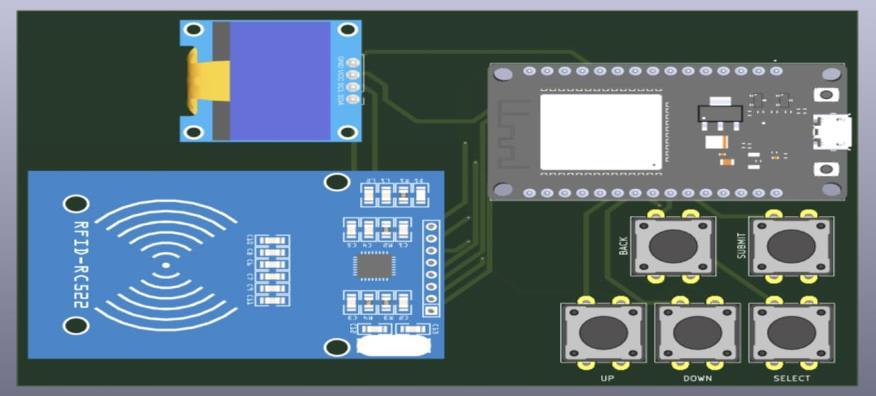
CustomPCB integratingESP32,powersupply,and connectorsforRFIDandOLED.
SecondaryRFIDscanner forUIDregistration.
2.2 Software Framework
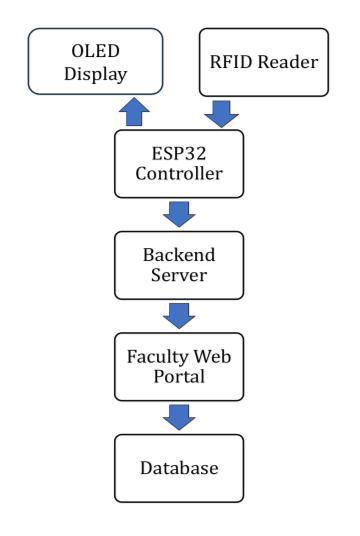
The ESP32 microcontroller is programmed using the ArduinoIDE,wheretheembeddedfirmware managesRFID cardscanning,OLEDdisplaycontrol,Wi-Ficonnectivity, and datacommunication withtheclouddatabasethrough HTTP requests. The backend of the system is developed using Node.js and MySQL,providingarobustandscalable environmentfordatastorageandAPIhandling.Thefrontend web portal, designed using HTML, CSS, and JavaScript, offersanintuitiveinterface forfacultyusers.Throughthis portal, faculty members can add, remove, or update student records, create lecture or practical sessions, submit attendance data received from the ESP32-based scanner, and generate detailed reports and analytics categorized by date, subject, or class. The combination of Node.jsandMySQLensuresfastprocessing,asynchronous data handling, and efficient real-time synchronization betweenthewebportalandtheIoThardware.
2.3 System Architecture Diagram
3.1 Custom PCB Design
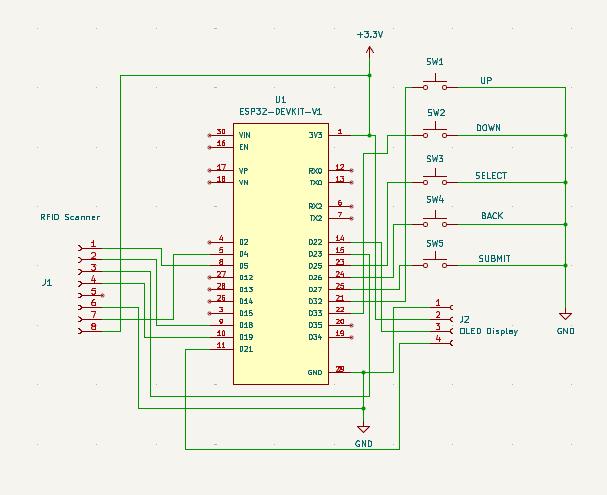
3.2 Circuit Schematic
The schematic integrates ESP32 GPIO pins with RFID (SPI interface)andOLED(I²C).Separatepinsareusedforserial debuggingandpowermonitoring.
3.3 Device Operation
WhenastudentscanstheirRFIDcard,theESP32retrieves the UID, verifies it with the database, and displays the student’snameandstatusontheOLED.Onceallstudentsare marked,thefacultypressestheSubmitbuttonontheweb interface, sending data to the backend for permanent storage.
International Research Journal of Engineering and Technology (IRJET) e-ISSN:2395-0056
Volume:13Issue:04|Apr2026 www.irjet.net p-ISSN:2395-0072
Theprototypewastestedinaclassroomenvironmentwith 25students.Thesystemsuccessfully:
VerifiedeachRFIDtaginunder 1second.
DisplayedaccuratestudentdetailsontheOLED.
Syncedattendancedatawiththebackendwithout packetloss.
Allowedaddition/removalofstudentsdynamically viathesecondaryregistrationscanner. The system demonstrated 100% recognition accuracy within 3 cm reading distance and reliable database synchronization. The modular design supports future IoT expansionsuchas cashlesscanteen, buspassvalidation, and librarybookissue underthesameUniversalSmartID framework.
This paper presents an innovative IoT-based Universal Smart ID Card System usingESP32andRFIDtechnology. Thesystemsuccessfullyautomatesattendancemanagement, enhancesdatareliability,andprovidesascalablehardwaresoftwareplatformforinstitutionalapplications.Withasingle ID card, multiple services can be accessed, reducing administrativeoverheadandpromotinga digitallyunified campus environment Future work includes integration with payment gateways andmobileappinterfacesforcomplete collegeautomation
The authors gratefully acknowledge the support of Mr. Swapnil Sajane for providing laboratory facilities and technicalguidanceduringtheproject.
[1]J. Smith etal.,“RFIDBased Smart AttendanceSystem,” IEEETransactionsonEducation,vol.65,no.3,pp.210-217, 2022.
[2]A.Gupta,R.Sharma,“IoTEnabledCampusManagement System Using ESP32,” International Journal of Advanced Research in Electronics and Communication Engineering, 2023.
[3]S.Pateletal.,“DesignofSmartIdentificationSystemfor InstitutionalAutomation,”IRJET,vol.11,issue5,2024.
[4] Datasheet, “ESP32-WROOM-32D Technical Reference Manual,”EspressifSystems,2024.
[5]RC522RFIDReaderDatasheet,NXPSemiconductors.

Shivam Karvire, B. Tech Student, Department of Mechatronics Engineering, Sharad Institute of TechnologyCollegeofEngineering, Yadrav. His interests lie in Web DevelopmentandDataProcessing.


Sohan Kumbhar, B. Tech Student, Department of Mechatronics Engineering, Sharad Institute of TechnologyCollegeofEngineering, Yadrav. His interests lie in microcontroller programming, sensorintegration.
BhushanKamble,B.TechStudent, Department of Mechatronics Engineering, Sharad Institute of TechnologyCollegeofEngineering, Yadrav. His interests lie in Electrical Wiring and Circuit Wiring.

AdarshManagave,B.TechStudent, Department of Mechatronics Engineering, Sharad Institute of TechnologyCollegeofEngineering, Yadrav.HisinterestslieinCADand CircuitDesigning.