
International Research Journal of Engineering and Technology (IRJET) e-ISSN: 2395-0056
Volume: 13 Issue: 01 | Jan 2026 www.irjet.net p-ISSN: 2395-0072
International Research Journal of Engineering and Technology (IRJET) e-ISSN: 2395-0056
Volume: 13 Issue: 01 | Jan 2026 www.irjet.net p-ISSN: 2395-0072
Srajal Mishra1,Siddharth Chaturvedi2 , Sakshi Dahayat3 , Sparsh Pal4 , Prof. Rajeev Raghuvanshi5
1,2,3,4, Student , CSE-AIML Department , Oriental Institute Of Science & Technology, Madhya Pradesh, India 5 Professor , CSE-AIML Department , Oriental Institute Of Science & Technology, Madhya Pradesh, India
Abstract - Jharkhand is rich in natural resources, wildlife, and cultural heritage, but tourism in the region remains underdeveloped due to lack of centralized information and accessibility. This paper presents the development of a smart digital platform aimed at promoting eco-tourismandcultural tourism in Jharkhand. The platform provides comprehensive information on eco-friendly travel destinations, cultural sites, local guides, tour packages, and sustainable travel practices. Designed using modern web technologies, the system ensure a user-friendly interface, easynavigation, andreal-time updates. By integrating eco-tourism and cultural tourism services into a single platform, the system aims to increase tourist engagement, promote responsible tourism, and support local communities. Experimental evaluation shows that the platform enhances accessibility, awareness, and participation in eco and cultural tourism activities in Jharkhand.
Key Words: Eco Tourism, Cultural Tourism, Smart Digital Platform, Sustainable Tourism, Jharkhand, Web Application
Jharkhand, known for its rich natural resources, dense forests,waterfalls,wildlife,andvibrantculturalheritage,has significant potential for eco-tourism and cultural tourism. Tourismnotonlycontributestotheeconomicdevelopment of a region but also helps in preserving local culture and promoting sustainable practices. Despite its natural and culturalwealth,Jharkhand’stourismsectorfaceschallenges suchaslackofcentralizedinformation,limitedaccessibility, andinsufficientawarenessamongpotentialtourists.
Tourismplaysasignificantroleintheeconomicandsocial development of a region by generating employment opportunities and supporting local communities. Ecotourismandculturaltourismemphasizesustainabletravel practicesthatconservenaturalresourcesandpromotelocal traditions, heritage, and cultural identity. Jharkhand is endowed with rich natural landscapes such as forests, waterfalls,wildlifesanctuaries,andadiversetribalculture, which provide immense potential for eco and cultural tourism development. However, despite these resources, tourism in Jharkhand remains under-promoted due to limited digital visibility, lack of centralized information systems,andinsufficientawarenessamongtourists.
Travelers often depend on scattered and outdated informationsources,makingtravelplanninginefficientand time-consuming. With the advancement of digital technologies, smart platforms have emerged as effective toolstoenhancetourismpromotionbyprovidingreal-time, accurate,andaccessibleinformation.
Inthiscontext,thedevelopmentofasmartdigitalplatform canplayacrucialroleinpromotingecoandculturaltourism inJharkhandbyimprovingaccessibility,enhancingtourist engagement,andsupportingsustainabletourismpractices.
Withtherapidadvancementofdigitaltechnologies,smart platforms can play a vital role in bridging this gap by providing tourists with comprehensive information, personalized recommendations, and eco-friendly travel options.Suchplatformscanalsosupportlocalcommunities bypromotingculturalactivities,localguides,andsustainable tourismpractices.
This paper proposes the development of a smart digital platform specifically aimed at promoting eco-tourism and cultural tourism in Jharkhand. The platform integrates informationaboutnaturaldestinations,culturalsites,tour packages, and sustainable travel guidelines into a single interface. By offering user-friendly navigation, real-time updates, and interactive features, the system aims to enhance tourist experience, increase engagement, and supportresponsibletourismintheregion.
The proposed system also focuses on creating awareness abouteco-tourism,encouragingvisitorstoadoptsustainable practices,andpreservingtheecologicalandculturalheritage ofJharkhand.
Severalstudieshaveexploredtheuseofdigitalplatformsto promotetourismandsustainabletravel.Kumaretal.(2021) developedamobile-basedtourismapplicationthatprovides location-based recommendations and information about populardestinations.Whileeffectiveforgeneraltourism,the system lacked integration of eco-friendly and cultural aspects.
International Research Journal of Engineering and Technology (IRJET) e-ISSN: 2395-0056
Volume: 13 Issue: 01 | Jan 2026 www.irjet.net p-ISSN: 2395-0072
Sharma (2020) proposed an eco-tourism management systemthatfocusesonpromotingsustainabletravelpractices in protected areas. Although it emphasized environmental conservation, the system did not provide cultural tourism informationorlocalcommunityinvolvement.
Patel et al. (2019) developed a web-based platform for cultural heritage preservation, offering tourists access to historical sites and traditional practices. However, this system did not address eco-tourism or sustainable travel, limitingitsapplicabilityforholistictourismpromotion.
Recentstudiesemphasizetheimportanceofintegratingecotourismandculturaltourismintoasingledigitalsolutionto enhance tourist engagement and promote sustainable practices.Platformscombiningreal-timeinformation,userfriendly interfaces, and support for local communities are likelytoincreasetourismparticipationandawareness.
Based on these studies, it is evident that existing systems eitherfocusoneco-tourismorculturaltourismindividually. Asmartdigital platformthatcombinesbothaspects,along with personalized recommendations and community support, is required to promote sustainable tourism effectivelyinregionslikeJharkhand.
Through the development of this minor project, several valuable learning outcomes were achieved. The project enhanced understanding of web application development, including frontend and backend integration. Practical knowledge of system architecture, workflow design, and modular development was gained. The project improved skills in problem analysis, requirement gathering, and implementationofreal-worldsolutions.
Exposure to concepts of sustainable tourism and digital transformation helped in understanding the social and environmentalimpactoftechnology.Additionally,theproject strengthenedabilitiesintechnicaldocumentation,research paperwriting,andpresentation,whichareessentialskillsfor academicandprofessionalgrowth.
Theproposedsystemisa smart digital platform designed topromoteeco-tourismandculturaltourisminJharkhand. The platform integrates information about natural destinations, cultural heritage sites, tour packages, local guides,andsustainable travel practicesintoa singleuserfriendly interface. It is designed using modern web technologies to ensure accessibility, scalability, and interactivefeatures.
The smart digital tourism platform is built on a threelayered architecture, designed to ensure scalability, reliability,andeaseofaccessfortourists andlocalguides. The User Interface Layer serves as the front-end of the platform, allowing users to interact with the system by exploringdestinations,accessingeco-tourismandcultural information,bookingtours,andprovidingfeedback.
The Application Layer, or middleware, manages the core logicofthesystem,includingtherecommendationengine, eco-tour guides, and tour booking management, and processing user requests. It ensures seamless communication between the front-end and the back-end database.TheDatabaseLayerstoresallcriticalinformation, such as destination details, cultural heritage content, user profiles,tourpackages,bookings,andfeedbackdata.
Requests from the user interface flow through the applicationlayertofetchorupdatedatainthedatabase,and responses are sent back to the front-end for display. This layered architecture ensures that the platform is efficient, maintainable, and capable of supporting multiple users simultaneously.Theoverallsystemstructureisillustratedin
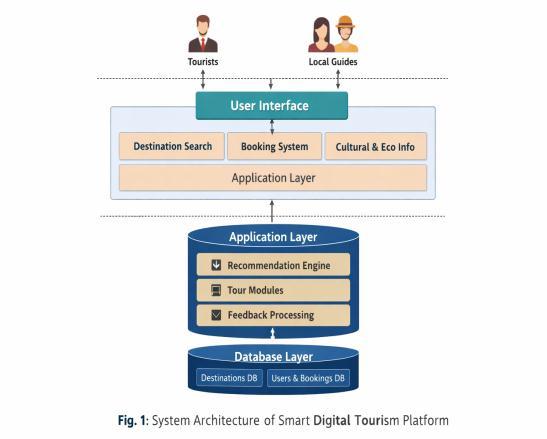
1,showingtheflowfromtheuserinterfacetothe applicationlayeranddatabaselayer.
The smart digital tourism platform consists of six key modules, each designed to provide a comprehensive and seamlessexperienceforpromotingecoandculturaltourism in Jharkhand. The User Registration and Login module allowstouristsandlocalguidestocreateaccounts,manage profiles, and securely access the platform, enabling a personalizedexperience.TheDestinationDiscoverymodule providesdetailedinformationabouteco-tourismsitessuch asforests,waterfalls,andwildlifeareas,aswellascultural heritage destinations including temples, festivals, and
International Research Journal of Engineering and Technology (IRJET) e-ISSN: 2395-0056
Volume: 13 Issue: 01 | Jan 2026 www.irjet.net p-ISSN: 2395-0072
historical landmarks. Users can search, filter, and explore destinationsbasedontheirpreferences.
The Eco-Tour Package Management module lists ecofriendly travel packages, including sustainable transportation,accommodations,andactivities,andallows userstobookpackagesdirectlythroughtheplatform.The CulturalHeritageInformationmodulepromotesawareness oflocaltraditions,handicrafts,festivals,andhistoricalsites, oftenwithmultimediacontenttoenhanceuserengagement.
The Local Guide Support module connects tourists with certified guides for personalized experiences, allowing guidestoupdateavailabilityandmanagebookings.
Finally, the Feedback and Rating module collects reviews and ratings from users for destinations, packages, and guides,helpingimprovetheplatform’squalityandassisting futuretouristsindecision-making.Theinteractionbetween thesemodulesensuresthatusershaveaccesstoeco-friendly andculturallyrichexperienceswhilesupportingsustainable tourism practices and local communities. This modular structureisvisuallyrepresented,showinghoweachmodule contributestotheoverallfunctionalityoftheplatform.
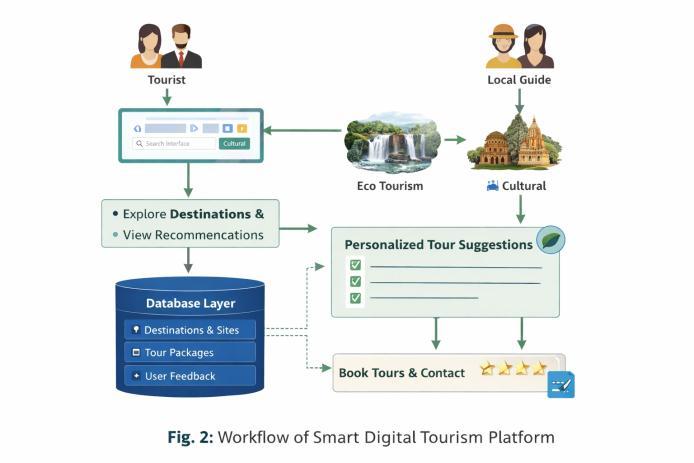
Theproposedsystemisdesignedtoprovideanintegrated digital platformforpromotingecoandcultural tourism in Jharkhand. The platform focuses on delivering a userfriendly,interactive,andsustainablesolutionthatconnects tourists witheco-tourismdestinations,culturalsites,local guides,andtourpackages.Theworkflowbeginswith user registration and login, where tourists and local guides createaccountsandsecurelyaccessthesystem.
Thismethodologyensuresthattouristshaveeasyaccessto eco-friendly and culturally rich experiences, while local communities benefit from increased engagement and sustainabletourismpractices.
Onceloggedin,userscanexplorethedestinationdiscovery module, which provides information about eco-friendly travelspotsandculturalheritagesites,alongwithlocation-
basedrecommendations.Thesystemgeneratespersonalized suggestions based on user preferences, previous interactions, and sustainability considerations, allowing userstofilterdestinationsaccordingtotheirinterests.After selectingsuitabledestinations,userscanproceedwithtour selectionandbooking,whichstoresallrelevantdatainthe platform’sdatabaseandsendsconfirmationtotheuser.The platformalsoofferslocalguidesupport,enablingtouriststo connectwithcertifiedguidesforpersonalizedexperiences, whileguidescanupdateavailabilityandmanagebookings.
Finally, the system collects user feedback and ratings for destinations,tours,andguides,whichhelpsinimprovingthe platformandprovidinginformationtofuturetourists.The overallworkflowensuresthatthetouristshaveeasyaccess to eco-friendly and culturally rich experiences, while also supporting local communities and promoting sustainable tourismpractices.Thismethodologyisillustratedin Fig. 2, showingthesequentialflowfromregistrationtofeedback submission.
The proposed smart digital tourism platform was implemented using a combination of modern web technologies to ensure accessibility, responsiveness, and scalability. The frontend was developed using HTML, CSS, and JavaScript, providing a user-friendly interface for exploringeco-tourismdestinations,culturalsites,andtour packages.The backend was implementedusing Node.js to managetheapplicationlogic,includingtherecommendation engine, tour bookings, and user interactions. MySQL was used as the database to store information related to destinations,culturalheritage,userprofiles,bookings,and feedback. The platform also incorporates APIs for map integrationandlocation-basedrecommendations.
Volume: 13 Issue: 01 | Jan 2026 www.irjet.net p-ISSN: 2395-0072
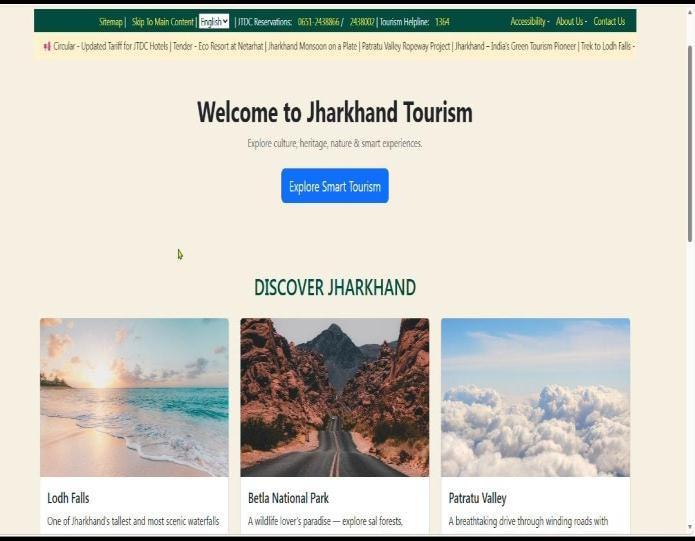
Severalscreenshotsoftheimplementedsystemdemonstrate itsfunctionality.Thehomepageprovideseasynavigationto destinations and tour packages, while the Destination Discoverymoduleallowsuserstofilterandsearchforecofriendly and cultural sites. The Eco Tour Package Management and Cultural Heritage Information modules present organized information, multimedia content, and booking options, while the Local Guide Support module enablesuserstoconnectwithcertifiedguides.TheFeedback andRatingmodulecollectsuserreviewstoimproveplatform services.
TheimplementedsystemiscloselyalignedwiththeSystem Architecture(Fig.1),Workflowdiagram(Fig.2),andSystem Modules which illustrate the platform’s layered design, sequentialworkflow,andmodularstructure.Thesediagrams provideaclearunderstandingofhowuserinteractionsflow fromregistrationtobookingandfeedbacksubmission.
9. Results
Thedevelopedsmartdigitalplatformwastestedtoevaluate its effectiveness in promoting eco and cultural tourism in Jharkhand. The system was assessed based on usability, accessibility of information, and overall user experience. Duringtesting,userswereabletosuccessfullyregister,log in, and explore eco-tourism destinations and cultural heritagesitesthroughasingleunifiedinterface.
The destination discovery module provided accurate and well-organized information, select eco-friendly tour packages, while the cultural heritage module enhanced awareness about local traditions, festivals, and historical sites. The integration of the local guide support module enabled users to connect with guides, improving personalization and engagement. The feedback and rating module collected user responses effectively, helping in analysingusersatisfactionandsystemperformance.
The destination discovery module produced accurate and structured outputs, enabling users to explore tourist locations efficiently. The eco-tour package and cultural information modules increased user awareness of sustainabletourismpracticesandlocaltraditions.
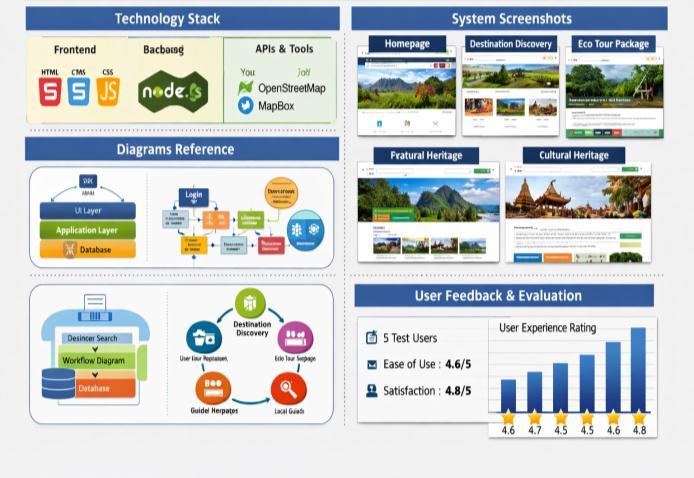
The results demonstrate that the proposed platform improves accessibility to eco and cultural tourism information,reducesmanualeffortintravelplanning,and promotessustainabletourismpractices.Overall,thesystem achieved its objectives by enhancing tourist engagement, supporting local communities, and providing a reliable digital solution for eco and cultural tourism promotion in Jharkhand.
Whichhelpeduserseasilyidentifysuitabletravellocations basedontheirinterests.Theeco-tourpackagemanagement modulefunctionedefficientlybyallowinguserstoviewand providing a reliable digital solution for eco and cultural tourismpromotioninJharkhand.
This paper presented the development of a smart digital platform aimed at promoting eco and cultural tourism in Jharkhand.Theproposedsystemsuccessfullyintegratesecotourism destinations, cultural heritage information, tour packages, and local guide support into a single digital interface.Byutilizingmodernwebtechnologies,theplatform provideseasyaccesstoreliableinformation,improvesuser engagement,andsupportssustainabletourismpractices.
The results obtained from system implementation and testingindicatethattheplatformenhancesaccessibilityto tourism-relatedinformationandsimplifiestravelplanning fortourists.Theinclusionofeco-friendlytouroptionsand cultural awareness features contributes to responsible tourismandhelpspreservetheenvironmentalandcultural heritageofJharkhand.Furthermore,theplatformsupports local communities by promoting local guides and cultural activities, thereby contributing to regional economic development.
Overall, the proposed smart digital platform meets its intendedobjectivesanddemonstratesthepotentialofdigital solutions in strengthening eco and cultural tourism. The systemcanserveasaneffectivetoolforsustainabletourism
International Research Journal of Engineering and Technology (IRJET) e-ISSN: 2395-0056
Volume: 13 Issue: 01 | Jan 2026 www.irjet.net p-ISSN: 2395-0072
promotion and can be further enhanced with advanced technologiesinthefuture.
Theproposedsmartdigitalplatformforpromotingecoand cultural tourism in Jharkhand can be further enhanced in several ways. Advanced technologies such as Artificial Intelligence and Machine Learning can be integrated to providepersonalizedtravelrecommendationsbasedonuser behaviourandpreferences.
Theplatformcanbeexpandedintoamobileapplicationto increase accessibility and convenience for tourists. Integrationwithreal-timeGPSnavigation,augmentedreality (AR) based virtual tours, and multilingual support can further improve user engagement and inclusivity. Online payment gateways and real-time booking systems can be incorporated to provide complete end-to-end tourism services.
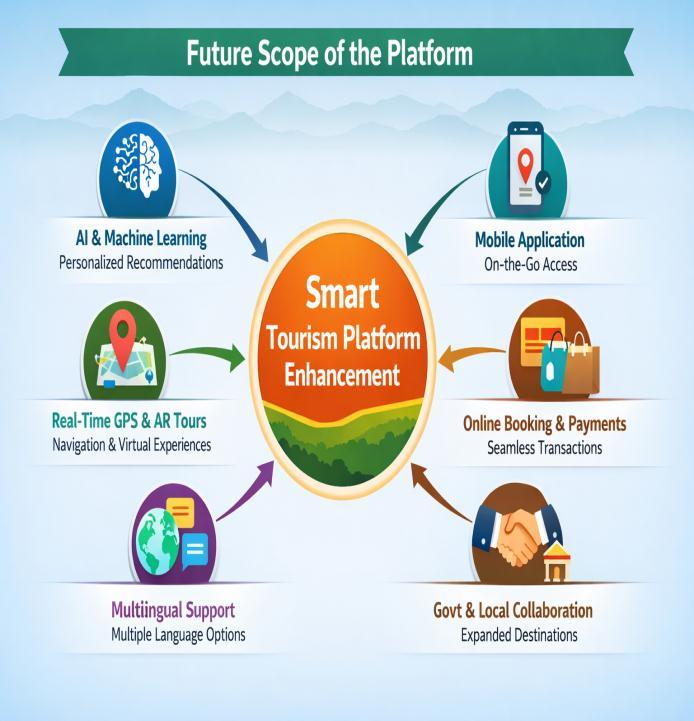
Additionally, collaboration with government tourism departmentsandlocalstakeholderscanhelpinexpanding the platform to cover more destinations and promote sustainabletourismonalargerscale.
Iwouldliketoexpressmysinceregratitude tomyproject guide and faculty members for their valuable guidance, encouragement, and continuous support throughout the completionofthisminorproject.Theirinsightfulsuggestions andconstructivefeedbackplayedacrucialroleinshaping thisresearchwork.
I am also thankful to my department and institution for providingthenecessaryresourcesandfacilitiesrequiredfor successful implementation of the project. Finally, I would like to acknowledge my friends and classmates for their cooperation and support during the development of this project.
Iwouldalsoliketoacknowledgethesupportprovidedbymy institution for offering the necessary infrastructure, laboratoryfacilities,andlearningresourcesrequiredforthe implementationoftheproposedsystem.
Finally, I extend my heartfelt thanks to my friends and classmates for their cooperation, discussions, and moral support during the course of this project. Above all, I am gratefultomyfamilyfortheirconstantencouragementand support, which motivated me to complete this work successfully.
[1] Ministry of Tourism, Government of India, “Incredible India–TourismDevelopmentInitiatives”,OfficialTourism Portal,2023.
[2] World Tourism Organization (UNWTO), “Sustainable Tourism Development Guidelines”, UNWTO Publications, 2022.
[3]R.KumarandS.Sharma,“RoleofInformationTechnology in Promoting Tourism”, International Journal of Tourism Research,vol.15,no.4,pp.245–252,2021.
[4] A. Singh, “Eco-Tourism and Cultural Heritage Management in India”, International Journal of EnvironmentalStudies,vol.10,no.2,pp.112–118,2020.
[5] IRJET, “Paper Submission Guidelines and Template”, International Research Journal of Engineering and Technology,2024.
[6] Jharkhand Tourism Development Corporation (JTDC), “Tourism Resources and Cultural Heritage of Jharkhand”, GovernmentofJharkhandPublications,2023.
[7]Pressman,R.S., SoftwareEngineering:APractitioner’s Approach,8thEdition,McGraw-Hill,2019.
[8] W3C, “Web Technologies Documentation: HTML, CSS, andJavaScript”,WorldWideWebConsortium,2023.