
International Research Journal of Engineering and Technology (IRJET) e-ISSN: 2395-0056
Volume: 13 Issue: 01 | Jan 2026 www.irjet.net p-ISSN: 2395-0072
DETERMINATION OF TOTAL PHENOLIC CONTENT AND TOTAL FLAVONOID CONTENT FROM LEAF AND FLOWER EXTRACTS OF Calotropis gigantea USING UV SPECTROSCOPY
R. Kanmani1 , V.S. Sanjay2 , k. Shanmugavel3, S. Sakthivel4
1 Assistant Professor, Sri Vijay Vidyalaya College of Pharmacy, Tamil Nadu, India. 2, 3, 4, B. Pharm students, Sri Vijay Vidyalaya College of Pharmacy, Tamil Nadu, India. ***
Abstract- This study aimed to evaluate the total phenolic content (TPC) and total flavonoid content (TFC) present in leaf and flower extracts of Caltrops gigantean using UV–Visible spectrophotometric techniques. Phenolic and flavonoids are bioactive plant constituents widely recognized for their antioxidant potential and therapeutic significance. Ethanolic extracts of the leaves and flowers were prepared and assessed for TPC using the Folin–Ciocalteu reagent, while TFC was determined through the aluminium chloride colorimetric assay. Gallic acid and quercetin served as calibration standards, with absorbance readings recorded at 765 nm and 415 nm, respectively. The quantitative analysis demonstrated that leaf extracts contained significantly higher levels of phenolic and flavonoid compounds than flower extracts. Results were expressed as milligrams of Gallic acid equivalents and quercetin equivalents per gram of extract. These findings suggest that Calotropis gigantea, particularly its leaves, represents a valuable source of natural antioxidant compounds and provides scientific support for its use in traditional medicine.
Keywords: Calotropis gigantea, phenolic compounds, flavonoids, UV–Visible analysis, antioxidant properties, medicinalplant
1. Introduction
Medicinal plants have long been recognized as invaluable sources of therapeutic agents in both traditional healthcare systemsandmodernpharmacology.Forcenturies,plant-basedremedieshaveplayedacrucialroleinthepreventionand treatment of various diseases, owing to their rich reservoir of bioactive compounds. The medicinal potential of plants is largely attributed to the presence of secondary metabolites, particularly phenolic compounds and flavonoids. These phytochemicals are known for their diverse biological activities, including antioxidant, anti-inflammatory, antimicrobial, antiviral, and anticancer properties. Among these, antioxidant activity is of particular importance, as oxidative stress caused by free radicals is a major contributor to the development of chronic and degenerative diseases such as cancer, cardiovasculardisorders,diabetes,andneurodegenerativeconditions.
Phenolic compounds and flavonoids exert their antioxidant effects primarily through their ability to donate hydrogen atomsorelectrons,therebyneutralizingfreeradicalsandinhibitinglipidperoxidation.Inaddition,thesecompoundscan chelate metal ions and modulate antioxidant enzyme activities, further enhancing cellular defence mechanisms. Due to these protective effects, the evaluation of phenolic and flavonoid content in medicinal plants has gained significant attentioninrecentyears,servingasareliableindicatoroftheirantioxidantpotentialandoveralltherapeuticvalue.
Calotropisgigantea(L.)R.Br.,belongingtothefamilyAsclepiadaceous,isawell-knownmedicinalplantwidelydistributed across India and other tropical and subtropical regions of Asia and Africa. The plant is commonly referred to as “giant milkweed”andhasbeenextensivelyusedintraditionalsystemsofmedicinesuchasAyurveda,Siddha,andUnani.Various partsoftheplant,includingleaves,flowers,roots,bark,andlatex,havebeentraditionallyemployedforthetreatmentof a wide range of ailments such as skin diseases, inflammation, asthma, fever, cough, rheumatism, and wound healing. The latexoftheplantisparticularlyknownforitsantimicrobialandanti-inflammatoryproperties,whiletheleavesandflowers areoftenusedfortheiranalgesicandantioxidanteffects.
ThepharmacologicalsignificanceofC.giganteaiscloselylinkedtoitsdiversephytochemicalcomposition.Previousstudies have reported the presence of several bioactive constituents, including phenols, flavonoids, alkaloids, cardiac glycosides, saponins, steroids, and terpenoids. These compounds collectively contribute to the plant’s wide spectrum of biological activities. However, the concentration and distribution of phenolic and flavonoid compounds may vary among different plantparts,influencingtheirantioxidantcapacityandtherapeuticeffectiveness.
Quantitative determination of total phenolic content (TPC) and total flavonoid content (TFC) is therefore essential for assessing the antioxidant potential of plant extracts. UV–Visible spectrophotometry is one of the most commonly
International Research Journal of Engineering and Technology (IRJET) e-ISSN: 2395-0056
Volume: 13 Issue: 01 | Jan 2026 www.irjet.net p-ISSN: 2395-0072
employed techniques for this purpose due to its simplicity, sensitivity, accuracy, and cost-effectiveness. Methods such as the Folin–Ciocalteu assay for phenolics and aluminum chloride colorimetric assay for flavonoids are widely used and providereliablequantitativedata.
In this context, the present investigation was undertaken to evaluate and compare the total phenolic and total flavonoid contentofleafandflowerextractsofCalotropisgiganteausingUV–Visiblespectrophotometricmethods.Thestudyaimsto provide scientific validation for the traditional use of this plant and to contribute to a better understanding of its antioxidantpotential,therebysupportingitspossibleapplicationinpharmaceuticalandnutraceuticalformulations.
2. Aim and Objectives
Aim
Todeterminethetotalphenoliccontentandtotalflavonoidcontentpresentinleafandflowerextractsof Calotropis gigantea usingUVspectrophotometricmethods.
Objectives
Tocollectandauthenticatetheleavesandflowersof Calotropis gigantea
Toprepareplantextractsusingsuitablesolvents
ToestimatetotalphenoliccontentusingtheFolin–Ciocalteumethod
Toestimatetotalflavonoidcontentusingthealuminiumchloridecolorimetricmethod
Tocomparethephenolicandflavonoidcontentbetweenleafandflowerextracts
ToevaluatetheantioxidantpotentialbasedonTPCandTFCvalues
3. Plant Profile
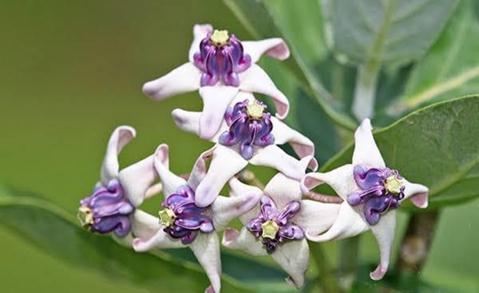
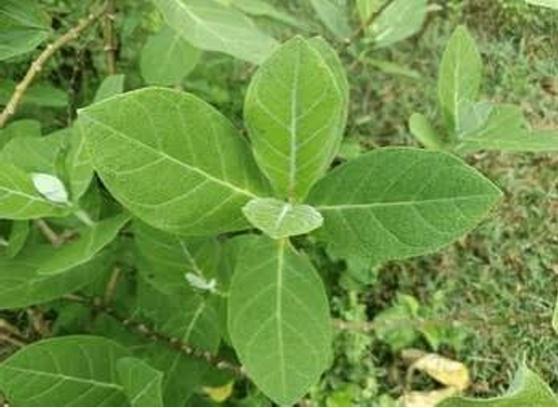
Botanical name:Calotropis gigantea (L.)R.Br.
Family: Asclepiadaceae
Common names: Giantmilkweed,Crownflower
Habitat: Tropicalandsubtropicalregions;commonlyfoundinwastelandsandroadsides
Parts used: Leaves,flowers,roots,latex
Medicinal Uses
Traditionally, Calotropis gigantea isusedasananti-inflammatory,analgesic,antimicrobial,expectorant,andwound-healing agent. Leaves and flowers are known to possess antioxidant and therapeutic properties due to the presence of phenolic andflavonoidcompounds.
International Research Journal of Engineering and Technology (IRJET) e-ISSN: 2395-0056
Volume: 13 Issue: 01 | Jan 2026 www.irjet.net p-ISSN: 2395-0072
4. Materials and Methods
Materials
Freshleavesandflowersof Calotropis gigantea
Solvents(ethanol/methanol)
Folin–Ciocalteureagent
Gallicacid(standardforTPC)
Aluminiumchloride
Quercetin(standardforTFC)
Sodiumcarbonate
UV-Visiblespectrophotometer
Volumetricflasks,pipettes,testtubes
5. Principle
Principle of Total Phenolic Content (TPC)
TheFolin–Ciocalteumethodisbasedonthereductionofphosphomolybdic-phosphotungsticacidcomplexespresentinthe Folin–Ciocalteureagentbyphenoliccompoundsunderalkalineconditions.Thisreactionresults intheformationofabluecollaredcomplex,whichshowsmaximumabsorbanceat 765 nm.Theintensityofthecolorisdirectlyproportionaltothe phenoliccontentpresentinthesample.
Principle of Total Flavonoid Content (TFC)
Thealuminiumchloridecolorimetricmethodisbasedontheformationofastableyellowcomplexbetweenflavonoidsand aluminiumchloride.Thiscomplexshowsmaximumabsorbanceat 415 nm.Theabsorbanceisdirectlyproportionaltothe flavonoidconcentrationintheextract.
6. Procedure
Preparation of Plant Extract
Thecollectedleavesandflowerswerewashedthoroughlywithwater,shade-dried,andpowdered.Thepowderedmaterial was extracted using ethanol by maceration/soxhlet extraction. The extracts were filtered and concentrated, and used for furtheranalysis.
Estimation of Total Phenolic Content
Standardgallicacidsolutionsofknownconcentrationswereprepared.
PlantextractwasmixedwithFolin–Ciocalteureagentandsodiumcarbonatesolution.
Themixturewasincubatedatroomtemperaturefor30minutes.
Absorbancewasmeasuredat 765 nm usingaUVspectrophotometer.
Estimation of Total Flavonoid Content
Standardquercetinsolutionsofknownconcentrationswereprepared.
Plantextractwasmixedwithaluminiumchloridesolution.
Themixturewasincubatedfor30minutes.
Absorbancewasmeasuredat 415 nm usingaUVspectrophotometer.
7. Calculations
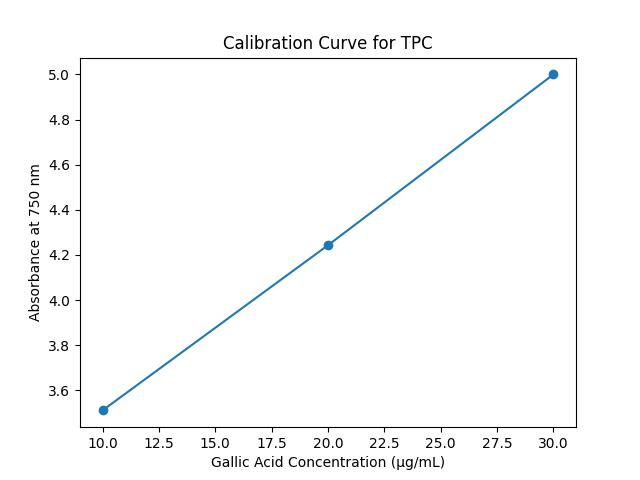
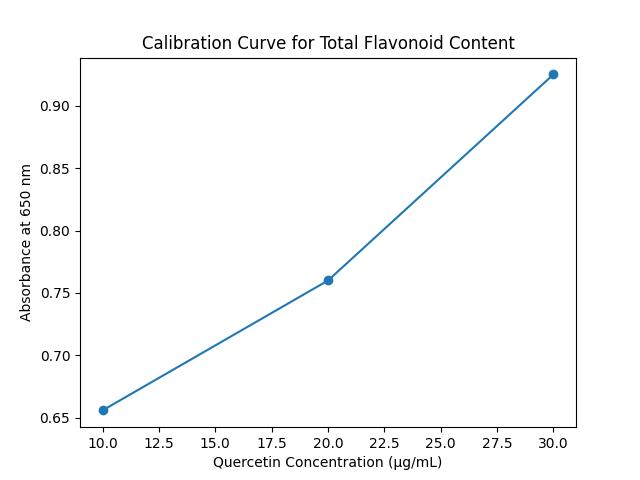
Calibrationcurveswereplottedusingstandardgallicacid(TPC)andquercetin(TFC).
The concentration of phenols and flavonoids in plant extracts was calculated using the regression equation obtainedfromthestandardcurves.
Totalphenoliccompound:
International Research Journal of Engineering and Technology (IRJET) e-ISSN: 2395-0056
Volume: 13 Issue: 01 | Jan 2026 www.irjet.net p-ISSN: 2395-0072
TotalFlavonoidcount
Expression of Results
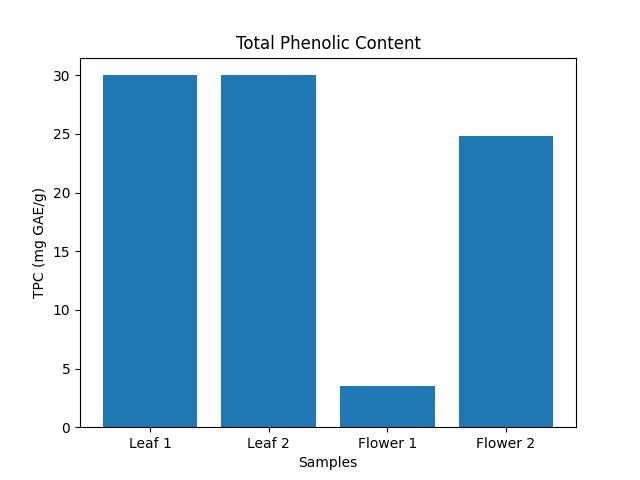
Totalphenoliccontentwasexpressedas mg gallic acid equivalents (GAE)/g of extract
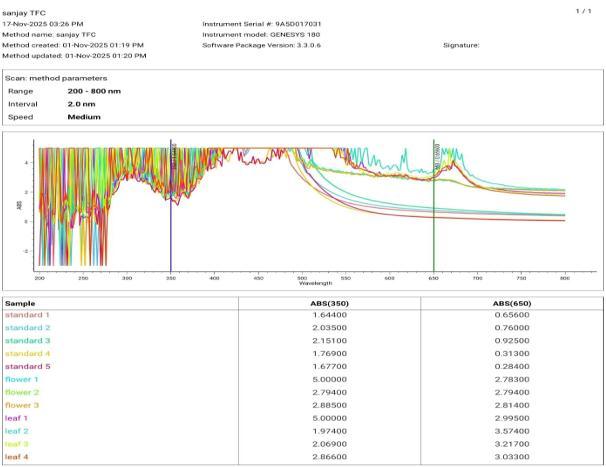
Totalflavonoidcontentwasexpressedas mg quercetin equivalents (QE)/g of extract
8. Results:
A) TPC
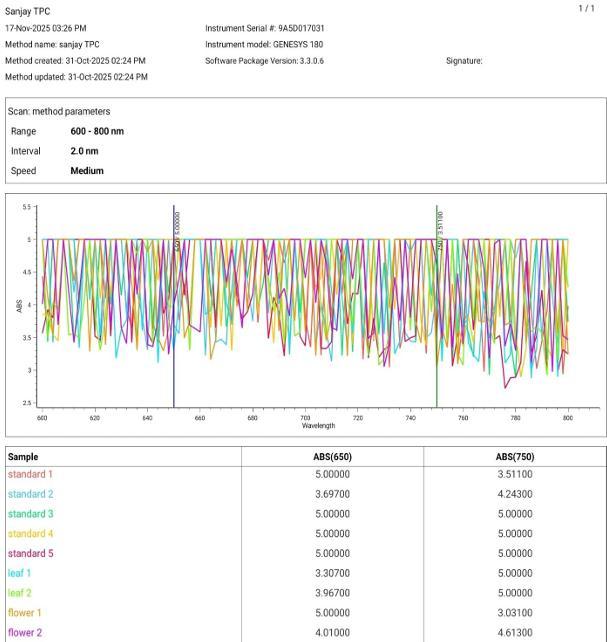
Fig no 02: TPC
Table no 01 : Final TPC Result
2026, IRJET | Impact Factor value: 8.315 | ISO 9001:2008
International Research Journal of Engineering and Technology (IRJET) e-ISSN: 2395-0056
Volume: 13 Issue: 01 | Jan 2026 www.irjet.net p-ISSN: 2395-0072
International Research Journal of Engineering and Technology (IRJET) e-ISSN: 2395-0056
Volume: 13 Issue: 01 | Jan 2026 www.irjet.net p-ISSN: 2395-0072
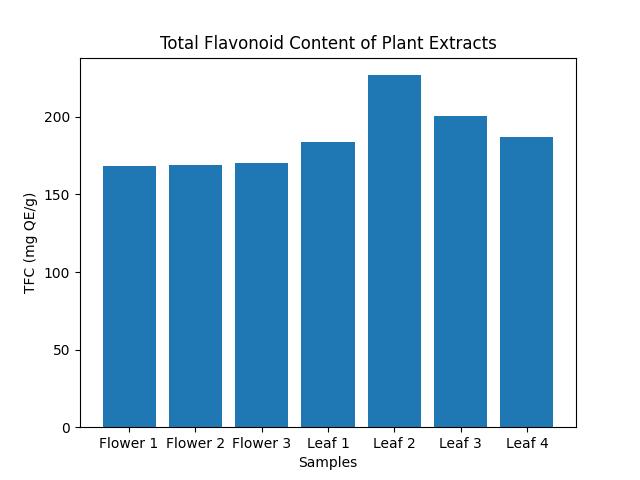
Table no 02: Final TFC Result
International Research Journal of Engineering and Technology (IRJET) e-ISSN: 2395-0056
Volume: 13 Issue: 01 | Jan 2026 www.irjet.net p-ISSN: 2395-0072
9. Discussion
Thefindingsofthepresent studyconfirmedthat bothleafand flower extractsof Calotropis gigantea containappreciable levelsofphenolicandflavonoidcompounds.However,theleafextractdemonstratednotablyhighertotalphenoliccontent (TPC)andtotalflavonoidcontent(TFC)whencomparedtotheflowerextract,suggestingthattheleavespossessstronger antioxidantpotential.
Phenoliccompoundsarewidelyrecognizedfortheirabilitytoneutralizefreeradicalsandprotectbiologicalsystemsfrom oxidative damage. Similarly, flavonoids are associated with diverse pharmacological effects, including anti-inflammatory, antimicrobial, and protective cellular activities. The elevated levels of TPC and TFC observed in the leaf extract may be attributedtoagreateraccumulationofbioactivesecondarymetabolitesinleaftissues,whichareactivelyinvolvedinplant defencemechanisms.
The use ofUV–Visiblespectrophotometrictechniques inthis study proved to bea dependable and efficient approachfor the quantitative analysis of phenolic and flavonoid constituents. The simplicity and accuracy of this method make it suitableforroutinephytochemicalevaluationofmedicinalplants.
10. Conclusion
Thepresentinvestigationeffectivelyevaluatedthetotalphenolicandtotalflavonoidcontentintheleafandflowerextracts of Calotropis gigantea through UV–Visible spectrophotometric analysis. The findings revealed that the leaf extract contained higher levels of phenolic and flavonoid compounds compared to the flower extract, indicating superior antioxidant potential. These results provide scientific validation for the traditional medicinal applications of Calotropis gigantea and suggest that the plant, especially its leaves, holds promise as a valuable source of natural antioxidant compounds. Further studies are recommended to explore its bioactive constituents and potential pharmaceutical applications.
11. References:
1. SakshiGupta,VishalBodke.(2023),Formulationandevaluationofhairremovalcreambyusinganherbalbase
2. Sharma,P.,&Singh,R.(2018),formulationandevaluationofherbaldepilatorycream.
3. Deepti Hiremath, Sakshi Kamble (2024), formulation and evaluation of hair removal cream by using an herbal base,IJCRT.
4. Kumar,S.,&Mishra,A.(2019),HERBALCOSMETIC,InternationalJournalofAdvancedResearchinPharmaceutical Science.
5. ShankerK,ShaikS,HerbalPlantsasasafeandnaturalhairdepilatory.
6. Patel,R.B.,Desi,J.,(2017),Developmentofherbalcosmeticformulationforhairremoval.
7. Kaur,H.,&Kaur,G.,(2015),Herbaldepilatoryagentsandtheirmechanismofaction.
8. Shailendra Tripathi, Vandana Sharma (2022), Natural hair removal cream, International Journal of Current PharmaceuticalReviewandresearch.
9. NeelamVerma,RajivGupta(2011),formulationandevaluationofherbaldepilatorycream.
10. Pandey,A.,Tripathi,P.,(2020),Naturalingredientusedincosmeticformulationandtheirbenefits.
11. Prathamesh Kantilal Bhalke, Vijaya Arjun Kute (2024), formulation and evaluation of hair removal cream for all skintypes.