
International Research Journal of Engineering and Technology (IRJET) e-ISSN: 2395-0056 Volume: 13 Issue: 05 | May 2026 www.irjet.net p-ISSN: 2395-0072
International Research Journal of Engineering and Technology (IRJET) e-ISSN: 2395-0056 Volume: 13 Issue: 05 | May 2026 www.irjet.net p-ISSN: 2395-0072
Seerapu Yamini1, Vantakula Lakshmi2
1 MCA Student, Gayatri Vidya Parishad College of Engineering(A), Visakhapatnam – 530048, Andhra Pradesh, India
2 Assistant Professor, Department of Computer Applications, Gayatri Vidya Parishad College of Engineering(A), Visakhapatnam – 530048, Andhra Pradesh, India
Abstract - Artificial intelligence-generated images are rapidly increasing due to advancements in deep learning models and image synthesis technologies. Large volumes of synthetic images are produced every year using techniques such as Generative Adversarial Networks (GANs) and diffusion models. However, most of these images are highly realistic and difficult for users to distinguish from real photographs without advanced analytical methods. This researchpresentsthedevelopmentofanAI-generatedimage detection system using EfficientNet-B0 and BLIP to identify whether an image is authentic or synthetically created by artificial intelligence. The proposed system integrates EfficientNet-B0 with transfer learning to analyze hidden visual patterns, structural inconsistencies, and image artifacts for accurate classification. The system also incorporates the BLIP (Bootstrapping Language-Image Pretraining) model to generate descriptive captions for uploaded images, improving interpretability and user understanding. The system converts image data into classificationresultsandtextualdescriptionsthroughimage preprocessing,featureextraction,andcaptiongeneration.By transforming complex deep learning processes into a simple andaccessiblesolution,theproposedsystemsimplifiesimage authenticity verification and helps reduce the spread of misleading AI-generated content across digital media platforms.
Key Words: AI-Generated Images, EfficientNet-B0, Deep Learning, Image Classification, BLIP, Image Authenticity Detection
Artificial intelligence plays a vital role in transforming digital content creation, image processing, and media generation across various domains. Modern AI technologies such as Generative Adversarial Networks (GANs), diffusion models, and deep learning architectures are capable of producing highly realistic synthetic images that closely resemble real-world photographs. These advanced technologies are widely used in fields including entertainment,socialmedia,advertising,virtualreality,and digitaldesign.
Organizationsandonlineplatformscontinuouslygenerate and share large volumes of digital images through social mediaapplications,websites,andAIbasedcontentcreation systems.Theseimagesincludebothauthenticphotographs andAIgeneratedsyntheticcontentcreatedusingadvanced image generation techniques. Although such technologies provide significant advantages in creativity and automation, they also create serious challenges related to misinformation,deepfakes,imagemanipulation,anddigital authenticityverification.
Traditional image verification methods mainly rely on manual inspection and basic image analysis techniques. This makes it difficult for users to accurately distinguish between real and AI-generated images, especially when synthetic images contain highly realistic textures, lighting, and visual patterns. With the increasing availability of AIgenerated content, there is a growing need for intelligent
International Research Journal of Engineering and Technology (IRJET) e-ISSN: 2395-0056
Volume: 13 Issue: 05 | May 2026 www.irjet.net p-ISSN: 2395-0072
systemsthatcanautomaticallyanalyzeimagesandprovide accurateauthenticityverificationinareliableandefficient manner.
Deeplearningtechniquesprovideaneffectivesolutionfor this challenge. Convolutional Neural Networks (CNNs) convert complex image data into meaningful feature representations that allow systems to identify hidden artifacts, visual inconsistencies, and structural patterns more effectively. Transfer learning techniques further improve performance by utilizing pre-trained models, reducingcomputationalcomplexityandtrainingtimewhile maintaininghighclassificationaccuracy.
This research proposes an AI-generated image detection systemusingEfficientNet-B0andBLIPthatintegratesdeep learning-basedclassificationandimagecaptiongeneration. The system allows users to analyze uploaded images, identifywhethertheyarerealorAI-generated,andgenerate descriptive captions through interactive processing. By transforming complex image analysis into meaningful classification and textual outputs, the system improves image authenticity verification and supports secure and reliabledigitalmediaanalysis.
A.AI-Generated Image Detection and Deep Learning Research
Deep learning techniques have become essential for analyzingandidentifyingAI-generatedimages.
Goodfellow et al. introduced Generative Adversarial Networks (GANs), a framework capable of generating highly realistic synthetic images through adversarial training between generator and discriminator networks [1]. Their work demonstrated the rapid advancement of imagegenerationtechnologiesandhighlightedthegrowing challenge of distinguishing synthetic images from real photographs. Rossler et al. developed FaceForensics++, a largescale dataset for detecting manipulated and AIgenerated images [2]. Their research showed that deep learning models can identify hidden artifacts and inconsistencies present in synthetic images. The study
emphasized the importance of benchmark datasets in trainingreliableimageauthenticitydetectionsystems.Liet al.furtherexploredAIgeneratedimageanalysisusingpixellevel artifact detection methods, demonstrating that deep learning techniques can effectively identify subtle structuralinconsistenciesingeneratedcontent[4].
Several studies have focused on improving image classification performance using advanced deep learning architectures.
TanandLeproposedEfficientNet,afamilyofconvolutional neural networks that achieves high accuracy while reducing computational complexity through compound scaling methods [3]. EfficientNet-B0 provides an optimal balance between efficiency and performance, making it suitableforimageauthenticitydetectionsystems.Heetal. introduced Residual Networks (ResNet), which improved deep learning performance by solving the vanishing gradientproblemindeepneuralnetworks[5].Theirwork significantlyenhancedfeatureextractionandclassification capabilitiesincomputervisiontasks.
Dosovitskiy et al. proposed Vision Transformers (ViT), which apply transformer-based architectures to image recognition problems and achieve competitive performanceinimageclassificationtasks[10].
C.Vision-LanguageModelsandImageCaptionGeneration Vision-language models combine image understanding with natural language processing to improve interpretability and content understanding. Radford et al. introducedCLIP,amodelthatlearnsvisualrepresentations using natural language supervision [6]. Their research demonstrated the effectiveness of combining visual and textualinformationforimageunderstandingtasks.
Li et al. proposed BLIP (Bootstrapping LanguageImage Pretraining),avision-languagemodelcapableofgenerating descriptive captions for images [7]. The model improves image interpretation by connecting visual content with
International Research Journal of Engineering and Technology (IRJET) e-ISSN: 2395-0056
Volume: 13 Issue: 05 | May 2026 www.irjet.net p-ISSN: 2395-0072
natural language descriptions. This approach enhances user understanding and supports explainable AI systems. These studies demonstrate that integrating image classification with caption generation significantly improvesinterpretabilityanduserinteractioncomparedto traditionalimageanalysissystems.
Despite significant advancements in AI-generated image detection,existingsystemsstillexhibitseverallimitations. Many detection models primarily focus only on classification and do not provide descriptive explanations of image content [2], [4]. Additionally, several systems require large computational resources and struggle to maintainefficiencyinreal-timeapplications.
Furthermore, many traditional image verification approaches rely heavily on manual analysis or static detection techniques, making them less effective against modernAI-generatedimages[1],[6].Thislimitstheability of users to accurately verify image authenticity and understandimagecontentsimultaneously.
Toaddresstheselimitations,thisresearchproposesanAIgenerated image detection system using EfficientNet-B0 andBLIP,whichintegratesefficientimageclassificationand descriptive caption generation. The proposed system improves accessibility, interpretability, and reliability by providing both authenticity verification and image description through an interactive and intelligent framework.
The dataset used in this research is collected from publiclyavailableimagedatasetsandAI-generatedimage repositoriesusedforcomputervisionanddeeplearning research. The dataset contains both real images and synthetic images generated using advanced artificial intelligence models such as Generative Adversarial
Networks (GANs) and diffusion-based image generation techniques.
The dataset consists of multiple types of image information,whicharedescribedbelow:
• Real Image Data: Contains authentic images collected from publicly available datasets. These images areusedasreferencedatafortrainingandevaluatingthe classificationmodel.
• AI-Generated Image Data: Includes synthetic images generated using AI-based image generation models.Thisdataisusedtoidentifyhiddenartifactsand inconsistenciespresentingeneratedimages.
• Caption Data: Contains descriptive textual informationrelatedtoimages.Thisdatasetisusedbythe BLIPmodeltogeneratemeaningfulcaptionsforuploaded images.
• Classification Labels: Includes labels such as “Real” and “AI-Generated” assigned to images for supervisedlearningandaccurateclassification.
The image datasetsare availableinformatssuchas JPG, JPEG, and PNG, which are directly suitable for image processing and deep learning tasks. Therefore, no additionalfileconversionisrequiredbeforetrainingand analysis.
Before classification and caption generation, the datasets undergo preprocessing steps such as: • Removingcorruptedandduplicateimages
• Resizingimagesintofixeddimensions
• Normalizingpixelvalues
International Research Journal of Engineering and Technology (IRJET) e-ISSN: 2395-0056
Volume: 13 Issue: 05 | May 2026 www.irjet.net p-ISSN: 2395-0072
•Organizing images into structured format These steps ensure that the data is clean, balanced, and ready for accurateimageclassificationandcaptiongeneration.
The proposed AI-generated image detection system is developed using a structured methodology consisting of threemajorphases:DatasetCollectionandPreprocessing, ModelDevelopmentandTraining,andImageClassification withCaptionGeneration.
Eachphaseofthemethodologyisexplainedindetailbelow.
Theoverallworkflowoftheproposedsystemisillustrated inFig.1.
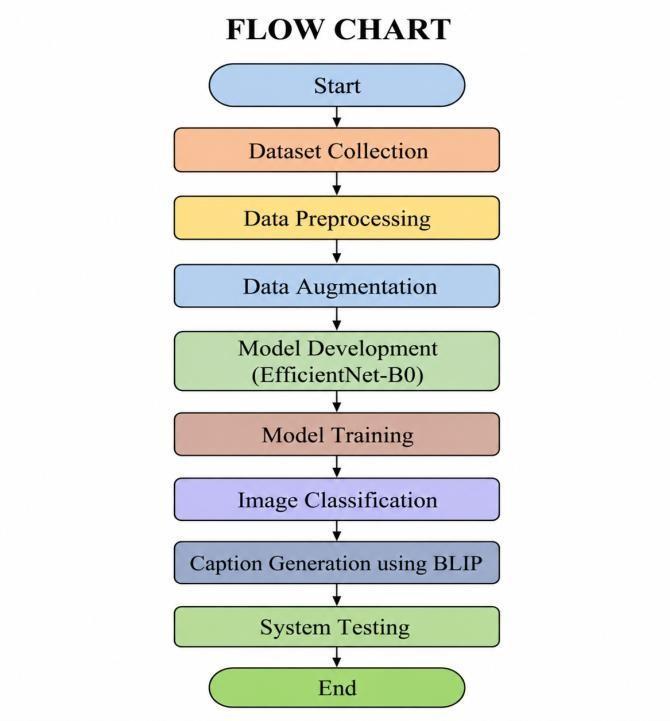
Fig.1:FlowchartofAI-GeneratedImageDetectionand CaptionGenerationSystem
Dataset Collection:
The datasets used in this research were collected from publicly available image datasets and AIgenerated image repositories used for deep learning and computer vision research.Thesedatasetscontainbothauthenticimagesand synthetic images generated using advanced artificial intelligencetechniquessuchasGANsanddiffusionmodels.
Thecollecteddatasetsinclude:
•Realimagedatasets
•AI-generatedimagedatasets
•Imagecaptiondatasets
•Classificationlabelinformation
Thedatasetscontainthousandsofimagesbelongingtoboth real and AI-generated categories for accurate model trainingandevaluation.
Data Preprocessing:
Rawimagedatasetsoftencontaincorruptedfiles,duplicate images, inconsistent image sizes, and unnecessary noise. Therefore,preprocessingisperformedtocleanandprepare thedatasetsforclassificationandcaptiongeneration.
Thepreprocessingstepsinclude:
•Resizingimagesintofixeddimensions
•Removingduplicateandcorruptedimages
•Normalizingpixelintensityvalues
•Organizingdatasetsintotrainingandtestingcategories
•Applyingimageaugmentationtechniquessuchasrotation andflipping
International Research Journal of Engineering and Technology (IRJET) e-ISSN: 2395-0056
Volume: 13 Issue: 05 | May 2026 www.irjet.net p-ISSN: 2395-0072
Python libraries such as Pandas, NumPy, TensorFlow, and OpenCV are used to perform image preprocessing and transformation. After preprocessing, the datasets are organized into structured directories for efficient model trainingandimageclassification.
Inthisphase, the processed imagedatasetsareintegrated into the deep learning framework for model development and training. The EfficientNet-B0 model and BLIP model areconfiguredtoperformimageclassificationandcaption generationtasks.
Model Development:
The pre-processed datasets containing real and AIgenerated images are loaded into the training environment. Transfer learning is applied using the EfficientNet-B0 architecture with pre-trained weights to improve classification performance and reduce training time.
Imagedatasetsaredividedintotrainingandtestingsetsto ensureproperevaluationandvalidationofthemodel.
Model Configuration:
Several model parameters are configured to support accurateimageclassification.Theseinclude:
•Imageinputdimensions
•Batchsizeandlearningrate
•Numberoftrainingepochs
•Optimizerandlossfunction
•Transferlearningconfiguration
The BLIP (Bootstrapping Language-Image Pretraining) modelisalsointegratedtogeneratedescriptivecaptionsfor uploadedimages
Training Techniques:
Various deep learning techniques are used to improve modelperformanceeffectively.Theseinclude:
•FeatureextractionusingEfficientNet-B0
•Transferlearningforefficienttraining
•Imageclassificationforauthenticitydetection
•CaptiongenerationusingBLIP
•Performance evaluation using accuracy, precision, and recallmetrics
The final phase involves developing an interactive system thatallowsuserstouploadimagesandobtainclassification resultsalongwithdescriptivecaptionsdynamically.
System Implementation: Severalmodulesaredevelopedtoperformdifferentimage analysistasks,including:•ImageUploadModule
•ImagePreprocessingModule
•EfficientNet-B0ClassificationModule
•BLIPCaptionGenerationModule
•PredictionResultDisplayModule
•PerformanceEvaluationModule
•UserInteractionInterface
Interactive Processing:
Interactive processing allows users to upload and analyze imageseasily.Userscanprovideinputimagesthroughthe systeminterfaceandreceiveinstantpredictionresults.
Thesystemperformsoperationssuchas:
•Imagepreprocessingandnormalization
International Research Journal of Engineering and Technology (IRJET) e-ISSN: 2395-0056
Volume: 13 Issue: 05 | May 2026 www.irjet.net p-ISSN: 2395-0072
•FeatureextractionusingEfficientNet-B0
•RealvsAI-generatedimageclassification
•Caption generation using BLIP • Displaying prediction resultsandimagedescriptions
When an image is uploaded, the system dynamically processes the image and updates the output results automatically.
Caption Generation and Output:
Image caption generation is implemented using the BLIP vision-language model. The system analyzes uploaded imagesandgeneratesdescriptivetextualcaptionsbasedon image content. The generated captions help users understand image context along with authenticity verification. This process improves interpretability and allows users to observe meaningful descriptions for both realandAIgeneratedimages.
The developed AI-generated image detection system successfullytransformscomplexdeeplearningoperations into accurate image classification and caption generation results.
The EfficientNet-B0 classification module accurately identifieswhetheruploadedimagesarerealorAIgenerated by analyzing hidden visual patterns and structural inconsistencies. The system provides fast and reliable prediction results through an interactive user interface. These results allow users to quickly verify image authenticity and understand whether the uploaded image issyntheticallygenerated.
TheBLIPcaptiongenerationmoduleproducesmeaningful textual descriptions for uploaded images through visionlanguageprocessingtechniques.Thesecaptionshelpusers understand the content and context of images along with authenticityverification.
The system also includes several important functionalities,suchas:•Realimagedetection
•AI-generatedimagedetection
•Imagepreprocessingandnormalization
•FeatureextractionusingEfficientNet-B0
•CaptiongenerationusingBLIP
•Performance evaluation using accuracy, precision, and recallmetrics
One of the most significant features of the system is the integration of image classification and caption generation within a single framework. The system not only identifies whetheranimageisrealorAIgeneratedbutalsogenerates descriptivecaptionsthatimproveinterpretabilityanduser understanding.
Overall, the proposed system provides an intelligent and interactiveplatformfordetectingAI-generatedimagesand generating image descriptions efficiently. The developed system simplifies image authenticity verification and supportssecureanalysisofdigitalmediacontent.
This research presented the development of an AI generatedimagedetectionsystemusingEfficientNetB0and BLIP for identifying real and AI-generated images. The systemintegratesdeeplearning-basedimageclassification and caption generation techniques to provide a comprehensiveimageauthenticityverificationplatform.
By transforming complex image data into classification results and descriptive captions, the system simplifies image analysis and improves accessibility for users. The system enables accurate authenticity detection, hidden artifact analysis, feature extraction, and automatic image captiongenerationthroughaninteractiveinterface.
International Research Journal of Engineering and Technology (IRJET) e-ISSN: 2395-0056
Volume: 13 Issue: 05 | May 2026 www.irjet.net p-ISSN: 2395-0072
Theresultsdemonstratethatmoderndeeplearningmodels such as EfficientNet-B0 and vision-language models like BLIP can significantly enhance the detection and interpretation of AI-generated images. The proposed system can support digital media verification, cybersecurity,imageforensics,andeducationalresearchby providing reliable and intelligent image analysis capabilities.
Future work may include integrating real-time image verification, video deepfake detection, advanced transformer-based architectures, and multimodal AI techniques for improved image authenticity analysis and contentunderstanding.
[1] I.Goodfellow,J.Pouget-Abadie,M.Mirza,B.Xu,D. Warde-Farley, S. Ozair, A. Courville, and Y. Bengio, “Generative Adversarial Networks,” Advances in Neural Information Processing Systems (NeurIPS), vol. 27, pp. 2672–2680,2014.
[2] A.Rossler,D.Cozzolino,L.Verdoliva,C.Riess,J. Thies,andM.Nießner,“FaceForensics++:Learningto DetectManipulatedFacialImages,” Proceedingsofthe IEEEInternationalConferenceonComputerVision(ICCV), pp.1–11,2019.
[3] M.TanandQ.Le,“EfficientNet:RethinkingModel ScalingforConvolutionalNeuralNetworks,” Proceedings of the International Conference on Machine Learning (ICML),pp.6105–6114,2019.
[4] A. Radford et al., “Learning Transferable Visual Models From Natural Language Supervision,” Proceedings of the International Conference on Machine Learning(ICML),2021.
[5] Y. Wang et al., “CNN-generated images are surprisingly easy to spot… for now,” Proceedings of the IEEE Conference on Computer Vision and Pattern Recognition(CVPR),2020.
[6] A.NicholandP.Dhariwal,“ImprovedDenoising Diffusion Probabilistic Models,” Proceedings of the International Conference on Machine Learning (ICML), 2021.
[7]J. Li, D. Li, C. Xiong, and S. Hoi, “BLIP: Bootstrapping Language-Image Pre-training for Unified VisionLanguageUnderstandingandGeneration,”2022.
[8] K.He,X.Zhang,S.Ren,andJ.Sun,“DeepResidual LearningforImageRecognition,” Proceedingsofthe IEEE Conference on Computer Vision and Pattern Recognition(CVPR),pp.770–778,2016.
[9] A. Dosovitskiy et al., “An Image is Worth 16x16 Words: Transformers for Image Recognition at Scale,” International Conference on Learning Representations (ICLR),2021.
[10] M.Sandler,A.Howard,M.Zhu,A.Zhmoginov,and L. Chen, “MobileNetV2: Inverted Residuals and Linear Bottlenecks,” Proceedings of the IEEE Conference on Computer Vision and Pattern Recognition (CVPR), pp. 4510–4520,2018.