
International Research Journal of Engineering and Technology (IRJET) e-ISSN: 2395-0056
Volume: 13 Issue: 05 | May 2026 www.irjet.net p-ISSN: 2395-0072

International Research Journal of Engineering and Technology (IRJET) e-ISSN: 2395-0056
Volume: 13 Issue: 05 | May 2026 www.irjet.net p-ISSN: 2395-0072
Sejal Gadling1 , Dr. Suchita K. Hirde2
1Student, M.Tech (Structural Engineering), Government College of Engineering, Amravati, Maharashtra, India
2Prof. & Head, Applied Mechanics Department, Government College of Engineering, Amravati, Maharashtra, India
Abstract - Irrigation infrastructure is a critical requirement for agricultural sustainability in droughtproneregions where conventional gravity flow isineffective. The present study focuses on the structural planning, analysis, and design of the head works components for the Bordi Nalla Lift Irrigation Scheme in Amravati, Maharashtra, designed to serve 3,161 hectares of agricultural land. Major structural components, including the intake structure, circular jack well, and a multi-level RCC pump house, were investigated to ensure safety under severe hydraulic, machinery, and seismic loading. Structural analysis was performed using STAAD.Pro software for 3D framed components and established engineering principles for hydraulic structures in accordance with IS 456:2000, IS 3370, and IS 1893:2016. The results indicate that all designed components are structurally stable, with the jack well exhibiting a factor of safety against flotation of 1.56, which safely exceeds the required 1.2 limit. Comprehensive stability checks for overturning, sliding, and soil bearing capacity confirmed the adequacy of the proposed structural configuration. The study validates that this integrated design approach provides a reliable, durable, and economicalsolutionfor implementingsustainable irrigation infrastructureinplateauterrains.
Key Words: Lift Irrigation Scheme, Structural Design, STAAD.Pro, Intake Structure, Jack Well, Pump House, Water Retaining Structure, Irrigation Infrastructure
1. INTRODUCTION
1.1 General Overview
Water scarcity and irregular rainfall in regions like Vidarbhasignificantlyimpactagriculturalproductivityand the national economy. Conventional gravity-based irrigation systems are often unable to serve cultivable lands situated at higher elevations than reservoir water levels. Therefore, the development of reliable Lift Irrigation Schemes (LIS) has become essential for ensuring agricultural sustainability and food security in drought-proneregions.
The mechanical lifting of water using pumping systems and pressurized pipelines has emerged as a promising engineering solution for providing assured irrigation to plateau terrains. The LIS method is based on the mechanical conveyance of water from a lower source to higherelevationfields,wherehydraulicstructuressuchas
intake works,jack wells,andpump houses mustmaintain structural integrity under severe hydrostatic forces, earth pressure,andmachineryloads.
Severalresearchershavesuccessfullyappliedstructural design principles for isolated hydraulic components like water tanks and intake works. However, limited studies areavailableregardingtheintegratedstructural design of complete lift irrigation head works involving intake structures, circular jack wells, and multi-level pump houses as a combined system. Therefore, the present investigation focuses on the structural planning, analysis, and design of the major head works components for the Bordi Nalla Lift Irrigation Scheme in Amravati, Maharashtra.
The structural models developed for the 3D framed pump house and other water-retaining components were processed using STAAD.Pro software and established engineering methodologies for graphical and stress analysis. The effectiveness of the proposed structural configuration was validated using Indian Standard codes such as IS 456:2000, IS 3370, and IS 1893:2016, ensuring the safety of the infrastructure against overturning, sliding,andflotation
A Lift Irrigation System (LIS) is used to convey water from lower elevations to higher agricultural areas using mechanicalpumpinginsteadofgravityflow.Suchsystems are highly suitable for Maharashtra due to its uneven terrain and availability of reservoirs. Lift irrigation improveswater-useefficiency,reducesconveyancelosses, and supports assured irrigation and higher agricultural productivity.
The Bordi Nalla Medium Project consists of major components including the intake structure, jack well, and pump house. The intake structure regulates and directs water from the reservoir while preventing the entry of debris and sediments. The jack well acts as a sump for temporary storage and provides adequate submergence for pump operation while resisting hydrostatic and uplift pressures.
International Research Journal of Engineering and Technology (IRJET) e-ISSN: 2395-0056
Volume: 13 Issue: 05 | May 2026 www.irjet.net p-ISSN: 2395-0072
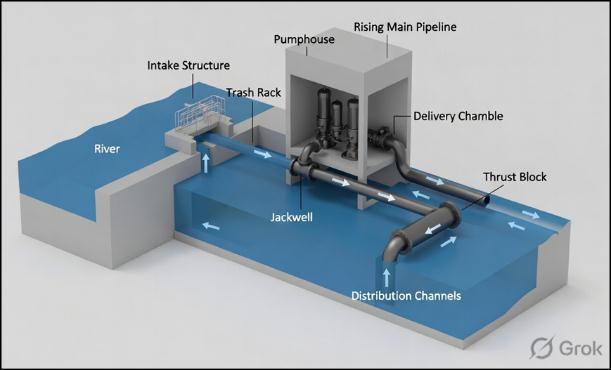
The pump house is a multi-level RCC framed structure housing pumps, valves, control systems, and a 7.5 T EOT crane.Itwasanalysedasathree-dimensionalspaceframe using STAAD.Pro considering dead loads, live loads,crane loads, and seismic forces. The overall design ensures structural safety, stability, durability, and efficient operationoftheliftirrigationsystem
1.3 Objectives of the Study
Theeffectivenessofaliftirrigationschemereliesonthe safety, efficiency, and durability of components like the intake structure and pump house, which endure significantstresses.Ananalyticalapproachisessentialfor stabilityand reducedmaintenance. Properdesign enables cost-effectiveconstructionanda reliable watersupplyfor agricultural areas not served by traditional methods. This study focuses on assessing and designing the structural components of the Bordi Nalla Lift Irrigation Scheme in accordancewithIndianStandardcodes.
Theobjectivesofthepresentinvestigationare:
1. To study project-specific hydraulic parameters and establish durability requirements for moderateexposureconditionsasperIS456:2000.
2. To analyse and design the circular RCC jack well considering circumferential hoop tension, hydrostatic pressure, and uplift pressure acting ontheraftfoundationinaccordancewithIS3370 provisions.
3. To evaluate the flotation stability and bearing pressure behaviour of the jack well under submergedandoperationalloadingconditions.
4. To develop a three-dimensional RCC beamcolumn frame model of the pump house using STAAD.Prosoftwareforanalysisunderdeadload, live load, crane load, and seismic loading conditions.
5. To analyse critical pump house components such as beams, slabs, staircase elements, corbels, and crane-supporting members for bending, shear, deflection,andserviceabilityrequirements.
6. To verify the overall structural safety, stability, and serviceability performance of the jack well andpumphouseRCCframeusingrelevantIndian Standardcodeprovisions.
2.1 General
The structural safety, serviceability, and durability of hydraulic structures are essential for the reliable functioning of Lift Irrigation Schemes in drought-prone regions.Forthisstudy,theheadworkscomponentsofthe Lift Irrigation Scheme associated with the Bordi Nalla Medium Project were analysed and designed in accordance with relevant Indian Standard codes. The methodology includes detailed structural planning, load estimation, stability analysis, and design of the intake structure, RCC approach box conduit, circular jack well, multi-level RCC framed pump house, delivery chamber, and thrust blocks. The pump house was modelled and analysed as a three-dimensional frame using STAAD.Pro software, while the water-retaining structures were designed using the Working Stress Method to ensure watertightnessandcrackcontrol.
2.2 Data Collection and Governing
The design and analysis of the structural components are primarily governed by a set of hydraulic, geometric, and operational parameters. These parameters form the basis for determining loading conditions, structural dimensions, and design criteria. The values of these governing parameters are obtained from project data and approved design reports, and they are considered throughout the analysis to ensure consistency and accuracyindesign.
Table
International Research Journal of Engineering and Technology (IRJET) e-ISSN: 2395-0056
Volume: 13 Issue: 05 | May 2026 www.irjet.net p-ISSN: 2395-0072
The structural modelling and analysis of the jack well and pump house of the Bordi Nalla Lift Irrigation Scheme were carried out using both manual design procedures and computer-aided structural analysis techniques in accordancewithrelevantIndianStandardcodeprovisions. The circular RCC jack well was analysed considering circumferential pressure developed due to stored water and hydrostatic action on the wall surface. The raft foundation of the jack well was analysed for upward pressure acting from the bottom of the structure to evaluateuplifteffectsandfoundationstability.Thedesign of the jack well components was performed using the Working Stress Method in accordance with IS 3370 provisionsforliquidretainingstructuresandIS456:2000 provisions for reinforced concrete design. The RCC detailing of the wall and raft sections was finalized based on the governing stresses and reinforcement requirements.
The pump house superstructure was modelled as a three-dimensional RCC beam-column frame using STAAD.Pro software. The analytical model included RCC columns, beams, slabs, staircase elements, corbels, gantry beamsupports,andcrane-supportingstructuralmembers. Structuralloadingconsideredintheanalysisincludedselfweight, live load, machinery load, crane wheel load, and earthquakeloadcombinations.TheEOTcraneloadingwas analysed under different wheel positions to determine criticalbendingmomentandshearforceconditionsinthe corbel beams and supporting members. Material properties, support conditions, member dimensions, and load combinations were assigned in accordance with IS 456:2000,IS875,andIS1893provisions.
The RCC framed components of the pump house, including beams, slabs, staircase waist slab, corbels, and gantry-supporting members, were analysed and designed using the Limit State Method. Manual calculations, Excelbaseddesignsheets,andSTAAD.Proanalysisoutputswere used for evaluating bending moments, shear forces, axial forces, reinforcement requirements, deflection criteria, and serviceability conditions. Structural safety checks for shear strength, deflection limits, reinforcement detailing, and durability requirements under moderate exposure conditionswereperformedbeforefinalizingthestructural configuration and reinforcement detailing for practical implementation.
The pump house and associated RCC framed componentsoftheBordiNallaLiftIrrigationSchemewere analysed for both Ultimate Limit State (ULS) and Serviceability Limit State (SLS) conditions in accordance with IS 456:2000 provisions. The structural analysis considered the combined effects of dead load, live load,
crane load, machinery load, and earthquake load to evaluate the safety and serviceability performance of the structureundercriticaloperatingconditions.
A. Ultimate Limit State (ULS) – For structural strength verification(bending,shear,axialforces):
1.5DL±1.5EQX/EQZ
0.9DL±1.5EQX/EQZ
1.5DL+1.5LL+1.05C.LEFT/RIGHT 1.2 DL + 1.2 LL + 1.05 C.LEFT/RIGHT ± 0.6
EQX/EQZ
1.2 DL + 1.2 LL + 0.53 C.LEFT/RIGHT ± 1.2
EQX/EQZ
B. Serviceability Limit State (SLS) –Fordeflection,crack control,andfunctionalperformance:
DL±EQX/EQZ
DL+LL+C.LEFT/RIGHT
DL+0.8LL+0.8C.LEFT/RIGHT±0.8EQX/EQZ
DL±EQX/EQZ+C.LEFT/RIGHT
(DL = Dead Load, LL = Live Load, CL = Crane Load, EQ = EarthquakeLoad)
Detailedperformanceverificationwasperformedunder critical operating conditions. The checks performed were buoyancy and flotation analysis of the circular jack well when empty, soil bearing capacity assessment for the foundationunderdifferentloadingconditionsandstability evaluationoftheintakeheadwallagainstoverturningand sliding. Deflection and shear serviceability checks were carried out for RCC slabs at valve floor, control floor and rooflevels.Thestaircasewaistslabwasanalyzedasaonewaycontinuousslabfordeflectionandshearstress.
Table -2: LoadCalculationsforSTAADInput
Flexure, shear friction and tension reinforcement of corbel and gantry beams were evaluated under crane wheel loads. Further, the crack control was checked for water retaining structures like jack well and delivery chamberusingWorkingStressMethod.
International Research Journal of Engineering and Technology (IRJET) e-ISSN: 2395-0056
Volume: 13 Issue: 05 | May 2026 www.irjet.net p-ISSN: 2395-0072
Thestructuralanalysisanddesignresultsforthemajor headworks of the Bordi Nalla Lift Irrigation Scheme indicate that all components satisfy the rigorous safety and serviceability criteria established by Indian Standard codes.Thefollowingsectionsevaluatetheperformance of criticalstructuresundervariedhydraulicandgeotechnical loadingconditions.
The structural stability of the RCC jack well was evaluated under two critical loading conditions to assess flotation safety and foundation performance. The analysis was carried out considering hydrostatic pressure, selfweight of the structure, live load, and uplift pressure acting on the raft foundation. The jack well was analysed as a liquid-retaining structure using the Working Stress MethodinaccordancewithIS3370provisions.
Two governing cases were considered during the stability analysis. Case-A represented the submerged external condition with the jack well empty, which is the most critical condition for uplift and flotation. Case-B representedtheoperationalconditionwithwaterretained inside the jack well, which governs the bearing pressure onthefoundation.
Table -3: BuoyancyandSBCcheck
Description Case-A: Submerged Outside Case-B: Water Inside
DesignDeadLoad 20,224kNLiveLoad 1,118kN -
WaterLoad - 15,260kN
TotalLoadonRaft 21,342kN 36,602kN
BuoyancyForce 39,476kN NotGoverning
FactorofSafety 1.56(>1.2-Safe)BearingPressure 7.90T/m2 13.50T/m2
SBC 15.00T/m2 15.00T/m2
Result Safe Safe
The results demonstrate that the proposed RCC jack well configuration is structurally stable under both submerged and operational loading conditions. The raft foundation was found adequate against uplift pressure, flotation, and excessive soil pressure, thereby ensuring safe and durable performance of the structure under criticalhydraulicconditions.
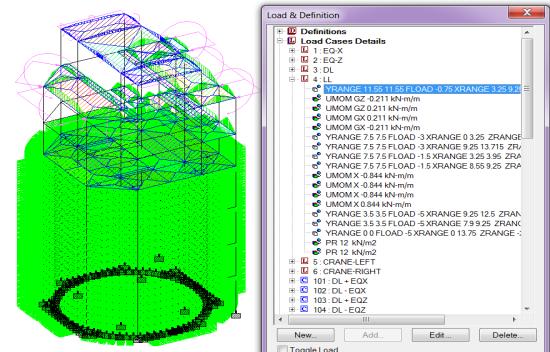
The structural performance of the pump house was evaluated using a three-dimensional RCC beam-column framemodeldevelopedinSTAAD.Prosoftware.Themodel
was analysed using M25 grade concrete and Fe500 reinforcementconsideringdeadload,liveload,craneload, soilpressure,andseismicforcescorrespondingtoSeismic ZoneII.
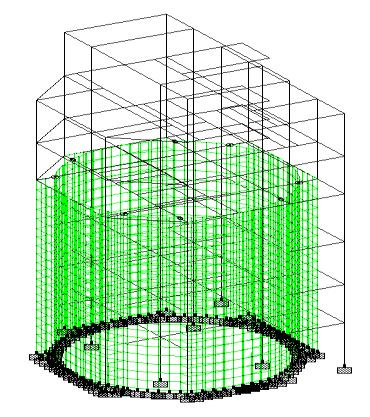
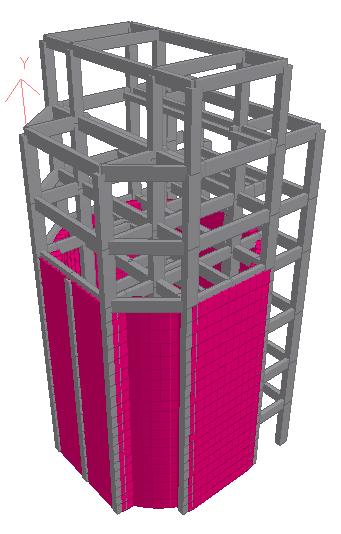
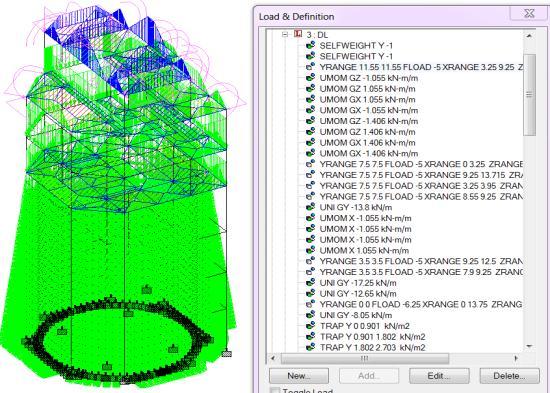
BothUltimateLimitState(ULS)andServiceabilityLimit State(SLS)loadcombinationswereconsideredtoevaluate bending moments, shear forces, axial forces, and support reactionsinthestructuralmembers.Specialattentionwas giventotheanalysisofRCCcorbelbeamssubjectedto7.5 TEOTcranewheelloadsunderdifferentwheelplacement conditionstodeterminecriticalstressbehaviour
International Research Journal of Engineering and Technology (IRJET) e-ISSN: 2395-0056
Volume: 13 Issue: 05 | May 2026 www.irjet.net p-ISSN: 2395-0072
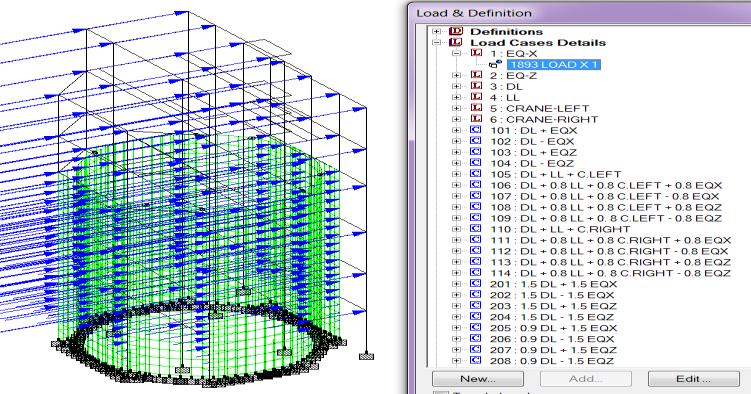
-6: EarthquakeLoadinginX-Direction
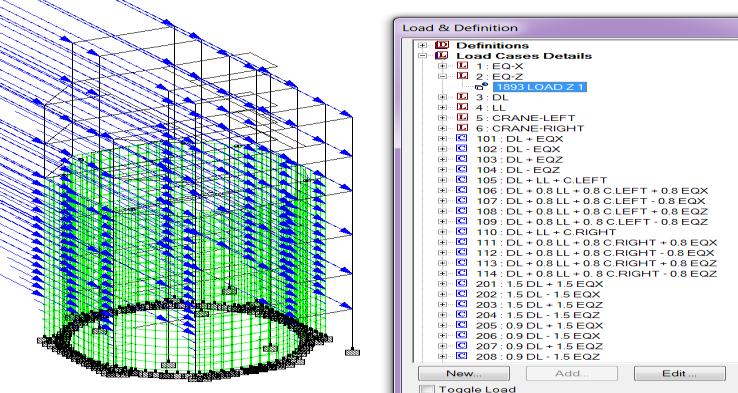
-7: EarthquakeLoadinginZ-Direction
TheanalysisresultsindicatedthatthepumphouseRCC frame satisfied the required strength and serviceability criteria under all governing load combinations. Beams, slabs,staircaseelements,andcorbelmemberswerefound safeagainstflexure,shear,anddeflectionrequirementsas per IS 456:2000 provisions. Manual design checks using Excel sheetswerealsocarriedoutforcritical components tovalidatetheSTAAD.Proanalysisresults.
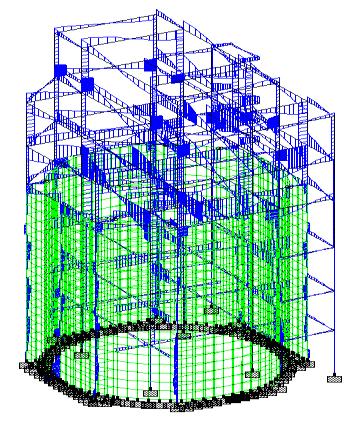
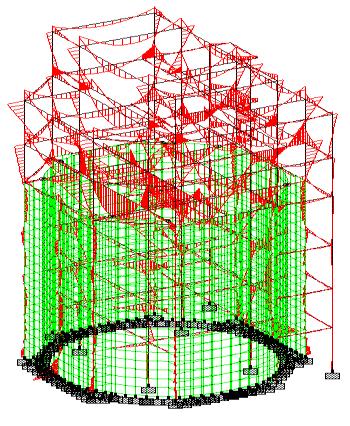
Overall, the analytical and manual verification confirmed the structural adequacy and stability of the proposed RCC pump house system under combined operationalandseismicloadingconditions.
This study concludes that the structural planning, analysis,anddesignforthe majorheadworksoftheBordi Nalla Lift Irrigation Scheme provide a safe, durable, and code-compliant infrastructure. The design ensures hydraulic efficiency and structural integrity for all components by adhering to rigorous safety standards for water-retainingandsuperstructureelements
Thekeyfindingsaresummarizedbelow:
1. The analysis and design results showed that the structural components satisfied strength, shear, deflection, and serviceability requirements as per relevant IS code provisions, and the proposed configurationwasfoundsafeforimplementation.
2. The circular RCC jack well satisfied the requirements of IS 3370 for liquid-retaining structures and provided adequate resistance againsthydrostaticandcircumferentialstresses.
3. The STAAD.Pro analysis of the pump house RCC frame demonstrated satisfactory structural behaviour under combined dead load, live load, craneload,andseismicloadcombinations.
4. Critical structural components including slabs, beams,staircasewaistslab, andcorbelbeamswere found safe against flexure, shear, and deflection requirementsasperIS456:2000provisions.
5. Manual calculations and Excel-based verification showed good agreement with STAAD.Pro analysis results, confirming the reliability of the adopted modellinganddesignmethodology.
6. The proposed RCC jack well and pump house configuration was found structurally stable, serviceable, and suitable for practical implementationintheliftirrigationscheme.
This integrated design approach is recommended as a reliable and efficient configuration for medium irrigation projects. While manual verifications ensure the accuracy of individual components, 3D STAAD.pro modelling remainsessentialforvalidatingthecomplexinteractionof the pump house frame under operational and environmentalforces
1. T.R.Jagadeeshand K.Jayaram,“WaterResources Engineering,” Studies on Planning and Design of IntakeStructures for Irrigationand WaterSupply Systems.
International Research Journal of Engineering and Technology (IRJET) e-ISSN: 2395-0056
Volume: 13 Issue: 05 | May 2026 www.irjet.net p-ISSN: 2395-0072
2. P. Dayaratnam, “Design of Liquid Retaining Structures and Water Tanks,” Emphasis on Structural Behaviour of RCC Water-Retaining Structures under Hydrostatic Pressure and Crack Control.
3. B. C. Punmia and Ashok Kumar Jain, “Irrigation and Water Power Engineering,” Planning, Hydraulic and Structural Design of Lift Irrigation Systems,PumpHousesandDeliverySystems.
4. B. C. Punmia, Ashok Kumar Jain and Arun Kumar Jain, “Limit State Design of Reinforced Concrete,” Behaviour of RCC Elements and Design as per IS 456:2000.
5. S. Unnikrishna Pillai and Devdas Menon, “Reinforced Concrete Design,” Behaviour of Reinforced Concrete Structures under Multiple LoadingConditionsandLoadCombinations.
6. S. S. Bhavikatti, “Structural Analysis using STAAD.Pro,” Application of Modern Software for AnalysisofComplexRCCFramedStructures.
7. C. V. R. Murty, “Earthquake Resistant Design of Structures,”SeismicAnalysisandDuctileDetailing asperIS1893.
8. K. Subramanian, “Design of Foundations and Hydraulic Structures,” Stability Analysis of Circular Tanks, Jack Wells and Intake Structures underSoilandWaterPressure.
9. M. S. Shetty, “Concrete Technology,” Durability Considerations for RCC Structures in WaterRetainingandAggressiveEnvironments.
10. IS 3370 (Part 1 & 2):2009, “Code of Practice for Concrete Structures for the Storage of Liquids,” BureauofIndianStandards,GuidelinesforDesign of Liquid Retaining Structures using Working StressMethod.
11. IS 456:2000, “Plain and Reinforced Concrete –Code of Practice,” Bureau of Indian Standards, Guidelines for Design and Detailing of RCC Structures.
12. IS 1893 (Part 1):2016, “Criteria for Earthquake Resistant Design of Structures,” Bureau of Indian Standards, Seismic Design Provisions and Load Combinations.
13. IRC 6, “Standard Specifications and Code of Practice for Road Bridges – Loads and Stresses,” IndianRoadsCongress.
14. IRC 78, “Standard Specifications and Code of Practice for Road Bridges – Foundations and Substructures,”IndianRoadsCongress.
15. H. W. Shenton III and A. N. Lin, “Relative Performance of fixed based and base isolated concrete frame,” ASCE, Journal of Structural Engineering,Vol.119,No.10(1993).