
International Research Journal of Engineering and Technology (IRJET) e-ISSN: 2395-0056
Volume: 12 Issue: 02 | Feb 2025 www.irjet.net p-ISSN: 2395-0072
International Research Journal of Engineering and Technology (IRJET) e-ISSN: 2395-0056
Volume: 12 Issue: 02 | Feb 2025 www.irjet.net p-ISSN: 2395-0072
PENKI ROHIT
ASSISTANTPROFESSOR
ECEDept,CEVP, Vishakapatnam JNTUGV Vizianagaram,India
THOTA JYOTHI KUMARI
ASSISTANTPROFESSOR
ECEDept,CEVP, Vishakapatnam JNTUGV Vizianagaram,India
VEMULAPATI PAVANI
ASSOSCIATE PROFESSOR
ECEDept,CEVP, Vishakapatnam JNTUGV Vishakapatnam,India
Abstract The idea of reconfigurability has been linked to the existing single usable microstrip patch antennas by making the necessary geometrical structure alterations throughexchanginganddisplayingtheantenna,especially when considering resounding frequency, polarization, and impedance bandwidth. A small, straightforward antenna withamicrostriplinefeedandafrequencyreconfiguration mechanism is constructed and evaluated. A Slotted Microstrip Patch Antenna with a UWB frequency reconfigurableisdesignedforcognitiveradioapplications. Amicrostrippatch,feed,andgroundareallconstructedin accordance with the parameter values in this specific design. In order to provide frequency reconfigurability, two diodes are positioned on a patch's rectangular slot. Applications for the proposed antenna include Ku-band (12.7–13.80) GHz and X-band satellite communications (8.05–9.75) GHz. It has been demonstrated that altering switch configurations can modify the antenna's operating frequency without altering the emission pattern. Finally, this suggested UWB Frequency Reconfigurable Slotted Antenna wastobedevelopedusingtheTeachingLearning BasedOptimization(TLBO)algorithm.
Keywords Frequency Reconfigurable, Ultra wide band, PINDiodes,CognitiveRadio,TLBO
I. Overview
Frequency Reconfigurable receiving wires are madeupofradiowirecomponentsthatcanindependently change their physical configuration, altering the reception apparatus's recurrence characteristics while maintaining constant radiation conduct. Reconfiguring one normal for thereceivingwireeventuallyaffectstheotherparameters, such as design variety and recurrence reaction, and vice versa. One of the main obstacles to the advancement of
DATLA RAJITHA
ASSOSCIATE PROFESSOR
ECEDept,MRCL, Vishakapatnam JNTUGV Vizianagaram,India
reconfigurable reception apparatuses is this relationship. Thistypeofreconfigurationincludesmultibandorpossibly stop band characteristics, coordinated impedance switchingorrelocatingaresoundingrecurrence.
These adjustable reception devices fall into two kinds;theyareconstantlyswappedout.Inordertoworkat specificandisolatedrecurrencegroups,exchangedtunable recurrence reconfigurable radio wires consider unmistakably changing instruments. The degree of variations in the electrical length that allow for tunability over different recurrence groups and the techniques to achievethesechangesarewherethetwotypestrulydiffer from one another. The most popular approach to achieve recurrence reconfigurability involves implementing a transmitter adjustment reconfiguration system to the microstrip receiving wires to change the successful electrical length, which allegedly changes working recurrence.
The working recurrence is mostly determined by the antenna's electrical length. In the most well-known straightdipoleradiowire,forinstance,whenthereceiving wire is half a wavelength long and has an unidirectional radiation example fixed on and ordinary to the dipole pivot, it resounds at its initial principal mode. The radio wireneedstobecutpreciselytothehalfwavelengthatthe new recurrence with a similar radiation design in the unlikely event that one wants to operate the receiving device at greater recurrence. Frequency reconfigurable radio wires have the advantage of limiting the amount of general reception equipment by allowing the absolute receiving wire volume to be reused through their unique operatingmodes.
International Research Journal of Engineering and Technology (IRJET) e-ISSN: 2395-0056
Volume: 12 Issue: 02 | Feb 2025 www.irjet.net p-ISSN: 2395-0072
Teaching Learning Based Optimization is an optimization technique based on population that mimics the teaching-learning dynamics of an actual classroom. Students (learners) and an instructor make up the algorithm'scomponents.Thisalgorithmisdividedintotwo stages: the teacher phase, where students learn from the teacher, and the learnerphase,wherestudentslearn from other students. Student grades are seen as algorithmic outputs that rely on the caliber of the instructor. Conversely, new wireless communication systems have recently focused on frequencyreconfigurable antennas, or FRAs.Theeliminationoftheneedformultipleantennasin a single system, the ability to tune an antenna for various uses, the resolution of microstrip antennas' narrow band, thesuppressionofunwantedsignalsandnoisesfromnonoperating bands, and sufficiency for cognitive radio applications are some significant benefits of frequency reconfigurable antennas. Due to their inherent design complexity in comparison to more conventional varieties, optimization algorithms are quite helpful when designing such antennas. This work aimed to bring the Teaching LearningBasedOptimization(TLBO)methodtothedesign of frequency reconfigurable antennas and enhance its performancebyusingachaossystem.
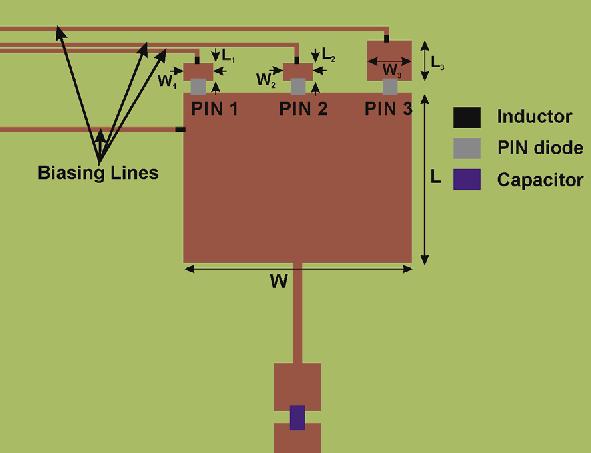
The planning and analysis of a straightforward andconservativeantennawithafrequencyreconfiguration mechanism and microstrip line feed is done. For cognitive radioapplications,anopeningmicrostripfixreceivingwire with a customizable UWB frequency is designed. This specific design includes feed and ground as well as a microstrip patch that is created based on the parameter values.Thisdesignusestwodiodesinarectangularsloton the patch to achieve frequency reconfigurability. Figure 2 is a representation of the planned patch antenna's geometry and dimensions, while Figure 3 shows the completed antenna. The antenna is etched into a single layer of inexpensive FR4 substrate that has a thickness of 1.6 mm and a dielectric constant of 4.4.The suggested
antenna features a complete ground plane and a straightforwardpatch.Theusualmicrostrippatchantenna design formulae were used to determine the patch's dimensions. The center frequency of the antenna's design was 6.4 GHz. High gain can be achieved by reducing the patch dimensions by truncating the corners of microstrip patcheswithvaryingdimensions.
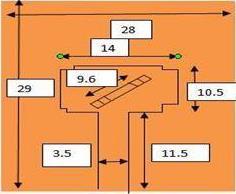
Two PIN diodes are positioned on a rectangular slottoachievefrequencyreconfigurability.Therecurrence of activity of the radio wires is altered by the variation of opening lengths; for this reason, PIN diodes are used in spaceswithvaryinglengths.AslumpedRLCorganizes,PIN diodes are shown. In the proposed plans, HFND4005 PIN diodes are used. The PIN diode arrangement has an obstruction value (R=4KΩ) while it is in the forward bias (ON)stateand a capacitance(C=0.017pf) whenitisin the switchbias(OFF)state.
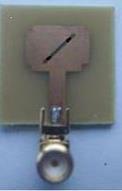
The 1.5 x 0.75 mm diodes are positioned on the corners of the rectangular slot that is 45 degrees rotated along the z axis. Since HPND4005 pin diodes are widely
International Research Journal of Engineering and Technology (IRJET) e-ISSN: 2395-0056
Volume: 12 Issue: 02 | Feb 2025 www.irjet.net p-ISSN: 2395-0072
accessibleandbestsuitedforfabrication,theyareutilized. Pin diode switching allows for frequency range reconfiguration. Thus, the antenna may flip between several frequency ranges. Table 1 shows the geometrical parameters of the suggested microstrip patch antenna. Figure 4 depicts the biasing configuration of the manufacturedantenna.
Table 1: GeometricalParametersofProposedDesign
Substrate
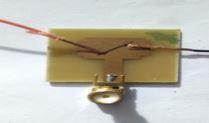
Figure 4: BiasingsetupofFabricated ReconfigurableAntenna
The antenna is made on a 1.6mm thick FR4 substrate with a misfortune digression of tan δ=0.027. Reception apparatus is made using a typical photolithography process. Both single band and double band modes of operation are possible with the specified antenna. Figure 5 shows the return losses curve for both simulatedandexperimentalvalues,andFigure6showsthe voltage standing wave ratio (VSWR) curve for both simulated and experimental values. The optimal recurrence range is less than 2 and more than 10dB, respectively. Return losses will be more significant than 10dB in the double band configuration (maximum of 16.2dB) between 12.7GHz and 13.8GHz. 13.2GHz is the thundering frequency (fr) in this double band scenario. A
comparison of the two groups in this double band arrangementrevealsthatthisresounding recurrenceband hassomeelevatedesteems.
SimD1,D2-Offcase
SimD1,D2-Oncase
MeasD1,D2-Offcase
MeasD1,D2-Oncase
Figure 5: Simulated&MeasuredS11ofProposed Antennawhen(DiodeD1,D2-ON,OFFcases)
SimD1,D2-Offcase
SimD1,D2-Oncase
MeasD1,D2-Offcase
MeasD1,D2-Oncase
Frequency(GHz)
Figure 6: Simulated&MeasuredVSWRofProposed Antennawhen(DiodeD1,D2-ON,OFFcases)
The single band configuration will function exceptionally well between 9.19GHz and 9.76GHz. The 2D radiation patterns and 3D polar plots for the D1&D2 on and off cases are shown in Figs. 7 and 8. Four switching states 00,01,10,11 areincludedinthissuggesteddesign whenallcasesaretakenintoaccount,withthe00,11cases accountingforbothdiodesD1,D2-OnandOffsituations.In thesestates,singleanddoublebandsarepresent.
International Research Journal of Engineering and Technology (IRJET) e-ISSN: 2395-0056
Volume: 12 Issue: 02 | Feb 2025 www.irjet.net p-ISSN: 2395-0072
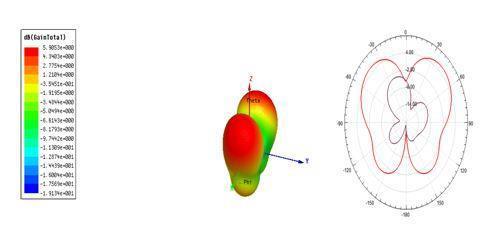
Figure 7: 3Dpolarplot&2Dradiationpatternof ProposeddesignwhenDiodeD1,D2-OFFcase.
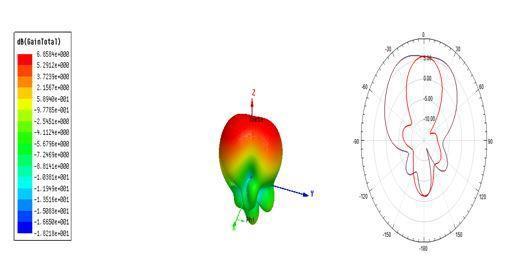
Figure 8: 3Dpolarplot&2Dradiationpatternof ProposeddesignwhenDiodeD1,D2-ONcase
V. Summary
Table 2 summarizes the suggested frequency reconfigurable slotted patch antenna with two diodes to achievereconfigurability.
Reconfigurable antennas must function in a dynamic environment while maintaining favorable electromagnetic properties. Implementing a switching mechanism introduces the idea of reconfigurability. In order to adjust the electrical length of the antenna, which in turn regulates the operational frequency, switching technology is employed utilizing PIN diodes to modify the physical geometry. A frequency-reconfigurable slotted printed antenna with two diodes that function at separate operating bands is proposed in this paper. The antenna is suitableforKu-bandapplications(12.7–13.80GHz)andXband satellite communications (8.05–9.75 GHz). For commercial applications such laptops and mobile phones thatneeddynamicbandswitching,thesuggestedantennas wouldbeagoodfit.
[1] Subrahmanyam Grandhi Venkata, andSri Rama Krishna Kalva, "UWB Monopole Antenna with Dual Notched Bands Verified by Characteristic Mode Analysis (CMA)," ProgressInElectromagneticsResearch C,Vol.121,39-48,2022.doi:10.2528/PIERC22051105
[2] N. Tasouji, J. Nourinia, C. Ghobadi and F. Tofigh, "A Novel Printed UWB Slot Antenna With Reconfigurable Band-Notch Characteristics," in IEEE Antennas and WirelessPropagationLetters,vol.12,pp.922-925,2013, doi:10.1109/LAWP.2013.2273452.
[3] H.Boudaghi,M.N.AzarmaneshandM.Mehranpour,"A frequency-reconfigurable monopole antenna using switchable slotted ground structure", IEEE Antennas WirelessPropag.Lett.,vol.11,pp.655-658,2012.
[4] R. Jothi Chitra and V. Nagarajan, "Frequency reconfigurable antenna using pin diode",CommunicationTwentiethNationalConference, 2014.
[5] Nishant Kumar, P. Ananda Raju and Santanu Kumar Behera, "Frequency reconfigurable microstrip antenna for cognitive radio applications", Communication and Signal Processing (ICSSP) International Conference, 2015.
Table 2: SummaryoftheProposedReconfigurable Antenna (2Diodes).
[6] T. Prem Bosco, P. Rohit, M. Satyanarayana and K. Anitha, "Design of Circularly Polarized E-Slot Aperture Coupled Dielectric Resonator Antenna for Wideband Applications," 2023 International Conference on Microwave, Optical, and Communication Engineering (ICMOCE), Bhubaneswar, India, 2023, pp. 1-5, doi: 10.1109/ICMOCE57812.2023.10165708.
[7] A. Mansoul, F. Ghanem, Mohamad Rijal Hamid and Mohamed Trabelsi, "A selective frequencyreconfigurable antenna for cognitive radio
International Research Journal of Engineering and Technology (IRJET) e-ISSN: 2395-0056
Volume: 12 Issue: 02 | Feb 2025 www.irjet.net p-ISSN: 2395-0072
applications", IEEE Antennas and Wireless Propagation Letters,vol.13,pp.515-518,2014.
[8] Christos G. Christodoulou, Youssef Tawk, Steven A. Lane and Scott R. Erwin, "Reconfigurable antennas for wireless and spaceapplications", Proceedings of the IEEE,vol.100,pp.2250-226,2012.
[9] P.Rohit,A.DattaandM.Satyanarayana,"DesignofHigh Gain Metasurface Antennas using Hybrid Atomic OrbitalSearchandHumanMentalSearchAlgorithmfor IoT Application," 202310thInternationalConferenceon Signal Processing and Integrated Networks (SPIN), Noida, India, 2023, pp. 20-24, doi: 10.1109/SPIN57001.2023.10116841.
[10] S.Yang,C.Zhang,H.K.Pan,A.E.FathyandV.K.Nair, "Frequency-reconfigurable antennas for multiradiowireless platforms", IEEEMicrow.Mag., vol. 10, no.1,pp.66-83,Feb.2009.
[11]Rohit, P., Datta, A. and Satyanarayana, M. (2024), Optimized Graph Sample and Aggregate-Attention Network-BasedHighGainMetaSurfaceAntennaDesign forIoTApplication.IntJCommun Syste6043. https:// doi.org/10.1002/dac.6043
[12] G.P. Jin,D.L.ZhangandR.L.Li,"Opticallycontrolled reconfigurable antenna for cognitive radio applications", Electron. Lett., vol. 47, no. 17, pp. 948950,Aug.2011.
[13] A. Tariq and H. Ghafouri-Shiraz, "Frequencyreconfigurable monopole antennas", IEEE Trans. AntennasPropag.,vol.60,no.1,pp.44-50,Jan.2012.
[14] J. Kiriazi, H. Ghali, H. Ragaie and H. Haddara, "Reconfigurable dual-band dipole antenna on silicon usingseriesMEMSswitches", Proc.IEEEAP-SInt.Symp., vol.1,pp.403-406,2003.
[15] P. Rohit, A. Datta and M. S. Narayana, "Design of Circular Microstrip Antenna with Metasurface Superstate for Wifi Applications," 2024 IEEE Wireless Antenna and Microwave Symposium (WAMS), Visakhapatnam, India, 2024, pp. 1-5, doi: 10.1109 / WAMS59642.2024.10527949.
[16] Z. Shi, R. Zheng, J. Ding and C. Guo, "A novel patternreconfigurable antenna using switched printed elements", IEEEAntennasWirelessPropag.Lett, vol. 11, pp.100-1103,2012.
[17] P.Rohit, K.Anitha, Dr.M.Satyanarayana, Development Of Small Disk Microstrip Inegrated Defected Ground Structure (Dgs) Antenna Using Particle Swarm Optimization,vol.13,no.no.6,p.2,2023.
[18] Y. Zhou, R. S. Adve and S. V. Hum, "Design and evaluationof patternreconfigurable antenna forMIMO applications", IEEETrans.AntennasPropag, vol. 62, no. 3,pp.1084-1092,Mar.2014.
[19] J.L. Freeman, B.J. Lamberty and G.S. Andrews, "Optoelectronically reconfigurable monopole antenna", IETElectron.Lett., vol. 28, no. 16, pp. 15021503,July1992
[20] J. S. Row and C. W. Tsai, "Pattern reconfigurable antenna array with circular polarization", IEEE Trans. Antennas Propag, vol. 64, no. 4, pp. 1525-1530, Apr. 2016.
[21] L. Ge, Y. Li, J. Wang and C. Y. D. Sim, "A low-profile reconfigurable cavity-backed slot antenna with frequency polarization and radiation pattern agility", IEEE Transactions on Antennas and Propagation,vol.65,no.5,pp.2182-2189,May2017.
[22] U. Musa et al., "Recent Advancement of Wearable Reconfigurable Antenna Technologies: A Review," in IEEEAccess, vol. 10, pp. 121831-121863, 2022, doi: 10.1109/ACCESS.2022.3222782.
[23] Datla, Rajitha & Karunakar, G. (2024). CAIWO based DRR usage in Antenna Array Synthesis. Journal of SystemsEngineeringandElectronics.34.51-53.
[24] Penki, Rohit & Datla, Rajitha & Vemulapati, Pavani & Thota, Jyothi Kumari. (2024). DESIGN OF UWB FRACTAL MONOPOLE ANTENNA BY USING DIFFERENTIAL EVOLUTION ALGORITHM. Kronika. 24. 125-135.
[25] Vemulapati, Pavani & Thota, Jyothi Kumari & Datla, Rajitha&Penki,Rohit.(2024).DesignofQuasiModified Rectangular Patch Antenna by using Ultra Wideband (UWB) Frequency for Radar Communications. Journal ofSystemsEngineeringandElectronics.34.515-518.
[26] Penki, Rohit & Datla, Rajitha & Vemulapati, Pavani & Thota, Jyothi Kumari. (2024). FUTURE TRENDS IN DESIGN OF METAMATERIAL PRINTED ANTENNAS BY USING 5G APPLICATIONS. Fangzhi Gaoxiao Jichukexue Xuebao.24.133-145.10.37896/JBSV24.8/3304.
[27] Penki, Rohit & Vemulapati, Pavani & Thota, Jyothi Kumari & Satyanarayana, Moturi. (2024). DESIGN OF FRACTAL WIDEBAND ANTENNA BY USING WIND DRIVENOPTIMIZATION.Volume-11.435-440.
[28] Penki,Rohit&Datta,Amlan&Satyanarayana,Moturi. (2024). DESIGN OF RECTANGULAR METASURFACE ANTENNAFORWIRELESSCOMMUNICATIONDEVICES. Journal of Systems Engineering and Electronics. 34. 519-523.
International Research Journal of Engineering and Technology (IRJET) e-ISSN: 2395-0056
Volume: 12 Issue: 02 | Feb 2025 www.irjet.net p-ISSN: 2395-0072
[29] Penki, Rohit & Koppala, Anitha & Satyanarayana, Moturi. (2023). DESIGN OF UWB MONOPOLE BASED FRACTAL BINARY TREE ANTENNA FOR WIRELESS COMMUNICATIONDEVICES.10.118-122.
[30]D.Rajitha,G. Karunakar, IWO based patternsynthesis of LAA based on tunning of parameters, Materials Today: Proceedings, Volume 33, Part 7, 2020, Pages 4349-4352, ISSN 2214 7853 ,https: // doi. org / 10. 1016/j.matpr.2020.07.577.
[31] R.K.Kushwaha,M.S.A.Ansari,J.V.N.RameshandP. Rohit, "MIMO Optimized Algorithm to Develop the Energy Efficiency Underwater," 2023 International Conference on New Frontiers in Communication, Automation, Management and Security (ICCAMS), Bangalore, India, 2023, pp. 1-5, doi: 10.1109/ICCAMS60113.2023.10525874.