
International Research Journal of Engineering and Technology (IRJET) e-ISSN: 2395-0056
Volume: 13 Issue: 03 | Mar 2026 www.irjet.net p-ISSN: 2395-0072

International Research Journal of Engineering and Technology (IRJET) e-ISSN: 2395-0056
Volume: 13 Issue: 03 | Mar 2026 www.irjet.net p-ISSN: 2395-0072
Aniket Ubale, Pankaj Mhaske, Akshay Sange, Neha Varma , Prof. Vijayalaxmi Tadkal
Bachelor's Degree in Computer Engineering
AIML & Bharat College of Engineering
Abstract - Modern program development demands builders to manage diversified tasks such as systematize, experiment, deployment, and method monitoring. These processes frequently demand knowledge of various programming foundations and cloud sciences, making development complex and behind. Jellyfish AI is an automated happening manifesto designed to facilitate full-stack spreadsheet design using Generative Artificial Intelligence. The system admits users to name request requirements in human language, after that the podium automatically create project structures, use law, and deployment configurations. The program still integrates containerization and orchestration electronics to ensure trustworthy and ascendable deployment of requests. In addition, Jellyfish AI provides a listening instrument panel that helps developers path application act and scheme resources. By joining AI-based law production with electronic deployment and administration finishes, the proposed order aims to reduce growth work and improve builder productivity. This policy displays how brilliant development atmospheres can organize software metallurgy workflows and support faster application growth.
Key Words: Generative Artificial Intelligence, Automated Code Generation, Full-Stack Development, Cloud Deployment, Containerization, Kubernetes Orchestration, DevOps Automation, Intelligent Development Platform
1.INTRODUCTION
Modernoperatingsystemdevelopmenthasprogressedbrisklywiththeprogressofmachineintelligence,cloud computing, and DevOps practices. Developers contemporary proper to manage diversified stages of the software happening lifecycle, containingrequirementstudy,systematize, testing,arrangement,andlistening.Managingtheseprocessesmanuallyoften demands expertise in various finishes and technologies, that can create development complex and behind, exceptionally forbeginnersandnarrowdevelopmentcrews.GenerativeArtificialIntelligencehascurrentlyemergedasa strong electronics that can assist developers in miscellaneous programming tasks. These models are fit understanding human language instructions and create significant outputs such as law particles, documentation, and organized project components.Byhandlingtheseefficiencies,developerscanreducethegrowth processbydescribing theiruse necessities in simple word while the systemwithout thinking producethe required law form. Another important happening in new software planning is the adoption of containerization and cloud-located arrangement technologies. Containers authorize requests to run in unique surroundings with all unavoidable dependencies contained, guaranteeing consistent conduct across various systems. Container written music manifestos help in managing diversified containers, automating arrangement,measuringapplications,andlisteningwholeresourcescapably.Tosimplifythecomplicatednesscomplicated in modern spreadsheet growth, this research introduces Jellyfish AI, an inventive principle designed to mechanize the development and arrangement of adequate-stack applications. The projected order integrates generative machine intelligence accompanying containerization and orchestration electronics to assist developers during the whole of the growth lifecycle. Developers can provide request necessities using human language, afterwards which bureaucracy automaticallycreateprojectforms,codemodules,andarrangementconfigurations.
Jellyfish AI is an bright development policy devised to simplify the process of construction and deploying entire- stack applications. Modern operating system happening often demands builders to work with diversified forms for coding, experiment,arrangement,andmonitoring.Thisprocessmaybecomplexandbehind,especiallyfornovicestheonemaynot have knowledge accompanying cloud technologies and canister-located environments .The projected Jellyfish AI whole uses Generative Artificial Intelligencetoassistdevelopersbyinevitablycreateprojectstructures and elementary use code established consumer requirements. Developers can interpret their use in simple vocabulary, and the system create the necessary components for happening .The manifesto also supports containerization and cloud arrangement electronics to ensure that uses run usually across different surroundings. By joining automated rule era with arrangement forms and monitoringvisage,JellyfishAIaimstoshortenthedevelopmentplanandboostproductivityforbuilders.
Volume: 13 Issue: 03 | Mar 2026 www.irjet.net p-ISSN: 2395-0072
The main objective of the Jellyfish AI terrace is to cut down the growth and deployment of thorough-stack spreadsheet applications by merging Generative Artificial Intelligence accompanying modern cloud electronics. Traditional incident workflowsrequireplannerstomanuallydesignusestructures,printabundantamountsofcode,andconstructarrangement environments.Theseprocessesmaybebehindandmaydemandknowledgeinmultipleformsandfoundations.JellyfishAI aims to automate these tasks by produce application law and project forms based on consumer necessities. The system alsosupportscanister-locateddeploymentanddetermineslisteningfeaturesthathelpbuilderspathapplicationconduct. By joining artificial intelligence accompanying happening and deployment finishes, the policy seeks to develop growth efficiencyandhumblethecomplicatednessinvolvedinup-to-dateprogramengineering.
Recent progresses in Artificial Intelligence and software metallurgy have considerably improved the habit new applications are grown and redistributed. Many researchers have concentrated on integrating smart orders with program happeningtoolsinconsiderationofdefeatmanualeffortandincreaseoutput.SeveralstudieshighlighttheuseofAI-helped prioritize tools that help builders produce code as a matter of usual practice based on consumer recommendation or predefinedtemplates.Thesetoolsresolveabundantdatasetsofprogrammingruleandsupportsuggestionstoplannerswhile writinguses.Suchapproaches correctdevelopmentspeedandweakensystematizeerrors. Research in cloud estimating has still contributed tomechanized application arrangement utilizing containerization technologies. Containers admit uses to run in private surroundings with agreeing configurations, which reduces arrangement across different policies. Technologiesinthewaythatcontainermusicaladaptationordersenableplannerstomanagediversifiedbucketsefficiently and guarantee extreme system chance. Other studies devote effort to something DevOps practices that integrate happening and deployment workflows. DevOps finishes mechanize processes such as construction, experiment, and deployingapplications,thatreducesthetimenecessarytoreleaseoperatingsystemupdates.Althoughthesescienceshave enhanced software growth processes, many existent systems still demand developers to manually mix various tools for systematize arrangement, and monitoring. This increases complicatedness and demands additional mechanics expertise .TheJellyfishAIflooraddressestheserestraintsbycombiningfruitfulmachineintelligence,automatedarrangementmeans, and monitoring finishes into a single united surroundings. This integrated approach clarifies the brimming-stack developmentprocessandhelpsplannersbuildandredistributeapplicationsmorecapably.
Numerous spreadsheet growth tools once lie that assist planners in writing law, directing requests, and deploying software to cloud policies. However, most of these orders devote effort to something only one some the happening lifecyclealternativelyprovidingafullyjoinedanswer.Someoftheusuallyusedpodiumsare:
• GitHub Copilot & Code Whisperer – These tools provide AI-based code suggestions and help developers write code faster. However, they mainly assist with small code snippets and do notgeneratecomplete full-stack projectstructures or handledeploymentautomatically.
• Low-Code Platforms (Bubble, OutSystems) – These platforms allow users to build applications with minimal coding. Althoughtheysimplifydevelopment,theyoftenlimitcustomizationandmaynotsupportcomplexapplicationarchitectures.
• Docker&KubernetesPlatforms–Thesetechnologiesenablecontainerizationandorchestrationofapplications.While theyprovidepowerfuldeploymentcapabilities,theyrequiretechnicalknowledgetoconfigureinfrastructure.
• CI/CD Tools (Jenkins, GitHub Actions) – These tools automate software build and deployment processes, but developersstillneedtoconfigureworkflowsandintegrationsmanually.
•CloudDevelopmentPlatforms–Variouscloudplatformsofferdevelopmentandhostingservices,buttheyoftenrequire separateconfigurationsforcoding,deployment,andmonitoring.
International Research Journal of Engineering and Technology (IRJET) e-ISSN: 2395-0056
Volume: 13 Issue: 03 | Mar 2026 www.irjet.net p-ISSN: 2395-0072
•Several research studies have surveyed the use of Artificial Intelligence to assist program development processes. AIstimulate systematize assistants and computerized incident planks have gained meaningful consideration for improving planneroutputandloweringmanualcodingwork.
• GitHubCopilot–Thisfinishusesmachinelearningmodelspreparedonabundantlawrepositoriestocreatelawplansfor developers. It helps in manuscript functions and accomplishing code blocks certainly but does not create a complete thorough-stackapplicationform.
• Amazon Code Whisperer – It specifies intelligent rule pieces of advice all along development and helps programmers compose rule efficiently. However, it chiefly focusesonrulecreationwithinthegrowthatmosphereand does not handle automatedarrangementorfoundationadministration.
• Low-Code and No-Code Platforms – Platforms such as Bubble and OutSystems admit consumers to build applications utilizingabletobeseenwitheyesinterfacesaccompanyingminimalsystematize.Whiletheseprinciplessimplifyincident, theyfrequentlylimitcustomizationandadaptabilityrequiredforcomplexspreadsheetplans.
• Containerization Technologies – Tools such as Docker authorize planners to bundle applicationsandtheirreliances into boxes, guaranteeing consistent killing across various environments. Container musical arrangement planks help control multiplebagsindeliveredsystems.
• DevOps and CI/CD Tools – Continuous unification and arrangement finishes automate the process of construction, experiment,anddeployingapplications.Thesefinisheshelpprogramdeliveryspeedbutstilldemandmanualarrangement andintegrationaccompanyinghappeningatmospheres.
• Althoughthesetechnologieshelpvariousstagesofthedevelopmentlifecycle,mostofrulingclassmanageasfreetools. Developers frequently need to merge multiplepodiums for systematize,arrangement, and monitoring.The projected Jellyfish AI whole aims to combine these skills into a distinct brilliant platform that reduces the whole operating system developmentplan.
The projected system presents an joined and brainy platform created to streamline the process of software growth and arrangement. The Jellyfish AI system focuses on automating various stages of the spreadsheet development lifecycle by joininggenerativemachineintelligence,cloudsciences,andcontainerizationtoolsintoaaloneterrace.Theplatformadmits builders to generate request buildings and code parts automatically established consumer requirements. By utilizing AIlocated development help, bureaucracy helps reduce manual systematize effort and betters output during the growth process. Developers can focus upon designing arrangement use rather than giving overdone time on repetitious coding tasks .Inaddition to rule production, the proposed arrangement supports computerized deployment utilizing bottle-based sciences. Applications maybe packaged into bags and deployed capably inside cloud environments. The system again specifiesmonitoringlineamentsthathelppaththeperformanceandrankofredistributedapplications .By mixing development, arrangement, and listening functionalitiesintoasingleatmosphere,JellyfishAIshortens the fullstackincidentplanandprovidesaorganizedapproachforbuildingup-to-daterequests.
Jellyfish AI plank is created to mechanize different stages of the operating system growth lifecycle utilizing Generative Artificial Intelligence and cloud sciences. The foundation focuses on simplifying application happening, containerization, arrangement,andlisteningthroughansmartandjoinedsystem.Thefollowingstepsdetailtheoccupiedfoundationofthe projectedplan:
Step1:Problem Identification
Issue: Modern software incident demands information of diversified finishes to a degree coding foundations, cloud aids, andarrangementpolicies.
International Research Journal of Engineering and Technology (IRJET) e-ISSN: 2395-0056
Volume: 13 Issue: 03 | Mar 2026 www.irjet.net p-ISSN: 2395-0072
Solution: Develop an AI-stimulate platform that facilitates the process of construction and deploying adequate-stack requests.
Step 2: Requirement Input
Issue: Developersfrequentlyspendtimeplottingprojectconstructionsbeforeoffsethappening.
Solution: The system admits users to support use necessities,thatarethereforeprocessedforoneAImodeltocreate the beginningprojectconstruction.
Step 3: AI-Based Code Generation
Issue: Writingrepetitiouscodepartscanhindergrowth.
Solution: GenerativeAImodelswithoutthinkingproducecodetemplatesandmodulesestablishedconsumernecessities.
Step 4: Containerization
Issue: Applicationsconcedepossibilityfunctiondifferentlyacrosssurroundingsonaccountofrelianceconflicts.
Solution: Thesystembundleusesintocontainerstoguaranteelogicalkillingacrossmanifestos.
Step 5: Orchestration and Deployment
Issue: Managingdiversifiedcratesandservicesmaybecomplex.
Solution: Containermusicaladaptationformssurvivearrangement,scaling,andhelpideas.
Step 6: Monitoring and Logging
Issue:Developersneedtomonitorrequestactfollowinginpositionortimedeployment.
Solution: Thepodiumintegrateslisteningfinishestopathwholeperformance,logs,andsupportcustom.
Step 7: User Interface and Interaction
Issue: Complexformscreategrowthdifficultforlearners. Solution: JellyfishAIsupportsansmooth-to-useinstrumentpanel thatadmitsuserstocontrolprojects,deployments,andlisteningventures.
Step 8: Scalability and Optimization
Issue: Applicationsmusthandlegrowingworkloadscapably.
Solution: The system supports scalable arrangement construction to accomplish extreme workloads and claim performance.
Step 9: Security and Access Control
Issue:Securityrisksconcedepossibilityhappenwhenusesareredistributedincloudsurroundings.
Solution: Authentication and secure approach mechanisms are executed to insulate consumer dossier and method resources.
Step 10: Result Generation
Issue: Developersdemandclearobservationsaboutplanaccomplishment.
© 2025, IRJET | Impact Factor value: 8.315 | ISO 9001:2008 Certified Journal | Page1273
International Research Journal of Engineering and Technology (IRJET) e-ISSN: 2395-0056
Volume: 13 Issue: 03 | Mar 2026 www.irjet.net p-ISSN: 2395-0072
Solution: The floor provides ocular instrument panels and reports that help consumers resolve arrangement status and requestconduct.
Existingprogramincidentplatformsfacevariouschallengesin automatingthecompletelifecycle ofusegrowth, especially whenmixingmachineintelligence,containerization,andarrangementsystems. Thefollowingissuesclimaxstructuraland workinglimitationsinadditiontotheirprojectedanswers:
1. Requirement Understanding and Processing Challenge:
Many development manifestos demand builders to manually define itemized project forms and structure requirements beforehappeningstarts,thatincreasestimeandcomplicatedness.
Solution:
ThesystemusesAI-locatednecessityprocessingthatresolvesconsumerrecommendationandautomaticallyproducethe primaryprojectformanddevelopmentplan.
2. AI-Based Code Generation Challenge:
Developers frequently give a significant amount momentary novel repetitious and boilerplate law all along program development.
Solution:
Integrate Generative AI models that instinctively produce law templates, modules, and basic program makeups establishedconsumerrequirements,loweringhappeningwork.
3. Environment Consistency and Dependency Management Challenge:
Applicationsmayproperlyotherwiseacrossmiscellaneousenvironmentsonaccountofrelianceconflictsandarrangement differences.
Solution:
Use containerization sciences to a degree Docker to bundle applications in addition to their reliances, guaranteeing consistentkillingacrosshappening,experiment,andproductionatmospheres.
4. Deployment and Orchestration Challenge:
Managingdiversifiedcanistersandservicesinadeliveredordercanenhancecomplexanddifficulttocontrol.
Solution:
Implement canister musical adaptation methods such as Kubernetes, that mechanize arrangement, scaling, and administrationofcontainerizeduses.
5. Monitoring and System Performance Challenge:
Developers frequently lack actual-time visions into useconductafterarrangement.
Solution:
Integrate listening and record tools that path scheme act, applicationlogs,andsystemexercise,allowancedevelopers fast discoverandresolveissues.
6. User Interface and Platform Accessibility Challenge:
Manygrowthplatformshavecomplexinterfacesthatformbureaucracytroublesomeforbeginnerstouse.
Solution:
Jellyfish AI supports a natural and common dashboard that admits consumers to control projects, generate law, redistributerequests,andmonitorperformancesurely.
7. Scalability and Resource Optimization Challenge:
Applications must handle growing workloads capablywithoutmovingaccomplishment.
Solution:
Theprincipleusesscalablecloudfoundationandboxwrittenmusictodynamicallyallocatemoneyestablishedusedemand.
International Research Journal of Engineering and Technology (IRJET) e-ISSN: 2395-0056
Volume: 13 Issue: 03 | Mar 2026 www.irjet.net p-ISSN: 2395-0072
8. Security and Access Control Challenge:
Cloud-basedincidentprinciplesconcedepossibilityfacesecurityriskstoadegreeunofficialapproachanddatabreaches.
Solution:
Implementconfirmationdevices,secureAPIs,andpart-basedapproachcontroltoguaranteesecureaccesstobureaucracy andcoverconsumerdata.
9. Integration of Development Tools Challenge:
Developersfrequentlyneedtousediversifiedformsforcoding,arrangement,andlistening,thatcomplicatestheplan.
Solution:
Jellyfish AI integrates law production, containerization, deployment, and listening finishes into a alone platform, simplifyingthecompleteincidentlifecycle.
10. Result Visualization and Reporting Challenge:
Developers demand clear insights into project rank andarrangementresults.
Solution:
The system supports visual instrument panels, data reports, and arrangement summaries that help consumers appreciate methodperformanceandprojectprogressefficiently.
3.3
The data model for the Jellyfish AI principle follows an Entity-Relationship Model (ERM) to guarantee organized and efficientdossieradministration.Itconsistsof:
•User Profile: Storesconsumerfacts,confirmationdetails,projectpurchase,andactionhistoryinsidethepolicy.
•
•Project Data: Containsprojectnecessities,generatedrulemodules,projectform,andconfigurationanalysesestablished bytheAIstructure.
•Deployment Data: Stores bucket countenances, deployment configurations, musical arrangement analyses, and environmentscenessecondhandduringusearrangement.
• System Logs and Monitoring Data: Maintainsuselogs,performanceversification,mistakereports,andsystemlistening factstopathplatformaccomplishmentandtroubleshootingactivities.
3.4 Methodology
To guarantee influence and scalability, the Jellyfish AI terrace is developed utilizing a orderly approach. The strategy residesof:
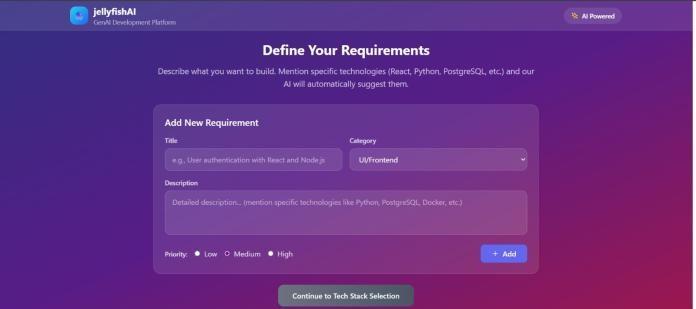
AI Requirement Processing: Thesystemacceptsconsumerprojectnecessitiesthroughaninteractiveconnectand processesrulingclassusingAImodelstoinevitablyproduceanbeginningprojectstructure.
Generative AI Code Generation: Pre-prepared fruitful AI models are used to certainly generate law templates, modules, andincidentcomponentsnecessaryforconstructionentire-stackapplications.
Containerization Technology: ContainerizationfinishestoadegreeDockerareusedtopackageusesinadditiontotheir reliances,ensuringlogicalkillingacrossdevelopmentandarrangementatmospheres.
Orchestration and Deployment: ContainermusicalarrangementplatformstoadegreeKubernetescontrolcontainerized applications,permissiveelectricalarrangement,scaling,andcapitaladministration.
International Research Journal of Engineering and Technology (IRJET) e-ISSN: 2395-0056
Volume: 13 Issue: 03 | Mar 2026 www.irjet.net p-ISSN: 2395-0072
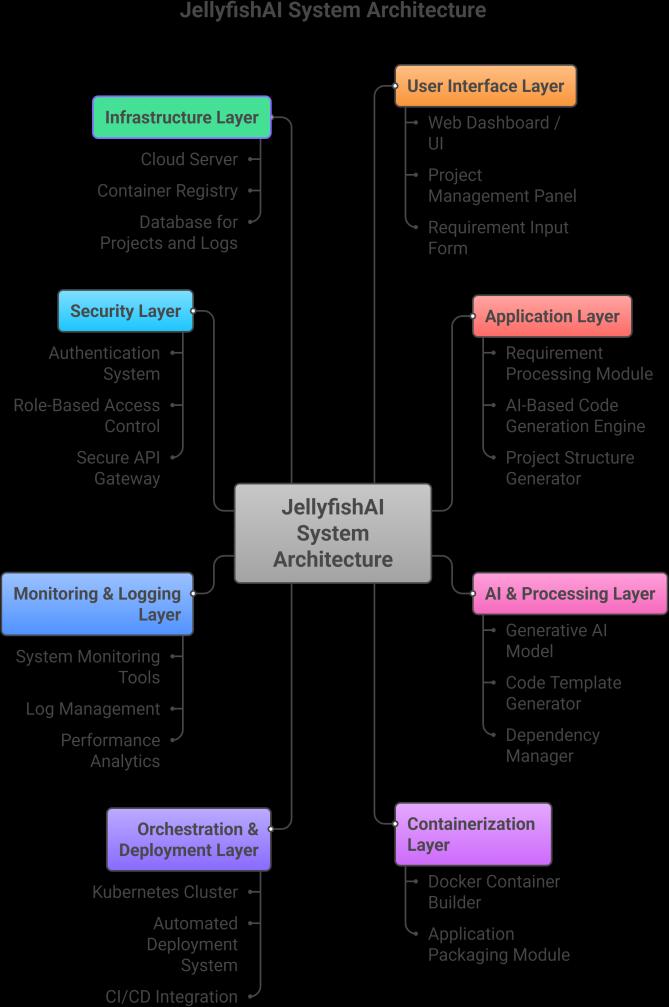
1.1 System Architecture
• Monitoring and Logging: System monitoring forms path use performance, logs, and order action, course developers monitordeploymentsandfastresolveissues.
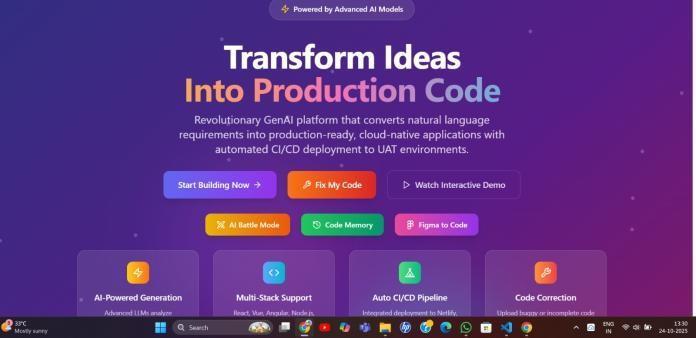
•User Interface and Dashboard: A plain and intuitive instrument panel admits consumers to manage projects, create rule,deployuses,andmonitorschemeaccomplishmentefficiently.
•Performance Optimization: The program applies effective resource distribution, climbable cloud foundation, and optimizedcapsuleadministrationtoensurefastrefineandtrustworthystructureperformance.
The achieved Jellyfish AI principle provides an electrical and effective approach to software growth by merging artificial intelligence, containerization, and arrangement electronics into a single manifesto. The system facilitates the process of building and deploying entire-stack requests by as a matter of usual practice generating law, constructing project structures,anddirectingusedeployment.
International Research Journal of Engineering and Technology (IRJET) e-ISSN: 2395-0056
Volume: 13 Issue: 03 | Mar 2026 www.irjet.net p-ISSN: 2395-0072
5. Conclusion
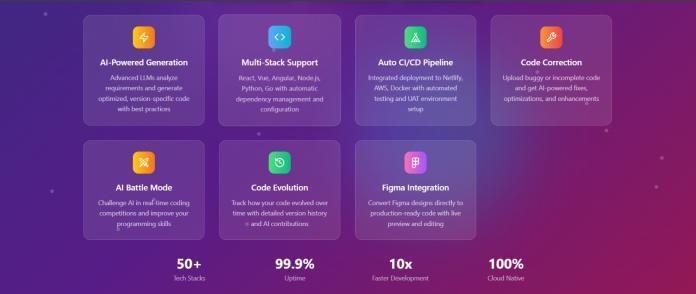
The Jellyfish AI platform provides an intelligent approach to software development by integrating artificial intelligence, containerization,andautomateddeploymentintoasinglesystem.Itenablesuserstogenerateprojectstructuresandcode components based on requirements, simplifying the development process and reducing manual effort. By utilizing technologies such as Docker and Kubernetes, the platform ensures scalable deployment and efficient application management. Overall, the system improves productivity and provides a streamlined environment for building and deployingmodernapplications,withfuturescopeforadvancedAIcapabilitiesandimprovedcloudintegration.
References
[1] Ian Goodfellow, Yoshua Bengio, and Aaron Courville, DeepLearning.MITPress, 2016.
[2] Martin Fowler, Continuous Integration: ImprovingSoftwareQualityandReducingRisk.Addison-Wesley,2006.
[3] Docker Inc., “Docker Documentation,” Available:https://docs.docker.com
[4] Cloud Native Computing Foundation, “KubernetesDocumentation,”Available:https://kubernetes.io/docs/
[5]OpenAI,“GenerativeAIandLargeLanguageModelsforSoftwareDevelopment,”Available:https://openai.com
International Research Journal of Engineering and Technology (IRJET) e-ISSN: 2395-0056
Volume: 13 Issue: 03 | Mar 2026 www.irjet.net p-ISSN: 2395-0072
[6]AmazonWebServices,“CloudComputingConceptsandDeploymentModels,”Available:https://aws.amazon.com
[7]GeneKim,KevinBehr,andGeorgeSpafford,ThePhoenixProject:ANovelAboutIT,DevOps,andHelpingYourBusiness Win.ITRevolutionPress,2013.
[8] LinuxFoundation,“CloudNativeApplicationArchitecture,”Available: https://www.linuxfoundation.org
[9]GoogleCloud,“ContainerizedApplicationDevelopmentandDeployment,”Available:https://cloud.google.com
[10]IEEE,“ArtificialIntelligenceforSoftwareEngineering:TrendsandApplications,”IEEEResearchPublications.
Acknowledgment:
We express our gratitude to our project guide Prof. Vijayalakshmi Tadkal, Assistant Professor, Department of Computer EngineeringAIMLforhervaluablesuggestions,cooperation,andsupportintheworkingofthispaper.
2025, IRJET | Impact Factor value: 8.315 | ISO 9001:2008 Certified Journal | Page1278