
International Research Journal of Engineering and Technology (IRJET) e-ISSN: 2395-0056
Volume: 13 Issue: 05 | May 2026 www.irjet.net p-ISSN: 2395-0072
International Research Journal of Engineering and Technology (IRJET) e-ISSN: 2395-0056
Volume: 13 Issue: 05 | May 2026 www.irjet.net p-ISSN: 2395-0072
Mr. Kumar N Krishnamurthy1,Avinash N U2,Vardhan C3,Varun Muthal S4,Vivek K S5
1Associate Professor, Department of ECE.PES College of Engineering Mandya, Karnataka, India 2345Students of ECE, PES College Of Engineering Mandya, Karnataka, India
Abstract-Road accidents are increasing every year, and many lives are lost due to delayed medical help. Proper accident data is often unavailable for investigations. To solve this, an IoT enabled Car Black Box System using ESP32 is proposed. The system monitors speed, movement, and location using CAN bus, IMU sensor, and GPS module. During accidents, it detects impact, stores data in an SD card, and sends alerts with live location to hospitals through GSM or Wi-Fi. The system is low cost, reliable, and improves road safety and emergency response
Key Words: ESP32,CarBlackBox,SDcard,GSMAlert,GPS, CANBus,IoT,AccidentDetection.
Road accidents are a significant cause of injuries and fatalities around the world. Slow emergency responses and incomplete accident data frequently worsen the impact of these incidents. A Car Black Box System is designed to capture essential vehicle information, including speed, location, and impact details, during an accident. In this project, an IoT-based Car Black Box System is created using an ESP32 microcontroller. The system is capable of automatically detecting accidents, storing critical data in memory, and sending emergency alerts along with real-time GPS location to nearby hospitals or pre-set emergency contacts. The proposed system is cost-effective, dependable, and contributes to enhanced road safety by enabling quicker responses and precisedatarecording.
Several researchers have developed vehicle black box systems for accident monitoring and analysis. Blackbox System for Car Accident Analysis focuses on recording speed, location, and impact data using embedded sensors forpost-accidentinvestigation.JiangandYu,inDesignand Implementation of Car Black Box Based on Embedded System, used the Samsung S3C2410 processor with CAN bus, GPIO, and A/D converters to collect vehicle parameterssuchasspeed,RPM,tirepressure,andseatbelt status.
Anotherwork,DesignandImplementationofBlackboxin Vehicles,proposedasystemforcontinuouslylogging
drivingdataandaccidentevents.Thesestudiesshowthat blackboxsystemsimprovesafety,evidencecollection,and accidentreconstruction.
The proposed Car Black Box System is designed using the ESP32 microcontroller as the central control unit for monitoring and emergency communication. An IMU sensor continuously measures acceleration, tilt, and sudden impact to detect accidents or rollover conditions accurately. A GPS module provides real-time vehicle location, speed, and route details during travel. The CAN bus module is used to collect important vehicle parameters such as speed, brake status, engine RPM, and engine condition from the vehicle network. When an accident is detected, the ESP32 immediately records all critical information including time, location, speed, and impact value into an SD card for future investigation. At thesametime,anemergencyalertmessagecontainingthe live GPS location is sent to the nearest hospital and registered emergency contacts through GSM or Wi-Fi communication.Cloudstorage supportisalsoprovided to securely back up accident records and enable remote monitoringwheneverinternetconnectivityisavailablefor users.
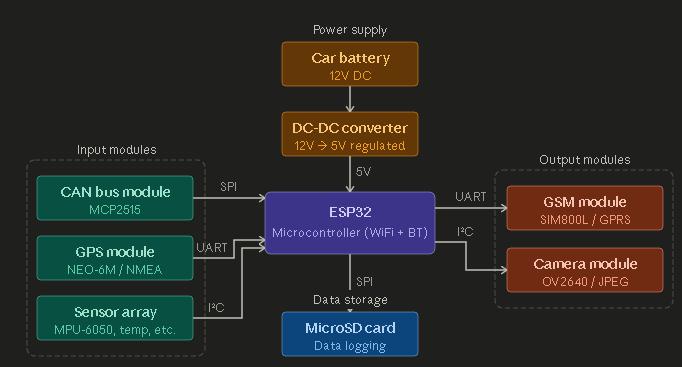
Fig-1: BlockdiagramofCarBlackBoxSystemUsingESP32
Volume: 13 Issue: 05 | May 2026 www.irjet.net p-ISSN: 2395-0072
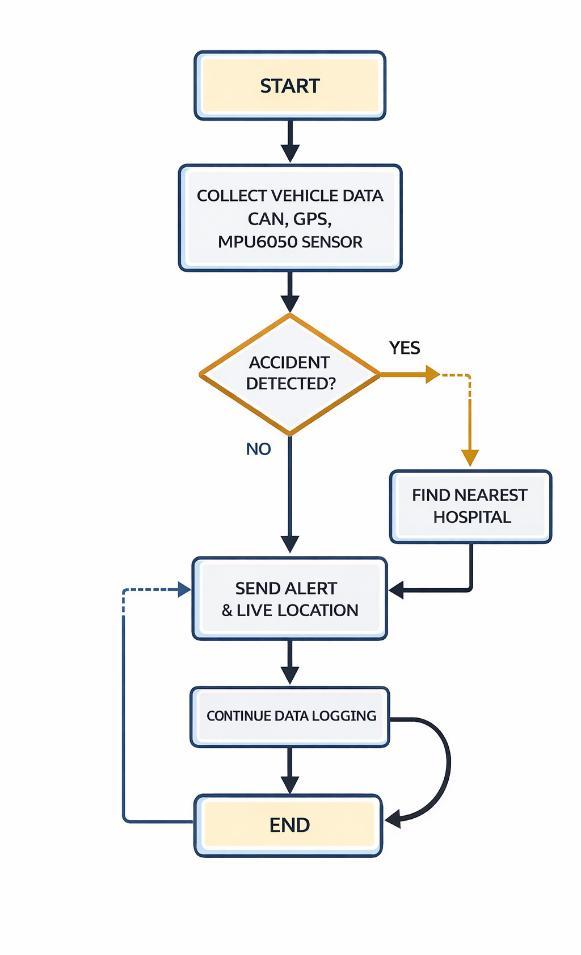
The system begins operation when the vehicle power is switched ON and the ESP32 initializes all connected modules. After startup, the controller continuously collects datafromtheCANbusmodule,GPSmodule,andMPU6050 sensor. The CAN bus provides vehicle parameters such as speed, brake status,andengine information, while the GPS module supplies real-time location coordinates. The MPU6050 sensor monitors acceleration, vibration, and tilt angle to identifysudden impacts or rolloverconditions. All received data is processed and stored periodically for continuousmonitoring.Thesystemthencheckswhetheran accident has occurred based on predefined threshold values. If no accident is detected, the system continues normal data logging and monitoring operation. If an accident is detected, the ESP32 immediately searches for the nearesthospital usingthe available locationdata.After identifying the nearest hospital, an emergency alert along with live GPS location is sent through GSM or Wi-Fi communication to hospitals and registered contacts. The system continues storing accident-related information in memoryforfutureanalysisandthenreturnstomonitoring mode.
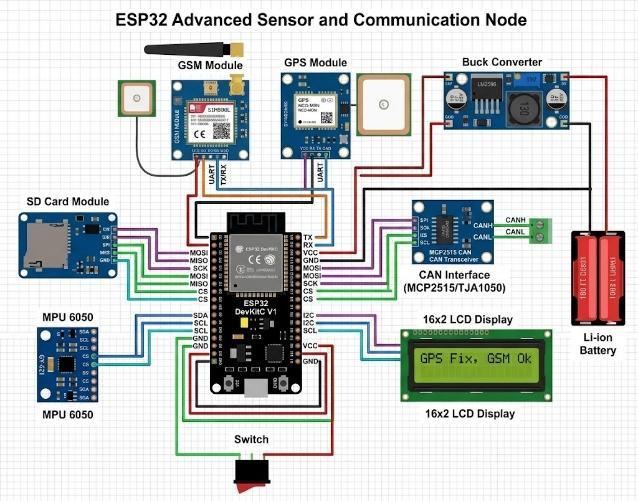
Fig-3: Systemcircuitdiagram
This circuit show in Figure 3 consists of the ESP32 microcontroller as the main processing and control unit, interfaced with various sensing, communication, and storagemodulesfortheCarBlackBoxSystem.TheESP32 receives input data from the MPU6050 sensor, GPS module, and CAN interface module. The MPU6050 sensor isconnectedthroughI2C communicationpinsandisused to measure acceleration, vibration, and tilt angles for accident detection. It helps identify sudden collision, rollover,orabnormalmovementconditionsduringvehicle operation.
The GPS module is connected through UART serial communication, where the TX and RX pins are linked to the ESP32. It continuously provides latitude, longitude, speed,andtimeinformationforreal-timevehicletracking. The CAN interface module MCP2515/TJA1050 is connected through SPI communication pins. It reads importantvehicleparameterssuchasspeed,brakestatus, RPM,andengineconditionfromthevehiclenetwork.
AnSDcardmoduleisalsoconnectedthroughSPIpinsand is used for storing accident data, speed records, sensor values,andlocationdetailsforfutureinvestigation.AGSM moduleisconnectedthroughUARTcommunicationandis used to send emergency alert messages with live GPS location to nearby hospitals and registered contacts wheneveranaccidentisdetected.
A 16x2 LCD display is connected to the ESP32 to display system status such asGPS signal, GSM network condition, and alert messages. The entire circuit is powered by a Liion battery through a buck converter, which provides regulated voltage levels. A switch is provided for ON and OFFcontrolofthesystem.
Volume: 13 Issue: 05 | May 2026 www.irjet.net
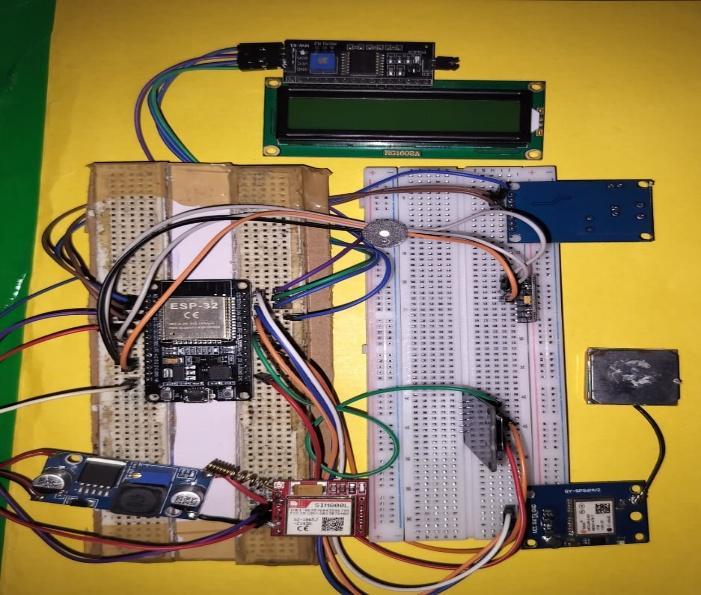
The developed Car Black Box System was tested under different operating conditions and showed satisfactory performance.Duringnormalvehiclemovement,theESP32 continuously collected data from the CAN bus, GPS module, and MPU6050 sensor without interruption. The GPS module successfully provided accurate location coordinatesinoutdoorconditions,whiletheCANinterface displayed vehicle speed and engine parameters correctly. The MPU6050 sensor reliably detected sudden impact, vibration, and tilt changes during simulated accident conditions.
Whenever an accident was triggered, the system immediately stored important data such as speed, time, impact level, and location into the SD card. At the same time,anemergencyalertcontaininglive GPSlocation was transmitted through the GSM module to nearby hospitals and registered contacts. The 16x2 LCD display clearly showed system status, GPS signal, and network availability.
The 16x2 LCD display clearly showed system status, GPS signal, and network availability during operation. The overall system operated reliably with low response time, accurate monitoring, and stable communication performance. The results confirm that the proposed system is suitable for accident detection, emergency response,andsecurevehicledatarecordingapplications.
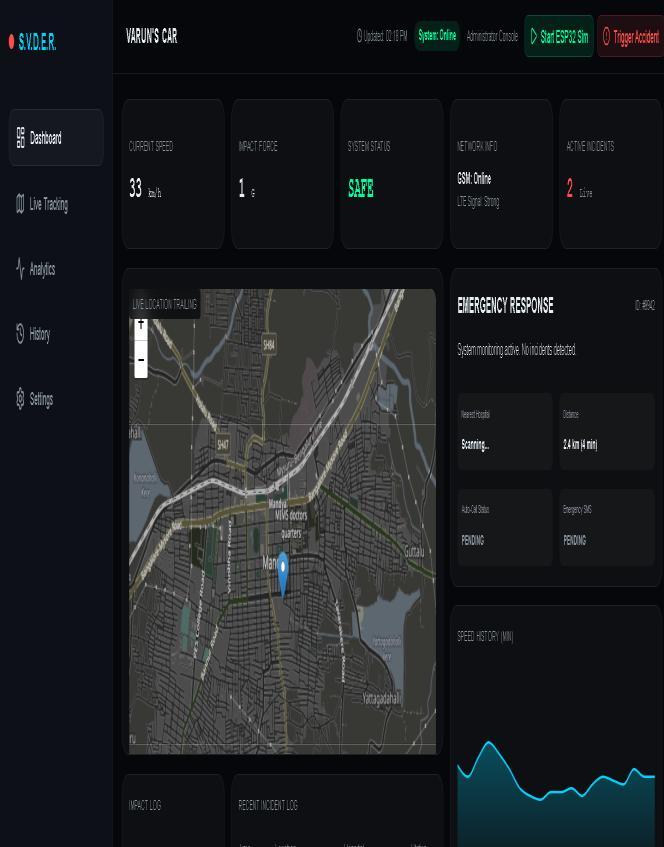
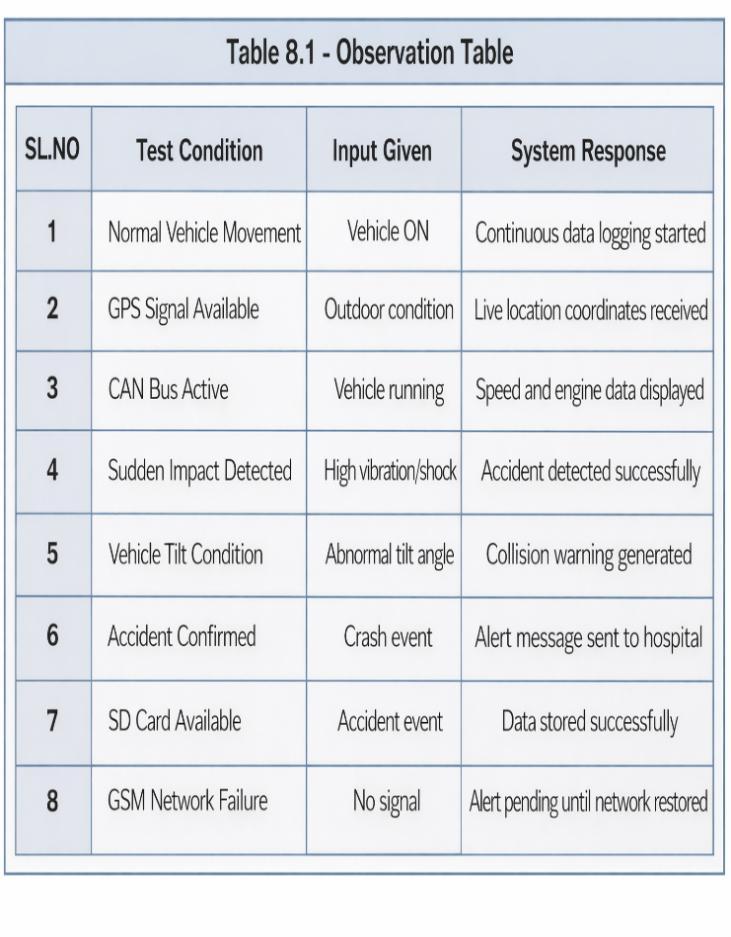
Table1 presents various test conditions applied to the proposed Car Black Box System along with the corresponding inputs and observed responses. It illustrates the system behavior under both normal and emergency situations, including vehicle movement, accident detection, GPS availability, CAN bus communication, and GSM-based alert transmission. The results confirm that the system operates as intended by continuously logging vehicle data during normal conditions, detecting sudden impact or abnormal tilt during accidents, and sending emergency notifications with live location details. The table also demonstrates the system’s ability to function effectively under practical conditions such as temporary GPS unavailability or network interruption while maintaining essential data recording functions. Additionally, it highlights the reliable storageofaccidentinformationintheSDcardandaccurate monitoring of vehicle parameters through CAN communication, which further improves the efficiency, safety, and robustness of the proposed system.
International Research Journal of Engineering and Technology (IRJET) e-ISSN: 2395-0056
Volume: 13 Issue: 05 | May 2026 www.irjet.net p-ISSN: 2395-0072
The proposed Car Black Box System is expected to automatically detect accidents using sensors such as accelerometer, gyroscope, and GPS modules. It can send real-time emergency alerts with live location details to nearbyhospitalsandrescueservicesforfasterassistance. The system provides accurate vehicle position and accident severity information to improve response time duringemergencies.Importantdatasuchasspeed,impact force, time, and location are securely recorded in both local SD card storage and cloud backup. These stored records can be used as reliable evidence for insurance claims and legal investigations. Overall, the system helps improveroadsafetybyenablingquickrescueoperations, proper accident analysis, and preventive measures for futureincidents
The proposed Car Black Box System offers significant scope for future enhancement with modern automotive and IoT technologies. A camera module can be integratedtocaptureimagesorcontinuousvideobefore, during, and after accidents, which can provide valuable evidence for investigation and insurance claims. Artificial intelligence and machine learning algorithms
can be implemented to analyze driving patterns, detect rash driving, over speeding, sudden braking, lane deviation, and predict accident severity in advance. A dedicated mobile application can be developed for live vehicle tracking, emergency notifications, route history, andremoteaccesstostoredaccidentrecords.
Cloud computing and data analytics can be used to manage multiple vehicles, monitor fleet performance, and generate detailed safety reports. Additional sensors suchasalcoholdetection,driverdrowsinessmonitoring, heart rate sensors, smoke sensors, and cabin temperature monitoring can improve driver and passenger safety. Integration with airbags, automatic braking systems, and engine cut-off control can reduce accidentimpact.
In future, the system can be widely adopted in smart cars, taxis, buses, trucks, ambulances, school vehicles, and public transport systems. It can become a complete intelligentvehiclesafetyplatformwithhigherreliability, automation,andreal-timeconnectivity.
The proposed IoT Enabled Car Black Box System using ESP32 successfully provides an effective solution for accident detection, emergency communication, and secure vehicle data recording. The system continuously monitors important vehicle parameters such as speed, location, acceleration, and engine status using CAN bus, GPS, and MPU6050 sensors. During accident conditions, it automatically detects abnormal impact or rollover, stores critical information in an SD card, and sends emergency alerts with live GPS location to nearby hospitals and registered contacts through GSM or Wi-Fi communication.
The developed system is low cost, reliable, and suitable forreal-timeapplicationsinmodernvehicles.Itsupports fasterrescue operations,accurate accidentanalysis,and reliable evidence for insurance and legal purposes. By combining embedded systems with IoT technology, the project helps improve road safety and reduces delay in emergencyresponse.Hence,the proposedmodel canbe considered a practical and scalable solution for future intelligenttransportationsystems.
[1] JiangLandYuC,“DesignandImplementationofCar Black Box Based on Embedded System”, 2010 International Conference on Electrical and Control Engineering,IEEE,pp.3537–3539,2010.
[2] Dev R, Kundu K, Rai A, Gupta S N, Kaushik A, and Agarwal R,“Designand ImplementationofBlackbox
International Research Journal of Engineering and Technology (IRJET) e-ISSN: 2395-0056
Volume: 13 Issue: 05 | May 2026 www.irjet.net p-ISSN: 2395-0072
in Vehicles”, 2024 11th International Conference on Reliability, Infocom Technologies and Optimization (ICRITO),IEEE,pp.1–5,2024.
[3] Authors Not Visible, “Blackbox System for Car Accident Analysis”, 2021 International Conference on Design Innovations for 3Cs Compute Communicate Control (ICDI3C), IEEE, pp. 178–183, 2021.
[4] Abhiram Nawathe, Arjun Patil, and Sharvari Kulkarni”, “Smart Car Black Box System”, International Journal of Scientific Research and Engineering Development (IJSRED), Vol. 3, Issue: 3, pp.1251–1254,May–June2020.
© 2026, IRJET | Impact Factor value: 8.315 | ISO 9001:2008