
International Research Journal of Engineering and Technology (IRJET) e-ISSN: 2395-0056
Volume: 13 Issue: 06 | Jun 2026 www.irjet.net p-ISSN: 2395-0072
International Research Journal of Engineering and Technology (IRJET) e-ISSN: 2395-0056
Volume: 13 Issue: 06 | Jun 2026 www.irjet.net p-ISSN: 2395-0072
Chetan Sukali1, Sapana Akka2 , R Sai Meghana3
1 B.Tech 2nd Year, Dept. of Electronics and Communication Engineering, Visvesvaraya Technological University, Belagavi, Karnataka, India.
2 B.Tech 2nd Year, Dept. of Electronics and Communication Engineering, Visvesvaraya Technological University, Belagavi, Karnataka, India.
3 Junior Research Fellow, Dept. of Electronics and Communication Engineering, Visvesvaraya Technological University, Belagavi, Karnataka, India.
Abstract - The Mini RADAR System is an embedded systems project developed using the STM32 Blue Pill microcontroller, HC-SR04 ultrasonic sensor, SG90 servo motor, LCD display, LED, buzzer, and a Python-basedradar visualizationinterface. The project was initially designed and simulated in Proteus software to verify system functionality and sensor interfacing before implementing the hardware prototype. The system operates by mounting the ultrasonic sensor on a servo motor that continuously scans the surrounding area from 0° to 180° and back. During scanning, the sensor measures the distance of nearby objects using ultrasonic waves. The STM32 microcontroller processes the measured distance and corresponding angular position, displayingtheinformationon an LCD screen in real time. When an object is detectedwithina predefined threshold distance, visual and audible alerts are generated through an LED and buzzer. Theangleanddistance data are transmitted to a computer via UART communication using a CP2102 USB-to-TTL converter. A Python-based application receives the serial data and displays detected objects on a real-time radar interface, providing a graphical representation of the scanning process. The developed system is cost-effective, reliable, and suitable for obstacle detection, security monitoring, robotic navigation, and educational demonstrations, highlighting practical embedded system design and real-time visualization techniques.
Key Words: Embedded Systems, HC-SR04 Ultrasonic Sensor, Mini Radar System, Servo Motor, STM32 Blue Pill
Radar (Radio Detection and Ranging) systems are widely used in defense, aviation, navigation, weather monitoring, robotics,andindustrialautomationfordetectingandtracking objects. Conventional radar systems use electromagnetic wavestodeterminetheposition,distance,andmovementof objects. However, such systems are often expensive and requirecomplexhardware.
AMiniRADARSystemcanbedevelopedusinglow-cost embedded system components to demonstrate the basic principlesofobjectdetectionandtracking.Inthisproject,an STM32 Blue Pill microcontroller is used as the main processingunit.AnHC-SR04ultrasonicsensorismountedon
an SG90 servo motor, allowing the sensor to scan the surrounding environment by rotating through different angles.
The ultrasonic sensor measures the distance of nearby objects,whiletheservomotorprovidesangularpositioning. Themeasureddistanceandangledataaredisplayedonan LCDscreenandsimultaneouslytransmittedtoa computer throughUARTcommunicationusingaCP2102USB-to-TTL converter. A Python-based radar visualization program processesthereceiveddataanddisplaysdetectedobjectson aradar-likegraphicalinterface.Additionalalertmechanisms suchasLEDsandabuzzerareusedtoindicatethepresence ofnearbyobstacles.
This project demonstrates the practical application of embeddedsystems,sensorinterfacing,serialcommunication, real-time data acquisition, and graphical visualization techniques.
Traditionalradarsystemsarecostlyandcomplex,making themunsuitableforeducationaldemonstrationsandsmallscaleapplications.Thereisaneedforalow-costandeasy-toimplement radar system capable of detecting objects, measuringtheirdistance,anddisplayingtheirlocationinreal time. The proposed Mini RADAR System addresses this requirement by utilizing ultrasonic sensing, servo-based scanning, and computer-based visualization. The main objectivesoftheprojectare:
1. TodesignanddevelopaMiniRADARSystemusingthe STM32BluePillmicrocontroller.
2. TomeasurethedistanceofobjectsusingtheHC-SR04 ultrasonicsensor.
3. To rotate the sensor using an SG90 servo motor for environmentalscanning.
4. TodisplayangleanddistanceinformationonanLCD display.
5. ToprovidevisualandaudiblealertsusingLEDsanda buzzer.
6. To transmit radar data to a computer through UART communication.
7. TodevelopaPython-basedradarvisualizationinterface forreal-timeobjecttracking.
International Research Journal of Engineering and Technology (IRJET) e-ISSN: 2395-0056
Volume: 13 Issue: 06 | Jun 2026 www.irjet.net p-ISSN: 2395-0072
Qiu et al. (2022) presented a comprehensive review of ultrasonicrangingmethodsanddiscussedvariouspulse-echo distance measurement techniques, signal processing methods,anderrorcompensationalgorithms.Theauthors concluded that ultrasonic ranging provides an economical and reliable solution for short-range object detection in roboticsandembeddedsystems.[1]
Utshaetal.(2021)developedanSTM32microcontrollerbased ultrasonic radar system using the STM32F103, HCSR04 ultrasonic sensor, SG90 servo motor, and graphical visualization software. Their work demonstrated that the STM32platformprovideshigherprocessingspeed,improved PWM control, and smoother radar scanning than conventionalArduino-basedimplementations.[2]
Xu(2025)proposedanultrasonicdetectionsystembased on the STM32 microcontroller for real-time obstacle detection.Thestudyutilizedtimer-basedpulsemeasurement and embedded signal processing to improve distance measurement accuracy and demonstrated stable system performanceunderdifferentoperatingconditions.[3]
AssemandAbdelmoneim(2025)presentedaminiature radarsystemforcriticalmissionapplications.Theirresearch focused on designing a compact radar platform capable of reliableobjectdetectionwhilereducinghardwarecomplexity and system cost, making it suitable for embedded surveillanceapplications.[4]
Guptaetal.(2023)developedaportableultrasonicradar using an ultrasonic sensor, servo motor, and embedded controller.Theproposedsystemcontinuouslyscannedthe surroundingenvironmentanddisplayeddetectedobjectson a radar interface, demonstrating reliable performance for obstacledetectionandeducationalapplications.[5]
Zapata (2025) investigated the calibration and performanceanalysisoftheHC-SR04ultrasonicsensorfor radar-baseddistancemeasurement.Thestudyreportedthat proper calibration significantly improves measurement accuracy while noting that environmental factors such as temperature and humidity influence ultrasonic sensor performance.[6]
The NIELIT Chennai project (2025) implemented an STM32-basedultrasonicradarsystemusingtheSTM32Blue Pill, HC-SR04 sensor, SG90 servo motor, UART communication, and Processing software. The project successfullydemonstratedreal-timeenvironmentalscanning, serialcommunication,andgraphicalradarvisualizationfor educationalandautomationapplications.[7]
Amicrocontroller-basedultrasonicradarproject(2022) presentedtheimplementationofaradar-likeobjectdetection
systemcapableofmeasuringdistanceandscanningnearby obstacles using ultrasonic sensing. The authors concluded that embedded radar systems provide a cost-effective solutionforroboticsandsurveillanceapplications.[8]
Simić et al. (2024) presented an ARM STM32-based parkingassistancesystemthatintegratedultrasonicsensing, motor control, and display modules for distance measurement. The study demonstrated that STM32 microcontrollersprovidereliablereal-timeperformancefor embeddedsensingandautomotiveassistanceapplications. [9]
Kumarietal.(2017)proposedanIEEE802.11ad-based radar system for jointvehicular communication and radar sensing.Theirworkdemonstratedthegrowingimportanceof radar technology in autonomous vehicles and highlighted futureopportunitiesforintegratingadvancedradarsystems withintelligenttransportationapplications.[10]
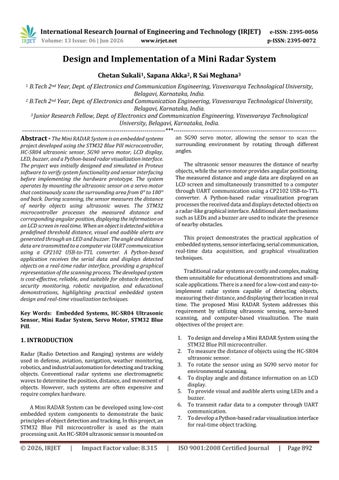
The Mini RADAR System is designed to detect and track nearby objects using ultrasonic sensing and servo-based scanning. The system consists of an STM32 Blue Pill microcontroller, HC-SR04 ultrasonic sensor, SG90 servo motor, LCD display, LED indicator, buzzer, and a Pythonbased radar visualization interface. The flow chart of the systemisshowninFig.1.
TheHC-SR04ultrasonicsensorismountedontheservo motor, which continuously rotates between 0° and 180°. Duringrotation,theultrasonicsensoremitsultrasonicwaves andreceivesthereflectedsignalsfromnearbyobjects.The STM32microcontrollercalculatesthedistanceofthedetected objectbasedonthetimetakenfortheechosignaltoreturn.
The measured distance and corresponding angular positionaredisplayedontheLCDscreenandsimultaneously transmittedtoacomputerthroughUARTcommunication.A Python application running on the computer receives the data and displays it on a radar-like graphical interface. An LEDandbuzzerprovidealertindicationswheneveranobject isdetectedwithinapredefineddistancerange.
The Mini Radar System is a microcontroller-based object detection and monitoring system that simulates the operationofarealradarusingultrasonicsensingtechnology. Insteadofusingradiowaveslikeconventionalradarsystems, it uses ultrasonic sound waves to detect the presence, distance,andpositionofobjectswithinitsscanningrange.
Whenthesystemispoweredon,theSTM32microcontroller initializesallconnectedcomponents,includingtheultrasonic
International Research Journal of Engineering and Technology (IRJET) e-ISSN: 2395-0056
Volume: 13 Issue: 06 | Jun 2026 www.irjet.net p-ISSN: 2395-0072
sensor,servomotor,anddisplayinterface.Theservomotoris settorotatewithinapredefinedangularrange,typicallyfrom 0° to 180°, enabling the sensor to scan the surrounding environment.
The ultrasonic sensor (HC-SR04) consists of a transmitter andareceiver.Thetransmitteremitsultrasonicsoundwaves atafrequencyofapproximately40kHz,whichisbeyondthe rangeofhumanhearing.Thesewavestravelthroughtheair untiltheyencounteranobject.
3. Echo Reception and Distance Measurement
Whentheemittedultrasonicwavesstrikeanobject,theyare reflectedbacktowardthesensor.Thereceivercapturesthe reflected waves (echo). The STM32 measures the time interval between the transmission and reception of the ultrasonicpulse.
Thedistancetotheobjectiscalculatedusingtheformula:
Distance=(SpeedofSound×Time)/2
The division by 2 is necessary because the measured time representstheround-tripjourneyofthesoundwave(from sensortoobjectandback).
Consideringthespeedofsoundinairisapproximately343 m/s:
Distance(cm)=Time(µs)×0.0343/2
4. Scanning Mechanism
The ultrasonic sensor is mounted on a servo motor that rotatesthroughaspecifiedanglerange.Astheservomoves,
the sensor continuously measures distances at different angularpositions. Forexample:
0°→Distancemeasurementtaken
10°→Distancemeasurementtaken
20°→Distancemeasurementtaken
180°→Distancemeasurementtaken
This process creates a two-dimensional scan of the surroundingarea.
TheSTM32collectstwoimportantparameters:
1. Angleoftheservomotor
2. Distancemeasuredbytheultrasonicsensor
Thesevaluesarecombinedtodeterminethelocationofan object relative to the sensor. The STM32 continuously processes this information and sends it to a computer throughserialcommunication.
6. Radar Visualization
A graphical interface developed using software such as ProcessingIDEreceivestheangleanddistancedatafromthe STM32.Thesoftwareplotsthedetectedobjectsonaradarlikedisplay.
Thedisplaytypicallyincludes:
Arotatingscanningline
Circulardistancemarkers
Angularreferencelines
Objectindicatorsshowingdetectedtargets
As the sensor scans, objects appear on the screen at their correspondingpositions,similartothedisplayofanactual radarsystem.
1. Theentireprocessisrepeatedcontinuously:
2. Servorotates.
3. Ultrasonicsensoremitssoundwaves.
4. Echoisreceived.
5. Distanceiscalculated.
6. DataisprocessedbySTM32
7. Informationisdisplayedontheradarscreen.
This enables real-time monitoring of the environment and immediatedetectionofobstaclesormovingobjects.
International Research Journal of Engineering and Technology (IRJET) e-ISSN: 2395-0056
Volume: 13 Issue: 06 | Jun 2026 www.irjet.net p-ISSN: 2395-0072
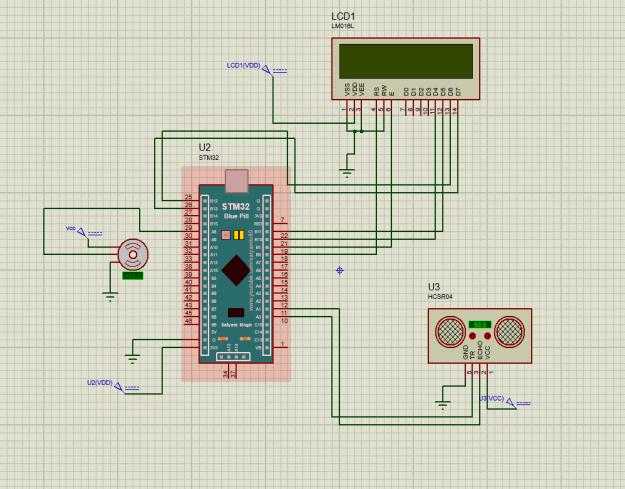
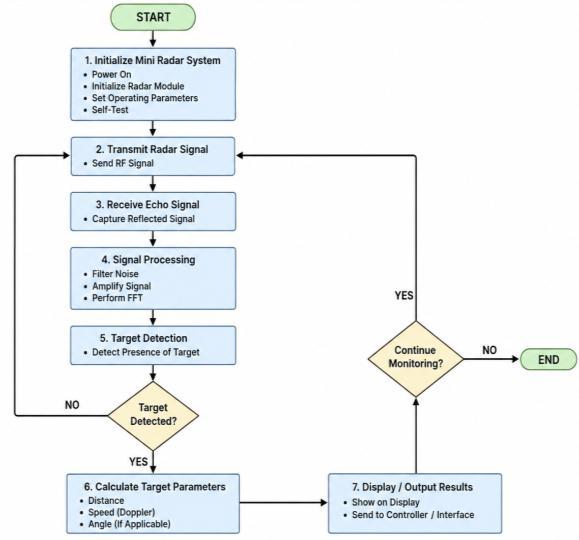
The software implementation of the Mini Radar System is developed using Keil uVision 4 IDE with Embedded C programming for the STM32 Blue Pill (STM32F103C8T6) microcontrollerisshowninFig.2.Thesoftwareisresponsible for controlling the ultrasonic sensor, processing distance measurements,anddisplayingtheresultsontheLCDmodule.
Atthestartofexecution,theSTM32initializestheGPIO pins, timer modules, and LCD interface. The HC-SR04 ultrasonic sensor is used to detect objects by transmitting ultrasonic waves and receiving their reflected echoes. The microcontrollergeneratesatriggerpulsetothesensor,which thenemitsultrasonicwavestowardnearbyobjects.
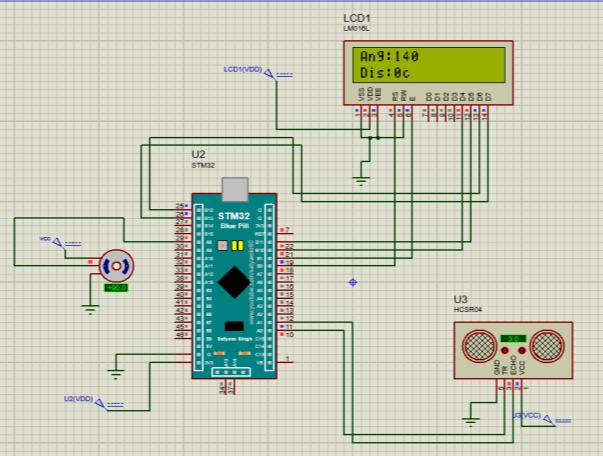
Fig -3:ProteusOutputofMiniRadarSystem
from 0° to 180° and back. At each angular position, the STM32triggerstheultrasonicsensortotransmitultrasonic wavesandmeasurestheechoreturntimeusingitsinternal timer.Basedonthemeasuredechotime,themicrocontroller calculatesthedistancetothedetectedobjectusingthespeed ofsound.
When the transmitted waves hit an object, they are reflectedbacktothesensor.Theechosignalisreceivedby theSTM32,andthetimermodulemeasuresthetimetaken for the signal to return. Based on this time interval, the microcontrollercalculatesthedistancebetweenthesensor andtheobjectusingthespeedofsound.
Thecalculateddistanceiscontinuouslydisplayedonthe 16×2LCD(LM016L)connectedtotheSTM32.Thesoftware
repeatedly performs distance measurement and LCD updating,enablingreal-timemonitoringofobjectswithinthe sensingrange.
Intheimplementedcircuit,theSTM32BluePillservesas thecentralprocessingunit.TheHC-SR04ultrasonicsensoris interfacedwiththemicrocontrollerthroughTriggerandEcho pins. The 16×2 LCD is connected to the GPIO pins of the STM32 to display distance values. Whenever an object is detected,themeasureddistanceisprocessedbytheSTM32 and instantly shown on the LCD, providing a simple and effectivereal-timeobjectdetectionsystem.
TheHardwareImplementationofMiniRadarSystemis implementedusingtheSTM32BluePill(STM32F103C8T6) microcontroller,anHC-SR04ultrasonicsensor,anSG90servo motor,a16×2LCDdisplay,anLED,abuzzer,andaCP2102 USB-to-TTLconverter.TheSTM32BluePillactsasthecentral controller, managing the operation of all connected peripherals.TheHC-SR04ultrasonicsensorismountedon the SG90 servo motor, allowing it to rotate and scan the surroundingareaforobjects.
Duringoperation,theSTM32generatesPWMsignalsto rotatetheservomotorthroughapredefinedangle,typically
The calculated distance and the corresponding scanning anglearedisplayedonthe16×2LCDinrealtime.Ifanobject isdetectedwithinapredefinedthresholddistance,theLED andbuzzerareactivatedtoprovidevisualandaudiblealerts. Simultaneously,theSTM32transmitstheangleanddistance datatoacomputerthroughUARTcommunicationusingthe CP2102USB-to-TTLconverter.
APython-basedradarvisualizationinterfacerunningon the computer receives the serial data and displays the detectedobjectsonaradar-likegraphicalscreeninrealtime. This hardware implementation enables continuous environmental scanning, accurate short-range object detection, real-time visualization, and efficient monitoring usingacompactandcost-effectiveembeddedsystem.
ThedevelopedMiniRadarSystemwastestedunderdifferent indoor conditions to evaluate its performance in detecting nearbyobjectsanddisplayingtheirpositionsinrealtimein proteusisshowninFig.3.Thesystemoperatedsuccessfully,
International Research Journal of Engineering and Technology (IRJET) e-ISSN: 2395-0056
Volume: 13 Issue: 06 | Jun 2026 www.irjet.net p-ISSN: 2395-0072
and all hardware and software components functioned as expected throughout the testing process. The HC-SR04 ultrasonicsensoraccuratelydetectedobjectsplacedwithin itseffectivesensingrangeofapproximately2cmto400cm.
The measured distances closely matched the actual distances, with only minor variations caused by environmental factorsandthesensor'sinherenttolerance. TheSTM32BluePillmicrocontrollerefficientlyprocessedthe echosignalsandcalculatedtheobjectdistanceusingtimerbasedpulsemeasurementwithoutanynoticeabledelay.
TheSG90servomotorrotatedsmoothlybetween0°and 180°,allowingtheultrasonicsensortoscanthesurrounding environment continuously. At each angular position, the STM32triggeredtheultrasonicsensor,measuredtheecho time,calculatedthecorrespondingdistance,andupdatedthe systeminrealtime.Thescanningoperationremainedstable throughout repeated test cycles, providing consistent coverageofthemonitoredarea.
The 16×2 LCD display successfully showed the current scanningangleandthemeasureddistance,enablingusersto monitor the detection process directly on the hardware. Whenever an object was detected within the predefined threshold distance, the LED indicator illuminated, and the buzzergeneratedanaudiblealert,confirmingthepresenceof anearbyobstacle.
Themeasuredangleanddistancedataweretransmitted continuouslyfromtheSTM32toacomputerthroughUART communicationusingtheCP2102USB-to-TTLconverter.The communication remainedreliable,withnosignificantdata lossortransmissionerrorsduringtesting.
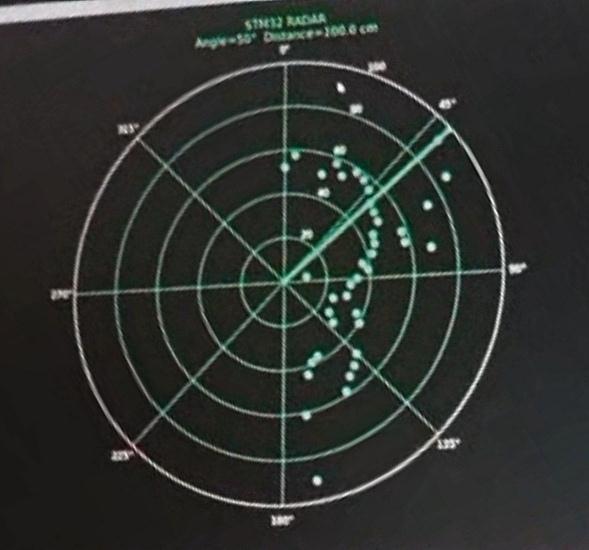
The Python-based radar visualization interface successfully received the serial data and displayed the detected objects on a radar-like graphical interface in real timeasshowninFig.4.Therotatingscanlinesynchronized
correctlywiththeservomotormovement,andthedetected objects appeared at their corresponding angular positions anddistancesontheradarscreen.Thisprovidedaclearand intuitivevisualizationofthescanningprocess.
Overall, the Mini Radar System demonstrated stable, reliable, and continuous operation during multiple testing cycles. The integrated hardware and software successfully performedreal-timeobjectdetection,distancemeasurement, serialcommunication,andgraphicalvisualization,confirming that the proposed system met all the intended design objectives.
The Mini RADAR System was successfully designed and implemented using the STM32 Blue Pill microcontroller, ultrasonicsensor,servomotor,LCDdisplay,LED,buzzer,and Python-basedradarvisualizationinterface.
The system was capable of detecting nearby objects, measuringtheirdistance,anddisplayingtheirpositioninreal time. The servo motor enabled continuous scanning of the surroundings, while the LCD display provided angle and distanceinformation.TheLEDandbuzzergeneratedalerts when objects were detected within a specified range. The Pythonradarinterfacesuccessfullyvisualizedthedetected objectsonaradar-likescreen.
The project achieved all the objectives defined at the beginning of the work and demonstrated the practical applicationofembeddedsystems,sensorinterfacing,serial communication, and real-time data visualization. The developedsystemiscost-effective,easytoimplement,and suitable for educational, security, and short-range object detectionapplications.
Theminiradarsystemhasconsiderablepotentialforfuture development and practical applications. By integrating advanced sensors such as LiDAR, infrared, or microwave radarmodules,thesystem'sdetectionrangeandaccuracycan be significantly improved. The addition of wireless communication technologies like Wi-Fi, Bluetooth, or IoT moduleswouldenableremotemonitoringandreal-timedata sharing.
The system can also be enhanced with Artificial Intelligence(AI)andMachineLearning(ML)techniquesfor object recognition, obstacle classification, and intelligent decision-making. Furthermore, the radar display can be upgradedwithmoresophisticatedgraphicalinterfacesand dataloggingcapabilities.Suchimprovementswouldmakethe system suitable for applications in autonomous vehicles, roboticnavigation,securityandsurveillancesystems,smart parking solutions, industrial automation, and disaster
International Research Journal of Engineering and Technology (IRJET) e-ISSN: 2395-0056
Volume: 13 Issue: 06 | Jun 2026 www.irjet.net p-ISSN: 2395-0072
management.Theseadvancementswouldtransformthemini radarsystemfromaneducationalprototypeintoaversatile andintelligentdetectionsystemforreal-worlduse.
[1] Z.Qiu,Y.Lu,andZ.Qiu,“ReviewofUltrasonicRanging MethodsandTheirCurrentChallenges,”Micromachines, vol. 13, no. 4, Art. no. 520, 2022, doi: 10.3390/mi13040520.
[2] S.G.Utsha,M.S.Rahman,M.A.Hasan,andM.A.Hossain, “STM32 Microcontroller Based Ultrasonic Radar,” Department of Electrical and Electronic Engineering, BangladeshUniversityofEngineeringandTechnology (BUET),ProjectReport,2021.
[3] G.Xu,“ExperimentalStudyonanUltrasonicDetection SystemBasedontheSTM32Microcontroller,”Research Square (Preprint), Aug. 2025, doi: 10.21203/rs.3.rs7380111/v1.
[4] M.AssemandF.Abdelmoneim,“AMiniatureRadarfor Critical Mission Application,” in Proc. International Conference on Future Technologies for Artificial Intelligence (IC-FTAI), 2025, doi: 10.1109/ICFTAI62324.2024.10950064.
[5] T.Gupta,B.P.Mishra,A.Dixit,andA.Kumar,“Portable Ultrasonic RADAR,” International Journal of Novel Research and Development (IJNRD), vol. 8, no. 5, pp. d679–d683,May2023.
[6] A. Zapata, “Speed Radar Using HC-SR04 and Arduino: Calibration and Data Analysis,” arXiv preprint arXiv:2506.06314,2025.
[7] “STM32 Microcontroller Based Ultrasonic Radar,” NIELITChennai,ProjectReport,2025.
[8] “MicrocontrollerBasedUltrasonicRadar,”Department ofElectricalandElectronicEngineering,ProjectReport, 2022.
[9] D. Simić, M. Mladenović, and M. Milojević, “Parking System Emulation Based on an ARM STM32 Microcontroller,” in Proc. IEEE Student Conference (IEEESTEC),2024,pp.67–71.
[10] P. Kumari, J. Choi, N. Gonzalez-Prelcic, and R. W. HeathJr.,“IEEE802.11ad-BasedRadar:AnApproachto Joint Vehicular Communication-Radar System,” IEEE TransactionsonVehicularTechnology,2017.