
International Research Journal of Engineering and Technology (IRJET) e-ISSN: 2395-0056
International Research Journal of Engineering and Technology (IRJET) e-ISSN: 2395-0056
Prof. P. V. Sridevi M.E 1 , PhD, Inaganti Himavardhini2 , Inapakurti Jahnavi3 , Didla John Paul4, Damodarapatruni Manoj Karthik5
Volume: 13 Issue: 06 | Jun 2026 www.irjet.net p-ISSN: 2395-0072 © 2026, IRJET | Impact Factor value: 8.315 | ISO 9001:2008 Certified Journal | Page499
1HOD, Department of Electronics and Communication Engineering, Andhra University College of Engineering (A), Andhra Pradesh, India
2,3,4,5(Students, Department of Electronics And Communication Engineering), Andhra University College of Engineering(A), Andhra Pradesh, India ***
Abstract-PhysicallyUnclonableFunctions(PUFs)have emerged as a lightweight hardware security primitive for device authentication and cryptographic key generation. This project presents a Configurable Ring Oscillator(RO)PUFusingHybridLogicGates,enhanced withanarea-optimizedhardwarecomparatorunitand integrated with an AES-128 key generation block (10 rounds). The configurable RO-PUF exploits manufacturing process variations to generate unique and unpredictable responses, ensuring secure device identificationwithoutstoringsecretkeysinmemory.The proposed hybrid logic gate design reduces power consumption and improves oscillation stability. Furthermore, the conventional comparator is replaced with an area-efficient hardware comparator, significantly reducing silicon area and delay while maintaining high reliability. The generated PUF responseisusedasa128-bitcryptographickeyinputfor AES encryption, enabling secure and tamper-resistant key generation for embedded and IoT devices. The overallarchitectureprovidesalow-cost,lightweight,and secure solution suitable for modern hardware security applications.
Key Words: Physically Unclonable Function (PUF), Ring Oscillator PUF (RO- PUF), Configurable PUF Architecture, Hybrid Logic Gates, Hardware Security, Area-Optimized Comparator, AES-128 Encryption, Cryptographic Key Generation.
PUFisoneofthemostpromisingsecurityprimitivesfor resource constrained scenarios, e.g. the Internet of Things (IoT) applications. A PUF utilizes process variationstogenerateuniqueCRPsforeachsinglechip. Evenwhenmanufacturedunderthesamecondition,the CRPsofaspecificchipwillbedifferentandtheseunique CRPscan be used to prevent the adversary from an
unauthorized copy of the chip. To date, various PUF structures have been proposed and they can be classifiedtodelaybasedPUFsandmemorybasedPUFs. ThemostciteddesignsincludeROPUFs,ArbiterPUFs andSRAMPUFs[1].CROPUF,asanimproveddesignof the conventional RO PUF, aims to acquire a high uniqueness, reliability and lower cost. A typical CRO PUFiscomposedofswitchingcomponents anddelay components,wheretheswitchingcomponentsprovide the reconfigurability to the PUF structure when the designiscompletedanddeployed.TheMUXsin[2]–[4] and the tristate gates in [5] act as the switching componentsandselectswhichdelayunitisinvolvedin theconstructionoftheCROPUF.AsCMOSintegrated circuits (ICs) are reaching its limitation, nano-device based PUFs provide new possibilities for reliable securitycircuits.ItisagreatchallengeforICdesigners and foundries to scale down the devices to the nanoscalesizesincetheunpredictablethicknessandthe cross-sectionalareaintroducelargeprocessvariations. However, this is a great opportunity for the PUF designers since the multiple variations and noise sourcescanimprovetheuniquenessandrandomnessof the PUF responses. Moreover, the entropy of a PUF design can be increased significantly due to the unpredictable variations and noises. Among the emergingPUFsbasedonnanotechnology,theresistive random access memory (RRAM, also referred to as memristororReRAM[6]).basedPUFdesignsareoneof the most promising approaches. Conventional RRAM based PUF designs mainly utilize the resistance variations and mismatch of the RRAM at a fixed programmingvoltageorprogrammingtime
A.RRAM BASED PUFS RRAMs can be classified as bipolar or unipolar according to the switching behaviors. The bipolar RRAM based on metal
International
Volume: 13 Issue: 06 | Jun 2026 www.irjet.net p-ISSN: 2395-0072
oxide(showninFig.1(a))isoneofthemostpromising candidates for applications in memory computing or configurablelogic[7].Byapplyingaproperpositiveor negativepulsetotheselectedRRAMcell,theresistance oftheRRAMwillbeswitchedbetweenHigh-Resistance State (HRS) and Low-Resistance State (LRS), correspondingtoONandOFFofthecircuit.Whenthe RRAM is configured in the low-resistive ON state, it workslikeadiode.Onthecontrary,iftheRRAMisin thehigh-resistiveOFFstate,thecurrentthatcanflow through the RRAM isvery small. RRAM is a popular primitiveforPUFdesigns,especiallyformemorybased PUF designs.Asurvey ofrecentstudiesinvestigating emergingnano-electronicdevicestobuildPUFsisgiven in[8].Mostofthesedesignsrelyontheresistanceof theRRAMsandonemajorissueoftheRRAMbasedPUF designisthatthestructuresneedextraanalogreading circuits e.g. analog-to-digital converter (ADC) to generatethecorrespondingresponse.Furthermore,the resistance of the RRAM is strongly related to the operatingtemperatureandtheprogrammingvoltages ortime.Thesemakethemunreliableandconventional RRAM based circuits suffer serious variability [9]. Besides, for crossbar based RRAM PUFs, the accumulated sneak current will also make them unstableandunreliable[10].
B. RRAM CMOS HYBRID DESIGNS RRAM CMOS hybrid
Design offers an opportunity to accomplish highdensitycircuit[11],sincetheRRAMhasbeenproven CMOS-compatibleanditcanbeintegratedinthemetal layers over the CMOS layer [12]. Previous research haveshownthatRRAMbasedswitchbox(SB)canbe appliedtothedesign of high performance and high density FPGAs [12], [13]. Furthermore, the RRAM CMOS hybrid circuits can accelerate neural network computations [14]. Inspired by the idea of the RRAM CMOS hybrid designs in the FPGA, hn-CRO PUF is proposed in the paper. Different from the previous RRAMbasedPUFdesigns[15]–[17],inthispaper,the RRAMsinthisworkareconfiguredatthefixedstateand worklikeaprogrammablenano-switchwhiletheCMOS invertersactasthedelaycomponents,asshowninFig. 1(b), which makes the proposed hn-CRO PUF more reliable.
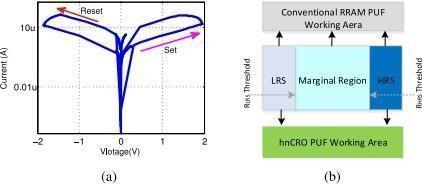
Fig. 1.RRAMcircuits:(a)I-VcurveoftheRRAM, and(b)workingareaoftheRRAMPUF.
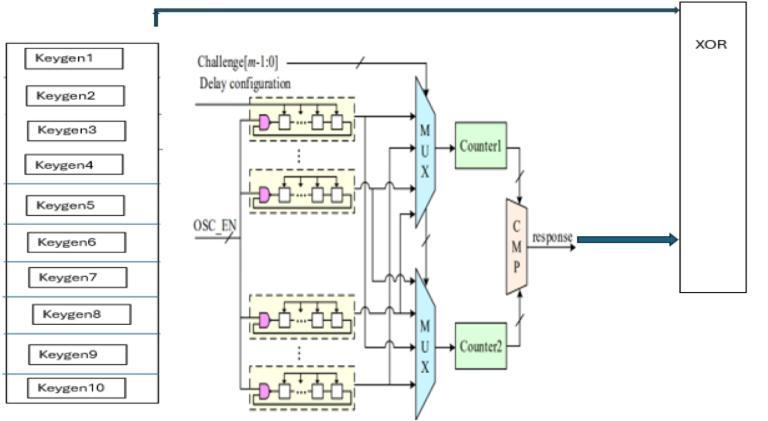
2.ProposedBlockdiagram
Theproposedarchitectureconsists of five major blocks. Multiplechallengesareappliedsequentially.Eachchallenge producesoneresponsebit.
After128comparisons:
Bitsareconcatenated→128-bitPUFkey.Optionalfiltering improvesreliability.
1. ConfigurableRingOscillatorArray
2. ChallengeGenerator/Selector
3. Area-OptimizedHardwareComparator
4. ResponseStabilization&KeyFormation
5. AES-128EncryptionCore(10Rounds)
6. Theoverallflowis:
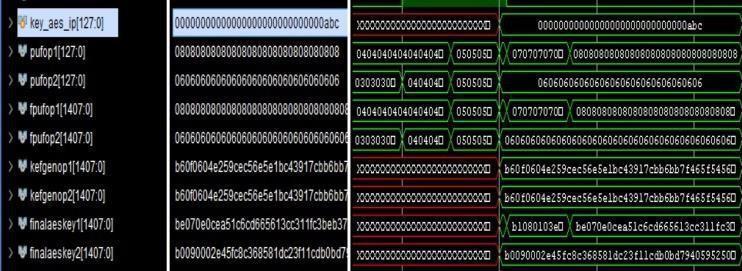
Challenge→RO-PUF→Comparator→128-bitKey→ AES Encryption
The overall architecture of the proposed PUF, which doesnotincludethecontrollingpart,isshowninFig.2 BasedontheproposedDCUs,wecanconstructahybrid configurable RO (HC-RO) with a NAND gate as the
International Research Journal of Engineering and Technology (IRJET) e-ISSN: 2395-0056
Volume: 13 Issue: 06 | Jun 2026 www.irjet.net p-ISSN: 2395-0072
leadingunit.Meanwhile,thefollowingtworulesmust beabidedby:
The RO_I of current DCU should connect to the RO_FofthepreviousDCUandtheRO_Fofcurrent DCUshouldconnecttotheRO_IofthenextDCU.
ThetotalnumberofreverselogicunitsinaHC-RO shouldbeodd,whichincludestheleadingNAND gate, DCU-1, DCU-3 and inverter if exists. Fig. 3 showsanexampleofourhybridconfigurableRO. As we can see, a NAND gate is placed at the beginning of the RO and the total number of reverse
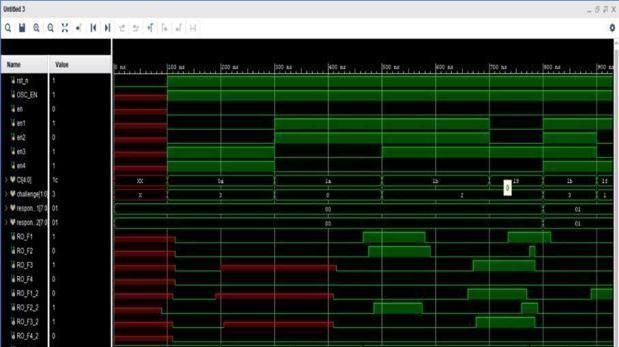
logicunitsisthree(i.e.,oneNANDgate,oneDCU-3 andoneDCU-1),exactlyanoddnumber.WhenRO_ENis low,RO_Fholdshighallthetime.OnceRO_ENturnsto high, the whole RO can oscillate at 2 5 = 32 kinds of frequenciesdeterminedbytheCI[4:0].Ofcourse,from theperspectiveofareacost,itwouldbebettertouse DCU-1orDCU-3asthestageunit.

For the falling time, let us assume RO_I is 1 at thebeginning,thusleadingRO_Ftobe1nomatterwhat valueCIholds.WhenRO_I pullsdown,the‘B’inputof theORgatewillpulldown.Also,theoutputoftheAND gate (i.e., AND_OUT) will pull down, no matter what valueCIholds.That is to say the ‘A’ input of the OR gate will also pulldown.Hence,theRO_Fwillalways followtheRO_Itopulldown.However,thefallingtime fromtheRO_ItoRO_FisnotthesamefordifferentCI values: 1) When CI = 1, the initial value of the AND_OUT is 1. So when RO_I pulls down, it must take a time of dAND_10 to pull down theAND_OUT firstly. After that, it will take another time ofdOR_00 topulldowntheRO_F.Inotherwords,ittakesatotal timeof (dAND_10+dOR_00)forRO_Ftobecome0after RO_I pulls down. 2) When CI = 0 (as shown in Fig. 5(b), Fig. 5(d)), becausetheinitial value ofAND_OUT isalready 0, it only takes a time of dOR_00 for RO_F tobecome 0 after RO_I pulls down. In conclusion, if theDCU-2 is used as a stage of the RO, the value of CI candecide whether an AND gate is included in the pathduring falling phases.Fortherising time,let
usassumeRO_Iis0atthebeginning,thusleadingRO_F to be 0 no matter what value CI holds. when RO_I pulls up, the ‘B’inputoftheORgatewillalsopullup. Hence,theRO_Fwillcertainly follow RO_I to pull up, no matter what value AND_OUT is. However, the rising time from the RO_I to RO_F varies a little for differentCIvalues:
1) WhenCI=1,theinitialvalueoftheAND_OUTis0. SowhenRO_Ipullsup,theAND_OUT(i.e.,the‘A’input oftheORgate)isrisingduringtheperiodofdAND_11.
2)WhenCI=0,theAND_OUTalwaysholds0. ThegeneratedPUFkeyisdirectly usedastheAES key.Area-OptimizedHardwareComparator
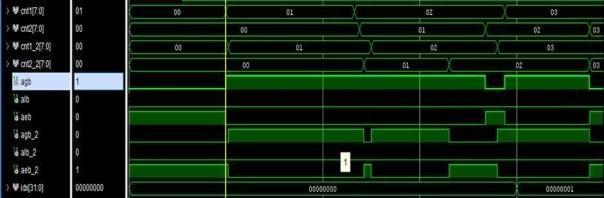
1. Counters count oscillations from both ROs duringafixedtimewindow.
2. The hardware comparator compares the twocountervalues.
3. Outputbitgeneration:
• IfRO1>RO2→output1
• IfRO1<RO2→output0
Why Area Optimized?
Reducedlogicgates
Lowersiliconarea
Fastercomparison
Lowerpowerconsumption
Output: 1-bitPUFresponse.
AES Operations:
AESperforms10roundsofencryption:
1. SubBytes
2. ShiftRows
3. MixColumns
4. AddRoundKey
Thisproducessecureencryptedoutput.
Importance
Keyis never stored inmemory.
Keyisgeneratedon-chipwhenneeded.
Preventskeytheftandcloning.
Output: Encryptedciphertext
International Research Journal of Engineering and Technology (IRJET) e-ISSN: 2395-0056
Volume: 13 Issue: 06 | Jun 2026 www.irjet.net p-ISSN: 2395-0072 © 2026, IRJET | Impact Factor value: 8.315 | ISO 9001:2008 Certified Journal | Page502

ADVANTAGES
1. Security Advantages :
Generates unique and unclonable keys from intrinsicchipvariations.
Eliminates the need for non-volatile memory
keystorage,preventingkeyextractionattacks.
Strongresistanceto:
o Physicaltampering
o Side-channelattacks
o Reverseengineering
2. Hardware Advantages:
Hybridlogicgatesreduce:
o Powerconsumption
o Propagationdelay
o Transistorcount
Area-optimizedcomparator:
o Reduceschipareasignificantly
o Improvescomparisonspeed
o EnablesscalabilityforlargePUFarrays
3. System Advantages:
Lightweight and suitable for resourceconstraineddevices
Scalableandreconfigurablearchitecture
LowcostandeasyVLSIimplementation
1.IoTDeviceSecurity:
Securebootandfirmwareauthentication
Deviceidentityforsmarthomedevices
Keygenerationforwirelesssensornetworks
2.EmbeddedSystems:
SecuremicrocontrollersandFPGAs
AutomotiveECUsecurity
SmartcardsandRFIDauthentication
3.Cloud&EdgeSecurity:
Hardwarerootoftrust
Securekeyprovisioning
Device-to-cloudauthentication
4.Military&Defense:
Securecommunicationhardware
Anti-counterfeitingofelectroniccomponents
International Research Journal of Engineering and Technology (IRJET) e-ISSN: 2395-0056
Volume: 13 Issue: 06 | Jun 2026 www.irjet.net p-ISSN: 2395-0072
This project demonstrates a secure and areaefficient hardware security architecture using a configurableRO-PUFintegratedwithanAES-128key generation block. The use of hybrid logic gates improvesenergyefficiencyandstability,whiletheareaoptimizedcomparatorreduceshardwareoverhead.By eliminating the need for stored secret keys and generating cryptographic keys directly from silicon variations, the proposed system enhances hardware trustandresilienceagainstattacks.Thearchitectureis highly suitable for low-power, resource-constrained, andsecurity-criticalapplications.
FUTURE SCOPE
TechnicalImprovements
Implement Machine Learning attack resistancetechniques
Adderrorcorrectioncodes(ECC)toimprove reliability
Develop temperature and voltage variation compensation
ArchitectureEnhancements
Integration with AES-256 or lightweight cryptography
FPGA and ASIC fabrication for real-chip validation
ImplementStrongPUFarchitectureforlarge CRPsets
1) J. Delvaux and I. Verbauwhede, “Side Channel Modeling Attacks on 65 nm Arbiter PUFs Exploiting CMOS Device Noise,” IEEE Trans. Inf. ForensicsSecurity,vol.10,no.3,pp.725–738,Mar. 2015.
2) G. T. Becker, “The Gap Between Promise and Reality:OntheInsecurityofXORArbiterPUFs,”in Proc.IEEECHES,2015,pp.535–555.
3) R.Maes,“ Physically Unclonable Functions: Constructions, Properties and Applications,” Springer,2016.
4) U. Ruhrmair and D. E. Holcomb, “PUFs at a Glance,”inProc.IEEEDATE,2014,pp.1–6.
5) Y. Gao et al., “Emerging Physical Unclonable
Functions With Nanotechnology,” IEEE Access, vol.4,pp.61–80,2016.
6) MaitiandP.Schaumont,“ImprovedRingOscillator PUF: An FPGA-Friendly Secure Primitive,” J. Cryptology,vol.24,no.2,pp.375–397,2011.
7)K. Yang et al., “A Physically Unclonable Function WithBER<1e−8forRobustChipAuthentication Using Oscillator Collapse in 40 nm CMOS,” IEEE ISSCC,2015.
8) M. Tehranipoor and C. Wang, Introduction to HardwareSecurityandTrust.Springer,2012.
9) J.Guajardoetal.,“FPGAIntrinsicPUFsandTheir Use forIPProtection,”inProc.IEEECHES,2007, pp.63–80.
10) S. Katzenbeisser et al., “PUFs: Myth, Fact or Busted? A Security Evaluation of Physically UnclonableFunctions,”IEEETrans.Inf.Forensics Security,vol.13,no.2,pp.352–365,2018.
11) X.Xuetal.,“AReliableandReconfigurableFPGABasedRingOscillatorPUF,”IEEETrans.CAD,vol. 37,no.11,pp.2783–2796,Nov.2018.
12) H. Handschuh and H. Gilbert, “AES Candidate AlgorithmSubmission,”NISTAESProposal,1999.
13) S. Sutar et al., “Lightweight Cryptography Imp lementati on Using PUF - Bas ed Key Generation,” IEEE Access, vol. 9, pp. 114563–114575,2021.
14) Y. Cao et al., “A 1.4 pJ/bit Fully Synthesizable PUF-BasedCryptographicKeyGeneratorin65nm CMOS,” IEEE JSSC, vol. 52, no. 10, pp. 2671–2682,Oct.2017.
15) M.Hilleretal.,“SystematicAnalysisofROPUFs andTheirSecureKeyGenerationCapabilities,” IEEETrans.DependableSecureComput.,vol.17, no.3,pp.553–566.
2026, IRJET | Impact Factor value: 8.315 | ISO 9001:2008 Certified Journal | Page503