
International Research Journal of Engineering and Technology (IRJET) e-ISSN: 2395-0056
Volume: 13 Issue: | June 2026 www.irjet.net p-ISSN: 2395-0072

International Research Journal of Engineering and Technology (IRJET) e-ISSN: 2395-0056
Volume: 13 Issue: | June 2026 www.irjet.net p-ISSN: 2395-0072
Romain Atangana1, 2, 3, Epiphanie Lauriane KenneTsakmo3 , Vivien Loick Beyala Kamgang3, , Amstrong Emini Me Zenanga3, Emmanuel BABA3,4,5 , Daniel Tchiotsop1, Godpromesse Kenne1
1 Unité de Recherche d’Automatique et d’Informatique Appliquée (UR-AIA) , IUT of Bandjoun, University of Dschang –Cameroun P. O Box 134 Bandjoun
2 Unité de Recherche de Matière Condensée d’Electronique et de Traitement du Signal (UR-MACETS), Faculty of Science, University of Dschang-Cameroun, P;O Box 67 Dschang
3 Department of Computer Science, Higher Teacher Training College, University of Bertoua-Cameroun P.O Box 652 Bertoua
4Mathematical and Computer Science Department, LaRi Lab. University of Maroua –Cameroon P.O Box 814 Maroua-Cameroon
5 CREATIVE Lab. University of Garoua –Cameroon P. O Box 346 Garoua- Cameroon
6Department of Mathematics, statistic and computer sciences, the University of Bertoua –Cameroon P.O Box 416 Bertoua
***
Abstract
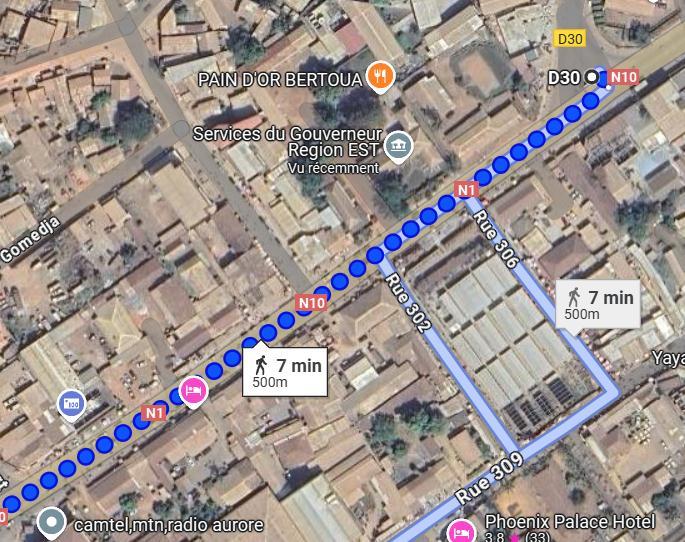
Rapid urbanization and the substantial growth of the vehicular population in Bertoua, particularly along the corridor connecting the MTN building to the Governor’s Office, have resulted in critical traffic congestion, impaired mobility, and a progressive deterioration in urban quality of life. To address these emerging challenges, this study proposes the design and performance evaluation of an intelligent urban traffic monitoring and guidance system. The proposed framework integrates Internet of Things (IoT)-based technologies for real-time traffic data acquisition with Artificial Intelligence (AI) approaches, notably Long Short-Term Memory (LSTM) networks, for traffic flow prediction and classification. This paper presents the overall system architecture, the methodologies adopted for data collection and preprocessing, and the AI models implemented for traffic analysis and decision support. Experimental results demonstrate the effectiveness of the proposed system in enhancing traffic fluidity and optimizing urban mobility management. Performance evaluation using standard classification metrics achieved an accuracy of 92.43%, highlighting the robustness and predictive capability of the developed model. Furthermore, the limitations associated with dataset diversity and scenario coverage are critically discussed. Overall, this work provides a significant contribution toward the development of intelligent transportation solutions for rapidly growing urban environments with similar infrastructural and mobility constraints.
Keywords : Traffic management, IoT, Artificial Intelligence, Neural networks, Traffic prediction, Smart cities, Bertoua.
PopulationgrowthandurbanexpansionincitieslikeBertoua,quarterheadofEastRegionofCameroon,whichissituated inthemidwayoftheDoualaDjamenacorridorareaccompaniedbyanexponentialincreaseinthenumberofvehicles.This dynamicputspressureon existing roadinfrastructure,leadingtomajorchallengessuchaschroniccongestion,increased road insecurity, and environmental degradation due to gas emissions waste of time due to traffic congestion. The MTN building - Governor's Office axis in Bertoua, crucial for economic and administrative activities, exemplifies this issue, characterizedbyfrequenttrafficjams,difficultiesinnavigation,andlongqueuesforusers.Inresponsetothesechallenges, Intelligent Transport Systems (ITS) are emerging as promising solutions, leveraging Information and Communication Technologies(ICT)tooptimizetrafficmanagement.Thesesystemsenablereal-timedatacollection,in-depthanalysis,and informed decision-making to dynamically regulate traffic flows. The integration of the Internet of Things (IoT) for detectionandcommunication,combinedwithArtificialIntelligence(AI)forpredictiveandprescriptiveanalysis,offersan innovativeapproachtotransformingurbanmobility.Thisarticleaimstodesignandevaluateanintelligenttrafficcontrol andguidancesystemspecificallyadaptedtothecontextofBertoua.Thegoalistoimprovetrafficflow,reducetraveltimes andfuelconsumption,andenhanceusersafety.Wehypothesizethatsuchasystem, basedonreal-timedatacollectionand
2026, IRJET | Impact Factor value: 8.315 | ISO 9001:2008 Certified Journal | Page538
International Research Journal of Engineering and Technology (IRJET) e-ISSN: 2395-0056
Volume: 13 Issue: | June 2026 www.irjet.net p-ISSN: 2395-0072
analysis and integrating a dynamic guidance system, can significantly optimize traffic flow management and facilitate transportation.
The advent of the Internet of Things (IoT) has revolutionized many sectors, including transportation. IoT enables the connectionofphysicalobjectsequippedwithsensorsandactuators,givingthemtheabilitytocollectandexchangedata.In the context of traffic management, IoT facilitates real-time monitoring and the collection of detailed data on road conditions. A Connected Object (CO) is a device capable of collecting, processing, and transmitting data via a network, without direct human intervention [Roxin and Bouchereau, 2017]. The IoT architecture is typically structured in several layers:theperceptionlayer(infraredsensors,cameras),thenetworklayer(datatransmission),thedataprocessinglayer (storage and analysis), the application layer (user interfaces), and a cross-cutting security layer [Mouhoub et al., 2015]. Recent work, such as that of [Dupont et al., 2023], has explored optimizing these architectures for complex urban environments, focusing on resilience and scalability. Communication technologies are essential for IoT. Short-range technologies like Bluetooth and Wi-Fi are useful for local connectivity, while long-range technologies such as cellular networks (4G/5G) and LPWANs (LoRa, Sigfox) are crucial for data transmission over large urban areas [Roxin and Bouchereau,2017][MartinandPetit,2024]recentlycomparedtheeffectivenessofdifferentLPWANtechnologiesforrealtimetrafficmonitoring,highlightingtheadvantagesofLoRaforlow-costandlow-powerdeployments.IoTplatforms,such asAWSIoTorThingspeak,playacentralrolebyprovidingthenecessaryservicesforthecollection,storage,analysis,and utilizationofdatafromconnectedobjects[Thiam,2023].
ArtificialIntelligence(AI)hasbecomeacornerstoneforsmarttrafficmanagement,particularly forflowpredictionandthe optimizationofsignalingsystems.Timeseries,whichrepresentsequencesofdataindexedbytime(suchashourlytraffic volume), are at the heart of these applications. AI-based time series prediction models are varied. Artificial Neural Networks (ANNs), and more specifically recurrent neural networks (RNNs) like Long Short-Term Memory (LSTM) networks,areparticularlyeffectiveatcapturingcomplextemporaldependenciesintrafficdata[AlMalawi,2024].Recent studies, including that of [Chen et al., 2023], have demonstrated the superiority of Deep Learning models (LSTM, CNN LSTM) compared to traditional statistical models (ARIMA) for short-term traffic prediction, especially under fluctuating trafficconditions.ConvolutionalNeuralNetworks(CNNs)arealsousedfortheanalysisofspatialtrafficdata,forexample byprocessing imagesortrafficdensitymatricesasinputdata [BENSRHAIR andVIENNEY,2021].TheintegrationofCNN and LSTM (CNN-LSTM) allows for simultaneous modeling of spatial and temporal traffic dependencies, providing more accuratepredictions[WangandLi,2022].
Many intelligent traffic management systems have been developed around the world. For example, systems based on computervision and deep learning have beenproposedforvehicledetectionand trafficdensity estimation[Garcia et al., 2023].Otherworkhasfocusedontheadaptiveoptimizationoftrafficlightsbasedonreal-timetrafficconditions.
FERHAT and MERABET (2025) "Traffic Management System in a Smart City" uses data collected in real time through sensors, surveillance cameras, and traffic lights. Their methodology is based on the design, simulation, and testing of devicessuchasadaptivetrafficlights,optimizedlighting,smartspeedbumps,andparkingthroughcomputervisionusing the Arduino platform and specialized software. The models employed are intelligent algorithms for anticipating traffic flows and computer vision models for parking management. The implicit limitations lie in the fragility of the Arduino board, requiring validation in real-world deployment. Despite this, the results obtained demonstrate a significant improvementintrafficflow,roadsafety,andenergyefficiency,contributingtomoresustainableurbanmobility
Ruiz-Guirola et al. (2024) "Modeling IoT Traffic Patterns: Insights from a Machine Type Communication Dataset" Methodology: This study adopts a statistical approach to model communication flows in IoT networks through classical distributions. The authors use statistical goodness-of-fit tests (Kolmogorov-Smirnov, chi-square, etc.) to verify the relevance of the proposed models. The data comes from the Smart Campus of the University of Oulu, a connected environment in which various IoT sensors provide regular measurements. The models used include the Poisson distribution, used to model random events such as network requests, and the quasi-periodic distribution, used to model cyclicalsensorupdates.Themodelsshowagoodfitwitherrorratesof11%forthePoissonmodeland7%forthequasiperiodic model. Thus, the study remains descriptive with no predictive capability, no traffic control application is being considered.
International Research Journal of Engineering and Technology (IRJET) e-ISSN: 2395-0056
Volume: 13 Issue: | June 2026 www.irjet.net p-ISSN: 2395-0072
Idriss Moumen, Jaafar Abouchabaka, Najat Rafalia (2023) Department of Computer Science, Faculty of Sciences, Ibn Tofail University, Kenitra, Morocco. To improve urban mobility, the authors propose a data collection system from IoT devicesontheroadthatincludesthreekeycomponents:theIoTrouter,theIoT platform,andthedatacenter,whichthen feed machine learning (ML) and deep learning (DL) models to predict short- and long-term traffic. These data are generatedbyobservingtrafficbetweentwospecificpoints.Thedatasetcontains25,092,093datapointswith9attributes, recorded every 5 minutes. It includes raw data (number of vehicles, average speed, measurement time) and metadata (sensor position, distance), all coming from the city of Aarhus, Denmark. As a result, several methods have been used to predict traffic patterns, including: Linear regression is a statistical model that analyzes the linear relationship between a dependentvariableandasetofindependentvariables.K-nearestneighbors(KNN)isanalgorithmthatmakespredictions basedonthefeaturesoftheknearestneighborsofadatapoint.Supportvectorregression(SVR)isavariantofthesupport vector machine designed for regression tasks. Long short-term memory (LSTM) is a type of recurrent neural network (RNN)designed tohandle thevanishinggradientproblem, makingit effectivefortimeseriesdata suchastraffic.Finally, theimplementationwascarriedoutusingdeeplearningframeworkssuchasTensorFlowandPyTorch.Thestudyresults arepromising.Thedatasetwassplitintotraining, validationandtesting(70%,20%,and10%).Herearetheresultsofthe machine learning models: linear regression with 41% accuracy, support vector regression with 46% accuracy, and Knearestneighborswith43%accuracy.Resultsofthedeeplearningmodel(LSTM)Afterseveraliterations,theLSTMmodel achievedanaccuracyof91%,demonstratingitseffectivenessinpredictingthenumberofvehiclesinrealtimeandfuture trafficpatterns.Likeanystudy,thisarticlehasitslimitations;amongothers,the studyfocusesmainlyonlinearregression, k-nearestneighbors,andsupportvectorregression,whicharesimplermachinelearningmodels.Thearticleacknowledges thatthesemodelshavelimitedaccuracyandarenotsufficientlyeffectiveforcomplextrafficforecasts.
ASTM (2024) "AutonomousSmartTrafficManagementSystem"Thisprojectproposesanautonomoustrafficmanagement system based on a dual approach: real-time vehicle detection and flow prediction through deep learning. The whole system is tested in the CARLA simulation environment, known for its realistic scenarios. The data provide simulated videosfromCARLAforvehicledetection,aswell assimulatedtraffichistoryfortrainingthepredictivemodel.YOLOv5is usedforreal-timevehicledetectioninvideostreams,andLSTMforpredictingtheexpectednumberofvehiclesatagiven intersection. The MAP (Mean Average Precision) achieved for detection is 0.885. RMSE (Root Mean Square Error): 2.232 for the prediction. Vehicle flow improved by +50%; waiting times reduced by 70%. However, all results are obtained in simulation;novalidationinreal-worldconditions.
Bhatt et al. (2025) "Architecting Digital Twins for Intelligent Transportation Systems" This work focuses on the development of a digital twin, called DigIT, to model and simulate a real-time intelligent traffic management system. It integrates sensors, data streams, and predictive analytics modules powered by ML algorithms, all orchestrated in an MLOps pipeline for continuous model updates. Although not described in detail, the system is assumed to operate with: Historical traffic data, real-time streams captured via traffic lights, road sensors, and connected vehicles. Predictive machinelearningalgorithms,integrationofmonitoring anddeployment toolsinan MLOpspipelinearethemodelsused. The results indicate that the system is capable of providing accurate, real-time predictions while remaining modular, flexible,andcomputationallyefficient.Likeanywork,thisarticlehaslimitations:notestswereconductedinarealurban environment,andtheresultsremainessentiallyqualitative,withoutcomparativeperformancemetrics.
Implemented architecture of the system
Inspiredbymodernintelligenttransportationsystems(ITS)(aspresentedintheworksofBhattetal.2025orMoumenet al.2023),theimplementedarchitecturereliesonIoTsensors,real-timedataprocessing,andvisualizationtoolsthatallow theoptimizationoftrafficflowandtheimprovementofurbantraffic.
International Research Journal of Engineering and Technology (IRJET) e-ISSN: 2395-0056
Volume: 13 Issue: | June 2026 www.irjet.net p-ISSN: 2395-0072
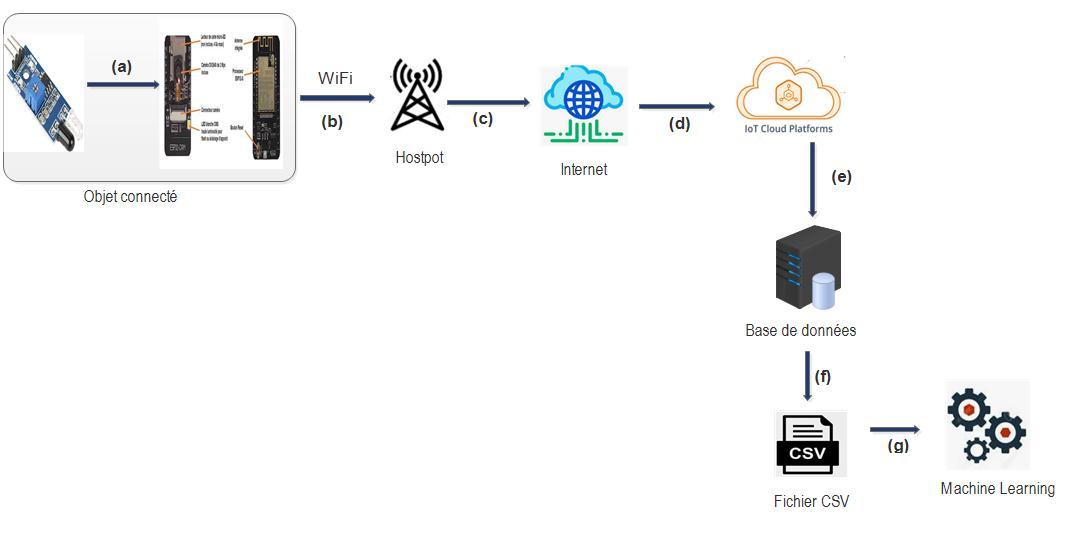
Physical sensors: Inductive loops, radars, cameras for traffic detection, an ESP32 for connectivity. (b), (c), and (d) Embedded IoT sensors (OBU) and fixed sensors (RSU): for vehicle-to-infrastructure communication. (e), (f), and (g) TrafficControlCenter(TCC):processinginterface,datacentralization,AIalgorithmexecution. Thisarchitecturefollowsan Edge-to-Cloudmodel,combiningedgeprocessing(EdgeAI)andcentralizedmodeling.
Description of dataset
ThedatasetusedcomesfromCSVfilesofroadtraffic,containing4,696roadsegmentsand24variables,including:
Geospatial variables:startandendcoordinatesofsegments(xD,yD,zD,xF,yF,zF);
Road signs:length,typeofroad,concessions,coordinates;
Target variable :AADT(AnnualAverageDailyTraffic);
In-depthdataengineeringwascarriedout: Typeconversion(fromstringstofloat).
Encodingcategoricalvariablesusing OneHotEncoder.
Creationofa 'Euclidean distance' featurebetweenstartandendpoints.
Removalofincompletedata.
The detailed architecture of the LSTM classification model [Van Houdt et al (2020)], optimized for high accuracy, is as follows: Input Layer: Input(shape=(N_STEPS, X_train_seq_class.shape[2])): Defines the shape of the input data, which aresequencesof N_STEPStimesteps, eachstephaving X_train_seq_class.shape[2] features.First LSTMLayer:LSTM(512, activation='relu', return_sequences=True): An LSTM layer with 512 units. The ReLU activation is used to introduce nonlinearity. return_sequences=True is crucial because the output of this layer is a sequence that will be passed to the next LSTM layer. First Batch Normalization Layer (BatchNormalization): BatchNormalization(): Normalizes the activations of the previous LSTM layer, which helps to stabilize and speed up the training of the deep network. First Dropout Layer: Dropout(0.5): Randomly disables 50% of the neurons in the previous layer during training. This reduces overfitting by preventingneuronsfromoverlyco-adapting.
Second LSTM Layer: LSTM (256, activation='relu', return_sequences=True): Another LSTM layer with 256 units. return_sequences=True is also used here. Second Batch Normalization Layer: BatchNormalization(): Normalization of activations.SecondDropoutLayer:Dropout(0.5):Randomlydisables50%oftheneurons.
Third LSTM Layer: LSTM (128, activation='relu'): A third LSTM layer with 128 units. return_sequences is omitted (or implicitlyFalse),whichmeansitonlyreturnsthefinaloutputofthesequence,notthefullsequence.
Third Batch Normalization Layer (BatchNormalization): BatchNormalization(): Normalization of activations. Third DropoutLayer:Dropout(0.4):Randomlydisables40%oftheneurons.FirstDenseLayer:Dense(128,activation='relu'):A
International Research Journal of Engineering and Technology (IRJET) e-ISSN: 2395-0056
Volume: 13 Issue: | June 2026 www.irjet.net p-ISSN: 2395-0072
fullyconnected(dense)layerwith128neuronsandReLUactivation.Itallowsthemodeltolearncomplexcombinationsof thefeaturesextractedbythepreviouslayers.
Fourth Batch Normalization Layer (BatchNormalization): BatchNormalization(): Normalization of activations. Fourth Dropout Layer: Dropout(0.3): Randomly disables 30% of the neurons. SecondDenseLayer:Dense(64,activation='relu'):Aseconddenselayerwith64neuronsandreluactivation.
Fifth Batch Normalization Layer: BatchNormalization(): Normalizes the activations. Fifth Dropout Layer: Dropout(0.2): Randomly disables 20% of the neurons. Output Layer: Dense(1, activation='sigmoid'): The final output layer. For binary classification, it has a single neuron and uses the sigmoid activation, which produces a probability between 0 and 1. A probabilityabove0.5isgenerallyinterpretedasthepositiveclass('high'traffic).
Thisdeeparchitectureandtheintegrationofregularizationtechniques(Dropout)andstabilization(BatchNormalization) aredesignedto allowthe model tolearncomplexpatternsinsequential data,whileminimizing the risk of overfitting, in ordertoachievehighaccuracy.
Fonctionnalités of the system
Le système intelligent de contrôle routier et d'orientation, basé sur l'approche méthodologique décrite, offre les fonctionnalitésprincipalessuivantes:
The intelligent road control and guidance system, based on the described methodological approach, offers the following mainfeatures:
1) Real-Time Data Collection: Infrared sensors are deployed along the Maison MTN-Governor Service axis to continuously collect data on vehicle volume, speed, and potentially their type. This raw data is transmitted by microcontrollers(ESP32CAM)throughIoTcommunicationtechnologies(Wi-Fi,cellular,LoRa)toacentralplatform.
2) Data Preprocessing and Storage: The received data undergoes a preprocessing pipeline (cleaning, type conversion, missingvalueimputation,temporalandspatialfeatureengineering,encoding,scaling).Thepreprocesseddataisthen storedinadatabasereadytobeusedbymachinelearningmodels.
3) PredictiveTrafficModeling:ADTPrediction:TheTrafficClassificationLSTMModel(BinaryClassification):TheLSTM classification model categorizes traffic in real-time into two states: 'high traffic' or 'low traffic.' This binary classificationisessentialforquickdecision-making
4) Decision-MakingandDynamicGuidance:Basedontrafficpredictionsandclassifications,thesystemcanrecommend actions to optimize flow. For example: Dynamic adjustment of traffic lights to prioritize certain flows. Suggestion of alternative routes for drivers via dynamic display signs or a mobile app. Alerts in case of imminent congestion or incidents.
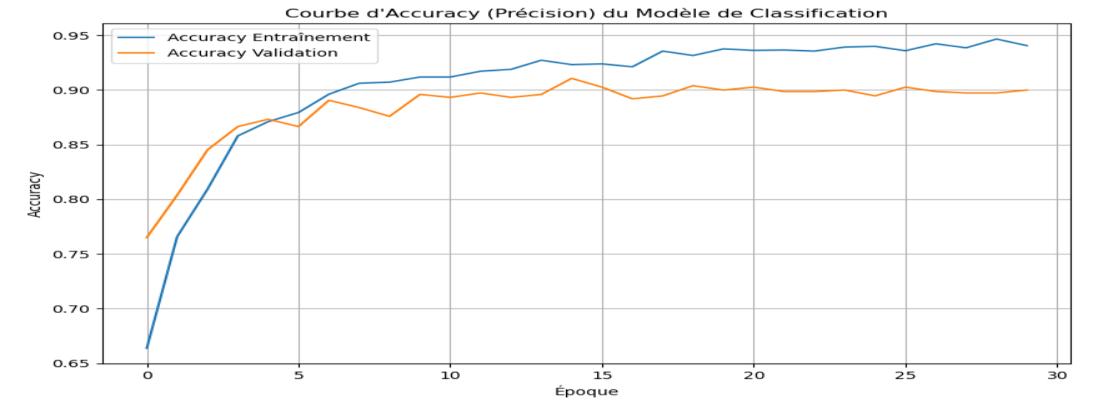
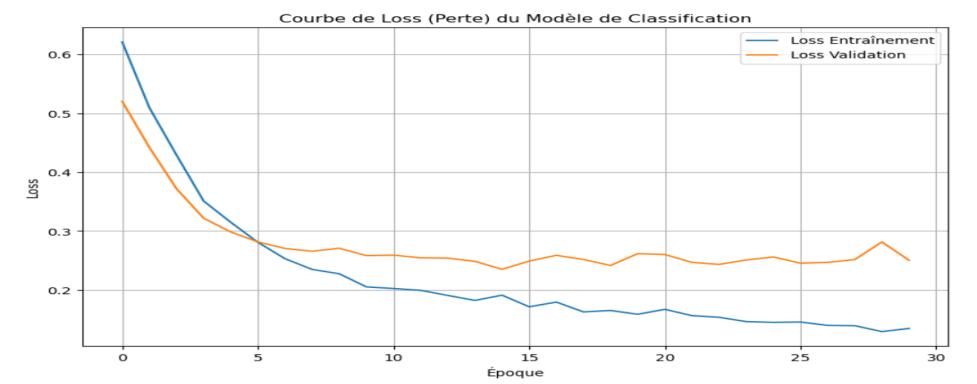
5) PerformanceMonitoringandReporting:Thesystemgeneratesregularreportsonmodelperformance(accuracy,F1Score,confusionmatrixforclassification; R²,MSE,MAEforregression).Visualizations(losscurves,accuracycurves) are produced to allow operators to monitor model health and identify the need for retraining or adjustment. 6. Class Imbalance Management: For classification, the system includes the ability to handle class imbalance by applying class weights during training, ensuring that the model does not bias its predictions toward the majority class.
Implemented models and processing Preliminary spectral analysis
The goal is to study AADT distributions through interpolation and spectral transformation. We obtained as results the frequencycurvesusefulforpeakdetectionandclasssegmentation.
Binary classification task
Predict whether the AADT value for a segment is above or below the median (supervised approach). The model used is LSTM with: One hidden layer, A sigmoid function at the output, 10-fold cross-validation for generalization, Split: 80% training/20%testing.
International Research Journal of Engineering and Technology (IRJET) e-ISSN: 2395-0056
Volume: 13 Issue: | June 2026 www.irjet.net p-ISSN: 2395-0072
Evaluation :Accuracy:92.43 %,F1-score:0.92,AUCROC:0.95
Real time visualization
Classification (traffic status)
Fortrafficstateclassification(e.g.,smooth,moderate,congested),theLSTMmodelhasalsoshownpromisingperformance. The learning curves illustrate convergence. The Confusion Matrix provides a detailed view of performance by class. (a) Trainingaccuracy(Classification).
International Research Journal of Engineering and Technology (IRJET) e-ISSN: 2395-0056
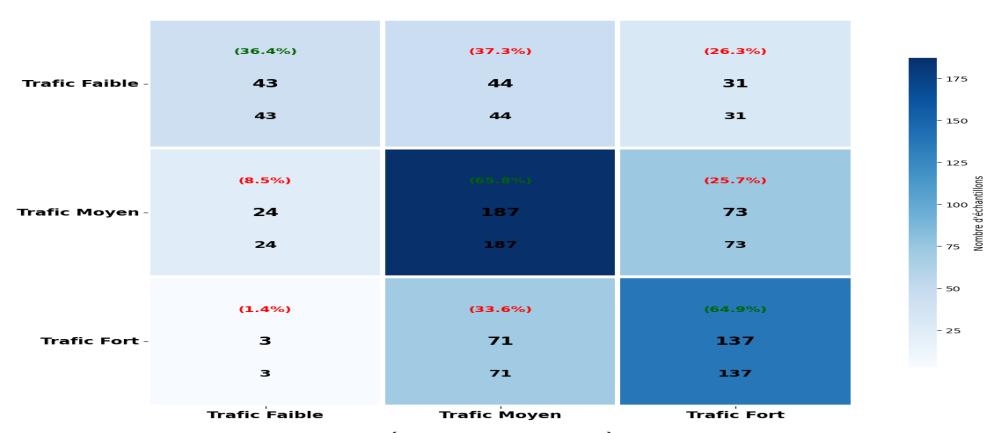
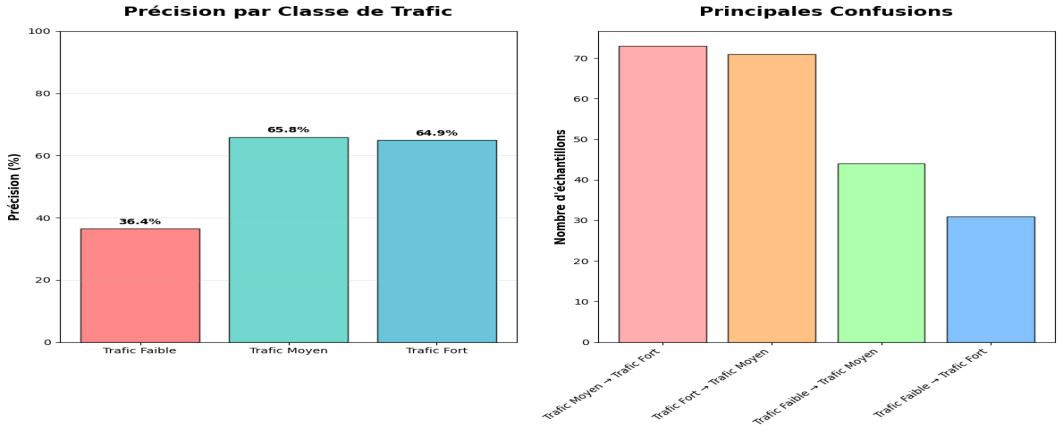
ThechoiceofLSTMforclassificationwasjustifiedbyitsabilitytolearncomplexpatternsintrafficdata and to providea reliableclassificationofcongestionstates.
DISCUSSIONS
References
FERHAT et MERABET 2025 Design, the simulation andtests Sensors, surveillance cameras and adaptive traffic lights Intelligent algorithms and computer vision models - Fragility of the Arduinoboard
Ruiz-Guirola 2024 Statisticalanalysis
Moumen et al. 2023 Edge sensors and ML/DL
ASTM2024 SimulationCARLA
Volume: 13 Issue: | June 2026 www.irjet.net p-ISSN: 2395-0072 © 2026, IRJET | Impact Factor
Campus Oulu MTC Fish/quasiperiodic Error<11 % No AI/prediction
UrbanEdgeIoT SVM,LSTM,etc. Greather to baselines
Simulated more images YOLOv5,LSTM +50 % flux, –70 % deadlines
Unspecified dataset
Simulations only
Bhatt et al. 2025 Digital twin plus... MLOps Historical plus real-time MLpredictif Architecture efficience Noprecision
Our Work (2025) AADT distributions via interpolation and spectraltransform CSV of road traffic
Interpretability
International Research Journal of Engineering and Technology (IRJET) e-ISSN: 2395-0056
Volume: 13 Issue: | June 2026 www.irjet.net p-ISSN: 2395-0072
Inadditiontothedatasetlimitationsmentionedearlier,thoseofthemodelsinclude: Generalization: Modelstrainedona specific area may not generalize well to other parts of the city with different traffic characteristics without retraining or morediversedata.
Complexity of Rare Events:
Models may have difficulty predicting or correctly classifying rare or unexpected traffic events (major accidents, largescalebreakdowns)duetotheirunderrepresentationinthetrainingdata.
Interpretability: Neural network models, although powerful, are often 'black boxes,' making it difficult to interpret the decisionsmadebythesystem.
Conclusion et perspectives
Thisarticlepresented the designandevaluationofan intelligentsystemforcontrollinganddirectingurbantrafficinthe cityofBertoua,relyingontheInternetofThingsandArtificialIntelligence.Wehavedemonstratedthesystem'scapability to collect real-time traffic data and to use neural network models (LSTM) for predicting traffic volume and classifying traffic conditions. The results obtained are encouraging and validate the relevance of this approach for alleviating road congestionandimprovingurbanmobility.
Intermsoffutureprospects,severalresearchanddevelopmentdirectionscanbeconsidered:
DeploymentExpansion;
IntegrationofHeterogeneousData;
AdvancedAIModels;
TrafficLightOptimization.
AlMalawi,H.(2024).Prédictiondutraficroutieràl'aidederéseauxlstm.JournaldelaModélisationduTrac,I(J).
BENSRHAIR, A. and VIENNEY, L. (2021). Applications des réseaux de neurones convolutifs en vision par ordinateur.Revued'IntelligenceArtificielle,M(N).
Boivin,J.(2024).Systèmesdenavigationintelligentspourvéhiculesautonomes.JournaldeRobotiqueetSystèmes Autonomes.
Chen, L., Zhang, Y., and Li, H. (2023). Deep learning models for short-term trafic ow prediction : A comparative study.TransportationResearchPartC:EmergingTechnologies,150:104040.
Dupont, P., Dubois, S., and Leroy, M. (2023). Optimisation des architectures iot pour la gestion du trafic urbain. IEEETransactionsonIntelligentTransportationSystems,24(5):45004510.
Garcia,M.,Rodriguez,A.,andPerez,E.(2023).Computervisionanddeeplearningforvehicledetectionandtra c densityestimation.ExpertSystemswithApplications,211:118580.
Idriss Moumen, Jaafar Abouchabaka, Najat Rafalia (2023). Enhancing Urban Mobility: Integration of IoT Road TrafficDataandAI. Départementd'informatique,FacultédesSciences,UniversitéIbnTofail,Kenitra,Maroc
KARA,N.(2017).Systèmesintelligentsbaséssurl'iotpourlagestiondesdéchets.Conférencesurl'IoTetlesVilles Intelligentes.
International Research Journal of Engineering and Technology (IRJET) e-ISSN: 2395-0056
Volume: 13 Issue: | June 2026 www.irjet.net p-ISSN: 2395-0072
Martin, C. and Petit, F. (2024). Évaluation comparative des technologies lpwan pour la surveillance du tra c en temps réel. Sensors, 24(1) :123135. [Mouhoub and et al., 2015] Mouhoub, M. and et al. (2015). Architecture de l'internetdesobjets:Unerevue.Journaldel'IoT.
Roxin, F. and Bouchereau, E. (2017). L'internet des objets : Enjeux et perspectives. Revue des Sciences et Technologiesdel'Information,X(Y):ZW.
VanHoudtetal(2020).VanHoudt,G.;Mosquera,C.;Napoles,G.AReviewontheLongShort-TermMemoryModel. Artif.Intell.
Thiam,M.(2023).Plateformesiotpourlesvillesintelligentes.ConférencesurlesTechnologiesUrbaines,E(F).
Wang, X. and Li, J. (2022). Spatio-temporal tra c prediction using cnn-lstm networks. Journal of Transportation Engineering,PartA:Systems,148(10):04022071.
Bhattetal.(2025).ArchitectingDigitalTwinsforIntelligentTransportationSystems
© 2026, IRJET | Impact Factor value: 8.315 | ISO 9001:2008 Certified Journal | Page546