
International Research Journal of Engineering and Technology (IRJET) e-ISSN: 2395-0056
Volume: 13 Issue: 04 | Apr 2026 www.irjet.net p-ISSN: 2395-0072

International Research Journal of Engineering and Technology (IRJET) e-ISSN: 2395-0056
Volume: 13 Issue: 04 | Apr 2026 www.irjet.net p-ISSN: 2395-0072
Dr. Sandeep Kulkarni1,Sheerssh Bhatnagar 1, Aryan Joshi 2, Rohit Jongra3, Ajeenkya D Y Patil
AssistantProfessor,DepartmentofComputerScience,Pune,MaharashtraUniversity Lohgaon,AirportRd,CharholiBudruk,Pune,Maharashtra
1.1 Abstract- Artificial Intelligence (AI) has significantly transformed human–computer interaction, particularly through the development of conversational agents such as chatbots. This research presents the design and development of Intellichat, a web-based AI-powered chatbot that provides intelligent and context-aware responses using modern web technologies and large languagemodel(LLM)APIs.Thesystemisdevelopedusing HTML, CSS, and JavaScript for the frontend interface and Python Flask for backend processing and server-side communication. To enable dynamic and human-like conversations, the chatbot integrates with the Groq API, which provides access to advanced AI language models capable of generating real-time responses based on user input.
Unlike traditional rule-based chatbots that rely on predefined responses, Intellichat utilizes AI-driven natural language processing techniques to interpret user queries and generate meaningful responses dynamically. The system follows a client–server architecture, where the frontend interface communicates with the backend server through RESTful APIs using JSON-based data exchange. Asynchronouscommunicationmechanismsallowreal-time message processing without requiring webpage refreshes, ensuringasmoothconversationalexperience.
The development process follows the Software Development Life Cycle (SDLC) using the Waterfall model, including requirement analysis, system design, implementation, testing, and deployment. Functional and performance testing confirmed reliable communication between system components and consistent response generation through the AI API. The results demonstrate that integrating lightweight web frameworks with AIbasedAPIscaneffectivelycreateintelligentconversational systems without requiring complex machine learning infrastructure.
The proposed system highlights the practical integration of web development and artificial intelligence for building interactive applications. Future enhancements may include database integration for chat history, user authentication, multilingual support, voice-based interaction, and cloud deployment to improve scalability andaccessibility.
Keywords: Artificial Intelligence, Chatbot, Flask, Large Language Models, Web Application, Natural Language Processing.
Artificial Intelligence (AI) has significantly transformed thewayhumansinteractwithmachines.Oneofthemost widely used applications of AI today is the chatbot, an automatedsoftwaresystemdesignedtosimulatehumanlike conversations. Chatbots are increasingly being used inareassuchascustomersupport,education,healthcare, and information services, as they allow users to communicate naturally and receive instant responses without human intervention. With rapid advancements in Natural Language Processing (NLP), machine learning, and cloud-based AI services, modern chatbots are now capable of understanding user queries, generating meaningful responses, and maintaining contextualconversations.
Traditional chatbots were primarily rule-based systems that relied on predefined responses and decision trees. While these systems were useful for simple tasks, they lacked the ability to understand complex queries or provide dynamic responses. As a result, their usability was limited in real-world scenarios where user input could vary significantly. The emergence of AI-powered language models and APIs has made it possible to build more intelligent chatbots that can interpret natural language and generate context-aware responses in real time.
This project, Intellichat, is a web-based AI chatbot developed using HTML, CSS, and JavaScript for the frontend interface and Python Flask for the backend server. The chatbot integrates with the Groq API, which provides access to powerful AI models capable of generating intelligent and human-like responses. Unlike traditional rule-based chatbots, Intellichat leverages AI toanalyzeuserinputandproducedynamicrepliesbased oncontextandconversationflow.
The main objective of this project is to develop a lightweight, efficient, and easy-to-deploy chatbot system that demonstrates the practical integration of modern web technologies with artificial intelligence. The project highlights the complete development lifecycle, including
-0056
Volume: 13 Issue: 04 | Apr 2026 www.irjet.net p-ISSN: 2395-0072
user interface design, backend routing, API communication, and real-time message processing. The system is designed to provide a clean and responsive interfacethat enablesseamlesscommunication between theuserandthechatbot.
Furthermore, this project helps in understanding key concepts such as RESTful APIs, client-server architecture, and AI-based response generation. By implementingIntellichat,thestudydemonstrateshowAI services can be effectively integrated into web applicationstocreateinteractiveandintelligentsystems. The project also opens possibilities for future enhancements such as database integration for chat history, user authentication, multilingual capabilities, voice-based interaction, and cloud deployment to improvescalabilityandaccessibility.
Tool / Concept Description
ELIZA(1966) Firstrule-basedchatbot
Dialogflow&Watson ModernNLPframeworks
Flask(Python) Lightweight backend framework
GroqAPI AItext-generationAPI
Chatbotshaveevolvedsignificantlyduetoadvancements in Artificial Intelligence (AI), Natural Language Processing (NLP), and machine learning technologies. Early chatbot systems such as ELIZA and ALICE were primarily based on pattern-matching techniques and predefined responses. These rule-based systems were able to simulate simple conversations but lacked the capability to understand the semantic meaning of user queries or generate dynamic responses. As research in artificial intelligence progressed, more advanced conversational systems were developed that used machine learning techniques to improve interaction qualityandresponseaccuracy[1],[9].
Recent studies highlight the transition from rule-based systems to intelligent conversational agents that utilize deep learning models and natural language processing techniques. According to Adamopoulou and Moussiades, modern chatbots are capable of understanding user input and generating context-aware responses using machine learning models and NLP algorithms [1]. Similarly, advances in large language models such as transformer-based architectures have significantly improved the ability of chatbots to generate human-like responsesinrealtime[5],[7].
Thedevelopmentoftransformer-basedmodelsanddeep learning architectures has played a crucial role in improving conversational AI systems. Research on transformer models demonstrates how attention mechanisms enablesystemstoprocesslanguagecontext more effectively, which is essential for chatbot response generation [4]. Additionally, modern conversational systemsrelyonpretrainedlanguagemodelssuchasGPT andBERT,whicharetrainedonlargedatasetstoimprove theirunderstandingoflanguagepatternsandcontext[5], [8].
Furthermore,conversational AIsystems are increasingly beingintegratedintowebapplicationsthroughAPIsand cloud-based services. RESTful APIs enable seamless communication between frontend applications and AI models, allowing developers to implement chatbot systems without building complex machine learning models from scratch [12]. Backend frameworks such as Flask are widely used to manage API communication, routing, and request processing in web-based applications[13].
The development of intelligent conversational systems also requires proper software engineering practices and human–computer interaction principles to ensure usability and system reliability. Studies in human–computer interaction highlight the importance of userfriendly interfaces for effective communication between humans and AI systems [16]. Similarly, software engineering methodologies such as the Software Development Life Cycle (SDLC) provide structured approaches for designing, implementing, and testing intelligentsystems[17].
Many existing chatbot systems face significant limitations that make them either too simplistic or too complex to implement in practical applications. Basic rule-based chatbots rely heavily on predefined patterns and scripted responses, which restrict their ability to understand natural language or generate meaningful responses beyond programmed rules. These systems often fail to handle diverse user queries and provide limitedconversationalcapabilities[1].
On the other hand, modern AI-powered chatbots are capable of generating highly intelligent responses but usually require complex infrastructure, advanced machine learning frameworks, and high computational resources. The development and deployment of such systemsofteninvolvespecializedhardwaresuchasGPUs and extensive knowledge of deep learning models [9], [10]. As a result, these solutions may not be easily accessible for students, beginners, or small-scale developers who wish to explore AI-based chatbot technologies.
Volume: 13 Issue: 04 | Apr 2026 www.irjet.net
The rapid growth of large language models and conversational AI technologies has created new opportunities for building intelligent systems that can simulate human-like conversations. Research on conversational AI indicates that integrating language models with web technologies can significantly improve theefficiencyandusabilityofchatbotsystems[2],[3].
Therefore, there is a need to develop a chatbot system that balances simplicity, efficiency, and intelligence. By integrating modern AI APIs with lightweight web frameworks such as Flask, it is possible to create conversational systems that provide intelligent responseswithoutrequiringcomplexinfrastructure[13]. Such systems can serve as practical learning tools and demonstratehowartificialintelligencecanbeintegrated into real-world applications using modern web technologies.
Objective 1: Develop a Responsive and User-Friendly ChatInterface
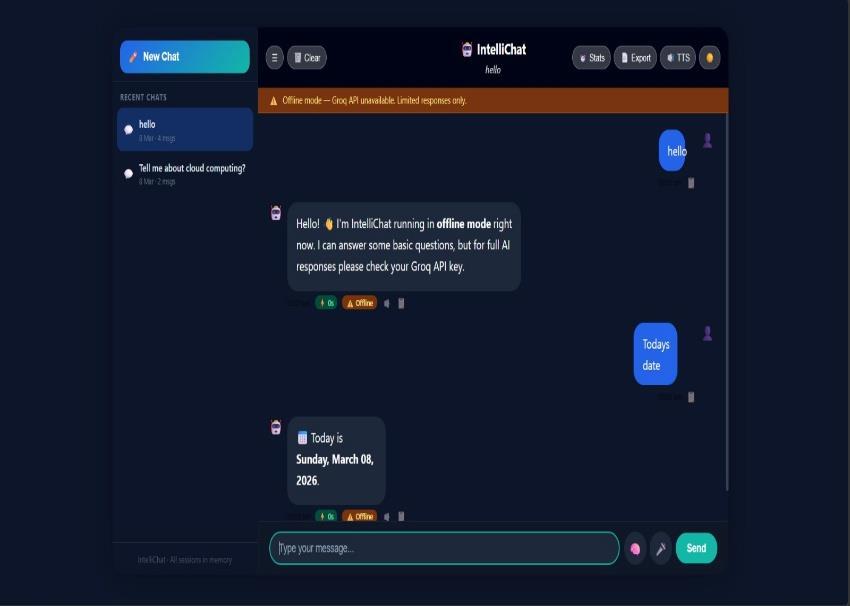
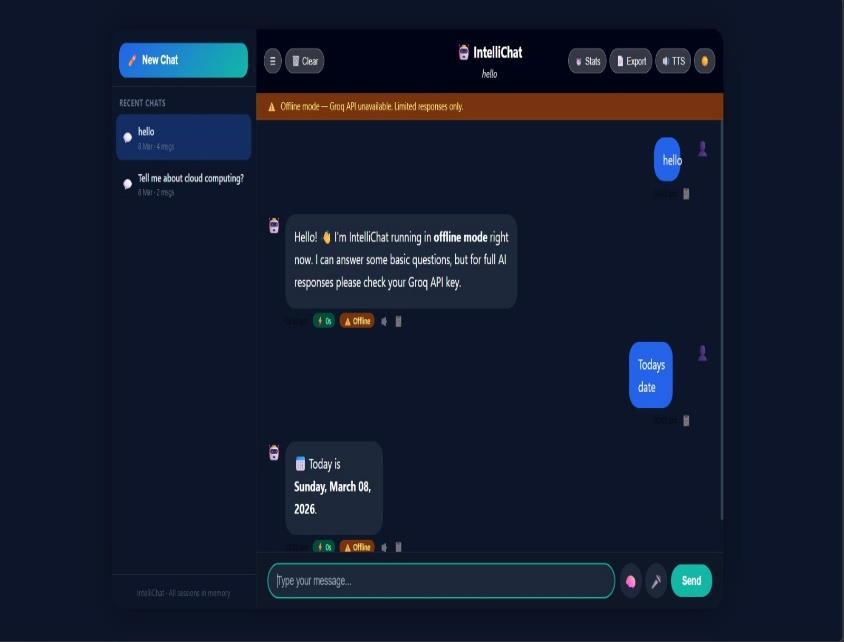
One of the main objectives of this project is to design a clean, intuitive, and responsive chat interface using HTML, CSS, and JavaScript. The interface allows users to easily type messages, send queries, and view chatbot responses in a structured conversation format. A responsive layout ensures that the chatbot works smoothly on different devices such as desktops, tablets, and mobile screens. A well-designed user interface improves usability and ensures that even non-technical userscaninteractwiththechatbotcomfortably.
Objective 2: IntegratePythonFlaskandRESTAPIfor BackendProcessing
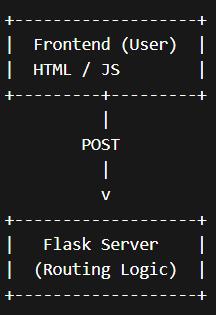
Another objective is to implement Python Flask as the backend framework to handle server-side operations. Flask manages routing, processes user requests, and enablescommunicationbetweenthefrontendandtheAI service.TheprojectusesRESTAPIconceptssuchasGET and POST methods to transfer data between the client and the server. This demonstrates how modern web applicationsuseAPIstoexchangeinformationefficiently andreliably.
BackendProcessingDiagram
Objective 3: IntegrateGroqAPIforAI-BasedDynamic Responses
A key objective of the project is to connect the backend server with the Groq API, which acts as the intelligence
International Research Journal of Engineering and Technology (IRJET) e-ISSN: 2395-0056
Volume: 13 Issue: 04 | Apr 2026 www.irjet.net p-ISSN: 2395-0072
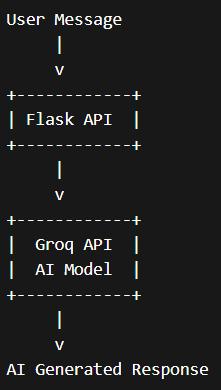
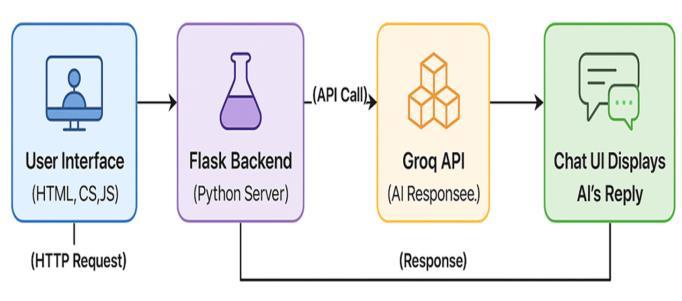
engine of the chatbot. The Flask server sends the user's message to the AI model through the API and receives a dynamically generated response. This integration allows the chatbot to understand the context of user queries and produce human-like answers instead of relying on fixedresponses.
AIResponseGenerationDiagram
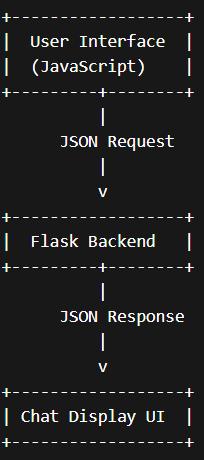
Objective 4: EnableSeamlessDataFlowBetween FrontendandBackend
For real-time chatbot interaction, the system must ensure smooth communication between JavaScript (frontend)andFlask(backend).Thisobjectivefocuseson transferring data using JSON format and asynchronous communication methods such as fetch() or AJAX. Efficient data exchange ensures that messages are processed quickly and responses appear instantly withoutrefreshingthewebpage.
DataFlowArchitecture
Objective 5:DemonstratetheCompleteSoftware DevelopmentLifecycle(SDLC)
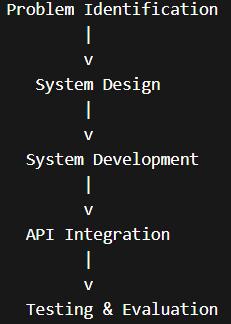
The project also aims to demonstrate a structured Software Development Lifecycle (SDLC) for building an AI-based system. The development process includes requirement analysis, system design, implementation, testing, deployment, and maintenance. Following these phases ensures that the chatbot system is built systematically and reflects real-world software engineeringpractices.
SDLCDiagram
Objective 6: BuildaLightweightandEfficientAIChatbot
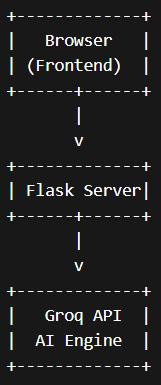
The final objective is to develop a chatbot that is lightweight, efficient, and easy to deploy. The system should be able to run on a local machine without requiring expensive hardware or complicated infrastructure. By using simple technologies such as Flask and external AI APIs, the chatbot remains accessibleforstudents,developers,andresearchers.This makes Intellichat useful for learning purposes, experimentation with AI services, and basic automation tasks.
LightweightSystemArchitecture
Volume: 13 Issue: 04 | Apr 2026 www.irjet.net
The research methodology used in this study focuses on the design, development, and evaluation of a web-based AI chatbot system named Intellichat. The methodology follows a development-oriented research approach where thechatbotsystem isimplementedusing modern web technologies and integrated with an AI inference engine to generate conversational responses. Artificial intelligence techniques and natural language processing methods are used to enable the chatbot to understand userqueriesandproducerelevantresponses[9].
The development process follows standard software engineeringpracticestoensureastructuredapproachto system implementation. According to software engineering principles, the development of intelligent systems should follow a systematic lifecycle including requirement analysis, system design, implementation, testing, and deployment [17]. This approach helps ensure that the system is reliable, scalable, and easy to maintain.
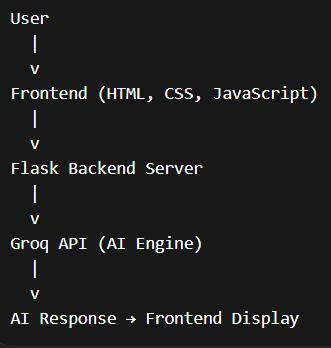
The system architecture is based on a client–server model where the user interacts with a web-based interface that communicates with a backend server. The backend server processes user requests and communicateswithanAIenginethroughRESTfulAPIsto generate responses [12]. Flask is used as the backend frameworkbecauseitprovidesalightweightandflexible environment for building web applications and managingAPIrequestsefficiently[13].
Additionally, the system follows human–computer interactionprinciplestoensurethatthechatbotinterface is simple and user-friendly. A well-designed interface improves the overall user experience and facilitates effective communication between the user and the AI system[16].
This research follows a development-based and experimental research design focused on the design, implementation, and evaluation of a web-based AI chatbot named Intellichat. The study emphasizes practical system development and real-time AI integration rather than theoretical model training. The objective is to demonstrate how modern web technologies and AI APIs can be combined to build an intelligent conversational system capable of generating dynamicresponses.
The research design includes several key stages such as system planning, interface development, backend implementation, API integration, and functional testing. During the development phase, the chatbot interface is created using HTML, CSS, and JavaScript, while Python
Flask is used as the backend framework to manage requests and server-side operations. The system integrates with the Groq API to generate intelligent responsesbasedonuserqueries.
After development, the system is tested to evaluate its functionality, response accuracy, and communication efficiency. The research design therefore focuses on demonstrating a complete working prototype that highlights the integration of frontend technologies, backend processing, and AI-based response generation withinasingleapplication.
The study adopts a qualitative and applied research approach to analyze the performance and functionality of the chatbot system. Instead of focusing on large-scale quantitative data or statistical analysis, the research evaluatesthechatbotbasedonitspracticalbehaviorand responsegenerationcapabilities.The evaluation process includes observing how the system processes user queries, generates responses through the AI API, and maintains smooth interaction between the frontend and backendcomponents.
Controlled testing is performed by providing various user inputs to the chatbot and analyzing the responses generated by the system. The performance is assessed based on factors such as response relevance, conversational flow, system stability, and real-time communication efficiency. This approach allows the researcher to examine the overall effectiveness of the chatbot in simulating human-like conversations while maintainingreliablesystemperformance.
International Research Journal of Engineering and Technology (IRJET)
-ISSN: 2395-0056
Volume: 13 Issue: 04 | Apr 2026 www.irjet.net p-ISSN: 2395-0072
Additionally, the applied research method focuses on demonstrating the practical implementation of modern web technologies and AI integration. By developing and testing Intellichat as a working system, the research highlights how lightweight frameworks and external AI services can be combined to create intelligent conversationalapplicationssuitableforreal-worldusage andfurtherexperimentation.
The development of Intellichat follows the Waterfall Model of the Software Development Life Cycle (SDLC) to ensure a structured and systematic development process. The Waterfall model divides the development process into sequential phases, where each phase must be completed before moving to the next stage. This approach helps maintain clarity in system design, implementation,andtesting.
Waterfall Development Model
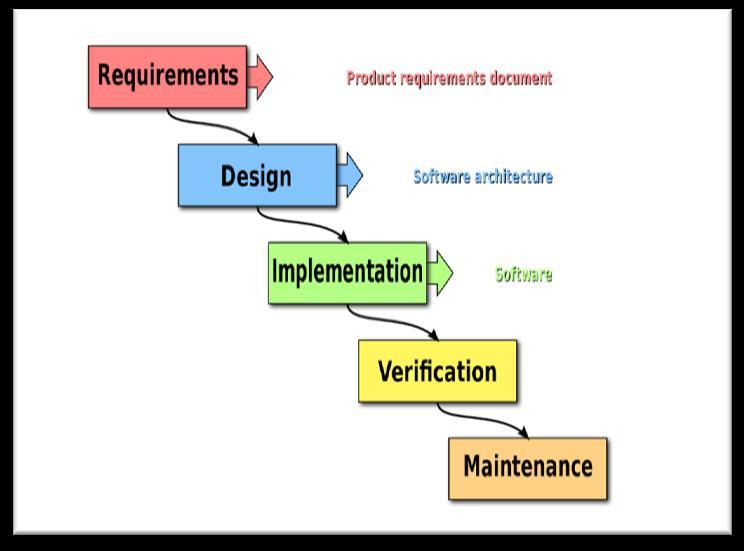
In this phase, both functional and non-functional requirements of the chatbot system were identified. Functional requirements define what the system should do, while non-functional requirements define performance,usability,andsystemreliability.
ThekeyrequirementsidentifiedforIntellichatinclude:
A user-friendly chat interface that allows userstosendmessageseasily.
Real-time message exchange betweentheuser andthechatbot.
AI-based dynamic response generation using amodernlanguagemodel.
Secure API communication between the backendandtheAIservice.
Smooth communication between the frontend and backend usingRESTAPIs.
During thesystem design phase,theoverall architecture ofthe chatbotsystem was defined. The system follows a client–server architecture, where the frontend interacts with the backend server, which in turn communicates withtheAIservice.
The frontend interface was designed using HTML, CSS, and JavaScript to provide an interactive and responsive chat environment. The backend was designed using Python Flask, which manages routing, request processing,andcommunicationwiththeAIengine.
REST API endpoints were created to handle chat requests, and JSON was selected as the data exchange formatduetoitslightweightstructureandcompatibility withwebtechnologies.
SystemArchitectureDiagram
In the implementation phase, the system components were developed according to the design specifications. The frontend interface was built using HTML, CSS, and JavaScript, allowing users to enter messages and view chatbotresponsesinaconversationalformat.
The backend was developed using Python Flask, which handles user requests, processes incoming messages,
Volume: 13 Issue: 04 | Apr 2026 www.irjet.net
and communicates with the Groq API. When a user submits a message, the backend sends the query to the Groq API, which generates a context-aware response usingalargelanguagemodel.
To ensure smooth user interaction, asynchronous JavaScript techniques such as fetch() and async/await were implemented. This allows the chatbot to send and receive data without reloading the webpage, enabling real-time communication between the user and the system.
4.4. Testing
Testingwasperformedtoensurethatthechatbotsystem operates reliably and produces correct responses. Differenttypesoftestingmethodswereappliedtoverify systemfunctionalityandstability.
Functional Testing: Verifiedthatusermessages are correctly sent to the backend and that responsesaredisplayedproperly.
API Testing: Ensuredsuccessfulcommunication betweentheFlaskbackendandtheGroqAPI.
User Interface Testing: Checked the responsiveness and layout of the chat interface acrossdifferentscreensizes.
Error Handling Testing: Tested the system’s behaviorwheninvalidinputisprovidedorwhen APIcommunicationfails.
Aftersuccessfultesting,thechatbotsystemwasdeployed onalocalFlaskserverfordemonstrationandevaluation purposes. Running the application locally allows developerstotestsystemfunctionalitywithoutrequiring externalhostingservices.
Forfuturescalability,potentialclouddeploymentoptions such as hosting on cloud platforms or web servers were also considered. Cloud deployment would allow the chatbot to be accessed remotely and support a larger numberofusers.
4.6.
Maintenance activities focus on improving system performance and ensuring long-term reliability. After deployment, the chatbot interface was refined to improveusabilityandresponsespeed.
Futuremaintenanceplansincludeintegratingadatabase system to store chat history, implementing user authentication features, and optimizing the system for betterscalabilityandperformance.
4.7.
Category Tools/Technologies
Frontend Html,Css,Javascript
Backend PythonFlask,Langchain
AI API GroqAPI
Editor VisualStudioCode
Testing Tool Postman
Version Control Git&Github
Database Mongodb,Chromadb
5.
In this research, no pre-existing dataset was used for training or evaluation. Instead, data was generated dynamicallyduringtheinteractionbetweentheuserand thechatbotsystem.Thechatbotreceivesinputmessages directlyfromusersthrough thewebinterface,andthese inputsareprocessedbythebackendserver.
Thecollecteddataprimarilyconsistsoftwocomponents: user input messages and AI-generated responses produced by the Groq API. Whenever a user sends a query, the message is transmitted to the Flask backend, which forwards the request to the Groq API. The AI model then generates a context-aware response that is returned to the user interface. This interaction process creates conversational data dynamically during system usage.
The data used for evaluation in this study was obtained throughcontrolledtestingsessionswheremultipletypes of queries were submitted to the chatbot. These queries included general questions, informational requests, and conversational prompts to observe how the chatbot responds in different scenarios. The system’s responses were then observed and analysed to evaluate the chatbot’s response quality, communication flow, and systemstability.
This method of dynamic data generation allows the system to demonstrate real-time AI capabilities without relyingonpredefineddatasets.Italsoreflectsreal-world usage where chatbot interactions are generated through liveuserconversationsratherthanstaticdatasources.
Volume: 13 Issue: 04 | Apr 2026 www.irjet.net p-ISSN: 2395-0072
The Intellichat system was successfully developed and tested as a functional web-based AI chatbot. The system demonstrated smooth communication between the frontendinterface,thebackendserver,andtheAIengine through the Groq API. During testing, the chatbot was abletoreceiveusermessages,processthemthroughthe Flask backend,and generate context-aware responses in realtime.
The user interface performed efficiently across different screensizes,confirmingtheresponsivenessoftheHTML, CSS, and JavaScript design. The asynchronous communication between the frontend and backend allowed messages to be exchanged without refreshing the webpage, resulting in a smooth conversational experience.
Testing results showed that the chatbot could handle various types of user queries including general questions, informational requests, and conversational prompts. The Groq API successfully generated meaningful responses based on the context of the user’s message. The average response time during testing remainedwithinanacceptablerange,demonstratingthe efficiencyofthesystemarchitecture.
Overall, the testing phase confirmed that the integration of modern web technologies with AI APIs can successfullyproduceanintelligentconversationalsystem capableofreal-timeinteraction.
7. Discussion
The development of Intellichat demonstrates how modern artificial intelligence technologies can be integrated with web-based systems to create intelligent conversational applications. Advances in natural language processing and large language models have significantlyimprovedtheabilityofchatbotstogenerate meaningfulandcontext-awareresponses[5],[7].
Thearchitectureimplementedinthisresearchcombines a web-based frontend with a Flask backend server and anAIinference engine. Thisapproachallowsdevelopers to build intelligent chatbot systems without directly training complex machine learning models. Instead, the system relies on external AI services that provide powerful language models capable of generating conversationalresponses[2],[3].
From a software engineering perspective, the use of structured development methodologies such as the Software Development Life Cycle helps ensure that the systemisdesignedandimplementedsystematically.This improves the reliability and maintainability of the applicationandsupportsfutureenhancements[17].
Furthermore, the integration of RESTful APIs and JSONbased communication enables efficient data exchange between system components. Such architecture is commonly used in modern web applications because it supportsscalabilityandmodulardevelopment[12],[14].
This research presented the design and development of Intellichat, a web-based AI chatbot that integrates modern web technologies with artificial intelligence services. The system was developed using HTML, CSS, and JavaScript for the frontend interface and Python Flask for the backend server. The Groq API was used as the AI engine to generate dynamic and context-aware responses.
The project successfully demonstrated how a full-stack application can be built to support real-time conversational interaction. Through the implementation of REST APIs, asynchronous communication, and AI integration,thechatbotwasabletoprocessuserqueries andgeneratemeaningfulresponsesefficiently.
The research highlights the importance of combining lightweight development frameworks with powerful AI APIs to create intelligent systems without requiring extensive computational resources. The results show that the Intellichat system performs reliably and providesauser-friendlyconversationalexperience.
In addition to demonstrating practical chatbot development, the project also contributes to understanding key concepts such as client-server architecture,RESTfulcommunication,AIAPIintegration, and real-time data exchange. These concepts are essentialforbuildingmodernAI-drivenapplications.
Future improvements may include database integration for storing chat history, user authentication features, multilingual capabilities, voice-based interaction, and cloud deployment to enhance scalability and accessibility.
9. References
[1] E. Adamopoulou and L. Moussiades, “Chatbots: History, technology, and applications,” Machine Learning withApplications,vol.2,2020.
[2]J.Dale,“GPT-3:What’sitgoodfor?”NaturalLanguage Engineering,vol.27,no.1,pp.113–118,2021.
[3] D. Jurafsky and J. H. Martin, Speech and Language Processing,3rded.,Pearson,2021.
[4]A.Vaswanietal.,“Attentionisallyouneed,”Advances inNeuralInformationProcessingSystems,2017.
International Research Journal of Engineering and Technology (IRJET) e-ISSN: 2395-0056
Volume: 13 Issue: 04 | Apr 2026 www.irjet.net p-ISSN: 2395-0072
[5] T. Brown et al., “Language models are few-shot learners,” Advances in Neural Information Processing Systems,2020.
[6]A.Radfordetal.,“Languagemodelsareunsupervised multitasklearners,”OpenAIResearchReport,2019.
[7] Y. Zhang, S. Sun, and J. Galley, “DialoGPT: Large-scale generative pre-training for conversational response generation,”ACLConference,2020.
[8] J. Devlin, M. Chang, K. Lee, and K. Toutanova, “BERT: Pre-training of deep bidirectional transformers for languageunderstanding,”NAACL,2019.
[9] S. Russell and P. Norvig, Artificial Intelligence: A ModernApproach,4thed.,Pearson,2021.
[10] M. Wooldridge, Artificial Intelligence Basics, Routledge,2021.
[11] M. Fowler, Patterns of Enterprise Application Architecture,Addison-Wesley,2020.
[12] L. Richardson and S. Ruby, RESTful Web Services, O’ReillyMedia,2020.
[13] M. Grinberg, Flask Web Development: Developing WebApplicationswithPython,O’ReillyMedia,2022.
[14] D. Crockford, “The application/json media type for JavaScriptObjectNotation(JSON),”RFC4627,2020.
[15] K. K. Patel and S. M. Patel, “Internet of Things-IOT: Definition, characteristics, architecture, enabling technologies,” International Journal of Engineering Science,2020.
[16] A. Dix, J. Finlay, G. Abowd, and R. Beale, Human–ComputerInteraction,4thed.,Pearson,2020.
[17] I. Sommerville, Software Engineering, 10th ed., Pearson,2020.
[18] M. L. Scott, Programming Language Pragmatics, MorganKaufmann,2020.
[19] Y. LeCun, Y. Bengio, and G. Hinton, “Deep learning,” Nature,vol.521,pp.436–444,2015.
[20] J. Balakrishnan and Y. K. Dwivedi, “Conversational commerce: entering the nextstageofAI-powereddigital assistants,”AnnalsofOperationsResearch,2024.