
International Research Journal of Engineering and Technology (IRJET) e-ISSN: 2395-0056
Volume: 13Issue: 05| May 2026 www.irjet.net p-ISSN: 2395-0072
International Research Journal of Engineering and Technology (IRJET) e-ISSN: 2395-0056
Volume: 13Issue: 05| May 2026 www.irjet.net p-ISSN: 2395-0072
1Tejas D. Fegade, 2Sahil R. Shaikh, 3Akash C. Kharat, 4Prof. Khatal Kavita
1234Dept. of Computer Engineering Sahyadri Valley College of Engineering and Technology Junnar, India
Abstract - Rural farming communities in India continue to face significant challenges in accessing digital agricultural services due to intermittent or absent internet connectivity. Whileweb-basedplatformshavedemonstratedeffectivenessin streamlining equipment rental operations, their reliance on continuous network access renders them impractical for a largesegment ofruralfarmers.Thispaperproposesthedesign of a mobile-first agricultural equipment rental application built onanoffline-first architecturalframework, enablingfull Operationalcapabilityunderzero-connectivityconditions.The proposed system employs Flutter as the cross-platform development framework and integrates a local SQLite database for offline data persistence, ensuring uninterrupted access toequipment listings,bookingrecords,anduserprofiles without requiring active network connectivity. A background synchronization mechanism is designed to reconcile locally stored data with the remote server upon connectivity restoration, maintaining consistency across distributed data instances. The application further incorporates multilingual Interfaces for Hindi and Marathi languages to address languageaccessibilitybarriers prevalent amongnon-Englishspeaking farming communities. Firebase Cloud Messaging is adopted for push notification delivery, and role-based access control differentiates functionalities for farmers, equipment owners, and administrators. This paper presents the system Architecture, module design, database schema synchronization protocol, and a comprehensive evaluation framework proposed for validating system performance, usability, and offline reliability upon implementation.
Key Words: Mobile Application, Offline-First Architecture, Flutter, SQLite, Agricultural Equipment Rental, Rural Connectivity, Smart Agriculture, Multilingual Support, Data Synchronization, DigitalFarming
Agricultureconstitutestheprimarysourceoflivelihoodfor ap-proximately58%ofIndia’sruralpopulation,withsmall holder and marginal farmers representing the most economically vulnerable segment of the agricultural workforce[2].Despiteremarkableadvancementsinmobile technology and digital agricultural services over the past decade, practical adoption of these tools among rural farming communities remains disproportionately low. A fundamental barriertothisadoption istheunreliableand often absent internet infrastructure in remote agrarian regions, particularly in semi-arid and hilly ones of
Maharashtra,MadhyaPradesh,andRajasthanwherefarming activitiesareconcentratedandnetworkcoverageislimited [3].Agricultural equipment rental represents a financially viable and increasingly popular strategy for farmers who cannot sustain the capital expenditure associated with purchasing and maintaining advanced machinery such as tractors, harvesters, and irrigation systems. A preceding workbytheauthorsintroducedaweb-basedFarmingRental Equipment Services platform that demonstrated effective digitization of the rental workflow for farmers with consistent internet access [1]. However, that platform’s fundamental dependency on continuous network connectivitywasidentifiedasacriticallimitation,effectively excluding the very demographic rural, low- connectivity farmers that stands to benefit most from digital rental services.Thispaperaddressesthatlimitationbyproposinga mobile-first application that adopts an offline-first architectural philosophy. Rather than treating network unavailability as an error condition, the proposed system treats offline operation as the default state and network connectivity as an enhancement. This inversion of the conventional online-first assumption ensures that core applicationfunctionalitiesremainfullyaccessibleregardless ofnetworkstatus;therebyextendingthepracticalreachof digitalagriculturalservicestopreviouslyunderservedrural communities.
Theprimarycontributionsofthispaperare:
•Acomprehensiveoffline-firstmobilearchitecturedesign UsingFlutterandSQLitespecificallytailoredforagricultural equipmentrentalservicesinruralIndia.
•Aconflict-awarebackgrounddatasynchronizationprotocol forreconcilinglocalandremoterecordsuponnetwork Restoration
•AmultilingualinterfacedesignsupportingHindiand Marathilanguagestoenhanceaccessibilityfornon-Englishspeakingfarmers.
•Arole-basedaccesscontrolframeworksupportingfarmer, Equipmentownerandadministratoruserclasses.
•Astructuredevaluationframeworkforvalidatingoffline Reliability,synchronizationperformance,andmultilingual Usabilityuponfullsystemimplementation.
Theremainderofthispaperisorganizedasfollows:Section IIreviewsrelatedliterature,SectionIIIpresentsthe Proposed system architecture, Section IV describes the design methodology; Section V outlines the proposed evaluation
International Research Journal of Engineering and Technology (IRJET) e-ISSN: 2395-0056
Volume: 13Issue: 05| May 2026 www.irjet.net p-ISSN: 2395-0072
FrameworkandSectionVIconcludeswithfuturedirections.
Theintegrationofdigitalplatformsintoagriculturalservice ecosystemshasbeenasubjectofgrowingscholarlyinterest.
Wolfertetal.[4]conductedacomprehensivereviewofbig dataapplicationsinsmartfarming,establishingthatcloudconnected platforms substantially improve resource allocation,equipmentscheduling,andoperationaldecisionmaking for farm operators. Their analysis, however, also highlighted that the effectiveness of cloud-dependent systems is fundamentally constrained by the quality of network infrastructure available at the point of use a constraint that severely limits their applicability in rural environments.
Kshetri [5] examined the role of mobile technology in transforming agricultural value chains in developing economies,concludingthatsmartphonepenetrationamong rural Indian farming communities had surpassed 60% by 2022, creating a viable delivery channel for mobile-based agricultural services. Importantly, the study noted that internetconnectivityquality,ratherthandeviceavailability, hademergedastheprimaryadoptionbarrier.
The offline-first design paradigm has gained significant tractionasaprincipledresponsetoconnectivityunreliability in mobile applications. Kleppmann and Beresford [6] formalized the theoretical foundations of offline-first systemsthroughtheirworkonConflict-FreeReplicatedData Types (CRDTs), demonstrating mathematically that distributed data stores can achieve eventual consistency without requiring continuous synchronization. Their framework provides the theoretical basis for the synchronizationprotocolproposedinthiswork.
Mehta and Gupta [7] evaluated an offline-capable mobile applicationforhealthcaredeliveryinruralIndia,reportinga 94%reductionindataaccessfailuresrelativetoonline-only counterpartsinareaswithintermittentconnectivity.Their timestamp-basedconflictresolutionapproachdemonstrated practicaleffectivenessinresolvingconcurrentmodification conflictsarisingfrommulti-deviceofflineusageachallenge directlyrelevanttothemulti-roleagriculturalrentalcontext addressedinthispaper
Flutter,Google’sopen-sourcecross-platformframework,has emergedasaleadingtoolfordevelopinghigh-performance mobileapplicationsfromasinglecodebase.Biørn-Hansenet al. [8] conducted a systematic comparative evaluation of
Flutter,ReactNative,andXamarin,concludingthatFlutter delivers superior UI rendering consistency and animation performance across Android and iOS platforms. For agriculturalapplicationstargetingtheheterogeneousdevice landscape characteristic of rural India, Flutter’s single codebase approach significantly reduces development complexityandlong-termmaintenanceoverhead.
Language represents a critical yet frequently underappreciated barrier to technology adoption among ruralIndianpopulations.RatherandSharma[9]investigated technologyengagementpatternsamongHindiandMarathispeakingfarmingcommunitiesinMaharashtra,findingthat language-mismatched interfaces reduced application engagementratesbyupto58%amonguserswithlimited Englishproficiency.Theirfindingsstronglyadvocateforthe embedding of regional language interfaces directly into application design rather than relying on post-hoc translationoverlays.
A critical review of existing literature reveals that while offline-firstdesignprinciplesarewell-establishedingeneral mobile development contexts, their application to agricultural equipment rental platforms in India remains largelyunexplored.Currentagriculturaldigitalplatformsare predominantly online-dependent, lack regional language support,andarenotdesignedforthelow-connectivity,lowliteracy operational context characteristic of India’s smallholder farming communities. This paper directly addressesthisgapbyproposinganintegratedoffline-first, multilingual mobile platform specifically designed for agriculturalequipmentrental.
The proposed system is grounded in the offline-first principle, which mandates that all user-facing operations mustfunctionindependentlyofnetworkavailability.Thisis achievedbymaintainingacontinuouslyupdatedlocaldata storeonthedevice,whichservesastheprimarydatasource for all application operations. Network communication is restricted to background synchronization processes that operate asynchronously without disrupting the user experience.
International Research Journal of Engineering and Technology (IRJET) e-ISSN: 2395-0056
Volume: 13Issue: 05| May 2026 www.irjet.net p-ISSN: 2395-0072
Thesystemarchitectureisorganizedintofourdistinct layersasillustratedin
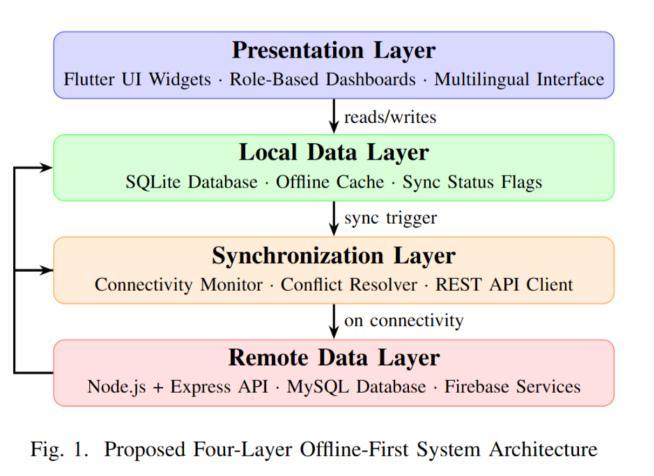
Presentation Layer: Implemented using Flutter widgets, this layer renders all user interface elements and handles userinteractions.ItcommunicatesexclusivelywiththeLocal DataLayer,ensuringUIresponsivenessisneverdegradedby networklatencyorunavailability.
LocalDataLayer: ImplementedusingSQLiteviathesqflite Flutter package, this layer maintains a complete deviceresident replica of all data pertinent to the authenticated user,includingequipmentlistings,bookingrecords,payment summaries,andnotificationhistories.
SynchronizationLayer: Thislayerservesastheintelligent bridgebetweenlocalandremotedatastores.Itcontinuously monitorsnetworkconnectivityusingtheconnectivity_plus package and activates synchronization processes upon detectingatransitionfromofflinetoonlinestate.
Remote Data Layer: A Node.js and Express.js backend exposes RESTful APIs consumed by the synchronization layer.AMySQLdatabaseservesasthecentralauthoritative datarepository.
C.
Protocol
The proposed synchronization engine operates as a backgroundisolateinFluttertopreventblockingthemainUI thread.Theprotocolexecutesthefollowingsequentialsteps uponconnectivityrestoration:
1. QuerylocalSQLiteforallrecordsflaggedPENDING_SYNC.
2. Transmitpendingrecordstotheremoteservervia authenticatedRESTAPIendpoints.
3. Receive server acknowledgments with updated canonicaltimestamps.
4. Fetchremoteupdatesgeneratedduringtheoffline period.
5. Merge remote updates into the local database, resolvingconflictsbyserver-timestampprecedence.
6. Update all successfully synchronized records to SYNCEDstatus.
D. Role-Based Access Control
Threedistinctuserrolesaredefinedwithinthesystem:
• Farmer: Equipment browsing, booking management, paymenthistory,andnotificationaccess.
• Equipment Owner: Equipment listing management, bookingapproval,andrentalincometracking.
• Administrator: Full system oversight including user management,disputeresolution,andanalytics.
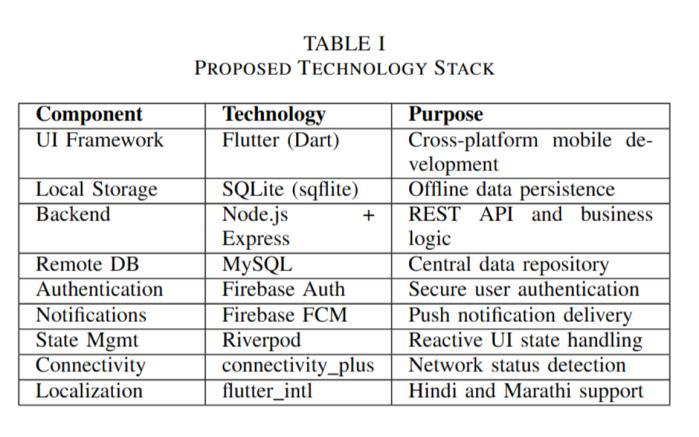
A. Technology Stack
Technologyselectionswereguidedbythreeprimarycriteria: offlineoperationalcapability,cross-platformcompatibility, and suitability for deployment on the low-end Android devices prevalent in rural India. Table I summarizes the proposedtechnologystack.
B. Database Schema Design
ThelocalSQLiteschemamirrorstheremoteMySQLschema with additional synchronization metadata columns. Each tableincorporatessyncstatus,localtimestamp,andservertimestamp fields to support the conflict resolution mechanism. The primarytablesare:
• Users-Farmer, owner, and admin profiles with authenticationtokens.
• Equipment-Machinery details including type, specifications,availability,price,andownerreference.
• Bookings-Rental requests with dates, statuses, and associatedentityreferences.
International Research Journal of Engineering and Technology (IRJET) e-ISSN: 2395-0056
Volume: 13Issue: 05| May 2026 www.irjet.net p-ISSN: 2395-0072
• Payments-Transaction recordswithamounts,methods, andstatuses.
• Notifications- Cached push notification payloads for offlinedisplay.
• sync log-Synchronization attempt records including outcomesanderrortraces.
C. Multilingual Implementation
Regional language support is implemented using Flutter’s internationalizationframework(flutter_intl)withApplication Resource Bundle (ARB) files maintained separately for English(en),Hindi(hi),andMarathi(mr).Languageselection is persisted locally to ensure consistent application of the chosenlanguageacrosssessions,includingfullyofflineones.
Critical interface elements translated across all three languages include equipment category names, booking statusdescriptors,paymentmethodlabels,errormessages, andallnotificationcontentstrings.
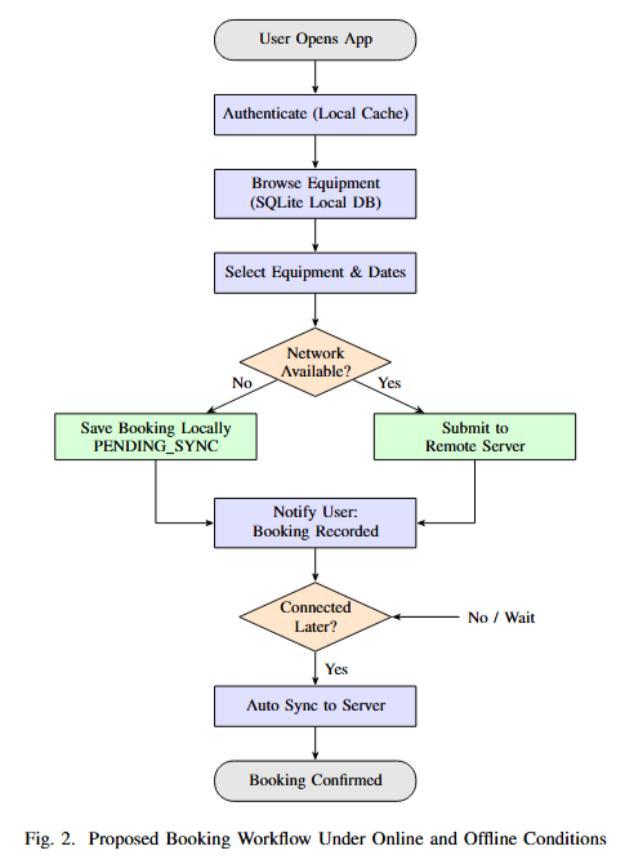
Fig.2illustratestheproposeduserworkflowforthebooking processunderbothonlineandofflineconditions.
Theproposeddevelopmentlifecycleisstructuredintofive sequentialphases:
Phase1-RequirementElicitation: Conductingstructured surveysandinterviewswithfarmersandequipmentowners intheJunnarandAmbegaontalukastocapturefunctional requirements, connectivity constraints, and language preferences.
Phase2-ArchitectureandDesign: Definingtheoffline-first architecture, database schemas, API specifications, synchronizationprotocols,andUI/UXwireframes.
Phase 3-Frontend Development: Building the Flutter application including all screens, navigation flows, offline dataaccesslogic,localizationARBfiles,andRiverpodstate management.
Phase4-BackendDevelopment: ConstructingtheNode.js REST API, MySQL database structure, Firebase Authentication integration, and FCM notification dispatch service.
Phase 5-Integration, Testing, and Deployment: Integrating all components, executing the proposed evaluationplan,anddeployingforfieldvalidation.
Upon full implementation, the system will be evaluated across three primary dimensions: offline functionality coverage, synchronization performance, and multilingual usability. This section presents the structured evaluation methodologyproposedforeachdimension.
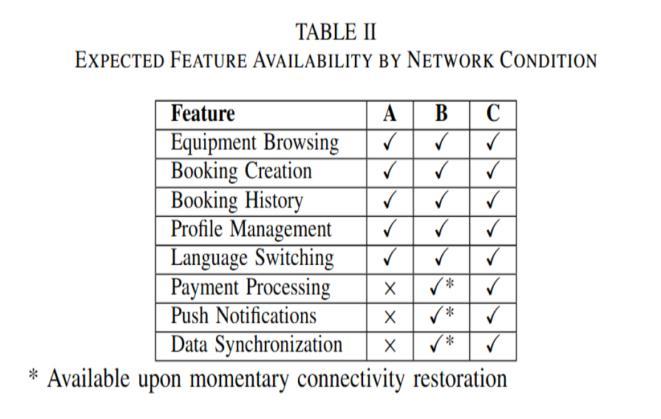
The application will be tested under three simulated networkconditionstoassessfeatureavailability:
• Condition A-Full Offline: Device in airplane mode simulatingzero-coverageruralareas.
• ConditionB-Intermittent: Networktoggledat30-second intervalstosimulatesignalfluctuationsinfringecoverage areas.
• Condition C-Online: Stable4Gconnectivityasabaseline performancereference.
International Research Journal of Engineering and Technology (IRJET) e-ISSN: 2395-0056
Volume: 13Issue: 05| May 2026 www.irjet.net p-ISSN: 2395-0072
TableIIpresentstheexpectedfeatureavailabilitymatrixfor eachconditionbasedontheproposedsystemdesign.
C. Synchronization Performance Evaluation
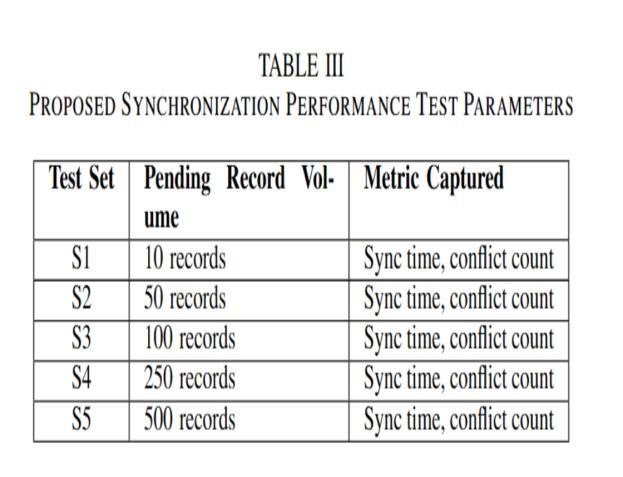
Synchronizationperformancewillbemeasuredbyrecording the time required to sync varying volumes of pending records upon network restoration. Table III defines the proposedtestparameters.
Astructuredusabilityevaluationwillbeconductedwith30 participants recruited from farming communities in the Junnar taluka, Pune district 10 participants per language condition(English,Hindi,Marathi).
Eachparticipantwillcompletefivestandardizedtasks:
1. Equipmentsearchusingcategoryfilters
2. Bookinginitiationforaselecteditem
3. Bookingcancellation
4. Paymentrecordviewing
5. Notificationhistoryreview
Primarymetricscollectedwillincludetaskcompletionrate, taskcompletiontime,andperceiveddifficultyscoreusinga 5-pointLikertscale.
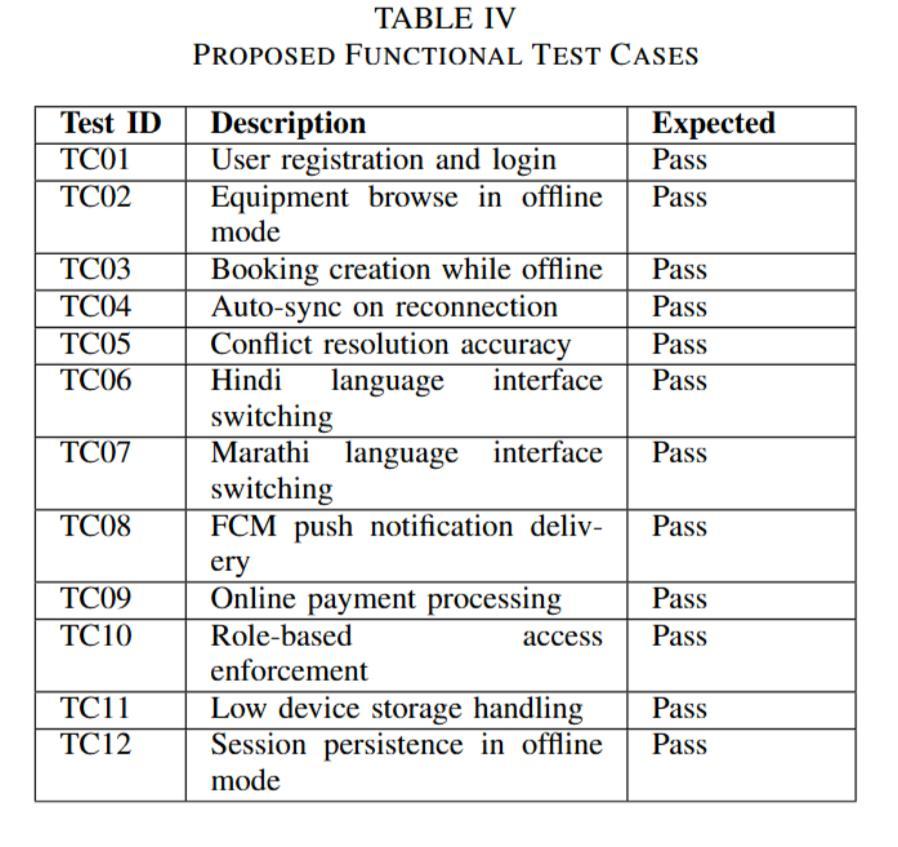
Table IV defines the functional test cases that will be executedduringthesystemvalidationphase.
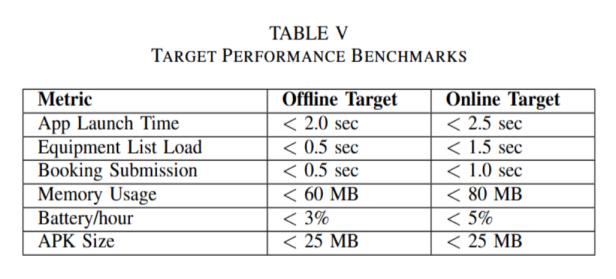
Based on established benchmarks for mobile applicationstargetinglow-resourcedevices[10],the following performance targets are defined for validation:
A. Conclusion
Thispaperpresentedthedesignandproposedevaluationof a mobile-first agricultural equipment rental application engineered specifically to address the connectivity constraints characteristic of rural India. By adopting an offline-first architecture grounded in local SQLite data persistenceandintelligentbackgroundsynchronization,the proposed system ensures that core rental functionalities equipmentbrowsing,bookingmanagement,anduserprofile operations remain fully accessible regardless of network availability.
The integration of multilingual support for Hindi and Marathidirectlyaddressesthelanguageaccessibilitybarrier
International Research Journal of Engineering and Technology (IRJET) e-ISSN: 2395-0056
Volume: 13Issue: 05| May 2026 www.irjet.net p-ISSN: 2395-0072
identified as a key adoption inhibitor among non-Englishspeaking farming communities. The role-based access framework and Firebase-powered notification system further enhance the platform’s operational completeness anduserengagementpotential.
The proposed system extends the authors’ prior work on web-basedagriculturalequipmentrental[1]byresolvingits fundamentalconnectivitydependency,therebybroadening the platform’s practical reach to include the rural smallholderfarmingcommunitiesmostinneedofefficient andaccessibleequipmentrentalsolutions.Thearchitectural design, module specifications, database schema, synchronization protocol, and evaluation framework presentedinthispaperestablisharigorousfoundationfor full system implementation and empirical validation in subsequentwork.
• On-DeviceMLRecommendations: IntegrationofTensor Flow Lite models for offline equipment recommendations basedoncroptype,season,andlandsizeinputs.
• IoT Integration: GPS and usage sensors embedded in rented machinery for real-time location and operational monitoring.
• Voice Interaction: Voice command support in regional languages to reduce literacy barriers for low-education users.
• Expanded Localization: Extension to Telugu, Tamil, Kannada,andBengalilanguageinterfaces.
• Dynamic Pricing Engine: Demand-aware rental rate optimizationusingseasonalbookingpatternanalysis.
• iOSDeployment: ExtendingFlutterapplicationtotheiOS platformforbroaderdevicecoverage.
• Peer-to-PeerSharing: Directfarmer-to-farmerequipment sharingarrangementswithintheplatformecosystem
[1] T. D. Fegade, S. R. Shaikh, A. C. Kharat, and K. Khatal, “FarmingRentalEquipmentServices:ASoftwarePlatform for Optimized Agricultural Machinery Usage,” Proc. [ConferenceName],[Location],[Year], pp.[xx–xx].
[2] Ministry of Agriculture and Farmers Welfare, Government of India, “Agricultural Statistics at a Glance 2022,”DirectorateofEconomicsandStatistics,NewDelhi, India,2022.[Online].Available:https://agricoop.nic.in
[3] Telecom Regulatory Authority of India (TRAI), “BroadbandIndia:RuralConnectivityandQualityofService Report,” New Delhi, India, Tech. Rep., 2023. [Online]. Available:https://www.trai.gov.in
[4] S. Wolfert, L. Ge, C. Verdouw, and M.-J. Bogaardt, “Big DatainSmartFarming:AReview,”AgriculturalSystems,vol. 153,pp.69–80,May2017.
[5]N.Kshetri,“TheRoleofMobileTechnologyinDeveloping Countries’ Agricultural Value Chains,” Journal of Global InformationTechnologyManagement,vol.23,no.2,pp.81–87,2020.
[6] M. Kleppmann and A. R. Beresford, “A Conflict-Free ReplicatedJSONDatatype,” IEEETrans. ParallelDistrib.Syst., vol.28,no.10,pp.2733–2746,Oct.2017.
[7]P.MehtaandR.Gupta,“Offline-FirstMobileApplication Design for Healthcare in Low-Connectivity Rural Environments,” Journal of Biomedical Informatics,vol.98, pp.103–112,2019.
[8] A. Biørn-Hansen, T. A. Majchrzak, and T.-M. Grønli, “ProgressiveWebApps:ThePossibleWeb-nativeUnifierfor Mobile Development,” Proc. Int. Conf. Web Information SystemsandTechnologies (WEBIST),pp.344–351,2017.
[9] S. Rathod and A. Sharma, “Language Barriers and Technology Adoption among Hindi and Marathi-Speaking Farming Communities,” Int. J. Rural Development and Technology, vol.7,no.2,pp.88–97,2021.
[10] Google Developer Documentation, “Android Vitals: PerformanceBenchmarksforMobileApplications,”Google LLC, 2023. [Online]. Available: https://developer.android.com/topic/performance