
International Research Journal of Engineering and Technology (IRJET) e-ISSN: 2395-0056
Volume: 13 Issue: 05 | May 2026 www.irjet.net p-ISSN: 2395-0072
International Research Journal of Engineering and Technology (IRJET) e-ISSN: 2395-0056
Volume: 13 Issue: 05 | May 2026 www.irjet.net p-ISSN: 2395-0072
1ParanjitD.Garje,2PravinS.Gosavi, 3SanketS.Gurav,4Gayatri Bhosle , 5 Shubham M. Chavan, 6 PruthvirajS.Jadhav
1, 3,6Student, Kolhapur Institute of Technology’s College of Engineering(Empowered Autonomous), Kolhapur 2Professor, Kolhapur Institute of Technology’s College of Engineering(Empowered Autonomous), Kolhapur, ***
Abstract - The increasing demand for automation in industrial and research applications has led to the development of efficient and cost-effective robotic systems. This paper presents the design and development of a four degree-of-freedom (4-DOF) robotic arm for pick-and-place operations using servo motors and an Arduino based control system. The proposed robotic arm is capable of performing multi-directional movements, enabling accurate and reliable object manipulation. Servo motors are utilized for precise control of joint movements, ensuring smooth and stable operation of the robotic arm. The Arduino microcontroller acts as the central control unit, processing user inputs and generating control signals for coordinated motion. The system can be operated using input devices such as a joystick, potentiometer, or pre-programmed commands, providing flexibility in control mechanisms. The developed robotic arm demonstrates effective performance in pick-and-place tasks with satisfactory accuracy. Furthermore, the system provides a scalable platform for future improvements through the integration of advanced technologies such as artificial intelligence and machine learning, contributing to the advancement of intelligent robotic systems.
Key Words: Degrees of Freedom (4-DOF),Servo motors ,Arduino control, Pick and Place operation, Inverse Kinematics/Forward Kinematics(for movement calculation), End effector/Gripper, Material handling ,Develop Prototype, DC power supply, Joystick control, Pre-program commands, Code, simulation
Robotics has emerged as a rapidly advancing field in engineering, focusing on the design, development, and control of automatedsystems.Itplaysasignificantroleinmodernindustrialenvironmentsbyenablingtaskstobeperformedwithhigh speed,precision,andefficiency.Theadoptionofroboticsystemshascontributedtothereductionofhumaneffortandthe enhancement of productivity, particularly in repetitive and time-intensive operations .In industrial applications, robotic systemsareextensivelyutilizedforoperationssuchaspick-and-placetasks,materialhandling,packaging,andassembly.These tasksrequireaccuratepositioning,controlledmovement,andhighrepeatability,whichcanbeeffectivelyachievedthroughthe implementationofroboticarms.Theintegrationofsuchsystemsensuresconsistentperformanceandimprovedoperational outcomes.Furthermore,theuseofroboticsminimizeshumanerrors,reducesoperationaltime,andenhancesoverallsystem efficiency. It also contributes to improved workplace safety by limiting human involvement in hazardous and high-risk environments. Owing to these advantages, robotic systems have become an essential component of modern industrial automation.Thisstudypresentsthedesignanddevelopmentofafour-axisroboticarmforpick-and-placeoperations.The proposedsystemisbasedontheconceptofanopenkinematicchain,enablingflexibleandcontrolledmotion.Thedesign emphasizessimplicity,cost-effectiveness,andeaseofimplementation,makingitsuitableforbasicautomationtasksaswellas educationalandresearchapplications.
In modern industries, automation is very important for improving productivity, accuracy, and efficiency. Pick and place operations,whereobjectsaremovedfromoneplacetoanother,arecommonlyusedinmanufacturingandpackaging.These tasksareoftendonemanually,whichcancausefatigue,slowerwork,andmoreerrors.
Althoughindustrialroboticarmscanautomatethesetasks,theyareusuallyexpensive,complex,andrequireadvancedcontrol systems.Becauseofthis,theyarenotsuitableforsmallindustries,educationalinstitutes,orlab-levelprojects.
Therefore,thereisaneedforasimple,low-cost,andefficientroboticarmthatcanperformpickandplaceoperationswithgood accuracy.Thesystemshouldhaveenoughflexibilityandbeeasytocontrol.Thisprojectfocusesondesigninga4-axisroboticarm usinganArduinomicrocontroller.Thegoalistodevelopacost-effectiveandsimpleautomationsystemsuitableforeducation, research,andsmall-scaleapplications.
International Research Journal of Engineering and Technology (IRJET) e-ISSN: 2395-0056
Volume: 13 Issue: 05 | May 2026 www.irjet.net p-ISSN: 2395-0072
1) JianqiangWang,YanminZhang,andXintongLiu(2021)proposed"ControlSystemof4-DOFPalletizingRobotBasedon ImprovedRControlMulti-ObjectiveTrajectoryPlanning."Theauthorsdevelopedacontrolsystemfora4-DOFroboticarmto improvetrajectoryplanningefficiencyandmotionaccuracy.TheyusedaB-splinetrajectoryplanningalgorithmalongwithan improvedR-controlmethodforfasterinterpolationandsmootherroboticmotion. Experimentaltestinginaproductionenvironmentshowedthatthesystemimprovedpathplanningspeed,controlprecision, andoverallreliability.Thestudyalsohighlightedbetter universalityandscalabilityoftheroboticarmcontrolsystemfor industrialautomation
2)MilindR.Shinde,V.N.Bhaiswar,andB.G.Achmare(2016)proposed“DesigningaSuitableRoboticArmforLoadingand Unloading of Material on Lathe Machine Using Workspace Simulation Software.” The study focused on automating lathe machineloadingandunloadingoperationstoimproveproductivityandreducemanualeffort.Theroboticarmwasdesigned usingCATIAV5andsimulatedinWorkspaceLTsoftware.Theproposedsystemuseda7-axisroboticarmwithadualgripper mechanismforsimultaneousloadingandunloadingofworkpieces.Theauthorsconcludedthattheroboticarmcanincrease machineutilization,reducecycletime,andprovideanefficientlow-costautomationsolutionforindustries.
3)Amarietal.(2020)proposeda4-axisshadowroboticarmintegratedwithflexsensorstomimichumanhandandelbow movementswirelessly.Thesystemusedsensorstodetectfingerbendingandelbowmotion,whileBluetoothcommunication transmittedsignalstoservomotorsforaccurateroboticmovement.TheroboticarmwasdesignedusingSolidWorksand fabricatedusing3Dprinting.Experimentalresultsshowedthatthearmsuccessfullycopiedhumanmotionswithsmallerror, makingitusefulforindustrialautomationandpick-and-placeapplications.
4)SanjayL.andShwetaP.(2012)proposed“PositionControlofPickandPlaceRoboticArm”presentedattheInternational ConferenceonEngineeringInnovationandTechnology,Nagpur.Thestudyfocusedonthedesignandpositioncontrolofapickand-placeroboticarmforindustrialautomationandmaterialhandlingapplications.ThesystemusedfiveRCservomotorsand amicrocontroller-basedcontrolsystem.Forwardandinversekinematicswereappliedtodetermineaccurateend-effector positionandorientation.Theresultsshowedeffectivepick-and-placeperformancewithgoodaccuracyinindustrialautomation applications.
5)JianqiangWang,YanminZhang,andXintongLiu(2021)proposed“ControlSystemof4-DOFPalletizingRobotBasedon ImprovedRControlMulti-ObjectiveTrajectoryPlanning.”Theauthorsdevelopedacontrolsystemfora4-DOFroboticarmto improvetrajectoryplanningefficiencyandmotionaccuracy.TheyusedaB-splinetrajectoryplanningalgorithmalongwithan improved R-control method for faster interpolation and smoother robotic motion. Experimental testing in a production environmentshowedimprovedpathplanningspeed,controlprecision,reliability,andscalabilityforindustrialautomation applications.
Forwardandinversekinematicsarefundamentalconceptsusedinroboticsystemstocontrolthemovementofaroboticarm. Forwardkinematicsreferstotheprocessofdeterminingthepositionandorientationoftherobot’send-effector(gripper) basedontheknownjointanglesandlinklengths.Inthiscase,theinputistheanglesofthejoints,andtheoutputistheexact positionoftherobot’shandinspace.Itisrelativelysimpleandismainlyusedtotrackthemotionoftherobot.Ontheother hand, inverse kinematics is the process of determining the required joint angles to achieve a desired position of the end effector.Here,thepositionisgivenasinput,andthesystemcalculatestheanglesneededateachjoint.Inversekinematicsis morecomplexbecausetherecanbemultiplepossiblesolutionsorsometimesnosolutionatall.Bothconceptsareessentialin roboticarmapplications,whereforwardkinematicshelpsinunderstandingthecurrentposition,whileinversekinematicsis usedtocontroltherobottoreachaspecifictargetpoint.
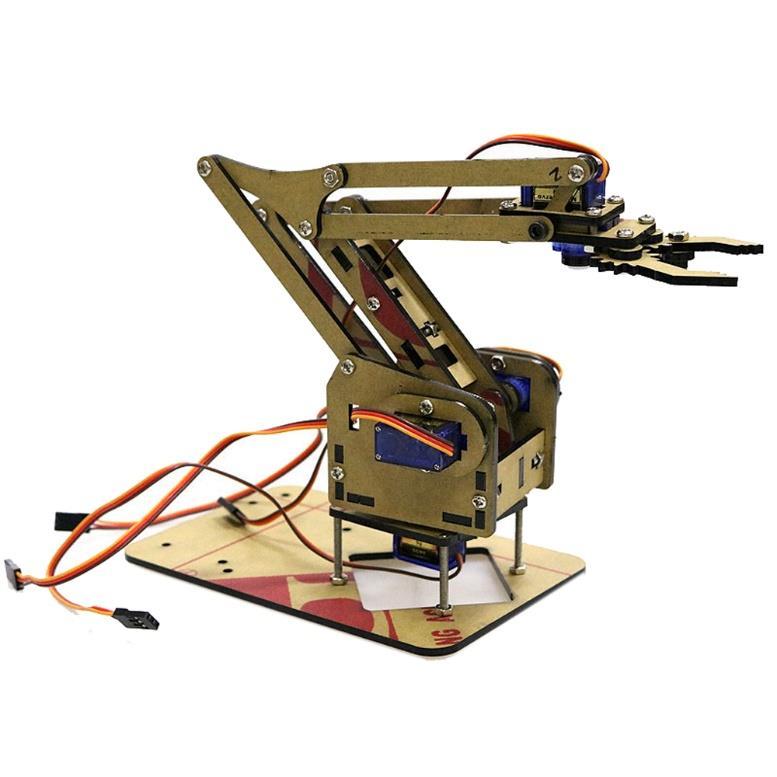
Introduction to System The robotic arm system is an automated mechanical device designed to perform pick and place operations.Itmimicsthemovementofahumanarmusingmultiplejointsandlinks.Thesystemisbasedonanopenkinematic chain, where each link is connected in series, allowing flexible movement in different directions. The system integrates mechanicalcomponents,electroniccircuits,andcontrolprogrammingtoachieveprecisemotion.Itismainlyusedforhandling objects,reducinghumaneffort,andimprovingefficiencyinrepetitivetasks
International Research Journal of Engineering and Technology (IRJET) e-ISSN: 2395-0056
Volume: 13 Issue: 05 | May 2026 www.irjet.net p-ISSN: 2395-0072
2.1 Mechanical Structure
Themechanicalstructureconsistsof:
Base(providesrotation)
Shoulderjoint(up-downmovement)
Elbowjoint(extension)
End-effector(gripper)
Thesecomponentsareconnectedthroughrigidlinksforminganopenchainstructure.
2.2 Actuators (ServoMotors)Servomotorsareusedtocontroljointmovements.Eachmotorrotatestoaspecificanglebased oninputsignals.Thesemotorsprovide:
Highaccuracy
Controlledmovement
Easyinterfacingwithmicrocontroller.
2.3 Controller (Arduino)
ThesystemiscontrolledusingArduinoUnomicrocontrollerboard.
Itactsasthebrainofthesystem.
FunctionsofArduino:
Sendscontrolsignalstomotors
Executesprogrammedinstructions
Controlsmovementsequence
2.4 Power Supply
ADCpowersupplyisusedtoproviderequiredvoltageto:
Arduino
Servomotors
Properpowermanagementensuresstableoperationofthesystem
2.5 End Effector (Gripper)
Thegripperisattachedattheendofthearmandisresponsiblefor:
Pickingobjects
Holdingobjects
Releasingobject
WorkingPrincipleofSystemTheroboticarmoperatesbasedonpredefinedinstructionsgiventhroughprogramming. Step-by-stepworking:
ThesystemispoweredON
Arduinoinitializesservomotors
Inputanglesaregiventojoints
Servomotorsrotateaccordingly
Armmovestopickposition
Gripperclosestoholdobject
Armmovestodestination
Gripperopenstoreleaseobject
Thisprocessisrepeatedautomatically
2.6 Control System Overview
Thesystemusesanopen-loopcontrolsystem,meaning:
Nofeedbackistakenfromoutput
Movementdependsonprogrammedinstructions
Futuresystemscanusesensorsforfeedbacktoimproveaccuracy
International Research Journal of Engineering and Technology (IRJET) e-ISSN: 2395-0056
Volume: 13 Issue: 05 | May 2026 www.irjet.net p-ISSN: 2395-0072
2.7 Kinematic Structure
TheroboticarmfollowsprinciplesofForwardKinematics:
Determinespositionofend-effector
Basedonjointangles
Eachjointcontributestotheoverallpositionofthearm
2.8 System Flow (BlockDescription)Input→Controller→Actuators→MechanicalMovement→Output
Explanation:
Input:Programmedangles
Controller:Arduinoprocessesinput
Actuators:Servomotorsmovejoints
Output:Objectispickedandplaced
2.9 System Features
Low-costdesign
Easytoprogram
Compactstructure
forsmallautomationtasks
3.
-1: componentsreadings(Data)
3.1 Simulation
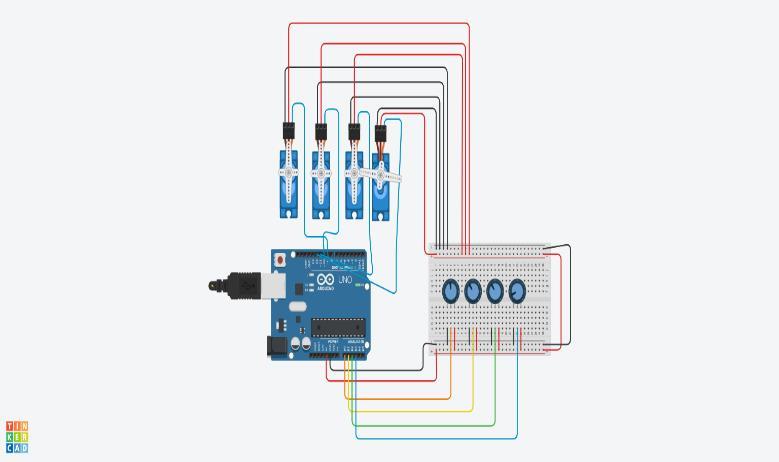
Fig -1: ArduinoUNOcircuitsimulationforcontrolling4servomotorsusing4potentiometers(actasananaloginputto adjusttheposition,angleofacorrespondingservomotor.
International Research Journal of Engineering and Technology (IRJET) e-ISSN: 2395-0056
Volume: 13 Issue: 05 | May 2026 www.irjet.net p-ISSN: 2395-0072
4. CONCLUSION:
Thisresearchsuccessfullydevelopeda4-DOFrobotarmforpick-and-placeoperations.Thesystemwastestedpractically,and theresultsshowthattherobotworksaccuratelywithonlysmallerrors.ThesmallerrorsareduetolimitationsofServomotors and the mechanical structure. Overall, the robot performs well and can be used for simple industrial tasks. For future improvement, sensors can be added for better gripping, and a camera system can be used to detect object positions automaticallyinsteadofusingfixedpositions.
ACKNOWLEDGMENTS:
ThestudentsareverythankfultoProf.P.S.Gosavi,forhisencouragement,invaluablepermission,andhiskindsupportin carryingoutthisresearchpaper.
REFERENCES
https://doi.org/10.25139/ijair.v3i1.3787
www.irjet.net
https://doi.org/10.18178/ijmerr.9.3.441-446
YourparMilindR.Shinde,V.N.Bhaiswar,B.G.Achmare"Designingasuitableroboticarmforloadingandunloadingof materialonlathemachineusingworkspacesimulationsoftware"ISO9001:2008CertifiedJournal.
MyatNoeWai,LuMaw,ThweWin,“KinematicsModelingandSimulationofthe4-DOFRoboticManipulator,” 1st UniversityResearchConferenceonScience&Engineering,Vol.1,pp.50–54,23January2020
SurenderKumar,MukherjeeS.K.,RoboticEngineering,Smt.SumitraHanda,FirstEdition,2001.
War Naing, Kyi Zar Aung, Aung Thike, Position Control of 3-DOF Articulated Robot Arm using PID Controller, InternationalPaperofScienceandEngineeringApplications,2018,Volume7–Issue09,254-259.
AhmedZakariAlassar,ModelingandControlof5DOFRobotArmUsingSupervisoryControl,DegreeofMasterof ScienceinElectricalEngineering,TheIslamicUniversityofGaza,ElectricalEngineeringDepartment,March2010.