
International Research Journal of Engineering and Technology (IRJET) e-ISSN: 2395-0056
Volume: 13 Issue: 06 | Jun 2026 www.irjet.net p-ISSN: 2395-0072
DESIGN AND AERODYNAMIC ANALYSIS OF CIRCULATION CONTROL
WING USING COANDA EFFECT FOR LIFT ENHANCEMENT
Solamon M1, Vinesh K2 , Arjun N P3, Kiran K murali4, Jobin John5
123B.Tech Semester 6, Dept. of Aeronautical Engineering, Toms college of Engineering, Mattakara, Kottayam, Kerala, India
4Assistant professor, 5HOD, Dept. of Aeronautical, Toms college of Engineering, Mattakara, Kottayam, Kerala, India
Abstract: - This project focuses on the design and aerodynamic analysis of a circulation control wing based on the Coanda effect for lift enhancement. The study aims to investigate how the attachment of a high-velocity jet over a curved trailing edge can increase circulation and improve aerodynamic performance. A modified airfoil with a rounded trailing edge and jet slot is modelled and analysed using Computational Fluid Dynamics (CFD). Simulations are carried out under various flow conditions to evaluate key aerodynamic parameters such as lift, drag, and pressure distribution. The results are compared with those of a conventional airfoil to assess performance improvements. The analysis demonstrates that the application of the Coanda effect significantly enhances lift and delays flow separation, especially at higher angles of attack. This study highlights the potential of circulation control wings in improving aircraft efficiency without major structural modifications. It also provides practical insights into airflow behaviour and the effectiveness of advancedaerodynamic control techniques.
Keywords: - Aerodynamic Analysis, Coanda Effect, Circulation control wing, Computational Fluid Dynamics,Flowseparation.
I. INTRODUCTION
Aerodynamic lift plays a crucial role in the performance, efficiency, and stability of aircraft. Conventional airfoils generate lift due to pressure differences created by airflow over their surfaces. However, at low speeds and high angles of attack, flow separation can occur, leading to reduced lift and increased drag. To address these limitations, advanced techniques such as circulation control using the Coanda effectareemployed.
TheCoandaeffectisthetendencyofafluidjetto attach itself to a nearby curved surface and follow its contour. In circulation control wings, a high-velocity jet of air is blown over a rounded trailing edge, increasing circulationandtherebyenhancingliftwithoutsignificant changes in wing geometry. This makes it a promising methodforimprovingaerodynamicperformance.
An airfoil is the cross-sectional shape of a wing designed to produce lift when air flows over it. Its geometry plays a vital role in determining aerodynamic characteristics.
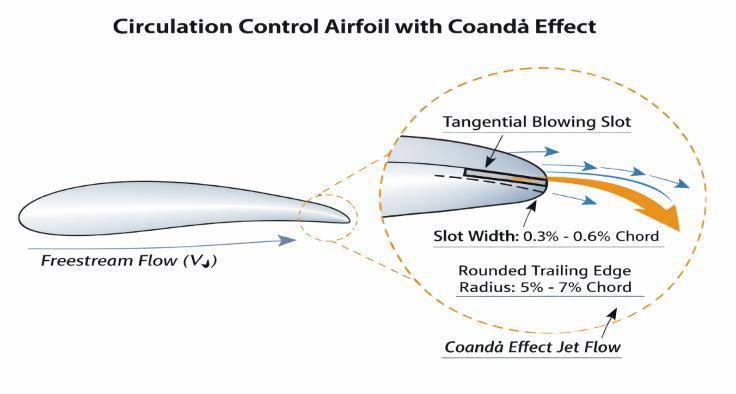
Fig.1 CirculationcontrolairfoilwithCoandaeffect.
FeaturesofanAirfoil
Leading Edge: The front portion of the airfoil thatfirstcontactstheairflow
TrailingEdge:Therearendwhereairflowleaves theairfoil
Chord Line: An imaginary straight line joining theleadingandtrailingedges
Camber: The curvature of the airfoil, which affectsliftgeneration
Thickness Distribution: The variation of thickness along the chord, influencing strength andairflow
Upper and Lower Surfaces: Shape difference createspressurevariationforlift.
RoundedTrailingEdge(CoandaAirfoil):Helpsin jetattachmentandcirculationenhancement.
JetSlot(inCoandaAirfoil):Allowshigh-speedair toflowandadheretothesurface.
ApplicationsofAirfoil
AircraftWings:Usedinairplanestogeneratelift forflight
Helicopter Rotor Blades: Provide lift and thrust inrotary-wingaircraft
International Research Journal of Engineering and Technology (IRJET) e-ISSN: 2395-0056
Volume: 13 Issue: 06 | Jun 2026 www.irjet.net p-ISSN: 2395-0072
Unmanned Aerial Vehicles (UAVs): Improve efficiencyandflightcontrol
Wind Turbine Blades: Convert wind energy into mechanical/electricalenergy
Automotive Aerodynamics: Improve vehicle stabilityandreducedrag
Marine Applications: Used in hydrofoils and propellersforefficientmovementinwater
High-LiftDevices: Appliedinflapsandadvanced wingsystemsfortake-offandlanding
CirculationControlWings:Enhanceliftusingthe Coandaeffectinmodernaerodynamicsystems
This project focuses on the design and CFD analysis of a Coanda airfoil to study airflow behavior and evaluate its effectivenessinimprovingliftcompared to conventional airfoils.
II.METHODOLOGY
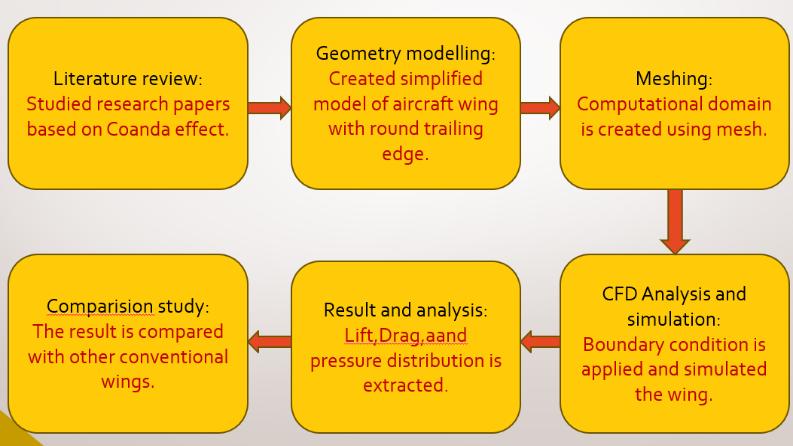
Fig.2: Flowdiagramofmethodology
A systematic methodology was adopted to investigate the aerodynamic performance of a conventional airfoil anda Coanda airfoil withcirculation control. The study began with an extensive literature reviewofresearchpapers,journalarticles,andtechnical publications related to the Coanda effect and circulation control wings to gain a thorough understanding of the fundamental aerodynamic principles and previous research findings. Based on the insights obtained from theliterature,twoairfoilgeometriesweredesignedusing CATIA software: a conventional airfoil and a modified Coandaairfoilincorporatinga roundedtrailing edgeand a jet slot for circulation control. Following the geometry creation, a computational fluid domain was developed around each airfoil to simulate external airflow conditions accurately while minimizing the influence of boundary effects. The computational domain was then discretized using ANSYS Meshing, where an appropriate mesh was generated to ensure accurate resolution of flow features, particularly in critical regions near the airfoil surface, trailing edge, and jet slot. Subsequently,
suitable boundary conditions were applied, including inlet velocity, outlet pressure, wall conditions, and jet velocity at the slot outlet of the Coanda airfoil, to replicate realistic operating conditions. Computational FluidDynamics(CFD)simulationswerethencarriedout in ANSYS Fluent to analyse the airflow behavior over bothairfoilconfigurationsundervariousflowconditions. During the simulation process, solver iterations were carefully monitored, and convergence was ensured through the examination of residual plots and iteration histories until the prescribed convergence criteria were satisfied. Upon achieving convergence, important aerodynamic parameters such as lift, drag, pressure distribution, velocity contours, and streamline patterns were extracted from the simulation results. A comprehensive comparative study was then performed to evaluate the aerodynamic performance of the conventional and Coanda airfoils, with particular emphasis on lift enhancement, drag characteristics, and flow behavior. Finally, the results were analysed and interpreted to understand the influence of the Coanda effect on aerodynamic performance, focusing on phenomena suchasjetattachmenttothecurvedtrailing edge, increased circulation around the airfoil, and delayed flow separation, all of which contribute to improved lift generation and overall aerodynamic efficiency.
III. OBJECTIVES OF STUDY
Theprimaryobjectiveofthisstudyistodevelop acomprehensiveunderstandingoftheCoandaeffectand its application in circulation control airfoils, with particular emphasis on its influence on airflow behavior and aerodynamic performance. The study aims to investigate the fundamental principles governing the Coanda effect, wherein a high-velocity jet flow tends to remain attached to a curved surface, resulting in increasedcirculationaroundtheairfoilandenhancedlift generation. To achieve this, a modified Coanda airfoil featuring a rounded trailing edge and an integrated jet slot is designed and analysed alongside a conventional airfoil configuration. The project seeks to evaluate how theintroductionofajetflowalterstheflowfieldaround the airfoil and influences key aerodynamic characteristicsundervariousoperatingconditions.
A major objective of the work is to perform detailed Computational Fluid Dynamics (CFD) simulationstovisualizeand analysetheairflow patterns around both airfoil configurations. Through numerical analysis,the study examinesimportant flow phenomena such as jet attachment to the curved trailing edge, changes in circulation strength, pressure distribution variations,boundarylayerdevelopment,andthedelayor suppression of flow separation. Understanding these flow mechanisms is essential for assessing the
International Research Journal of Engineering and Technology (IRJET) e-ISSN: 2395-0056
Volume: 13 Issue: 06 | Jun 2026 www.irjet.net p-ISSN: 2395-0072
effectiveness of circulation control techniques in improving aerodynamic performance. The study also aims to investigate the interaction between the injected jetandthesurroundingairflow,andhowthisinteraction contributes to the modification of the pressure field and enhancementoflift.
Another important objective is to quantify and compare the aerodynamic performance of the conventional and Coanda airfoils by evaluating key parameters such as lift coefficient, drag coefficient, liftto-drag ratio, pressure coefficient distribution, velocity contours, and streamline patterns. By conducting a comparative analysis, the study seeks to identify the advantages and limitations of the Coanda airfoil concept relative to conventional airfoil designs. Particular attention is given to determining the extent of lift augmentation that can be achieved through circulation control and assessing whether the associated aerodynamicbenefitsoutweighanypotentialincreasein system complexity or energy requirements for jet injection.
Furthermore, the study aims to explore the role of circulation control as an advanced aerodynamic technique for enhancing aircraft performance. The investigation focuses on understanding how increased circulation around the airfoil contributes to greater lift generation without requiring significant changes in airfoil geometry or angle of attack. This aspect of the research is particularly relevant for applications involving short take-off and landing (STOL) aircraft, unmanned aerial vehicles (UAVs), high-lift systems, and other aerospace configurations where improved lift characteristics are desirable. The study also seeks to provide insights into the potential of Coanda-based circulationcontrol systemsforreducingflowseparation, improvingaerodynamicefficiency,andenhancingoverall flightperformance.
In addition to evaluating aerodynamic performance, the project aims to develop practical knowledge and expertise in the application of CFD tools for aerodynamic analysis. This includes geometry creation, computational domain development, mesh generation, boundary condition specification, numerical simulation,convergencemonitoring,andpost-processing of results using industry-standard software. Through these activities, the study intends to establish a systematicmethodologyforanalysingcirculationcontrol airfoilsandgeneratingreliableaerodynamicdata.
Ultimately, the objective of this research is to contribute to the understanding of Coanda-effect-based circulationcontroltechnologyandtoassessitsfeasibility as a means of improving aerodynamic efficiency and lift generation. The findings of this study are expected to providevaluable insightsintotheaerodynamicbehavior
of Coanda airfoils and demonstrate their potential for future aerospace applications where enhanced performance, improved controllability, and efficient lift augmentationarerequired.
IV. GEOMETRY DESCRIPTION
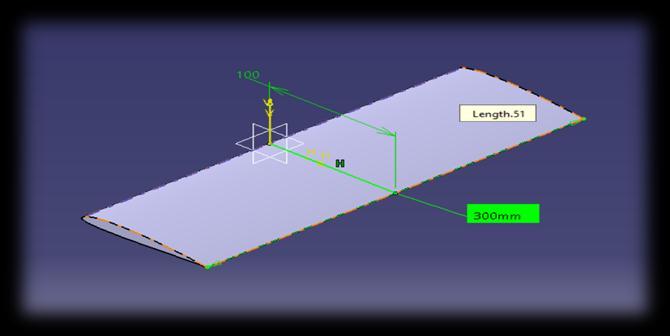
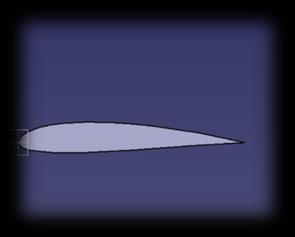
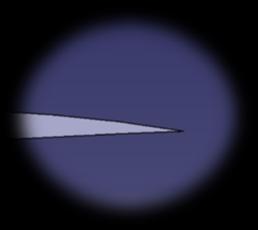
Differentgeometryofconventionalairfoil(NACA 2412)
The airfoil chosen for this design is the NACA 2412profile,awidelyusedairfoilknownforitsbalanced aerodynamicperformanceandsuitabilityforavarietyof low- and moderate-speed applications. The designation "2412" provides important geometric information about the airfoil shape. The first digit, 2, indicates that the airfoil has a maximum camber equal to 2% of the chord length. Camber refers to the curvature of the airfoil, and this slight curvature contributes to the generation of lift evenatrelativelysmallanglesofattack.Theseconddigit, 4, signifies that the location of maximum camber is positionedat40%ofthechordlengthmeasuredfromthe leading edge. This placement influences the pressure distribution over the airfoil surface and contributes to stable aerodynamic behavior. The final two digits, 12, indicatethatthemaximumthicknessoftheairfoilis12% of the chord length, providing a good balance between structuralstrengthandaerodynamicefficiency.
For the purpose of this design and analysis, a chord length of 100 mm has been selected, while the span of the wing has been taken as 300 mm. These dimensionsprovideapracticalmodelsizethatissuitable for fabrication, testing, and performance evaluation. The selectedairfoil incorporatesa sharp leading edge, which allowstheincomingairflowtobedirectedsmoothlyover theupperandlowersurfacesofthewing.Thisgeometric featurecaninfluencetheflowcharacteristicsaroundthe airfoil andhelps establish a clearstagnation point atthe
International Research Journal of Engineering and Technology (IRJET) e-ISSN: 2395-0056
Volume: 13 Issue: 06 | Jun 2026 www.irjet.net p-ISSN: 2395-0072
front of the profile. The combination of the NACA 2412 geometry, the chosen chord and span dimensions, and the sharp leading-edge configuration makes the airfoil suitable for aerodynamic investigations, offering an effective compromise between lift generation, drag characteristics,andstructuralpracticality.
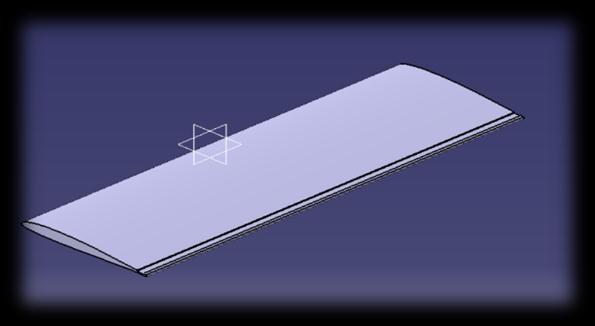
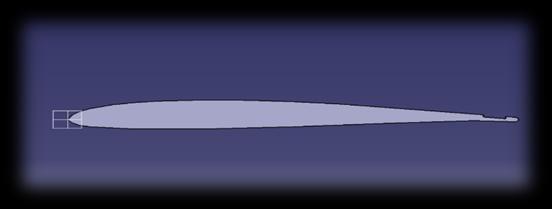
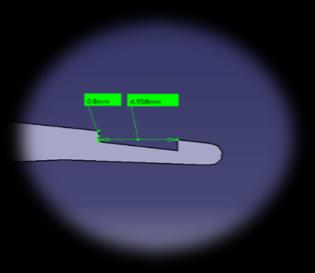
Fig.4:DifferentgeometryofCoandaairfoil(NACA2412)
The wing configuration is based on the NACA 2412 airfoil, which serves as the reference geometry for the design. A chord length of 100 mm has been selected as the reference length for the airfoil, providing a suitablescaleforaerodynamicanalysisandexperimental evaluation. The overall thickness distribution of the modifiedairfoilismaintainedascloseaspossibletothat oftheoriginalNACA2412profileinordertopreserveits fundamental aerodynamic characteristics, including lift generation, pressure distribution, and structural integrity.
To incorporate flow-control capabilities, the airfoilhasbeenmodifiednearthetrailing-edgeregion.A narrowslotwithaheightof0.8mmhasbeenintroduced to act as a jet slot through which airflow can be discharged. The slot is positioned close to the trailing edgesothattheinjectedairflowcaneffectivelyinfluence the boundary layer and wake development in the downstream region. This placement is particularly important because the trailing-edge region plays a significant role in determining the overall lift and drag characteristics of the airfoil. By introducing airflow
through the slot, it becomes possible to modify the local flow behavior, delay flow separation, and potentially improveaerodynamicperformance.
Thetrailingedgeitselfhasbeendesignedwitha rounded geometry rather thana sharptermination. This rounded trailing-edge configuration provides adequate space for the integration of the jet slot while ensuring smoothairflowguidancetowardtheexit.Inaddition,the trailing-edge profile follows a curved contour, allowing the discharged jet to be directed along the surface more effectively. The curved shape promotes a gradual flow turningeffectandhelpsmaintainattachmentofthejetto the airfoil surface, which can enhance the interaction between the injected airflow and the external flow field. Overall, the modified design combines the proven aerodynamic characteristics of the NACA 2412 airfoil with a rounded and curved trailing-edge configuration featuring a 0.8 mm jet slot, creating a geometry that is well suited for studies involving active flow control, lift enhancement,anddragreduction.
V.FLOW CONDITIONS AND ASSUMPTIONS
Theflowanalysisiscarriedoutbyconsideringa steady, external aerodynamic flow over the airfoil. The main flow parameters and conditions used in the simulationarelistedbelow:
The computational fluid dynamics (CFD) analysiswascarriedoutundersteady-stateexternalflow conditions using air as the working fluid. A free-stream velocity of 60 m/s was specified to represent the incoming airflow over the airfoil. Since the flow velocity is significantly lower than the speed of sound, the flow regime isconsidered subsonic, witha Machnumber less than 0.3. Under these conditions, compressibility effects are negligible, allowing the flow to be treated as incompressible for the numerical simulation. The analysis focuses on understanding the aerodynamic behavior of the airfoil and the influence of the trailingedgejetonthesurroundingflowfield.
The computational domain was defined with appropriateboundaryconditionstoaccuratelyrepresent the external aerodynamic environment. At the inlet boundary,auniformvelocityinletconditionwasapplied, ensuring a constant free-stream velocity across the entire inlet plane. At the outlet boundary, a pressure outlet condition corresponding to atmospheric pressure was specified, allowing the airflow to exit the domain naturally without imposing unnecessary constraints on the solution. The operating pressure throughout the simulation was also set to atmospheric pressure, providing a realistic representation of standard ambient conditions.
International Research Journal of Engineering and Technology (IRJET) e-ISSN: 2395-0056
Volume: 13 Issue: 06 | Jun 2026 www.irjet.net p-ISSN: 2395-0072
The airfoil surface was modelled using a no-slip wall boundary condition, which assumes that the fluid velocity relative to the solid surface is zero. This conditionisessentialforaccuratelycapturingboundarylayer development, wall shear stresses, and flow separation phenomena. In addition to the primary airflow, a high-velocity jet was introduced through the slotlocatednearthetrailingedgeofthemodifiedCoanda airfoil. The jet flow interacts with the external stream and follows the curved trailing-edge surface due to the Coanda effect, thereby influencing the pressure distribution, enhancing flow attachment, and potentially increasingliftwhilereducingflowseparation.
To account for the effects of turbulence in the flow field, the standard k–ε turbulence model was employed. This model is widely used in aerodynamic simulations because of its robustness, computational efficiency,andabilitytoprovidereliablepredictionsfora broad range of engineering flow problems. The governingequationsweresolvedusingapressure-based solver, which is particularly suitable for incompressible and low-speed aerodynamic applications. The combination of steady-state assumptions, atmospheric operating conditions, appropriate boundary conditions, and the k–ε turbulence model provides a stable and effective framework for evaluating the aerodynamic performance of the modified Coanda airfoil under subsonicflowconditions.
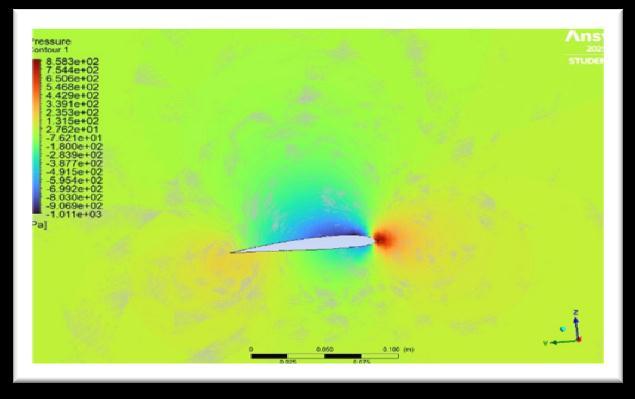
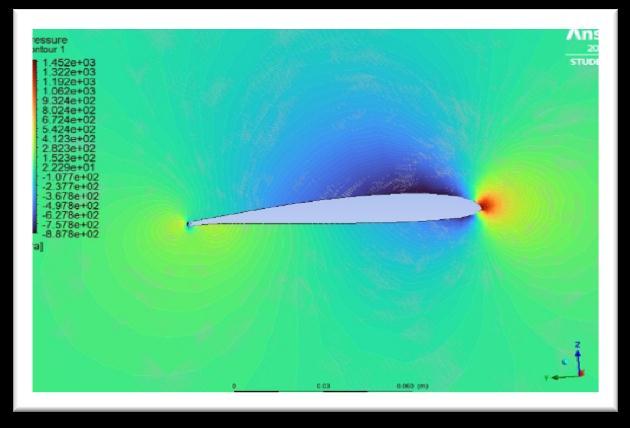
Assumptions:
The analysis is performed under certain simplifying assumptions to make the problem computationally efficient. The flow is assumed to be steady and timeindependent. Air is treated as an incompressible fluid with constant properties such as density and viscosity. The study is carried out as a two-dimensional analysis, assuming uniform flow along the spanwise direction. Viscous effects are considered, while body forces like gravity are neglected. The flow is also assumed to be isothermal, meaning no heat transfer takes place. Additionally, the airfoil surface is considered perfectly smooth without any surface roughness. These assumptionshelpsimplifytheanalysiswhilemaintaining reasonableaccuracyintheresults.
VI. CFD METHODOLOGY
The aerodynamic analysis of both the conventional airfoil and the Coanda airfoil was carried out through a systematic Computational Fluid Dynamics (CFD) methodology. Initially, detailed two-dimensional geometric models of the conventional airfoil and the Coanda airfoil were developed using CATIA, ensuring accurate representation of their aerodynamic profiles. Following geometry creation, an external computational flow domain was established around each airfoil with sufficiently large upstream, downstream, and far-field boundaries to minimize the influence of boundary conditions on the flow field and to accurately simulate free-stream conditions. The computational domain was then discretized using ANSYS Meshing, where a combination of structured and unstructured meshing techniques was employed to achieve an optimal balance betweencomputational efficiencyandsolution accuracy. Special attentionwasgiven totheairfoil surface, trailing edge region, and areas of expected flow separation by incorporating finer mesh elements to capture detailed flow characteristics. Additional mesh refinement was appliedintheboundarylayerregionsandaroundthejet slot of the Coanda airfoil, enabling precise resolution of steep velocity gradients and complex flow interactions associatedwiththeCoandaeffect.Aftermeshgeneration, appropriate boundary conditions were specified for the simulation. A velocity inlet condition of 60 m/s was imposed at the upstream boundary to represent the incoming airflow, while an atmospheric pressure outlet conditionwasassignedatthedownstreamboundary.
Theairfoilsurfaceswere modelled asstationary walls with a no-slip boundary condition, ensuring realisticrepresentationofviscouseffects.FortheCoanda airfoilconfiguration,ahigh-velocityjetinletwasdefined at the trailing-edge slot to simulate the blowing mechanism responsible for flow attachment and circulationenhancement.Theflowsolutionwasobtained
International Research Journal of Engineering and Technology (IRJET) e-ISSN: 2395-0056
Volume: 13 Issue: 06 | Jun 2026 www.irjet.net p-ISSN: 2395-0072
using the pressure-based solver available in ANSYS Fluent, which is well suited for incompressible aerodynamic analyses. To accurately model turbulent flow behavior, the standard k-ε turbulence model was selected due to its robustness and widespread use in external aerodynamicsimulations. Prior to computation, the solution was initialized using appropriate reference values to provide a stable starting point for the numerical calculations. The solver then performed iterative computations, continuously updating the flow variables until convergence criteria were satisfied. Convergence was monitored through residual reduction and stabilization of key aerodynamic parameters, ensuringthereliabilityandaccuracyoftheresults.Upon achieving convergence, comprehensive post-processing wasconductedtoevaluatetheaerodynamicperformance ofbothairfoilconfigurations.Keyparameterssuchaslift force, drag force, lift-to-drag ratio, pressure coefficient distribution, velocity contours, streamlines, and flowfield characteristics were extracted and analysed. The resulting contour plots and streamline visualizations provided valuable insights into the effects of the Coanda jet on flow attachment, circulation enhancement, pressure distribution, and overall aerodynamic efficiency, thereby enabling a detailed comparison betweentheconventionalandCoandaairfoildesigns.
VII. ANALYSIS
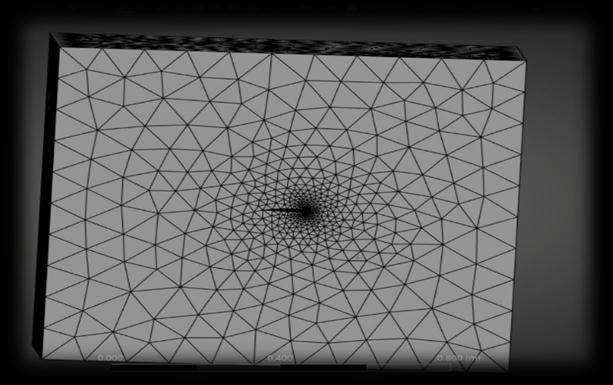
Fig.7:Meshingofnormalairfoil.
Graph.1:Iterationcurveofnormalairfoil.
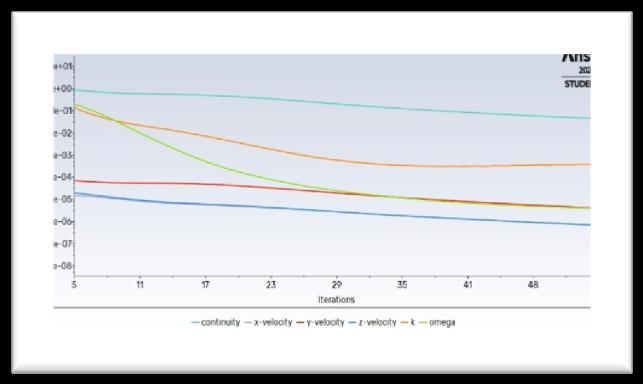
The iteration curve of the normal airfoil illustrates the convergence behavior of the Computational Fluid Dynamics (CFD) simulation by showing the variation of residual values with increasing iterations. As observed in the graph, the residuals for continuity, velocity components, turbulent kinetic energy (k),and specific dissipation rate(ω)decreasesteadilyasthesolutionprogresses. At the beginning of the simulation, the residual values are relatively high due to large numerical errorsandtheinitialapproximationoftheflowfield. With each successive iteration, these residuals reduce significantly, indicating that the governing equationsarebeingsatisfiedmoreaccurately.Thexvelocity, y-velocity, and z-velocity residuals decrease to values below 10⁻⁵, while the turbulence parameters also show a substantial reduction and stabilization. Although the continuity residual remains comparatively higher than the other variables, it exhibits a consistent downward trend withoutsignificantoscillations,indicatingacceptable convergence behavior. The smooth decline and stabilization of all residual curves demonstrate that thenumericalsolutionhasreachedaconvergedstate andthattheflowfieldhasbecomestable.Therefore, the aerodynamic parameters obtained from the simulation, such as lift coefficient, drag coefficient, pressure distribution, velocity contours, and streamline patterns, can be considered accurate and reliableforevaluatingtheperformanceofthenormal airfoilunderthespecifiedoperatingconditions.
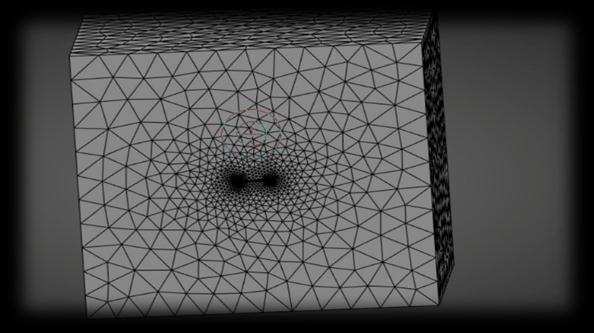
Fig.9:Meshofcoandaairfoil.
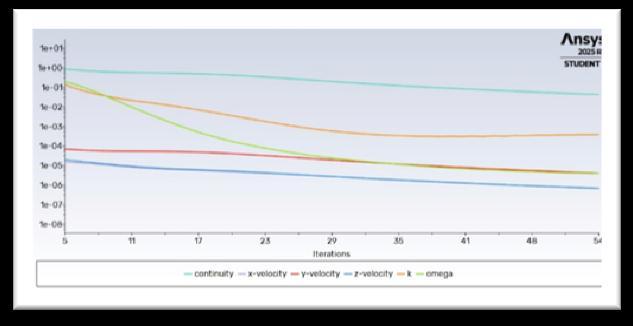
Graph.2:IterationcurveofCoandaairfoil.
International Research Journal of Engineering and Technology (IRJET) e-ISSN: 2395-0056
Volume: 13 Issue: 06 | Jun 2026 www.irjet.net p-ISSN: 2395-0072
The iteration curve of the Coanda airfoil illustrates the convergence characteristics of the CFD simulation whenajetflowisintroducedatthetrailingedge. During theinitialstagesofthesimulation,theresidualvaluesare relatively high due to the complex flow physics associated with the interaction between the primary airflowandthehigh-velocityjet.Thisinteractioncreates additional turbulence, flow mixing, and momentum transfer effects, making the numerical solution more challenging to stabilize compared to that of a conventional airfoil. As the iterations continue, the residual values gradually decrease, indicating that the governing equations are being satisfied more accurately andthatthesolutionismovingtowardaconvergedstate.
In comparison with a normal airfoil, the iteration curve of the Coanda airfoil may exhibit small fluctuations or oscillations throughout the convergence process. These fluctuationsarisefromthepresenceofthejetflow,which introduces additional unsteady flow features and increases the complexity of the aerodynamic behavior around the airfoil surface. Nevertheless, the overall downward trend of the residuals demonstrates that the solver is successfully reducing numerical errors and improving solution accuracy with each iteration. Once theresidualsreachsufficientlylowvaluesandmaintaina stable pattern without significant variations, the simulation can be considered converged. This stable convergence indicates that the computed aerodynamic parameters, such as lift coefficient, drag coefficient, pressure distribution, and overall flow behavior around theCoandaairfoil,aredependableandcanbeconfidently used for performance evaluation and further aerodynamicanalysis.
VIII.RESULT SUMMARY
Table.1:Resultofanalysis.
TheCFDanalysisofboththeconventionalairfoil and the Coanda airfoil was successfully carried out to evaluatetheir aerodynamic performance underidentical flow conditions. The results were analysed in terms of iterationconvergence,pressuredistribution,andliftand dragcharacteristics.
The iteration curves for both airfoils showed a steady reduction in residuals, indicating proper
convergence of the numerical solution. However, the Coanda airfoil exhibited slight fluctuations during the initial stages due to the interaction between the free streamflowandthehigh-velocityjetatthetrailingedge. Despite this, the solution stabilized, confirming reliable simulationresults.
The pressure distribution plots revealed a significant difference between the two airfoils. The conventional airfoil showed a typical pressure variation with moderate pressure difference between the upper and lower surfaces. In contrast, the Coanda airfoil demonstrated a much larger pressure difference due to the attachment of the jet flow along the curved trailing edge. This increased suction on the upper surface contributeddirectlytohigherliftgeneration.
In terms of aerodynamic performance, the Coanda airfoil showed a clear improvement over the normal airfoil. The lift generated by the Coanda airfoil was noticeably higher due to increased circulation causedby the jet flow.Additionally,flow separation was delayed in the Coanda airfoil, allowing it to maintain lift evenat higherangles ofattack.Although there may be a slight increase in drag due to jet interaction, the overall lift-to-dragratiowasimproved,makingitmoreefficient. The velocity and streamline patterns further confirmed that the jet flow remained attached to the curved surface, validating the presence of the Coanda effect. This attachment enhanced the momentum of the boundary layer and prevented early separation. Overall, the results clearly demonstrate that the implementation of the Coanda effect in a circulation control wing significantly enhances lift performance compared to a conventional airfoil. The study confirms that such modifications can improve aerodynamic efficiency without majorstructural changes, making it a promising approachforadvancedaerodynamicapplications.
IX.KEY OBSERVATIONS
The CFD simulations for both airfoils showed proper convergence, confirming reliable results
The Coanda airfoil exhibited slight fluctuations initerationcurvesduetojetflowinteraction
Pressure difference between upper and lower surfacesishigherintheCoandaairfoil
Strong suction region observed on the upper surfaceoftheCoandaairfoil
Jet flow successfully attaches to the curved trailingedge,confirmingtheCoandaeffect
FlowseparationisdelayedintheCoandaairfoil comparedtothenormalairfoil
Coanda airfoil generates significantly higher lift thantheconventionalairfoil
International Research Journal of Engineering and Technology (IRJET) e-ISSN: 2395-0056
Volume: 13 Issue: 06 | Jun 2026 www.irjet.net p-ISSN: 2395-0072
Slight increase in drag may be observed due to jetinteraction
Overall lift-to-drag ratio is improved in the Coandaairfoil
Enhancedcirculationaroundtheairfoil leadsto betteraerodynamicperformance
X.CONCLUSION
Thisproject successfullyinvestigated the design and aerodynamic performance of a circulation control wing using the Coanda effect for lift enhancement. A comparativeCFDanalysisbetweenaconventionalairfoil and a modified Coanda airfoil was carried out under identicalflowconditions.
The results clearly demonstrate that the Coanda airfoil providessignificantimprovementinliftduetoincreased circulation caused by the high-velocity jet flow. The jet attachment over the rounded trailing edge enhances the pressure difference and delays flow separation, leading to better aerodynamic performance. Although a slight increaseindragisobserved,theoveralllift-to-dragratio isimproved.
The study confirms that the application of the Coanda effect is an effective method for enhancing lift without major geometric modifications to the airfoil. This makes circulation control wings a promising solution for improvingaircraftefficiency,especiallyinlow-speedand highangleofattackconditions.
Overall, the project highlights the importance of advancedaerodynamictechniquesanddemonstratesthe effectiveness of CFD tools in analysing and optimizing airfoilperformance.
XI.REFERENCES
1) 1.Airfoil gust load alleviation by circulation control:YonghongLi,NingQin(2020)
2) 2.Analytical and experimental investigation of circulation control by means of a turbulent Coandajet:E.S.Levinsky,T.T.Yeh(1972)
3) 3.Numerical study of turbulent air and water flows in a nozzle based on a Coanda effect: Youssef El Halal, Cristofer H. Marques, Luiz A.O. Rocha, Liercio A. Isoldi, Rafael de L. lemos, CristianoFragassa,ElizaldoD.dosSantos(2019)
4) 4.NumericalsimulationandanalysisofaCoanda effect circulation control for wind turbine applications:MohdFaisalAbdulHamid(2011)
5) 5.Mathematical modelling and numerical investigations on the Coanda effect: A. Dumitrache,F.Frunzulica,T.C.Ionescu(2012)