
International Research Journal of Engineering and Technology (IRJET) e-ISSN: 2395-0056
Volume: 11 Issue: 12 | Dec 2024 www.irjet.net p-ISSN: 2395-0072

International Research Journal of Engineering and Technology (IRJET) e-ISSN: 2395-0056
Volume: 11 Issue: 12 | Dec 2024 www.irjet.net p-ISSN: 2395-0072
Mujeeb Ullah Daudzai1 , Zhang Xinyou2
1MSc Student, School of Computer Science and Artificial Intelligence, Department of Computer Science, Southwest Jiaotong University, Chengdu, China
2Associate Professor, School of Computer Science and Artificial Intelligence, Department of Computer Science, Southwest Jiaotong University, Chengdu, China
Abstract - Adversarialattackscreateasubstantialthreat to the robustness and reliability of deep learning models, necessitating the creation of effective and efficient mitigation strategies. This study seeks to assess the vulnerability of neural networks to adversarial attacks and presents the Guided Filter, a Spatial Smoothing technique, as a potential countermeasure. The proposed defense is evaluated using three datasets:ImageNet Subset, CIFAR-10, and MNIST, against various adversarial attack strategies, including single-step (L∞ Fast Gradient Sign Method), iterative (L∞ and L2 Projected Gradient Descent), and optimization-based (L2 Carlini & Wagner) attacks. Experimental results indicate that the Guided Filter significantly improves adversarial robustness, increasing robust accuracy across all datasets, even under extreme perturbation levels. For example, on the ImageNet Subset, robust accuracy increased from 0.00% (without defense) to 73.52% (with defense) under L2 C&W attacks, and on CIFAR-10, accuracy against L∞ PGD attacks surpassed 87.29% at elevated epsilon values. The Guided Filter alleviated adversarial perturbations and occasionally enhanced baseline model performance by reducing input noise. This research shows that the Guided Filter is a lightweight, computationally efficient, and effective technique for mitigating adversarial perturbations, making it appropriate for practical application. Future directions include assessing its robustness to adaptive attacks and exploring its applicability in real-time scenarios to improve its significance inadvancing strongand resilient AI & DNNs systems.
Key Words: Adversarial Attacks; Spatial Smoothing; GuidedFilter;DNNs;FGSM;PGD;C&W
Deepneuralnetworkshaveachievedsignificantsuccessin vision and speech recognition tasks; nevertheless, they display paradoxical characteristics, particularly their susceptibilitytoadversarialattacks.Theseattacksinclude the introduction of unnoticeable perturbations to input images, resulting in misclassification by the network. Studies demonstrate that little perturbations can profoundly interfere with the categorization process, exposing the discontinuities in the learned mappings of
neuralnetworks.Furthermore,thecharacteristicsofthese adversarial cases are not purely random; identical perturbationscaninducemisclassificationsacrossdiverse networks trained on distinct datasets. This highlights the necessityforefficientdefencestrategiestoimprovemodel robustness. Recent methodologies indicate that integrating adversarial examples into training enhances generalization, paving the way for more robust network architectures,Szegedyetal.2013[1].
In neural networks and machine learning, models' susceptibility to adversarial examples is a major obstacle that may compromise their efficacy and dependability. Adversarial examples, which are minor alterations of accurately categorized inputs, can deceive models into generatingincorrectoutputswithhighconfidence,raising issues regarding how resistant they are in diverse applications. Previous research has specifically indicated that these adversarial weaknesses frequently arise from the linear characteristics of models functioning in highdimensional environments, rather than the nonlinearity and overfitting that are typically referenced. This comprehension offers a chance to investigate efficient adversarialtrainingmethodsthatcanfunctionasatypeof regularization,Goodfellowetal.2015[2].
Our research involves employing a variety of datasets, including CIFAR-10, MNIST, and ImageNet Subset, in conjunction with multiple untargeted adversarial attack techniques, such as L∞ FGSM, L∞ PGD, L2 PGD, and L2 C&Wattack,tofacilitateathoroughexaminationofmodel performance under adversarial circumstances. To tackle these issues, applying Spatial Smoothing techniques, especially Guided Filters, has surfaced as an effective defencestrategy,showingthecapabilitytoimprovemodel robustness against adversarial perturbations. The results ofthesestudiesdemonstratethatintegratingsuchdefence mechanisms can substantially enhance the robustness of deep learning models, underscoring the necessity for ongoinginvestigationinadversarialmachinelearning.
The study emphasizes the increasing risk of adversarial attacks on deep neural networks, especially in image
International Research Journal of Engineering and Technology (IRJET) e-ISSN: 2395-0056
Volume: 11 Issue: 12 | Dec 2024 www.irjet.net p-ISSN: 2395-0072
recognition applications. FGSM is a prominent and straightforward technique for creating adversarial examples.Thismethodusedgradientinformationfromthe target model to generate perturbations, though it has shortcomings, including the creation of visually different perturbations that are frequently detectable by humans. The research highlights the significance of Convolutional Neural Networks (CNNs), specifically the EfficientNet design,recognizedforitsexcellentscalingindepth,width, andresolution.Thesuggesteddefensemechanism,Entropy Aware Spatial Smoothing, employs entropy as a statistical metrictoevaluatetheunpredictabilityofincomingimages, facilitating the distinction between natural images and those perhaps influenced by adversary attacks. This method employs a sophisticated Spatial Smoothing strategy to reduce adversarial perturbations while preservingtheauthenticityofrealimageinformation,thus improvingthe model's resilience. Theassessmentisbased onstudiesusinga malarial cell imagedataset,highlighting the relevance of the suggested defense mechanism in medical image classification contexts and emphasizing the need for dependable and secure deep learning systems in criticalsituations,Muthuramanetal.2024[3].
The study offers an extensive analysis of adversarial attacks and defenses in medical imaging, outlining a technique that encompasses a systematic review of attack strategies and their respective defensive measures. The studyemphasizesthecategorizationofmedicalimagesinto distinct groups, concentrating on the manner in which adversarial attacks distort inputs to provoke inaccurate classifications. The results of this research demonstrate that adversarial attacks, especially those employing techniques such as the FGSM and Adaptive Mask Segmentation Attack, considerably affect the accuracy of deep learning models. The research emphasizes the necessity of integrating adverse images into training datasets to strengthen model robustness, illustrating that ensemble-based defense strategies can improve classification precision against adversarial disturbances. Thefindingsadvocateforrobustdefensestoguaranteethe reliability and accuracy of segmentation models used in healthcare, highlighting the necessity for continuous researchtoaddressdevelopingissuesinthefield,Muokaet al.2023[4].
This study evaluates adversarial defenses using datasets like CIFAR-10 and ImageNet, highlighting the influence of adaptive attacks on defense strategies. It underscores the efficacy of an adaptive attack that integrates projected gradient descent (PGD) with expectation over transformations (EOT) to markedly diminish the accuracy of several defenses. The concept entails formulating loss functions to produce adversarial cases by maximizing misclassification while regulating perturbation magnitude. The results indicate that numerous defenses are still susceptible, frequently diminishing model accuracy to
levels comparable to undefended classifiers, hence underscoring the need for ongoing enhancement in protection against adaptive attack techniques. This highlights the persistent difficulty of creating dependable defenses in adversarial machine learning, Tramer et al. 2020 [5]. The study provides a comprehensive evaluation of adversarial attacks and countermeasures, classifying attacks according to the attacker's knowledge and objectives. It analyzes diverse approaches, including adversarial training, which seeks to enhance model resilience by incorporating adversarial cases during the training process. The survey classifies significant attacks, such as confidence reduction white-box attacks and targeted black-box attacks, emphasizing their effects on deep neural networks. It also examines prevalent datasets used for evaluation, including MNIST, CIFAR-10, and ImageNet, while addressing the issues related to attaining preciseaccuracywhendefensesareincluded.Thefindings demonstrate the importance of sophisticated methods designedtoimprovemodelrobustnessagainstadversarial attacksandthepersistentnecessityforefficientevaluation metrics to assess the efficacy of diverse defenses across multiple datasets. The research emphasizes the necessity of examining real-world events, advocating for the exploration of varied datasets to improve comprehension of adversarial effects and the efficacy of suggested solutions,Costaetal.2024[6].
Various mechanisms have been suggested to counter adversarial attacks. However, despite the existing attacks anddefenses,thereisnoguaranteeregardingtheeffective robustness of these networks or their reliability in critical domains, highlighting the necessity for deep neural networkstobeinherentlyrobustoreasilyupdatableupon discovering new vulnerabilities. This supports the current work,whoseprimarycontributionsareoutlinedasfollows:
In this study, we provide a thorough examination of recent adversarial attacks on popular image datasets, namely CIFAR-10, MNIST, and ImageNet Subset.Our researchexamines several untargeted attack methodologies, including L∞ PGD, L∞ FGSM, L2 PGD, and L2 C&W attacks. We also use Guided Filters to examine their efficacy against a state-of-the-art Spatial Smoothing defense mechanism.
We classify adversarial attacks according to their efficacy and robustness, emphasizing the unique attributesofeachattackcategory.Additionally,we present data illustrating the differences in attack success rates of adversarial examples against the networksinvolved.
Furthermore, we examine the metrics typically employedtoassesstheefficacyofbothadversarial attacks and defenses, presenting our findings on the outcomes obtained across the specified
International Research Journal of Engineering and Technology (IRJET) e-ISSN: 2395-0056
Volume: 11 Issue: 12 | Dec 2024 www.irjet.net p-ISSN: 2395-0072
datasets. Our findings demonstrate considerable enhancements in model robustness through the application of the Spatial Smoothing technique, indicating promising avenues for future research inadversarialdefenses.
This research effort aims to evaluate the robustness of neural networks to adversarial attacks by applying and analyzing several attack tactics on popular datasets, such as CIFAR-10, MNIST, and an ImageNet Subset. The study investigates several untargeted adversarial methods, specifically L∞ FGSM, L∞ PGD, L2 PGD, and L2 C&W attacks, to illustrate the vulnerabilities present in deep learning models. This study aims to improve defensive strategiesagainsttheseattacksbyusingSpatialSmoothing techniques, specifically Guided Filters which have demonstrated significant efficacy in strengthening model robustness. The research seeks to deliver substantial insights into adversarial robustness and establish new performance standards for defense mechanisms in machine learning through the development of a comprehensiveevaluationmethodology.
4.
This section provides a detailed summary of the used datasets, the adversarial attacks executed on these datasets, the deep neural network models employed in this study, and the application of the suggested Robust Spatial Smoothing Technique for defending against adversarialattacks.
4.1
4.1.1 The CIFAR-10 Dataset
The CIFAR-10 dataset is frequently used in machine learningandcomputervision,having60,000colorimages of 32x32 pixels, categorized into 10 classes, each containing 6,000 images. The categories encompass airplane,vehicle,bird,cat,deer,dog,frog,horse,ship,and truck. This dataset includes 50,000 images designated for training and 10,000 for testing, providing a manageable yetdiversecollectionthatposesasignificantchallengefor classification algorithms, especially CNNs, Krizhevsky, 2009[7].
4.1.2
This dataset is a valuable resource in machine learning andcomputervision,oftenusedfortrainingvariousimage processing systems. The collection includes 70,000 grayscale images of handwritten digits (0-9), each measuring 28x28 pixels. The dataset contains 60,000 trainingphotographsand10,000testimages,renderingit appropriate for assessing classification systems. MNIST
has significantly contributed to the development and evaluation of several machine learning techniques and neuralnetworkarchitecturesbecausetoitssimplicityand accessibility,Lecunetal.1998[8].
ImageNet is a major resource in computer vision, developedforextensivepictureclassificationapplications. ThisImageNetSubsetvalidationdatasethas1,000classes, eachillustrated by 5 photographs,concludingina total of 5,000 images. This small dataset is essential for systematically testing and verifying models, enabling researchers to assess performance across different object categories. This subset's images are typically scaled to 224x224pixelsandinclude3colorchannels(RGB),giving a total of 150,528 parameters per image. This format has becomestandardformanydeeplearningapplicationslike CNNs, and is essential for the advancement of the field, Dengetal.2009[9].
FGSM is a well-established adversarial attack technique that targets machine learning models, especially neural networks. Ian Goodfellow and his colleagues developed FGSM. This study focuses on the L∞ FGSM, an effective technique for generating adversarial examples by perturbing input data. FGSM generates adversarial examplesusingthegradientofthelossfunctiontomodify pixel values, aiming to cause misclassification while preserving minimal perturbations. The L∞ variant precisely limits these alterations to a maximum permissiblethresholdforanyindividualpixeladjustment, rendering it a practical option for assessing model resilience,Dengetal.2009b[9].
Fig -1:FGSMEquation
PGD attack is a powerful adversarial technique that enhances the FGSM by iteratively optimizing adversarial samples, hence increasing the distortion of input data to expose model vulnerabilities. In my research, I used both the L∞ and L2 varieties of PGD because of their unique advantages. The L∞ PGD variation employs a focused strategy by limiting perturbations to a maximum permissible alteration per pixel, hence enhancing the probability of misclassification while preserving the adversarial features of the input. The L2 PGD variant, on the other hand, allows for more subtle modifications by evaluating the total distance of changes across all pixels.
International Research Journal of Engineering and Technology (IRJET) e-ISSN: 2395-0056
Volume: 11 Issue: 12 | Dec 2024 www.irjet.net p-ISSN: 2395-0072
Thismayhindertheidentificationofadversarialinstances. Employing both methods facilitates a comprehensive assessment of a model's robustness by evaluating its performanceagainstbothsevereandnuancedadversarial alterations,Madryetal.,2017[10].
Fig -2:PGDEquation
4.2.3
TheL2C&Wuntargetedattackisanefficienttechniquefor generating adversarial samples that lead classifiers to generateincorrectresultswithoutfocusingonaparticular class. In my research, I selected this technique due to its ability to implement small alterations that preserve a significant level of visual similarity to the source images while effectively bypassing many model protections. The L2 variation explicitly seeks to minimize the L2 distance between the original and adversarial scenarios, hence facilitating accurate control of the applied distortion. The attack employs an optimization-driven approach, aiming to identify perturbations that minimize a specified objective function. The objective function is carefully constructed to achieve enhanced success rates in generating adversarial examples while conforming to the established restrictions. The optimization process of the L2 C&W attack is typically performed through iterative methods, progressively refining the perturbation until an appropriate adversarial sample is obtained, Carlini & Wagner,2017[11].
4.3.1
Microsoft researchers developed ResNet-50. ResNet-50, Heetal.2015[12]enhancesdeepneuralnetworktraining by addressing the degradation problem. Containing 50 layers with a bottleneck design, it employs residual learningusingacombinationof1x1and3x3convolutions, resulting in reduced computational expenses while improving accuracy. This architecture markedly mitigates vanishing gradient issues and has led to its extensive adoptionindeeplearningapplications.
4.3.2
Microsoft researchers developed ResNet-18. ResNet-18, He et al. 2015 [12] is a convolutional neural network architectureformulatedtoeffectivelytraindeepnetworks. The architecture consists of 18 layers, including a 7x7 convolutional layer with 64 filters, a 3x3 max pooling layer, and four residual blocks, each containing two 3x3
convolutional layers with 64, 128, 256, and 512 filters, respectively, in addition to batch normalization and ReLU activations. The architecture consists of a 7x7 average pooling layer and a fully connected layer. ResNet-18 uses shortcut connections to mitigate the issue of vanishing gradients,improvinggradientpropagationduringtraining anddemonstratingtheeffectivenessofresiduallearningin deepnetworks.
LeNet,developedby,Lecunetal.,1998,[8],andhiscolleaguesin the late 1980s, is one of the earliest convolutional neural networkarchitectures,containing seven layers: an inputlayer,a convolutional layer (5x5, 6 filters), an average pooling layer, a second convolutional layer (5x5, 16 filters), another average pooling layer, a fully connected layer, and an output layer. Originallydesignedfortheidentificationofhandwrittendigits,it gained attention for adversarial attacks when, Szegedy et al., 2013 [1], demonstrated its susceptibility to adversarial attacks, showing how minimal alterations in input could lead to significantmisclassifications.
4.4.1
Spatial Smoothing is an important technique in image processing aimed at reducing noise and enhancing visual quality by averaging pixel values within a defined neighborhood, thus eliminating high-frequency noise while preserving essential structures. This technique is necessaryforapplicationslikeimageenhancement,object recognition,andcomputervision,wheremaintainingedge integrity is imperative. The main objective of Spatial smoothing is to balance noise reduction with detail preservation, employing methods including Gaussian Smoothing, median filtering, and bilateral filtering, each possessing unique benefits and drawbacks. However, traditional methods may struggle with images containing significant edge information, leading to blurriness and diminished clarity. To resolve these challenges, advanced techniquessuchasGuided Filteringhave been developed, enhancing noise reduction while preserving critical features.
The Guided Filter is an advanced edge-preserving smoothing technique designed to enhance image quality and decrease noise. It operates through using a reference image that guides the filtering procedure to maintain critical structural details. The process starts by padding the input and reference images to ensure uniform application. It additionally computes local averages and variances within a designated neighborhood to derive linear coefficients that signify the relationship between the guided picture and the input. Applying these coefficients to the guiding picture, the Guided Filter
International Research Journal of Engineering and Technology (IRJET) e-ISSN: 2395-0056
Volume: 11 Issue: 12 | Dec 2024 www.irjet.net p-ISSN: 2395-0072
generates a smoothed output that effectively reduces noise while preserving edges and details. This property makes the Guided Filter particularly beneficial in various imageprocessingapplications,enablingimprovedanalysis andinterpretationofvisualdata
5.2.1
The formula for q(x) regarding adversarial attacks and perturbations including local statistics from the guiding imageIandtheinputimagePtoproducearobustoutput. The expression (I)+ ∈ stabilizes the computation by avoidingdivisionbyzeroandreducingtheimpactofsmall perturbations,soassuringthatthevarianceoftheguiding image favorably influences the result. The sum of this modified variance and I(x) enhances the impact of constant guidance, despite the existence of adversarial noise. The computation of the local mean of p inside a neighborhoodN(x)reducestemporaryadversarialeffects, while enhancing the fundamental output. Furthermore, the result is modified by deducting a component that reflectsthecovariancebetweenIandp,therebytuningthe outputtomitigatedistortionsfromadversarialalterations. This method preserves the integrity of picture features, improvingrobustnesstoperturbationswhileassuringthat the final output q(x) accurately represents the desired attributesofbothimages.
In our experiments, we used ResNet-50, ResNet-18, and LeNet, three common convolutional neural network designs. Kaiming created ResNet-50 and ResNet-18, He et al., 2015 [12]. A residual learning architecture helps him and his colleagues construct extraordinarily deep networks, optimizing gradient flow and improving classification performance. However, Lecun et al., 1998, [8] and his colleagues constructed LeNet, an early convolutional neural network for handwritten digit recognition, to demonstrate convolutional layers and pooling. We integrated the architectural aspects of these three models into our study to assess their classification accuracy and efficacy in numerous experimental situations.
The FGSM was introduced in, Goodfellow et al., 2015 [2]. One of the oldest and most popular adversarial attack methods. It generates adversarial examples by computing thelossfunctiongradientfortheinputimageandaltering the input to maximize this loss. The L∞ variant of FGSM limits perturbation to a specific epsilon threshold, minimizing image alterations but still misleading the model. While regular FGSM may not limit perturbations under specified norms, the L∞ version significantly controlsimagedistortions,preservingvisualresemblance. This makes it ideal for controlled model robustness evaluation. This study generated adversarial examples from all images in thetestingdataset using L∞FGSMand evaluated their impact on model performance. Its computational efficiency and simplicity made it suitable forthiswork,allowingspeedyandcomprehensivedataset testing.
A popular method for developing adversarial examples throughrepeatedmodificationsisPGD,Madryetal.,2017 [10]. The L∞ PGD version uses the gradient of the loss functiontomakeslight,controlledalterationstotheinput image, keeping them within a set limit (epsilon). This generates powerful adversarial samples that fool the model while preserving the images. L2 PGD measures imagechangesusingtheL2standard,allowingforsmaller alterationsthatmaybelessobvious.IusedL∞andL2PGD to assess the model's response to adversarial attacks in this study. These approaches are better than FGSM because their iterative approach often generates more effective attacks. I used these methods to analyze the model's flaws and design stronger defenses against opposedthreats.
The L2 C&W approach, proposed by Carlini and Wagner, Carlini&Wagner,2017,Carlini&Wagner,2016[11],[14], generates advanced adversarial samples that deceive machinelearningalgorithms.Optimizingalossfunctionto provide small perturbations allows this attack to manipulate model output. The L2 variant minimizes the perturbation's L2 norm to misclassify the original image withlittlealterations.IincludedtheL2C&Wattackinthis research because it produces extremely effective adversarial samples that are harder to identify than simpler methods. The optimization-based approach ensures that adversarial perturbations are effective and subtle, which is essential for validating the model's robustness to complex attacks. I used this method to evaluatethemodel'svulnerabilitiesandinformprotection methodsagainstadversarialthreats.
International Research Journal of Engineering and Technology (IRJET) e-ISSN: 2395-0056
Volume: 11 Issue: 12 | Dec 2024 www.irjet.net p-ISSN: 2395-0072
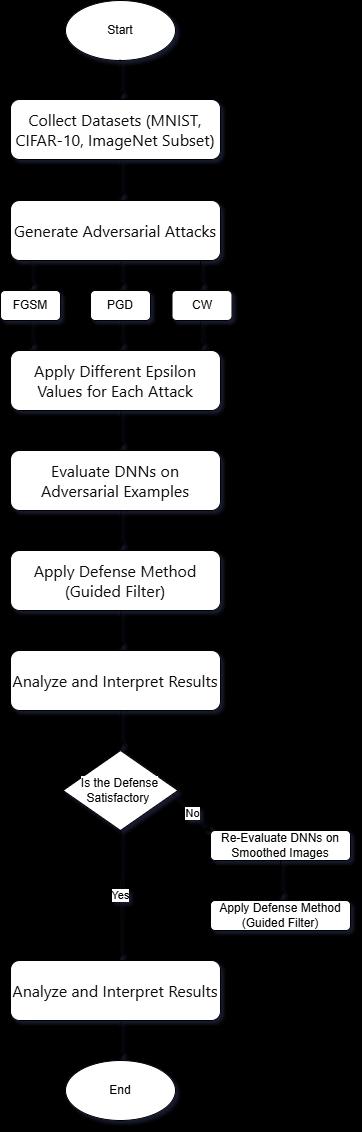
Fig -4:ExperimentsFlowchart
5.3 Defense
In order to mitigate these adversarial attacks, we used Spatial Smoothing, specifically through the Guided Filter. By employing a localized smoothing approach that maintains edge properties while reducing noise from adversarial changes, this technique reduces the impact of adversarial perturbations. To increase the model's resistance to the applied attacks, we used the Guided Filter.
6.1 ImageNet Dataset Results
Thetop-1accuracyofResNet-50onthisdatasetis76.06%.
The optimized ResNet-50 model was assessed on an ImageNet Subset dataset of 5,000 images, including a normalization procedure for standardization with designated mean and standard deviation values. The model employedasequentialarchitecture,integratingthe normalization layer with a pre-trained ResNet-50. A validationdatasetincluding2,500randomlypickedphotos was established, with preprocessing that included scaling to 224x224 pixels and conversion to tensors. The dataset wasimportedintoaDataLoaderforoptimizedevaluation.
The cross-entropy loss was employed for performance evaluation, and model robustness was examined against L∞ PGD, L∞ FGSM, L2 PGD, and L2 C&W adversarial attacks across multiple epsilon values, each producing distinct outcomes. To alleviate these concerns, Spatial Smoothing was used, particularly through the Guided Filtertoimproverobustnessagainstdisturbances.
Table -1: ImageNetDatasetResults
Volume: 11 Issue: 12 | Dec 2024 www.irjet.net p-ISSN: 2395-0072
Without the Guided Filter, models on ImageNet Subset experienced dramatic performance degradation as attack strengths increased. Under L∞ FGSM, robust accuracy decreasedfrom11.12%at1/255to6.64%at32/255,and L∞ PGD and L2 PGD attacks made the model nearly worthless, with robust accuracy falling to 0.00% at comparatively low epsilon values (e.g., 8/255). The L2 C&W attack showed a comparable pattern, entirely compromising the model with 0.00% accuracy. Nonetheless, the application of the Guided Filter resulted in significant enhancements across all categories of attacks. As an instance, the L∞ PGD applying the Guided Filter attained a robust accuracy of 73.60% at 1/255, sustaining 70.52% even at high epsilon values (e.g., 32/255), whereas the L2 C&W attack improved robust accuracy from 0.00% to 73.52%. Loss values remained minimalacrosseverycircumstancewiththefilterapplied, illustratingitsstabilizingeffect.
The basic architecture of ResNet-18 achieves a top-1 accuracy of 95.28%. The ResNet-18 model was assessed using the CIFAR-10 dataset, including color pictures of 32x32 pixels across 10 distinct classes. A normalization procedure was implemented to standardize the input photos during preprocessing. The dataset employed PyTorch'sintegratedCIFAR-10resources,withtheimages transformed into tensors to enhance training efficiency. A DataLoader was established with a batch size of 64 for effective data management. The model's efficacy was assessed using the cross-entropy loss function. Additionally, its resilience against adversarial attacks, L∞ PGD, L∞ FGSM, and L2 PGD, was evaluated by examining different epsilon values to assess their impact on performance. To improve the model's resilience against adversarial threats, Spatial Smoothing techniques were used,especiallytheGuidedFilter,tomitigatetheimpactof perturbations.
Table -2: CIFAR-10DatasetResults
1/255
2/255
8/255
PGD& GuidedFilter
PGD& GuidedFilter
OntheCIFAR-10dataset,attackssuchasL∞FGSMandL∞ PGD led to severe performance drops without defenses. Robust accuracy decreased from 67.40% to 16.78% with increasing epsilon values for L∞ FGSM and from 51.22% to0.01%forL∞PGD.AsimilarpatternwasnotedwithL2 PGD, where the starting accuracy of 31.77% decreased to 0.00%atelevatedepsilonvalues,underscoringsignificant model vulnerabilities. The Guided Filter significantly enhancedrobustaccuracy:L∞FGSMmaintainedaccuracy at almost 93% for lower epsilon values and 74.36% for 32/255, whereas L∞ PGD achieved 93% robust accuracy for smaller epsilons and above 87.29% for higher perturbations. Likewise, L2 PGD using the Guided Filter showed robust performance, start at 93.34% at 0.25 epsilonandsustainingabove75%evenat8.00epsilon.
2/255 93.41% 0.2949 4/255 93.20%
L∞FGSM& GuidedFilter 1/255 93.45% 0.2951
MNIST fundamental architecture, the top-1 accuracy of LeNet is 98.99%. The LeNet model was evaluated using the MNIST dataset, consisting of 28x28 pixel grayscale images of handwritten numbers. The model used a normalizationproceduretostandardizeinputphotos.The
International Research Journal of Engineering and Technology (IRJET) e-ISSN: 2395-0056
Volume: 11 Issue: 12 | Dec 2024 www.irjet.net p-ISSN: 2395-0072
training and test datasets were generated via a custom Dataset class that imported photos from CSV files, standardizing the pixel values to the interval [0, 1]. A DataLoader was employed to efficiently batch the data with a size of 32. The model's efficacy was evaluated by cross-entropy loss. Furthermore, adversarial robustness was evaluated against FGSM and PGD attacks, examining the impact of different epsilon values on performance. A Spatial Smoothing defense technique was employed to improve robustness against adversarial threats, specificallythroughtheuseoftheGuidedFilter.
Table -3: MNISTDatasetResults
1/255 98.86% 0.0006
2/255 98.65% 0.0007
4/255 98.19% 0.0009
L∞FGSM
L∞FGSM& GuidedFilter
8/255 96.85% 0.0015
16/255 91.71% 0.0042
32/255 60.88% 0.0221
1/255 99.01% 0.0320
2/255 99.01% 0.0320
4/255 99.03% 0.0324
8/255 98.98% 0.0330
16/255 98.89% 0.0353
32/255 98.60% 0.0453
1/255 99.64% 0.0004
2/255 99.50% 0.0005
4/255 99.13% 0.0008
L∞PGD
L∞PGD& GuidedFilter
L2PGD
8/255 97.64% 0.0019
16/255 90.74% 0.0080
32/255 44.78% 0.0630
1/255 99.71% 0.0132
2/255 99.70% 0.0134
4/255 99.70% 0.0137
8/255 99.68% 0.0146
16/255 99.58% 0.0173
32/255 99.25% 0.0272
0.25 98.97% 0.0009
0.50 96.95% 0.0024
1.00 86.11% 0.0124 2.00 26.25% 0.1084 4.00 0.10% 0.4697 8.00 0.00% 0.9533
L2PGD& GuidedFilter 0.25 99.70% 0.0004 0.50 99.70% 0.0004
On MNIST, the observed degradation without defenses followed a similar pattern. Under L∞ FGSM, accuracy decreased from 98.86% at 1/255 to 60.88% at 32/255, whileL∞PGDsimilarlydroppedfrom99.64%to44.78%. L2 PGD attacks were especially destructive, decreasing robust accuracy from 98.97% at 0.25 epsilon to 0.00% at 8.00 epsilon. The Guided Filter significantly enhanced results, with L∞ FGSM sustaining a strong accuracy of over 99.00% for all epsilon levels, decreasing slightly to 98.60%at32/255.InthecaseofL∞PGD,robustaccuracy continuallyabove99.25%,evenatelevatedepsilonvalues, whereas L2 PGD demonstrated comparable performance, attaining 99.70% at 0.25 epsilon and sustaining a commendable 94.91% at 8.00 epsilon, accompanied by minimallossvalues.
This research methodically examined the adversarial robustness of neural networks across three datasets (ImageNet Subset, CIFAR-10, and MNIST) under several attack,includingL∞FGSM,L∞PGD,L2PGD,andL2C&W attacks. The research primarily aimed to assess the performance degradation that generated by adversarial perturbations and the efficacy of the Guided Filter, a Spatial Smoothing method, in addressing these impacts. This study emphasizes the significance of preprocessing defenses, such as the Guided Filter, in effectively mitigating adversarial vulnerabilities. Achieving robust AI systems requires the integration of preprocessing approaches with other strategies, including adversarial training, input transformations, or feature denoising, to establish comprehensive and layered defenses. The Guided Filter functions as an effective initial safeguard, enhancing model-level approaches for adversarial robustness.
While this study demonstrated the effectiveness of the Guided Filter across diverse datasets and attacks, several limitations and future research directions are worth highlighting:
Dataset
WhiletheGuidedFilterperformedwellonMNIST, CIFAR-10, and the Subset of ImageNet, future work is needed to evaluate its scalability and efficacyonmorechallengingdatasetswithgreater diversity and complexity, such as ImageNet-Adv orCOCO.
Standardadversarialattackswereassessedinthe currentstudy,butfutureresearchshouldexamine
International Research Journal of Engineering and Technology (IRJET) e-ISSN: 2395-0056
Volume: 11 Issue: 12 | Dec 2024 www.irjet.net p-ISSN: 2395-0072
how robust the Guided Filter is against adaptive attacks that are specifically built to go over defenses.
Real-Time Applications
To ensure the Guided Filter is suitable for deployment in time-sensitive or resourceconstrainedenvironments,itsefficacyinreal-time contexts must be assessed by analyzing its computationaloverheadandlatency.
9. REFERENCES
[1] Szegedy,C.,Zaremba,W.,Sutskever,I.,Bruna,J.,Erhan, D., Goodfellow, I., & Fergus, R. (2013b). Intriguing properties of neural networks. arXiv (Cornell University). https://doi.org/10.48550/arxiv.1312.6199
[2] Goodfellow, I. J., Shlens, J., & Szegedy, C. (2015). Explaining and Harnessing Adversarial Examples. International Conference on Learning Representations.https://ai.google/research/pubs/pu b43405
[3] Muthuraman, A. A., Kathir, R. M., Pragadeesh, T., & Rajam, V. M. A. (2024b). Entropy Aware Spatial Smoothing in Removal of Perturbation as a Defense Against Adversarial Attacks. 2022 13th International Conference on Computing Communication and Networking Technologies (ICCCNT), 1–8. https://doi.org/10.1109/icccnt61001.2024.1072566 4
[4] Muoka,G.W.,Yi,D.,Ukwuoma,C.C.,Mutale,A.,Ejiyi,C. J., Mzee, A. K., Gyarteng, E. S. A., Alqahtani, A., & AlAntari, M. A. (2023). A Comprehensive Review and Analysis of Deep Learning-Based Medical Image Adversarial Attack and Defense. Mathematics,11(20), 4272.https://doi.org/10.3390/math11204272
[5] Tramer,F.,Carlini,N.,Brendel,W.,&Madry,A.(2020). OnAdaptiveAttackstoAdversarialExampleDefenses. arXiv (Cornell University). https://doi.org/10.48550/arxiv.2002.08347
[6] Costa, J. C., Roxo, T., Proença, H., & Inácio, P. R. M. (2024).HowDeepLearningSeesthe World:ASurvey on Adversarial Attacks & Defenses. IEEE Access, 12, 61113–61136. https://doi.org/10.1109/access.2024.3395118
[7] Krizhevsky, A. (2009). Learning Multiple Layers of Features from Tiny Images. https://www.cs.toronto.edu/~kriz/learning-features2009-TR.pdf
[8] Lecun, Y., Bottou, L., Bengio, Y., & Haffner, P. (1998). Gradient-based learning applied to document recognition. Proceedings of the IEEE, 86(11), 2278–2324.https://doi.org/10.1109/5.726791
[9] Deng,J.,Dong, W., Socher,R.,Li,L.,Li,N.K., &Fei-Fei, N. L. (2009). ImageNet: A large-scale hierarchical image database. 2009 IEEE Conference on Computer Vision and Pattern Recognition. https://doi.org/10.1109/cvpr.2009.5206848
[10] Madry, A., Makelov, A., Schmidt, L., Tsipras, D., & Vladu, A. (2018). Towards Deep Learning Models Resistant to Adversarial Attacks. arXiv (Cornell University).http://arxiv.org/pdf/1706.06083.pdf
[11] Carlini,N.,&Wagner,D.(2017).AdversarialExamples Are Not Easily Detected: Bypassing Ten Detection Methods. arXiv (Cornell University). https://doi.org/10.48550/arxiv.1705.07263
[12] He, K., Zhang, X., Ren, S., & Sun, J. (2015). Deep Residual Learning for Image Recognition. arXiv (Cornell University). https://doi.org/10.48550/arxiv.1512.03385
[13] Kurakin, A., Goodfellow, I. J., & Bengio, S. (2018). Adversarial Examples in the Physical World. In Chapman and Hall/CRC eBooks (pp. 99–112). https://doi.org/10.1201/9781351251389-8
[14] Carlini, N., & Wagner, D. (2016). Towards Evaluating the Robustness of Neural Networks. arXiv (Cornell University). https://doi.org/10.48550/arxiv.1608.04644

Mujeeb Ullah Daudzai Master'sstudentwithprimary researchinterestsinartificial intelligence,cybersecurity,machine learning,andbigdata. mujeebdaudzai888@gmail.com
Zhang Xinyou
Ph.D. Associate Professor with primary research focuses on distributed computing applications, network security, and artificial intelligence. xyzhang@swjtu.edu.cn