
International Research Journal of Engineering and Technology (IRJET) e-ISSN: 2395-0056
Volume: 13 Issue: 06 | Jun 2026 www.irjet.net p-ISSN: 2395-0072
International Research Journal of Engineering and Technology (IRJET) e-ISSN: 2395-0056
Volume: 13 Issue: 06 | Jun 2026 www.irjet.net p-ISSN: 2395-0072
Macha Harsha Vardhan1 , Dr. A. Damodaram2
1M.Tech Scholar, Dept of CSE JNTUH UCESTH, Hyderabad, Telangana, India
2Senior Professor, Dept of CSE JNTUH UCESTH, Hyderabad, Telangana, India
Abstract - Surveillance systems are extensively deployed in both public and private environments for security monitoring; however, conventional approaches largely rely on manual supervision, which makes them inefficient for analyzinglargevolumesofvideodatafrommultiplecamera feeds.Toovercometheselimitations,thisprojectintroduces a Multi-Camera Behavioural Surveillance Framework (MCBSF) designed to automatically perform human detection, tracking, and behavioural interpretation in real time using advanced deep learning methods. The proposed framework is built to ensure continuous monitoring of individuals across multiple camera networks while identifying abnormal or suspicious activities. It integrates the YOLOv8n model for fast and precise person detection, along with a person re-identification module that helps maintain consistent identity tracking when individuals transition between different camera views. This ensures reliable cross-camera association even in complex surveillance environments. Behavioural understanding is achieved by analyzing spatiotemporal features such as movement trajectories, velocity changes, interaction patterns, andtime-basedactivitysequences. Basedonthese features, the system detects various activities including running, loitering, crowd gathering, unauthorized perimeter entry, fall incidents, and other unusual motion patterns. A combination of rule-based logic and motion smoothing techniques is applied to enhance decision stability, thereby reducing false positives and improving detectionreliability. Experimentalevaluation indicates that the proposed framework delivers efficient real-time processing, improved accuracy in behaviour recognition, and consistent multi-camera tracking performance. The system is suitable for deployment in smart surveillance scenarios such as public safety monitoring, educational institutions, industrial zones, transportation hubs, and commercial complexes, offering a scalable and intelligent solutionformodernsecurityapplications.
Key Words: YOLOv8, DeepSORT, Long Short-Term Memory (LSTM), Person Re-Identification, Behaviour Analysis, Computer Vision, Exponential Moving Average (EMA), Real-Time Object Tracking, Intelligent Surveillance System
Surveillance systems play a crucial role in ensuring security and monitoring activities in public and private
environments such as campuses, industries, transport hubs, and commercial spaces. However, most traditional systems rely heavily on human operators to continuously observemultiplecamerafeeds,whichbecomesinefficient, error-prone, and impractical in large-scale surveillance scenarios.
With the rapid increase in video data and the widespread deployment of CCTV cameras, there is a growing need for intelligent surveillance solutions that can automatically analyze human behaviour in real time. Advances in deep learning have enabled significant progress in computer visiontaskssuchasobjectdetection,tracking,andactivity recognition. Models like YOLO provide fast and accurate detection, while tracking algorithms such as DeepSORT help maintain object identities within a single camera. However,maintainingidentityconsistencyacrossmultiple cameras and accurately interpreting complex human behavioursremainchallengingtasks.
To overcome these limitations, this project proposes a Multi-Camera Behavioural Surveillance Framework (MCBSF) that integrates deep learning-based detection, multi-object tracking, person re-identification, and behaviouralanalysisintoaunifiedsystem.Theframework is designed to monitor human activities across multiple camera feeds in real time, detect abnormal behaviours suchasrunning,loitering,crowdformation,andintrusion, and generate alerts through a centralized dashboard, thereby improving overall surveillance efficiency and reliability.
The field of intelligent video surveillance has gained significant attention in recent years due to the increasing demandforautomatedsecuritysystems.Researchershave explored various deep learning-based approaches to replace traditional manual monitoring methods. Among these, object detection models such as YOLO (You Only Look Once) have been widely adopted because of their ability to perform real-time detection with high accuracy. Thelatestversions,includingYOLOv8,havedemonstrated improved performance in detecting humans in crowded andcomplexenvironments.
In addition to detection, multi-object tracking has been extensively studied to maintain object identities across
International Research Journal of Engineering and Technology (IRJET) e-ISSN: 2395-0056
Volume: 13 Issue: 06 | Jun 2026 www.irjet.net p-ISSN: 2395-0072
video frames. Algorithms like DeepSORT combine motion estimation and appearance features to track individuals effectively within a single camera view. However, extending tracking across multiple cameras remains a challenging task due to variations in lighting, viewpoint changes,andocclusions.Toaddressthis,researchershave introduced person re-identification techniques that use deep feature embeddings to match individuals across differentcamerafeeds.
Behaviour analysis is another important area in surveillance research, where temporal models such as LSTM are used to understand sequential movement patterns and detect abnormal activities. These models help in identifying actions like running, loitering, crowd formation,andsuddenfalls.Somestudiesalsoincorporate rule-based systems and statistical smoothing techniques like Exponential Moving Average (EMA) to improve predictionstabilityandreducefalsealarms.Despitethese advancements, fully integrated multi-camera behavioural surveillancesystemsstillfacechallengesinachievinghigh accuracy and real-time performance, motivating further researchinthisdomain.
Modern surveillance systems are widely deployed in public and private environments; however, most of them still rely on manual monitoring of multiple camera feeds, which is inefficient, time-consuming, and prone to human error. As the number of surveillance cameras increases, it becomes increasingly difficult for human operators to continuously analyze live video streams and identify suspiciousactivitiesinrealtime.
Existingautomatedsurveillanceapproachesoftenfocuson single-camera detection and tracking, which limits their effectiveness in large-scale environments where individuals move across multiple camera views. Challenges such as identity switching, occlusion, varying illumination, and changes in camera angles make it difficult to maintain consistent tracking of individuals. Additionally, accurate detection of complex human behaviours such as loitering, running, crowd formation, and abnormal motion patterns remains a difficult task in dynamicreal-worldconditions. Therefore, there is a need for an intelligent and scalable multi-camera surveillance framework that can automatically detect, track, and analyze human behaviour across distributed camera networks. The system should ensure reliable person re-identification, minimize false alarms, and provide real-time alerts for suspicious activities, thereby improving overall security monitoring efficiency and reducing dependence on manual supervision.
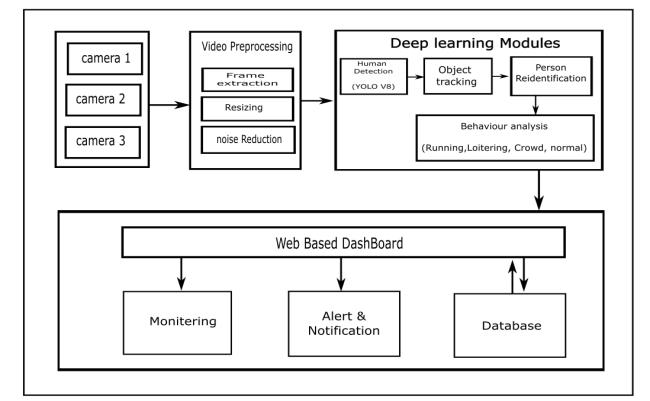
The development of the Multi-Camera Behavioural Surveillance Framework (MCBSF) follows a structured module-based implementation strategy to ensure smooth integration of detection, tracking, re-identification, and behavioural analysis components. Each module is developed independently and later integrated into a unifiedpipelineforreal-timesurveillance.
The system begins with the video input setup, where multipleCCTVcamera feeds areconnectedandprocessed using a frame extraction pipeline. Each frame is standardized and forwarded to the detection module for furtherprocessing.
The human detection module is built using the YOLOv8n architecture, which is trained and optimized for real-time person detection. The model outputs bounding boxes and confidence scores for every detected individual, forming thebasisfortrackingandanalysis.
Next, the tracking module is implemented using DeepSORT, which links detections across consecutive frames.ItassignsuniqueIDstoindividualsandmaintains their movement history using motion prediction and appearance feature matching, reducing identity switching withinacamera.
There-identificationmoduleisdevelopedtohandlecrosscamera tracking. Feature embeddings are extracted for each detected person and stored in a feature database. These embeddings are then compared across multiple camera feeds to maintain identity consistency even when visualconditionschange.
The behaviour analysis module is built using temporal feature extraction techniques, where movement patterns such as speed, direction, and trajectory are analyzed. An LSTM-based approach and rule-based logic are combined
Volume: 13 Issue: 06 | Jun 2026 www.irjet.net
to classify behaviours like running, loitering, crowd formation,andintrusionevents.
Finally, the alert and dashboard module is integrated to visualizeresultsinrealtime.Whenabnormalbehaviouris detected, alerts are generated and displayed on a centralized monitoring interface, enabling quick response anddecision-making.
This modular development approach ensures scalability, easydebugging,andefficientintegrationofallcomponents intoacompletesurveillancesystem.
The Multi-Camera Behavioural Surveillance Framework (MCBSF) utilizes a combination of specialized datasets to support different functional modules of the system. For thehumandetectionmodule,large-scaleannotatedimage datasets containing pedestrians in diverse surveillance environments are used. These images include crowded scenes,indoorandoutdoorlocations,varyingillumination conditions,andpartiallyoccludedindividuals.Eachhuman instanceislabeledwithboundingboxannotationsundera single class “person,” enabling the YOLOv8n model to learn accurate object localization and detection. Data augmentation techniques such as scaling, flipping, rotation, and brightness adjustment are applied to improvemodelrobustnessandgeneralization.
For tracking, re-identification, and behaviour analysis modules, sequential video datasets are used where temporal continuity is preserved across frames. The tracking dataset supports identity consistency within a single camera, while the person re-identification dataset contains images of the same individuals captured from multiple camera views with variations in pose, angle, and background. This helps the system learn discriminative feature embeddings for cross-camera matching. Additionally, behaviour analysis datasets consist of annotated video clips representing activities such as walking, running, loitering, crowd formation, fall detection, and intrusion events. These datasets capture motion trajectories, speed variations, and interaction patterns, enabling effective temporal learning and anomalydetection.

International Research Journal of Engineering and Technology (IRJET) e-ISSN: 2395-0056
Volume: 13 Issue: 06 | Jun 2026 www.irjet.net p-ISSN: 2395-0072
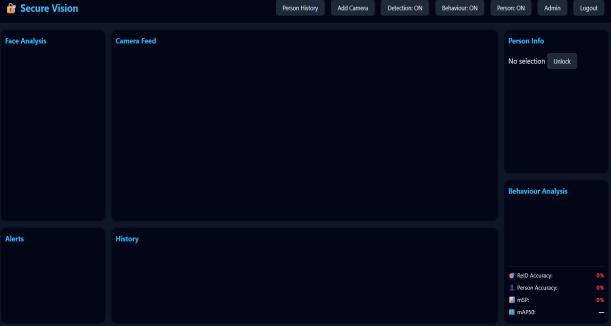
The web-based dashboard functions as the primary control interface of the surveillance system, providing a centralized platform for user interaction. It enables administratorstoconfigureandmanagecameras,observe live video streams in real time, and access detailed information about detected individuals. The system also delivers immediate alerts when unusual or suspicious behavior is identified and allows users to review stored surveillance history for further investigation. Designed with a simple and intuitive interface, it ensures smooth operation and efficient monitoring of all integrated modules.
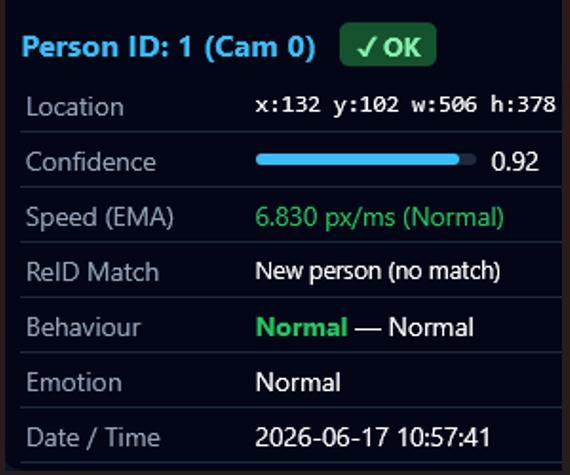
Fig 6 :output
The surveillance system successfully detected and locked onto a male subject, assigning him as Person ID 1 on Camera0withahighconfidencescoreof0.92,placinghis boundingboxatcoordinatesx:132,y:102withdimensions 506×378pixels.Thesubjectwasrecordedmovingat6.830 px/ms, classified within the normal mobility range, while the real-time behavioral analysis module evaluated his activityandemotionalstateasentirelyNormal,indicating no suspicious or threatening patterns at the time of capture. Upon performing a cross-frame Re-Identification lookup, the system returned no prior match, flagging him as a newly encountered individual, with the detection session timestamped at 10:57:41 on June 17, 2026, and confirmedwithaverifiedOKstatus.
The proposed surveillance system integrates multiple intelligent modules into a unified framework for efficient and reliable monitoring of human activities. The webbased dashboard acts as the central interface, allowing seamless control over camera management, live video surveillance, and access to detailed person-level information. By incorporating real-time alert mechanisms and historical data analysis, the system enhances situational awareness and supports timely decisionmaking. Overall, the combination of advanced detection, tracking, and behavior analysis techniques results in a robust and scalable solution for modern security applications.
[1] Bochkovskiy, A., Wang, C. Y., & Liao, H. Y. M. (2020). YOLOv4: Optimal Speed and Accuracy of Object Detection.arXiv:2004.10934.
[2] Tarvainen,A.,&Valpola,H.(2017).MeanTeachersare Better Role Models: Weight-Averaged Consistency Targets Improve Semi-Supervised Deep Learning NeurIPS.
[3] Zhang, S., et al. (2019). FixMatch: Simplifying SemiSupervised Learning with Consistency and Confidence.NeurIPS.
[4] Xie, Q., et al. (2020). Self-training with Noisy Student improvesImageNetclassification.CVPR.
[5] Li, Y., et al. (2021). Temporal Ensembling and EMAbasedLearningforVideoUnderstanding.IEEEAccess.
[6] He, K., et al. (2020). Momentum Contrast for UnsupervisedVisualRepresentationLearning(MoCo). CVPR.
[7] Wu, Y., et al. (2018). A Study on Exponential Moving Average in Deep Neural Network Optimization. arXiv:1805.00180.
[8] Wang, H., et al. (2022). Deep Learning-based Human Activity Recognition using Temporal Smoothing Techniques.IEEESensorsJournal.
[9] Singh, R., et al. (2023). Real-Time Surveillance Systems using EMA-based Behavior Filtering. IEEE Access.
[10] Liu, Z., et al. (2023). Spatio-Temporal Human Behavior Analysis using Deep Learning. IEEE TransactionsonMultimedia.
[11] Zhangqiang Ming, Min Zhu, Xiangkun Wang, Jiamin Zhu, Junlong Cheng, Chengrui Gao, YongYang, "Deep learning-based person re-identification methods: A survey and outlook of recent works",Volume 119, 2022,10439, https://doi.org/10.1016/j.imavis.2022.104394
[12] R. Zhao, W. Ouyang, and X. Wang, “Person reidentificationbysaliencematching,”inProceedingsof the 2013 14th IEEE International Conference on Computer Vision, ICCV 2013, pp. 2528–2535, aus, December2013.