
International Research Journal of Engineering and Technology (IRJET) e-ISSN: 2395-0056
Volume: 13 Issue: 05 | May 2026 www.irjet.net p-ISSN: 2395-0072
International Research Journal of Engineering and Technology (IRJET) e-ISSN: 2395-0056
Volume: 13 Issue: 05 | May 2026 www.irjet.net p-ISSN: 2395-0072
Mr. Suraj Pawar1 , Vishwajeet Mahadik2 , Shrikant Pilave3, Vaibhav Kumbhar4, Prof. shrikant Kadam5
1 B.Tech Student, Dept of Computer Engineering, JCEP College
KM Gad Sangli, Maharashtra, India
2 B.Tech Student, Dept of Computer Engineering, JCEP College
KM Gad Sangli, Maharashtra, India
3 B.Tech Student, Dept of Computer Engineering, JCEP College
KM Gad Sangli, Maharashtra, India
4 B.Tech Student, Dept of Computer Engineering, JCEP College
KM Gad Sangli, Maharashtra, India
5 Associate Professor, Dept of Computer Engineering, JCEP College
KM Gad Sangli, Maharashtra, India ***
Abstract - Electronic voting systems are becoming increasingly important due to the growing demand for secure, transparent, and efficient election processes. Traditional voting methods often face challenges such as centralized control, vote tampering, voter impersonation, lack of transparency, and slow vote counting. This paper presents a Decentralized E-Voting System using Blockchain and Face Recognition to overcome these limitations by combining blockchain technology with biometric authentication. The proposed system uses Ethereum blockchain and Solidity smart contracts to ensure secure, transparent, and tamper-proof vote recording. A hybrid storage model is implemented in which important voting data is stored on-chain, while large files such as identity documents and facial images are maintained off-chain to improve storage efficiency. Face recognition authentication is implemented using OpenCV and the LBPH algorithm to verify voter identity and prevent unauthorized voting. The backend of the system is developed using FastAPI, while HTML, CSS, and JavaScript are used to build the frontend interface. The system supports administrator, voter, and candidate roles for secure election management and realtime result generation. Experimental results show that the proposed system improves election security, transparency, and reliability while reducing manual intervention and the riskofdoublevoting.
Key Words: Blockchain, Electronic Voting, Decentralized Voting System, Ethereum, Smart Contracts, Face Recognition, Transparency, FastAPI, OpenCV
The rapid growth of digital technology has transformed many sectors such as banking, healthcare, education, and governance. Despite these advancements, voting systems inseveralregionsstilldependontraditionalmethodsthat are often slow, inefficient, and vulnerable to fraud or manipulation. Maintaining transparency, security, and public trust during elections continues to be a major challenge in modern democratic systems. Even existing electronic voting systems face issues because of centralized architectures, which increase the risk of data tampering,unauthorizedaccess,andsystemfailure.
Blockchain technology has emerged as a reliable solution for developing secure and decentralized applications. Features such as decentralization, immutability, transparency,andcryptographicsecuritymakeblockchain highlysuitableforelectronicvotingsystems.Byrecording votesonadistributedledger,blockchainhelpsensurethat election data cannot be modified once stored and allows transparent verification of results without relying on a centralauthority.
This research presents a Decentralized E-Voting System usingBlockchainandFaceRecognitiontoprovideasecure and transparent digital voting platform. The proposed system integrates Ethereum blockchain technology with biometric authentication to strengthen voter verification and election integrity. Smart contracts developed using Solidity automate important election operations such as
International Research Journal of Engineering and Technology (IRJET) e-ISSN: 2395-0056
Volume: 13 Issue: 05 | May 2026 www.irjet.net p-ISSN: 2395-0072
voter registration, candidate verification, election management,votecasting,andresultgeneration.
To improve authentication security, the system uses face recognitiontechnologyimplementedwithOpenCVandthe Local BinaryPatternHistogram(LBPH)algorithm. During registration,votersuploadfacialdatathatislaterusedfor identity verification during voting. This process reduces thechancesofimpersonationandunauthorizedvoting.
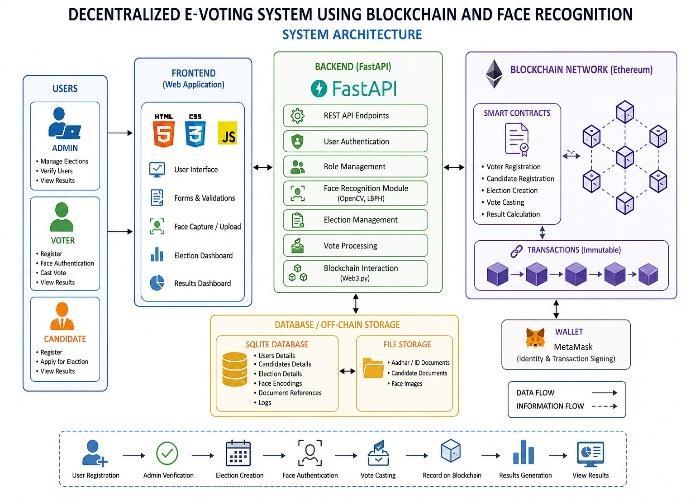
The proposed system follows a hybrid architecture in which critical election data and voting transactions are stored on the blockchain, while large files such as facial images and identity documents are maintained off-chain. This approach improves scalability, reduces blockchain storage costs, and maintains data integrity through cryptographic hashing techniques. The backend is developed using FastAPI and Web3.py for blockchain interaction, while HTML, CSS, and JavaScript are used to create a user-friendly frontend interface. The system supports different user roles including administrator, voter, and candidate for efficient election management andsecureparticipation.
The proposed decentralized voting platform aims to overcome the limitations of traditional voting systems by improving transparency, preventing double voting, strengthening voter authentication, and reducing manual intervention. The project demonstrates how blockchain and biometric technologies can be combined to develop secure and reliable next-generation electronic voting systems for educational institutions, organizations, and futurelarge-scaleapplications.
The rapid growth of digital technologies and increasing concerns regarding election security have encouraged researchers to explore blockchain technology as a reliable solution for modern electronic voting systems. Traditional voting methods often face problems such as centralized control, vote tampering, lack of transparency, voter impersonation, and delays in result generation. To overcomethesechallenges,manyresearchershavefocused on developing decentralized voting frameworks using blockchain technology, smart contracts, and biometric authenticationtechniques.
M. M. H. Onik et al. [1] discussed the importance of blockchain technology in Industry 4.0 applications and explaineditspotential insecureelectronic votingsystems. Theirstudyhighlightedimportantblockchainfeaturessuch asdecentralization,transparency,immutability,andsecure transaction management, which make blockchain suitable for modern digital elections. However, the authors also pointed out challenges related to scalability, privacy, and implementation complexity in blockchain-based voting systems.
A. K. Singh and R. Kumar [2] reviewed blockchain-based electronic voting systems and concluded that blockchain technology improves election transparency and reduces the risk of vote manipulation. Their research mainly focusedondistributedledgerarchitectureandsecurevote recording mechanisms. Similarly, S. Pawar and R. Sharma [3] proposed a smart contract-based e-voting framework usingEthereumblockchain.Theirworkdemonstratedthat Solidity smart contracts can automate voting operations andreducemanualinterventioninelectionmanagement.
H. Patel and D. Shah [4] developed a decentralized voting system using Ethereum blockchain and explained how distributed ledger technology helps prevent unauthorized modifications to voting records. Their study also emphasized the importance of cryptographic security and transparency in decentralized election systems. P. Sharma and A. Verma [5] further extended this concept by integrating biometric authentication with blockchain voting systems. Their research showed that combining blockchain technology with biometric verification improves voter authentication and reduces impersonation attacks.
M. Gupta and S. Jain [6] implemented a smart contractbased e-voting system and demonstrated that Ethereum smartcontractscanefficientlyautomatevoterregistration, vote casting, andresultgeneration processes. K.Rathiand V. Kulkarni [7] proposed a blockchain-powered transparent voting mechanism that focused on improving public trust through immutable and transparent vote storage. Similarly, T. Nguyen and L. Tran [8] introduced a securee-votingframeworkusingEthereumblockchainand analyzedhowdecentralizedarchitectureimproveselection integrityandpreventsdatatampering.
Authentication and voter verification have become important research areas in modern voting systems. R. Mehta and P. Deshmukh [9] proposed a face recognitionbased authentication mechanism for secure electronic voting. Their work demonstrated that biometric verification can reduce voter impersonation and improve election security. Likewise, R. Gupta [10] reviewed different biometric authentication techniques for online voting systems and concluded that biometric verification significantly strengthens identity validation in digital elections.
S. Nakamoto [11] introduced the foundational concepts of blockchain technology and distributed systems, which established the principles of decentralized and tamperprooftransactionmanagementusedinmodernblockchain applications, including e-voting systems. Y. Chen and H. Wang [12] focused on security analysis of smart contracts in Ethereum-based voting systems and highlighted
International Research Journal of Engineering and Technology (IRJET) e-ISSN: 2395-0056
Volume: 13 Issue: 05 | May 2026 www.irjet.net p-ISSN: 2395-0072
possible vulnerabilities such as reentrancy attacks and transaction manipulation. Their study emphasized the importance of secure smart contract development and propertestingpractices.
Storageefficiencyandscalabilityremainmajorconcernsin blockchain-based voting systems. A. Joshi and M. Kulkarni [13] proposed a hybrid on-chain and off-chain storage model to reduce blockchain storage overhead while maintaining data integrity. Their research inspired the adoption of hybrid storage architectures in modern blockchain applications. D. Lee and J. Kim [14] discussed scalabilitychallengesinblockchain-basede-votingsystems and identified issues such as transaction latency, gas fees, andnetworkcongestionthataffectlarge-scaledeployment.
Recent studies have also explored transparency, governance, and decentralized application developmentin blockchain voting systems. M. Arora and S. Patil [15] presented a secure and transparent voting framework using blockchain technology and demonstrated how blockchainimproveselectionauditabilityandreliability.V. Singh and P. Sharma [16] developed a blockchain-based decentralizedapplicationforonlinevotingandhighlighted theimportanceofdistributedgovernanceandaccessibility indigitalelectionsystems.
N.K.RaoandA.Mishra[17]proposedanelectronicvoting system using blockchain and face recognition technology. Their work is closely related to the proposed system because it combines biometric authentication with decentralized vote storage. The study concluded that integrating blockchain with facial recognition improves electiontransparencyandvoterverification.S.Bhosaleand R. Patil [18] worked on Ethereum smart contract optimization techniques for voting applications and suggested methods for reducing gas consumption and improvingtransactionefficiency.
Security and privacy challenges in decentralized voting systems have also been widely discussed in recent research. P. K. Sharma [19] analyzed security and privacy risks in blockchain-based voting systems and highlighted issues related to voter anonymity, cyberattacks, and data leakage. H. Lee [20] further examined cybersecurity risks in decentralized voting applications and emphasized the need for secure authentication mechanisms, encryption techniques,andinfrastructureprotection.
Recent advancements have also focused on scalability improvements and advanced authentication technologies. A. R. Khan and M. Ali [21] proposed blockchain-powered governance systems for secure digital administration and elections. R. Verma and S. Chauhan [22] discussed advanced face recognition techniques for secure authentication systems and recommended deep learning-
based approaches for improving authentication accuracy and robustness. T. Joseph and K. Roy [23] introduced Layer-2 blockchain solutions to improve scalability and reduce transaction costs in blockchain-based voting systems.
The integration of blockchain and biometric technologies has received significant attention in recent years. M. Patel and J. Fernandes [24] discussed blockchain and biometric integration for digital elections and demonstrated that combining decentralized architectures with biometric authentication improves election integrity and transparency. Finally, S. Kulkarni and A. Patwardhan [25] explored the future scope of blockchain-based national voting systems and concluded that decentralized voting platforms have the potential to transform large-scale democratic processes through transparency, automation, andsecuredigitalgovernance.
From the reviewed literature, it is clear that blockchain technologyprovidesstrongcapabilitiesforbuildingsecure, transparent, and tamper-proof electronic voting systems. However, many existing systems still face challenges related to scalability, voter authentication, privacy, and storage efficiency. The proposed Decentralized E-Voting System addresses these limitations by integrating Ethereum blockchain, Solidity smart contracts, face recognition-based biometric authentication, and a hybrid on-chain/off-chain storage architecture to develop a secure,reliable,andscalabledigitalvotingplatform.
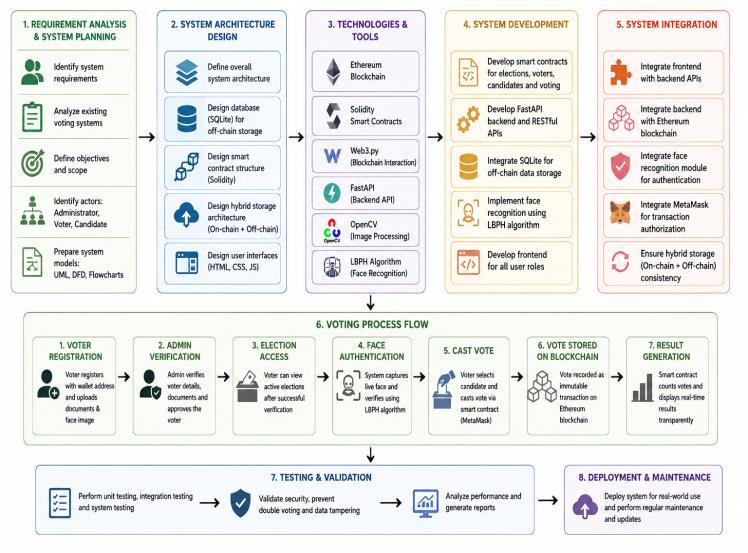
The proposed Decentralized E-Voting System using Blockchain and Face Recognition follows a hybrid methodology that combines blockchain technology, biometric authentication, and web-based application development to create a secure and transparent voting platform. The methodology mainly focuses on improving election security, maintaining data integrity, preventing voter fraud, and reducing manual intervention during the voting process. The system integrates Ethereum blockchain, FastAPI backend services, face recognition techniques, and a web-based interface to build a decentralizedvotingenvironment.
The development process started with system planning andrequirementanalysis.Duringthisstage,themajoruser roles were identified as Administrator, Voter, and Candidate. The administrator manages elections and verifies users, voters participate in elections after successful authentication, and candidates apply for elections and contest after approval. Different design modelssuchasDataFlowDiagrams(DFD),UMLdiagrams, flowcharts, and system architecture diagrams were
International Research Journal of Engineering and Technology (IRJET) e-ISSN: 2395-0056
Volume: 13 Issue: 05 | May 2026 www.irjet.net p-ISSN: 2395-0072
preparedtodefineworkflowsandcommunicationbetween systemmodules.
Blockchain technology acts as the core component of the proposed system. Ethereum blockchain was selected because of its decentralized structure and support for smart contracts. Smart contracts were developed using Soliditytoautomateimportantelectionactivitiesincluding voterregistration,candidateregistration,electioncreation, vote casting, and result generation. Once deployed on the blockchain, these contracts automatically execute predefinedrulesandensurethatvotingrecordscannotbe modified. Each vote is stored as a blockchain transaction, which helps maintain transparency and immutability throughouttheelectionprocess.
For development and testing, the blockchain network was deployed locally using Ganache, which provides a private Ethereum environment. MetaMask wallet integration was implemented for secure account management and transaction authorization. Communication between the backend and blockchain network was established using Web3.py, enabling interaction with deployed smart contractsandblockchaindata.
ThebackendofthesystemwasdevelopedusingFastAPI,a lightweightand high-performance Python framework. The backend handles API requests, user authentication, blockchain communication, and election-related operations. It also manages voter verification, candidate approval, election timelines, and duplicate voting prevention. SQLite database technology was used to store off-chain data such as user information, document references,andfacialrecognitiondata.
To strengthen authentication security, face recognition technology was integrated into the system. OpenCV was used for image processing and face detection. The Haar Cascade Classifier algorithm detects facial regions from uploadedimages,whiletheLocalBinaryPatternHistogram (LBPH) algorithm is used for face recognition. During the voting process, facial features captured from the user are compared with previously stored data to verify voter identity.Thismechanismhelpspreventimpersonationand unauthorizedvoting.
Theproposedsystemfollowsahybridstoragearchitecture toimprovescalabilityandreduceblockchainstoragecosts. Important election records such as votes, transaction hashes,andelectiondetailsarestoredon-chain,whilelarge files including Aadhaar documents and facial images are maintained off-chain in the database. Cryptographic hashing techniques such as Keccak-256 are used to maintainintegritybetweenon-chainandoff-chaindata.
The frontend of the application was developed using HTML, CSS, and JavaScript to provide a simple and user-
friendly interface. Separate dashboards were designed for administrators,voters,andcandidates.Thefrontendallows users to register, upload documents, complete authentication, participate in elections, and view election results in real time. REST APIs developed using FastAPI enable communication between frontend and backend modules.
The voting process follows a secure sequence of operations. Initially, voters register using their blockchain wallet address and upload identity documents along with facial images. After verification by the administrator, eligible users can participate in active elections. During voting, the system performs face recognition authentication before allowing vote casting. Once verified, the vote is recorded as an immutable blockchain transaction,andsmartcontractsautomaticallyupdatevote countsandgenerateresultsinrealtime.
Testing and validation were conducted in a controlled environment to evaluate the functionality, performance, and security of thesystem.Different testing methodssuch asunittesting,integrationtesting,andsystemtestingwere performed on modules including registration, authentication, blockchain transactions, voting operations, and result generation. The results confirmed that the proposed system successfully prevents double voting, secureselectionrecords,andimprovestransparencyinthe electionprocess.
The methodology used in this project demonstrates how blockchaintechnologyandbiometricauthenticationcanbe integrated to develop a secure and reliable decentralized votingplatform.Theproposedapproachreducestheriskof election fraud, minimizes human intervention, and providesa scalableframework for future electronic voting systems.
International Research Journal of Engineering and Technology (IRJET) e-ISSN: 2395-0056
Volume: 13 Issue: 05 | May 2026 www.irjet.net p-ISSN: 2395-0072
The implementation of the proposed Decentralized EVoting System usingBlockchainandFaceRecognitionwas carried out using blockchain technology, biometric authentication, backend frameworks, and web development technologies. The system was designed to provide secure election management, transparent vote recording, and reliable voter authentication through a decentralizedarchitecture.
The implementation process began with the development oftheblockchainlayerusingtheEthereumplatform.Smart contracts were written in Solidity to manage important election operations such as voter registration, candidate registration, election creation, vote casting, and result generation. These smart contracts execute predefined election rules automatically without requiring manual intervention. Once deployed on the blockchain, the stored data becomes immutable, ensuring that voting records cannotbemodifiedortamperedwith.
Fordevelopmentandtesting,theEthereumblockchainwas deployed locally using Ganache, which provides a private blockchain environment with test accounts and simulated transactions. MetaMask wallet integration was implemented to allow users to securely connect their Ethereumaccountsandauthorize blockchaintransactions. Communication between the backend server and blockchain network was established using the Web3.py library, which enables interaction with deployed smart contractsandblockchaindataretrieval.
The backend of the system was developed using the FastAPI framework in Python. FastAPI was selected becauseofitshighperformanceandefficientAPIhandling capabilities. The backend manages user authentication, election operations, blockchain communication, face recognition processing, and database management. REST APIs were developed for functionalities such as voter registration, candidate application, election creation, vote casting,andresultretrieval.
SQLite database technology was used for storing off-chain information including voter details, candidate records, facial data, and document references. Since storing large filesdirectlyontheblockchainisexpensiveandinefficient, the system follows a hybrid storage architecture. Important election data and vote transactions are stored on-chain,whilelargefilessuchasAadhaardocumentsand facial images are maintained off-chain. Cryptographic hashingtechniquesareusedtomaintainintegritybetween blockchainrecordsandoff-chaindata.
Biometric authentication was implemented using OpenCV and the Local Binary Pattern Histogram (LBPH) face recognition algorithm. During voter registration, users
upload facial images that are processed and stored in the database.TheHaarCascadeClassifieralgorithmisusedfor face detection by identifying facial regions from uploaded images. The extracted facial features are then processed usingtheLBPHalgorithmforvoterverification.
Duringthevotingprocess,the systemcapturesor uploads a live facial image of the voter and compares it with previouslystoredfacialdata.Ifthesimilarityscorematches theauthenticationthreshold,thevoterisallowedtocasta vote.Thisverificationprocesshelpspreventimpersonation andunauthorizedvoting.
The frontend of the application was developed using HTML, CSS,and JavaScript.A responsive and user-friendly interface was designed for administrators, voters, and candidates. The frontend supports functionalities such as registration, document upload, election participation, face verification, candidate application, and real-time result viewing. JavaScript was used to manage dynamic interactionsandAPIcommunicationbetweenfrontendand backendservices.
The administrator module allows authorized users to createelections,defineelectiontimelines,verifycandidates andvoters,andmonitorelectionresults.Thevotermodule enables users to register, complete face authentication, upload identity documents, and cast votes securely. The candidate module allows users to apply for elections and waitforadministratorapprovalbeforeparticipation.
Several validation mechanisms were implemented to improvesystemsecurity.Smartcontractsverifywhethera voterhasalreadyvotedbeforeallowinganewtransaction. Backend validations ensure that only approved users can participate in active elections during the specified time period. MetaMask wallet authentication further improves transactionsecurityanduserverification.
The complete system was tested in a controlled local environment using the Ganache blockchain. Unit testing and integration testing were performed to validate functionalities such as registration, authentication, blockchain transactions, vote recording, and result generation.Experimentalresultsconfirmedthatthesystem successfully improves transparency, prevents double voting, secures election records, and provides reliable biometricauthentication.
The implementation demonstrates that combining blockchain technology with biometric verification can improve the security, transparency, and reliability of modern electronic voting systems. The developed framework also provides a practical foundation for future decentralized election platforms and can be extended
International Research Journal of Engineering and Technology (IRJET) e-ISSN: 2395-0056
Volume: 13 Issue: 05 | May 2026 www.irjet.net p-ISSN: 2395-0072
further usingadvanced blockchain networksand AI-based biometricauthenticationtechnologies.
The proposed Decentralized E-Voting System using Blockchain and Face Recognition was successfully implementedandtestedinacontrolledenvironmentusing Ethereum blockchain, Ganache, FastAPI, and OpenCV technologies. The system was evaluated on the basis of functionality, security, transparency, authentication accuracy, and overall system performance. The experimentalresultsshowedthattheproposedframework effectively overcomes several limitations of traditional voting systems, including centralized control, vote tampering,impersonation,andmanualvotecounting.
The implementation results confirmed that the system successfully supports important functionalities such as voter registration, candidate registration, administrator verification,electioncreation,securevotecasting,andrealtime result generation. The administrator module efficiently managed election activities by verifying users, controlling election timelines, and monitoring voting operations. The voter module allowed users to register securelyusingwallet-basedauthentication,uploadidentity documents, complete face verification, and cast votes through blockchain transactions. Similarly, the candidate module successfully handled candidate registration and approvalprocesses.
Theblockchainimplementationensuredtransparencyand immutability throughout the election process. Each vote was stored as a blockchain transaction, making it impossible to modify voting records after submission. Smartcontractsautomaticallyenforcedelectionrulessuch as preventing duplicate voting and restricting
unauthorized access. The decentralized architecture removeddependenceonacentralauthorityandimproved trustinthevotingsystem.
The face recognition module showed satisfactory performance during testing. OpenCV-based face detection along with the LBPH face recognition algorithm successfully authenticated registered voters during the voting process. The system compared live facial images withpreviouslystoreddataandallowedonlyverifiedusers to participate in elections. However, testing also indicated that face recognition accuracy can be affected by factors suchaslightingconditionsandimagequality.
Performance analysis showed that the FastAPI backend provided fast response times and smooth communication between the frontend, backend, and blockchain network. The REST API architecture efficiently handled user requests and election-related operations. Although blockchain transaction confirmation introduced slight delays,itensuredsecureandtamper-proofvoterecording. The hybrid storage architecture also improved system efficiency by storing only critical election data on-chain while maintaining large files such as facial images and identitydocumentsoff-chain.
Thesystemimplementedmultiplesecuritymechanismsto maintain election integrity. Blockchain technology provided transparent and immutable vote storage, while wallet-based authentication and biometric verification strengthened voter identity validation. The voting mechanism successfully prevented double voting by checking whether a voter had already participated before allowing a new transaction. Unauthorized users were restricted from accessing election functionalities without properverification.
A comparison between the traditional voting system and the proposed decentralized system showed noticeable improvements in transparency, automation, security, and fraud prevention. Unlike traditional systems that rely on centralized management and manual vote counting, the proposed system automated election operations using smartcontractsandgeneratedresultsinrealtime.Theuse ofbiometricauthenticationfurtherimproved reliabilityby reducingimpersonationrisks.
Despite the successful implementation, some limitations were identified during testing. The system currently operates on a local blockchain network using Ganache, which limits scalability for large-scale deployment. Blockchain transactions may also introduce latency when handling many users simultaneously. In addition, the existing face recognition module remains vulnerable to spoofing attacks using photographs because liveness detectionmechanismsare not yet implemented.Managing
International Research Journal of Engineering and Technology (IRJET) e-ISSN: 2395-0056
Volume: 13 Issue: 05 | May 2026 www.irjet.net p-ISSN: 2395-0072
blockchain wallet credentials may also be challenging for non-technicalusers.
Overall, the results confirm that integrating blockchain technology with biometric authentication provides a secure, transparent, and efficient framework for modern electronic voting systems. The proposed system demonstrates the practical feasibility of decentralized digitalvotingandestablishesastrongfoundationforfuture improvementsandreal-worlddeployment.
The proposed decentralized e-voting system can be furtherimproved byintegratingadvancedtechnologies to enhance security, scalability, and practical usability. One possible improvement is the use of advanced deep learning-based face recognition models such as FaceNet, DeepFace,andDlib,whichcanprovidebetteraccuracyand more reliable authentication under different lighting and environmental conditions. In addition, liveness detection techniques such as blink detection, head movement analysis, and real-time video verification can be implemented to reduce the risk of spoofing attacks using photographsorrecordedvideos.
The security of the system can also be strengthened by implementing end-to-end encryption, secure key managementtechniques,anddirectMetaMasktransaction signing without exposing private keys to the backend server. These measures can improve transaction safety andprotectsensitiveuserinformation.
For large-scale real-world deployment, the system can be extended by deploying it on public blockchain networks such as Ethereum Mainnet or Polygon instead of a local Ganache environment. Layer-2 blockchain solutions can also be integrated to reduce gas fees and improve transaction speed and scalability when handling a large numberofvoterssimultaneously.
In the future, mobile application support for Android and iOS platforms can be developed to increase accessibility andimprovevoterparticipation.Integrationwithnational digital identity systems and cloud-based infrastructure can further enhance reliability, usability, and adoption of the system for government, organizational, and institutional elections. These improvements can help transform the proposed framework into a more practical andscalablenext-generationdigitalvotingsolution.
The proposed Decentralized E-Voting System using Blockchain and Face Recognition successfully demonstrates a secure, transparent, and efficient digital voting platform that addresses several limitations of traditional voting systems, including centralized control, vote tampering, impersonation, and lack of transparency. By integrating Ethereum blockchain technology with Solidity smart contracts, the system ensures secure and immutable vote recording while automating important election operations such as voter registration, candidate verification,votecasting,andresultgeneration.
Theintegration of biometric authentication using OpenCV and the LBPH face recognition algorithm improves voter verification and helps prevent unauthorized voting. In addition,thehybridstoragearchitectureincreasessystem efficiency by storing critical election data on the blockchain while maintaining large files such as facial imagesandidentitydocumentsoff-chain.
The experimental results confirmed that the system successfully improves transparency, prevents double voting, strengthens election security, and reduces manual intervention during the voting process. The decentralized architecturealsoincreasestrustintheelectionprocessby ensuring that voting records cannot be altered after submission.
Althoughcertainchallengessuchasblockchainscalability, transaction latency, and face spoofing risks still remain, the project provides a strong foundation for future decentralized voting systems. Overall, the study demonstrates that combining blockchain technology with biometric authentication can significantly improve the security, reliability, and trustworthiness of modern electronicvotingsystems.
[1] M.M.H.Onik,M.A.R.Ahad,S.M.S.Hossain,andM.R. K. Alam, “Blockchain in the Era of Industry 4.0: A Review on E-Voting System,” IEEE Access, vol. 9, pp. 122–145,2021.
[2] A. K. Singh and R. Kumar, “Blockchain-Based Electronic Voting System: A Review,” International Journal of Advanced Computer Science and Applications,vol.13,no.2,pp.234–240,2022.
[3] S. Pawar and R. Sharma, “Secure Blockchain-Based Electronic Voting Using Smart Contracts,” International Journal of Computer Applications, vol.
International Research Journal of Engineering and Technology (IRJET) e-ISSN: 2395-0056
184,no.12,pp.15–21,2022.
[4] H. Patel and D. Shah, “Decentralized Voting System using Ethereum Blockchain,” International Journal of Innovative Research in Technology, vol. 9, no. 5, pp. 101–107,2022.
[5] P. Sharma and A. Verma, “Blockchain-Based Secure VotingSystemwithBiometricAuthentication,”Journal of Information Security and Applications, vol. 68, pp. 1–10,2023.
[6] M. Gupta and S. Jain, “Implementation of Smart Contract-Based E-Voting System,” International JournalofEngineeringResearch&Technology,vol.12, no.4,pp.201–207,2023.
[7] K. Rathi and V. Kulkarni, “Blockchain-Powered Transparent Voting Mechanism,” Procedia Computer Science,vol.218,pp.115–123,2023.
[8] T.NguyenandL.Tran,“ASecureE-VotingFramework Using Ethereum Blockchain,” IEEE International Conference on Blockchain Computing and Applications,pp.220–227,2023.
[9] R. Mehta and P. Deshmukh, “Face Recognition-Based Authentication for Secure Voting Systems,” International Journal of Computer Vision and Image Processing,vol.13,no.3,pp.55–67,2023.
[10] R.Gupta,“Biometric AuthenticationTechniques for OnlineVoting,”JournalofEmergingTechnologiesand InnovativeResearch,vol.10,no.6,pp.402–409,2023.
[11] S. Nakamoto, “Blockchain Technology and Secure Distributed Systems,” Blockchain Research Journal, vol.5,no.1,pp.1–15,2020.
[12] Y. Chen and H. Wang, “Smart Contract Security Analysis in Ethereum-Based Voting Systems,” IEEE Access,vol.11,pp.55410–55425,2023.
[13] A.JoshiandM.Kulkarni,“HybridOn-chain and Offchain Storage Model for Blockchain Applications,” International Journal of Advanced Research in ComputerScience,vol.14,no.2,pp.77–85,2023.
[14] D. Lee and J. Kim, “Scalability Challenges in Blockchain-Based E-Voting Systems,” IEEE Transactions on Network and Service Management, vol.20,no.4,pp.3300–3312,2024.
[15] M. Arora and S. Patil, “Secure and Transparent Voting using Blockchain Technology,” International Conference on Emerging Technologies in Computer
Engineering,pp.89–96,2024.
[16] V. Singh and P. Sharma, “Blockchain-Based Decentralized Application for Online Voting,” International Journal of Scientific Research in EngineeringandManagement,vol.8,no.1,pp.45–52, 2024.
[17] N. K. Rao and A. Mishra, “Electronic Voting System UsingBlockchainandFaceRecognition,”International Journal of Computer Science and Mobile Computing, vol.13,no.4,pp.120–128,2024.
[18] S. Bhosale and R. Patil, “Ethereum Smart Contract Optimization for Voting Applications,” Journal of BlockchainTechnology,vol.6,no.2,pp.66–74,2024.
[19] P. K. Sharma, “Security and Privacy Challenges in Blockchain-Based Voting,” IEEE International ConferenceonCyberSecurityandProtectionofDigital Services,pp.188–194,2024.
[20] H.Lee,“CybersecurityRisksinDecentralizedVoting Applications,” International Journal of Network Security,vol.27,no.1,pp.90–101,2025.
[21] A. R. Khan and M. Ali, “Blockchain-Powered Secure Governance Systems,” International Journal of Information Technology, vol. 16, no. 2, pp. 300–309, 2025.
[22] R. Verma and S. Chauhan, “Advanced Face Recognition Techniques for Secure Authentication,” Journal of Artificial Intelligence and Data Science, vol. 4,no.1,pp.55–66,2025.
[23] T.JosephandK.Roy,“Layer-2BlockchainSolutions for Scalable E-Voting Systems,” IEEE Access, vol. 13, pp.10210–10224,2025.
[24] M. Patel and J. Fernandes, “Blockchain and BiometricIntegrationforDigitalElections,”Journalof ComputerEngineeringandApplications,vol.15,no.3, pp.144–153,2026.
[25] S. Kulkarni and A. Patwardhan, “Future Scope of Blockchain-Based National Voting Systems,” International Journal of Advanced Computing and Communication Technologies, vol. 14, no. 1, pp. 10–21,2026.
| Page1836
Volume: 13 Issue: 05 | May 2026 www.irjet.net p-ISSN: 2395-0072 © 2026, IRJET | Impact Factor value: 8.315 | ISO 9001:2008