International Research Journal of Engineering and Technology (IRJET)
e-ISSN: 2395-0056
Volume: 13 Issue: 10 | Oct 2026
p-ISSN: 2395-0072
www.irjet.net
Cura: A Serverless Cloud-Based Medical Consultation System with RoleBased Access Control and Machine Learning-Driven Disease Prediction Ronald Aaron1, Sam Manoj2, Sharon Sam3, Ms. Varsha Nagpurkar4 123Department of Computer Engineering, St. Francis Institute of Technology, Mumbai, India, Email:
4Project Guide, Department of Computer Engineering, St. Francis Institute of Technology, Mumbai, India, Email:
----------------------------------------------------------------------***---------------------------------------------------------------------
Abstract - Primary health care in resource-constrained
environments often faces challenges in terms of manual records and absence of specialists. This delays patient diagnosis by weeks, putting lives at risk. In this paper, we present Cura, a secure, serverless cloud-based consultation system, which digitizes the clinical processes and connects on-site staff to remote doctors. The architecture of Cura uses React.js front-end on Amazon S3 along with an AWS serverless back-end, coordinated by AWS Amplify SDK. The Role-Based Access Control (RBAC) is done using Amazon Cognito User Pools with the help of custom attributes to differentiate administrators, nurses, doctors, and patients. The clinical vitals (blood pressure, SpO2, pulse) collected by on-site nurses using the system are saved in Amazon DynamoDB by AWS Lambda. The remote doctors use the logs, issue signed digital prescriptions, and initiate disease prediction based on Amazon SageMaker scikit-learn Random Forest classifier. Tests reveal high performance, less than 15 ms database queries, and usability.
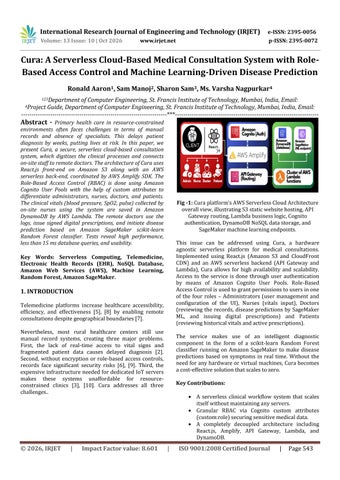
Fig -1: Cura platform’s AWS Serverless Cloud Architecture overall view, illustrating S3 static website hosting, API Gateway routing, Lambda business logic, Cognito authentication, DynamoDB NoSQL data storage, and SageMaker machine learning endpoints. This issue can be addressed using Cura, a hardware agnostic serverless platform for medical consultations. Implemented using React.js (Amazon S3 and CloudFront CDN) and an AWS serverless backend (API Gateway and Lambda), Cura allows for high availability and scalability. Access to the service is done through user authentication by means of Amazon Cognito User Pools. Role-Based Access Control is used to grant permissions to users in one of the four roles – Administrators (user management and configuration of the UI), Nurses (vitals input), Doctors (reviewing the records, disease predictions by SageMaker ML, and issuing digital prescriptions) and Patients (reviewing historical vitals and active prescriptions).
Key Words: Serverless Computing, Telemedicine, Electronic Health Records (EHR), NoSQL Database, Amazon Web Services (AWS), Machine Learning, Random Forest, Amazon SageMaker.
1. INTRODUCTION Telemedicine platforms increase healthcare accessibility, efficiency, and effectiveness [5], [8] by enabling remote consultations despite geographical boundaries [7]. Nevertheless, most rural healthcare centers still use manual record systems, creating three major problems. First, the lack of real-time access to vital signs and fragmented patient data causes delayed diagnosis [2]. Second, without encryption or role-based access controls, records face significant security risks [6], [9]. Third, the expensive infrastructure needed for dedicated IoT servers makes these systems unaffordable for resourceconstrained clinics [3], [10]. Cura addresses all three challenges..
© 2026, IRJET
|
Impact Factor value: 8.601
The service makes use of an intelligent diagnostic component in the form of a scikit-learn Random Forest classifier running on Amazon SageMaker to make disease predictions based on symptoms in real time. Without the need for any hardware or virtual machines, Cura becomes a cost-effective solution that scales to zero. Key Contributions: A serverless clinical workflow system that scales itself without maintaining any servers. Granular RBAC via Cognito custom attributes (custom:role) securing sensitive medical data. A completely decoupled architecture including React.js, Amplify, API Gateway, Lambda, and DynamoDB.
|
ISO 9001:2008 Certified Journal
|
Page 543
International Research Journal of Engineering and Technology (IRJET)
e-ISSN: 2395-0056
Volume: 13 Issue: 10 | Oct 2026
p-ISSN: 2395-0072
www.irjet.net
For remote clinics, Gupta et al. [3] introduced SAHARA with cloud telemetry features. However, SAHARA requires special biosensors which raises its cost. Cura gets rid of hardware with responsive web-form data acquisition.
Random Forest Real-Time Integration on SageMaker for Diagnosis During Consultation. Usability testing and benchmarking for latency, availability, and effectiveness.
Privacy in the healthcare sector is essential. The Privacyby-Design reference architecture was developed by Tertulino et al. [6], whereas Mishra et al. [9] developed GDSPS following the HIPAA/GDPR regulations. Nankya et al. [8] provided a review on the paradigms of e-health security. SHACS was developed by Sangeetha et al. [11], which includes both RBAC and ABAC along with anomaly detection mechanisms. Fugkeaw et al. [10] implemented blockchain with CP-ABE in fog EHR systems but with significant computation costs. Zhang et al. [7] proved that structured consultation.
2. LITERATURE SURVEY Predictive health analysis is achieved with cloud computing and machine learning technologies. Sundas et al. [1] introduced SPMR with deep learning techniques for chronic conditions classification. Ramadhan et al. [2] discussed the methods of ML preprocessing for disease prediction. Mai et al. [4] created an adaptive ML approach to regulate remote blood pressure. These solutions perform well offline but require no interactive consulting and prescriptions.
Table -1: Comparative Analysis of Proposed Cura System with Existing Literature Reference
Focus Area
Core Methodology
Sundas [1]
Cloud Analytics
Deep Learning & Cloud
Gupta [3]
Remote Monitoring
Cloud Telemetry Sensors
Tertulino [6]
EHR Architecture
Privacy by Design SRA
Systematic segregation
Fugkeaw [10]
Fine-Grained Access
CP-ABE & Blockchain
Fine-grained encryption & Revocation
Sangeetha [11]
Cloud Security
Zhang [7] Cura (Proposed)
Key Advantages Highly accurate predictions of chronic diseases & Physiological status monitoring security
RBAC-ABAC & ML Low authentication delay Anomaly OHC Interfaces Wizard-of-Oz User Study Power imbalance in web interface reduced Serverless React.js, AWS Amplify, Fully serverless (zero Consultation & API Gateway, Lambda, maintenance), scale-toML Diagnosis DynamoDB, SageMaker zero cost, integrated MLdriven disease prediction
Research Gap / Limitations Lack of consultation and prescription management. Expensive hardware requirements; not suitable for resource-poor hospitals. Abstract reference model; lacks practical implementation. Computationally heavy on resource-constrained systems. Administrating dynamic rules raises complexity. Is focused solely on frontend conversations. Lacks automated sensor integration and real-time video consults.
3. PROPOSED SYSTEM
3.2 User Roles and Functional Partitioning
Cura consolidates the information in Amazon DynamoDB using AWS Lambda and Amazon API Gateway.
The features are segregated through custom attributes defined in Cognito (custom:role): Administrator (manages user accounts and UI layout settings without accessing patient information).Nurse (consumes BP, SpO2, and pulse on examination), Doctor (analyzes patient medical record, makes predictions for ML diseases (and prescriptions issued), and Patient (personal history and current medications accessed).
3.1 Design Objectives Some of the key design objectives that will be achieved include: (1) Real-Time Ingestion using the AWS Amplify SDK to log vitals; (2) Granular RBAC using Amazon Cognito User Pools; (3) NoSQL Persistence for flexible clinical records; (4) Decision support through SageMaker real-time ML endpoints; and (5) Cost efficiency by means of a scale-to-zero serverless deployment approach.
© 2026, IRJET
|
Impact Factor value: 8.601
|
ISO 9001:2008 Certified Journal
|
Page 544
International Research Journal of Engineering and Technology (IRJET)
e-ISSN: 2395-0056
Volume: 13 Issue: 10 | Oct 2026
p-ISSN: 2395-0072
www.irjet.net
Patient Access: Authentic patient access to their records. Algorithm 1: Serverless Ingestion and Role-based Filtering 1: Input: Credentials C = {email, pass}, Pid, vitals V = {bp, spo2, pulse} 2: Output: Redirect dashboard or commit to DynamoDB. 3: JWT ← CognitoAuth(C) 4: if JWT is invalid then return AccessDenied end if 5: Role ← ExtractCustomRole(JWT); Redirect to Role dashboard 6: if Role = Nurse then 7: Validate: 40 ≤ bpsys ≤ 220, 30 ≤ bpdia ≤ 130, 40 ≤ pulse ≤ 200, 50 ≤ spo2 ≤ 100 8: if valid then 9: Item ← {Pid, bp, spo2, pulse, timestamp} 10: DynamoDB_PutItem(Cura_Medical_Records, Item); return Success 11: else return ValidationError: Out of bound metrics 12: end if 13: else return PermissionError: Nurse role required 14: end if
Fig -2: Use case diagram showing interaction of actors with system through Administrator, Nurse, Doctor, and Patient classes in Cura System. 3.3 NoSQL Data Structure DynamoDB stores two tables - Cura_Medical_Records (Partition Key: patientId, Sort Key: entryTimestamp) that holds the data related to vitals, doctor’s notes, and prescriptions; and Cura_Config containing information about the UI layout (NAV_CONFIG, PANEL_LABELS) loaded at client startup.
Algorithm 2: Consultation, SageMaker ML Prediction, and Prescription 1: Input: Doctor JWTdoc, Pid, symptoms S, notes L, prescription Rx = {DrugName, Dosage, Frequency, Duration} 2: Output: Prediction, Prescription, and Updating of Database. 3: Role ← ExtractCustomRole(JWTdoc) 4: if Role ≠ Doctor then return PermissionError end if 5: History ← DynamoDB_Query(patientId = Pid); Display on dashboard 6: if S ≠ ∅ then 7: Prediction ← SageMaker.InvokeEndpoint(S); Display Prediction 8: end if 9: if Rx = ∅ or L = ∅ then return ValidationError end if 10: Sig ← Hash(JWTdoc + timestamp) 11: Item ← {Pid, L, Rx, Prediction, Sig, timestamp} 12: DynamoDB_PutItem(Cura_Medical_Records, Item); return Success
4. METHODOLOGY All clinical transactions involve validation and role-based verification by Cura. 4.1 Operational Workflow Authentication: User authenticates via React; Amplify retrieves a JWT from Cognito. Role Verification: The frontend takes custom:role out of the JWT for role-specific dashboards. Vitals Ingestion: Nurse inputs vitals; API Gateway sends the payload to Write Lambda, which stores the information in DynamoDB. Clinical Consultation: Doctor gets medical history from Read Lambda and may use symptoms to query SageMaker. Prescription Issuance:Doctor makes entry in patient’s notes; signed notes are put in DynamoDB database.
© 2026, IRJET
|
Impact Factor value: 8.601
|
ISO 9001:2008 Certified Journal
|
Page 545
International Research Journal of Engineering and Technology (IRJET)
e-ISSN: 2395-0056
Volume: 13 Issue: 10 | Oct 2026
p-ISSN: 2395-0072
www.irjet.net
Fig -3: Sequence diagram depicting the timelines of messages passed among Nurse, React Frontend, AWS Amplify SDK, Cognito User Pools, API Gateway, Lambda Write Function, and DynamoDB while ingesting vitals. 4.2 Algorithmic Formalization Algorithm 1 gives details about nurse vitals validation, and Algorithm 2 provides a formal structure for doctor consultation, SageMaker ML inference, and prescription authorization.
5. SYSTEM ARCHITECTURE The Cura design uses a three-tier serverless microservice architecture that is highly available, scalable, and requires minimal management effort.
Fig -5: Activity Diagram showcasing the paths of decisionmaking, fork, and join for remote patient consultation, machine learning prediction, and prescription authorization.
Fig -4: Component Diagram depicting modular coupling between React Client UI, AWS Amplify SDK, Cognito Auth, API Gateway, Lambda Logic Core, DynamoDB Data Store, and SageMaker ML Engine.
© 2026, IRJET
|
Impact Factor value: 8.601
|
ISO 9001:2008 Certified Journal
|
Page 546
International Research Journal of Engineering and Technology (IRJET)
e-ISSN: 2395-0056
Volume: 13 Issue: 10 | Oct 2026
p-ISSN: 2395-0072
www.irjet.net
Fig -6: Data Flow Diagram showing data flow at Level-0 (Context Diagram) and Level-1 (Process & Data Store Diagram) starting from Nurse Intake till Prescription Delivery using SageMaker Predictions. 5.1 Architectural Layering 1. User Interface Layer: React.js SPA running on Amazon S3 with CloudFront CDN; session management and routing are handled via Amplify SDK. 2. Business Logic Layer: Amazon API Gateway validates Cognito JWT and directs requests to isolated AWS Lambda functions. 3. Database and ML Layer: Amazon DynamoDB for NoSQL data store, Amazon Cognito for user directories and Amazon SageMaker for Random Forest models. 5.2 Architectural Modeling Fig -8: Patient Care Workflow Diagram outlining logical transitions from patient arrival and nurse vitals logging to remote doctor examination, SageMaker ML insight generation, and prescription retrieval.
The structure and behavior of the system are captured using unified diagrams: System Architecture (Fig. 1), Use Case Diagram (Fig. 2), Sequence Diagram (Fig. 3), Component Diagram (Fig. 4), Activity Diagram (Fig. 5), Data Flow Diagram (Fig. 6), Deployment Architecture (Fig. 7), and Patient Care Workflow (Fig. 8).
6. IMPLEMENTATION 6.1 Technology Stack The technology stack chosen is described in Table 2 Table -2: Cura System Serverless Technology Stack Component Technology / Service Selection Layer Client Frontend React.js, HTML5, CSS3, JavaScript (ES6) Client SDK AWS Amplify Library (Auth & API Modules) API Router Amazon API Gateway REST API Compute Layer AWS Lambda (Node.js / Python Functions) Database Layer Amazon DynamoDB (NoSQL Key-Value Store) Authentication Amazon Cognito User Pools Model Hosting Amazon SageMaker AI Real-time
Fig -7: Deployment Architecture consisting of CloudFront Edge Caching, S3 Frontend Hosting, Secure VPC Lambda Runtimes, DynamoDB Replication in Multi-AZ across Availability Zones A & B, and SageMaker Inference Endpoints.
© 2026, IRJET
|
Impact Factor value: 8.601
|
ISO 9001:2008 Certified Journal
|
Page 547
International Research Journal of Engineering and Technology (IRJET)
e-ISSN: 2395-0056
Volume: 13 Issue: 10 | Oct 2026
p-ISSN: 2395-0072
Component Layer
www.irjet.net
Technology / Service Selection
Require ment Type
Endpoints scikit-learn Random Forest (cura_model.py) Static Web Amazon Simple Storage Service (S3) & Hosting CloudFront Development VS Code, Git, GitHub, Python, Jupyter Tools Notebook ML Classifier
Client RAM Client OS Client Browser Cloud Serverless Host Database Engine Inference Engine Connectivi ty
6.2 Frontend Client and Amplify Integration Route guarding in the React.js SPA is accomplished using react-router-dom. Amplify Auth fetches the user’s role from the JWT token (custom:role), while Amplify API sends HTTPS requests with bearer tokens. The following modules are among those in use: Vitals Ingestion Form, Consultation Panel, Prescription Generator, and Patient Portal.
Specification / Environment above) Minimum 4 GB (Recommended 8 GB) Windows 10/11, Linux (Ubuntu/Debian), macOS Google Chrome, Mozilla Firefox, Microsoft Edge Amazon API Gateway & AWS Lambda Amazon DynamoDB (Multi-AZ NoSQL Store) Amazon SageMaker AI Real-time Endpoint Standard Internet Connection (Broadband/4G/5G)
6.3 Serverless Business Logic Layer (AWS Lambda) Stateless Lambda functions perform backend processing: Write Lambda checks for valid input ranges and performs DynamoDB PutItem operations, meanwhile, Read Lambda authenticates the user and executes DynamoDB query through Query on patientId. 6.4 Machine SageMaker)
Learning
Integration
(Amazon
Random Forest Classifier trained on the symptom-disease data set is used as a SageMaker endpoint for prediction purposes. A Lambda function takes the symptom entered by the doctor and invokes the SageMaker endpoint using the AWS SDK.
Fig -9: Vital Signs Monitoring for Patient (7-day Trend) – Systolic Blood Pressure (120–132 mm Hg), Diastolic Blood Pressure (78–88 mm Hg), and Heart Rate (70–82 BPM) tracked across a 7-day observation window.
6.5 Security Infrastructure
7.2 Performance and Latency Audits
Security measures will be taken at all levels, which include: (1) Amazon Cognito User Pools, (2) Custom role JWT claims for protecting client routes, (3) API Gateway JWT authorizers, and (4) IAM roles.
The following performance benchmarks were established through the evaluation: DynamoDB Multi-AZ Replication has 99.99% availability; queries against the primary key, fetch patient’s data within <15 ms; Lambda cold start takes 150–220 ms (as opposed to 12–18 ms taken by warm Lambda function); and Cognito token authentication prevents unauthorized API requests.
7. EXPERIMENTAL RESULTS 7.1 System Specifications
7.3 Physiological Vitals Trend Monitoring
Deployments were verified for environments as described in Table 3.
Longitudinal vitals for 7 days are displayed in Fig. 9. The systolic blood pressure values vary between 120–132 mmHg, while the diastolic blood pressure varied between 78–88 mmHg, and Heart rate was 70–82 BPM.Correlation of multiple metrics helps doctors quickly recognize patient trends.
Table -3: Cura Platform System Resource Specifications Require Specification / Environment ment Type Client CPU Intel Core i3 or equivalent (2.0 GHz or
© 2026, IRJET
|
Impact Factor value: 8.601
|
ISO 9001:2008 Certified Journal
|
Page 548
International Research Journal of Engineering and Technology (IRJET)
e-ISSN: 2395-0056
Volume: 13 Issue: 10 | Oct 2026
p-ISSN: 2395-0072
www.irjet.net
8. DISCUSSION
2) N. G. Ramadhan, Adiwijaya, W. Maharani, and A. A. Gozali, “Chronic Diseases Prediction Using Machine Learning With Data Preprocessing Handling: A Critical Review,” IEEE Access, vol. 12, pp. 84261–84279, 2024.
8.1 Serverless, Scale-to-Zero Architecture Different from IoT solutions that require specific hardware to be purchased [3], [10], Cura is entirely software-based. Pay per request billing models prevent expenses on idle resources, whereas managed services reduce server management overhead.
3) A. K. Gupta, J. Nagaraja, C. R. Padma, M. Kumar N, and R. M. S, “SAHARA: A Cloud-based Remote Health-Vitals Monitoring System,” in Proc. 2024 2nd Int. Conf. Networking, Embedded and Wireless Systems (ICNEWS), Bengaluru, India, 2024.
8.2 Flexible Schemas in NoSQL Environments The flexible schema of DynamoDB does not require any migrations to accommodate new attributes for clinical information, whereas the user interface metadata (NAV_CONFIG) is stored directly with the record.
4) V. T. Mai, K. A. Alattas, Y. Bouteraa, E. Ghaderpour, and A. Mohammadzadeh, “Personalized Blood Pressure Control by Machine Learning for Remote Patient Monitoring,” IEEE Access, vol. 12, pp. 88350– 88365, 2024.
8.3 Intelligent Decision Support via SageMaker
5) E. Gaeta, M. S. Haleem, L. Lopez-Perez, M. Manea, M. F. C. Umpierrez, L. Pecchia, and G. Fico, “GATEKEEPER Platform: Secure Processing Environment for European Health Data Space,” IEEE Access, vol. 13, pp. 34627–34638, 2025.
Unlike offline models [1], [2], the SageMaker endpoints dynamically adapt to symptoms, helping the remote physicians during consultation sessions.
9. LIMITATIONS & FUTURE WORK Limitations: Needs continuous connectivity on internet; manual entries prone to errors by humans; no video/audio calling facility; no synchronization of data in offline mode.
6) R. Tertulino, N. Ivaki, and H. Morais, “Design a Software Reference Architecture to Enhance Privacy and Security in Electronic Health Records,” IEEE Access, vol. 12, pp. 112157– 112179, 2024.
Future Work: Video consultation using WebRTC; React Native mobile application development; Bluetooth-based IoT sensors; Clinical alerts from AWS SNS; and deep learning-based models [2] for multi-classification of diseases.
7) L. Zhang, J. Zhan, V. K. W. Wan, and Y. Wang, “Designing and Evaluating Online Health Consultation Interfaces: A Perspective of Physician-Patient Power Asymmetry,” IEEE Access, vol. 12, pp. 124111–124127, 2024.
10. CONCLUSION
8) M. Nankya, A. Mugisa, Y. Usman, A. Upadhyay, and R. Chataut, “Security and Privacy in E-Health Systems: A Review of AI and Machine Learning Techniques,” IEEE Access, vol. 12, pp. 148796– 148816, 2024.
Cura was introduced in this paper, which is a cloud-based platform for medical consultations and diagnosis using serverless technology. With the transition from the old system of maintaining paper-based files to an integrated dynamo DB, Cura offers real-time tracking of vital signs and even virtual consultations. The technology used to build Cura includes React.js, AWS Amplify, API Gateway, Lambda, Cognito, and SageMaker.
9) V. Mishra, K. Gupta, D. Saxena, and A. K. Singh, “A Global Medical Data Security and Privacy Preserving Standards Identification Framework for Electronic Healthcare Consumers,” IEEE Trans. Consum. Electron., vol. 70, no. 1, pp. 1–9, Feb. 2024.
REFERENCES
10) S. Fugkeaw, R. P. Gupta, and K. Worapaluk, “Secure and Fine-Grained Access Control With Optimized Revocation for Outsourced IoT EHRs With Adaptive Load-Sharing in Fog-Assisted Cloud Environment,” IEEE Access, vol. 12, pp. 82753–82768, 2024.
1) A. Sundas, S. Badotra, G. S. Shahi, A. Verma, S. Bharany, A. W. Abulfaraj, and F. Binzagr, “Smart Patient Monitoring and Recommendation (SPMR) Using Cloud Analytics and Deep Learning,” IEEE Access, vol. 12, pp. 51834– 51848, 2024.
© 2026, IRJET
|
Impact Factor value: 8.601
11) S. K. B. Sangeetha, C. Selvarathi, S. K. Mathivanan, J. Cho, and S. V. Easwaramoorthy, “Secure
|
ISO 9001:2008 Certified Journal
|
Page 549
International Research Journal of Engineering and Technology (IRJET)
e-ISSN: 2395-0056
Volume: 13 Issue: 10 | Oct 2026
p-ISSN: 2395-0072
www.irjet.net
Healthcare Access Control System (SHACS) for Anomaly Detection and Enhanced Security in Cloud-Based Healthcare Applications,” IEEE Access, vol. 12, pp. 164543–164559, 2024. 12) S. Kamble, K. P. Karunakaran, and J. Shah, “Machine Minds: A Psychotherapeutic Evaluation of LLMs,” Journal of Technology, vol. 13, no. 7, pp. 583–591, 2025. 13) S. B. Soumma, F. Shahriar, U. N. Mahi, M. H. Abrar, M. A. R. Fahad, and A. S. L. Hoque, “Design and Implementation of a Scalable Clinical Data Warehouse for Resource-Constrained Healthcare Systems,” arXiv:2502.16674v2, May 2025.
© 2026, IRJET
|
Impact Factor value: 8.601
|
ISO 9001:2008 Certified Journal
|
Page 550