
International Research Journal of Engineering and Technology (IRJET) e-ISSN: 2395-0056
Volume: 13 Issue: 06 | Jun 2026 www.irjet.net p-ISSN: 2395-0072
International Research Journal of Engineering and Technology (IRJET) e-ISSN: 2395-0056
Volume: 13 Issue: 06 | Jun 2026 www.irjet.net p-ISSN: 2395-0072
1Samruddhi Gahininath Bargaje, 2Bhanage Vrushali Machhindra, 3Rachana Bhimraj Mandlik, 4Sakshi
Sadashiv Mane
Abstract-The rapid growth of cryptocurrency markets has introduced significant volatility, making accurate price prediction a challenging task. This paper presents Crypto Predict, an AI-powered system that integrates machine learning and natural language processing techniques to forecast crypto currency prices and analyse market sentiment. The proposed system utilizes historical price data along with technical indicators such as Simple Moving Averages (SMA) and Relative Strength Index (RSI) to predict short-term price movements using an autoregressive linear regression model. Additionally, sentiment analysis is performed on social media data using TextBlob to capture market psychology and investor behavior. The system combines quantitative price predictionswithqualitativesentimentinsightstogenerate intelligenttradingsignalssuchasBuy,Sell,or Hold.A fullstack architecture is implemented using Flask for backend processing,Reactforfrontendvisualization,andMongoDB for data storage. Real-time cryptocurrency data is fetched via API integration to ensure up-to-date predictions. Experimental results demonstrate high prediction accuracy and effective sentiment classification, improving decision-making reliability. The proposed approach highlights the importance of hybrid models that integrate financial indicators with behavioural analysis for enhanced cryptocurrency forecasting and trading strategies.
Keywords-Crypto currency Prediction, Machine Learning, Sentiment Analysis, Linear Regression, Natural Language Processing, Financial Forecasting, Trading Signal Generation
Cryptocurrency markets have experienced exponential growth over the past decade, emerging as a significant component of the global financial ecosystem. Unlike traditional financial systems, cryptocurrencies operate on decentralized blockchain technology, eliminating the need for centralized authorities and enabling peer-topeertransactions[1][2].Thisdecentralization,combined with the potential for high returns, has attracted investors, researchers, and institutions worldwide. However, despite their advantages, crypto currency markets are characterized by extreme volatility, rapid price fluctuations, and susceptibility to external influences such as regulatory changes, technological developments, macroeconomic trends, and investor
sentiment[3][4].Thesefactorsmakeaccurateprediction of cryptocurrency prices a highly challenging task. Traditional financial forecasting models, which rely heavily on statistical assumptions and linear relationships, often fail to capture the nonlinear and dynamic nature of cryptocurrency markets [5]. As a result, machine learning (ML) and artificial intelligence (AI) techniques have gained significant attention due to theirabilitytomodelcomplexpatterns, learnfromlarge datasets,andadapttochangingmarketconditions[6][7]. Various ML approaches, including regression models, decision trees, support vector machines, and deep learning architectures, have been applied to predict cryptocurrency price movements with improved accuracy[8][9].
In addition to quantitative price data, qualitative factors such as public sentiment and investor behavior play a crucialroleininfluencingcryptocurrencymarkets.Social media platforms, online forums, and news articles often drivemarkettrendsbyshapinginvestorperceptionsand decisions [10][11]. Consequently, sentiment analysis usingNaturalLanguageProcessing(NLP)techniqueshas emerged as an essential tool for understanding market psychology. Methods such as TextBlob, VADER, and transformer-based models enable the extraction of sentiment polarity and emotional context from textual data[12][13].
Recent research has focused on hybrid approaches that combine machine learning-based price prediction with sentiment analysis to improve forecasting performance [14]. These integrated systems leverage both technical indicators (e.g., moving averages, RSI, MACD) and sentiment signals to provide a more comprehensive understanding of market dynamics [15]. However, many existing solutions lack real time data integration, scalability, and unified frameworks for generating actionabletradingdecisions.
Toaddresstheselimitations,thispaperproposesCrypto Predict, an AI-powered hybrid system that combines autoregressive machine learning models with sentiment analysisforcryptocurrencyprice prediction.Thesystem incorporates historical price data, real-time API inputs, and social media sentiment to generate accurate forecastsandintelligenttradingsignalssuchasBuy,Sell, and Hold. By integrating quantitative and qualitative analysis within a full stack architecture, the proposed
International Research Journal of Engineering and Technology (IRJET) e-ISSN: 2395-0056
Volume: 13 Issue: 06 | Jun 2026 www.irjet.net p-ISSN: 2395-0072
approach aims to enhance prediction accuracy, improve decision-making, and provide a practical solution for moderncryptocurrencytradingenvironments.
Numerous studies have explored cryptocurrency price prediction using a wide range of machine learning, statistical,anddeep learningapproaches.Early research primarily focused on regression-based models due to their simplicity, interpretability, and effectiveness in short-term forecasting scenarios [1][2][3]. Linear regression and its variants have been widely applied to model the relationship between historical prices and future values, particularly in autoregressive frameworks where past observations are used as predictors. These models are computationally efficient and provide baseline performance; however, they often struggle to capture nonlinear patterns inherent in cryptocurrency markets.
To address these limitations, time-series forecasting techniques such as Autoregressive Integrated Moving Average (ARIMA) and Seasonal ARIMA (SARIMA) have been extensively utilized [4][5][6]. These models are designedtohandletemporaldependenciesandtrendsin sequential data. While ARIMA-based models perform well under stable conditions, their predictive capability is limited when dealing with highly volatile and nonstationaryfinancialdatalikecryptocurrencies.
In recent years, deep learning approaches have gained significant attention due to their ability to model complex nonlinear relationships. Long Short-Term Memory (LSTM) networks, a type of recurrent neural network (RNN), have been particularly effective in capturing long-term dependencies in time-series data [7][8][9].LSTMmodelsovercomethevanishinggradient problem and can learn intricate temporal patterns, making them suitable for cryptocurrency prediction tasks. Furthermore, hybrid deep learning architectures thatcombineLSTMwithConvolutionalNeuralNetworks (CNNs)haveshownimprovedperformancebyextracting both spatial and temporal features from the data [10][11].
Apart from numerical data, sentiment analysis has emergedasa crucial component in financial forecasting. Research indicates that public sentiment expressed on socialmediaplatformssuchasTwitter,Reddit,andnews outlets significantly influences cryptocurrency price movements [12][13][14]. Positive sentiment often correlateswithpriceincreases,whilenegativesentiment can trigger market declines. To analyze such data, Natural Language Processing (NLP) techniques are employed. Tools like TextBlob and VADER are widely used for sentiment polarity classification due to their
simplicity and effectiveness in handling short textual data[15][16].
Several studies have proposed hybrid models that integrate sentiment analysis with machine learning algorithms to enhance prediction accuracy [17][18][19]. These models combine quantitative features (e.g., historical prices, technical indicators) with qualitative features (e.g., sentiment scores), providing a more comprehensive understanding of market behavior [20][21]. Such approaches have demonstrated improved performance compared to standalone models, as they capturebothmarkettrendsandinvestorpsychology.
Featureengineeringplaysavitalroleinimprovingmodel performance. Technical indicators such as Relative StrengthIndex(RSI),SimpleMovingAverage(SMA),and Moving Average Convergence Divergence (MACD) are commonlyusedtoextractmeaningfulpatternsfromraw price data [22][23][24]. These indicators help in identifying trends, momentum, and potential reversal points in the market. Additionally, data preprocessing techniques such as normalization and scaling, particularly MinMax normalization, are essential for ensuring stable model training and faster convergence [25].
Recent advancements in this domain include the development of real-time prediction systems that integrate live data streams through APIs and provide interactive visualization through web-based dashboards [26][27]. Full-stack implementations using modern technologies enable seamless interaction between backendpredictionmodelsandfrontenduserinterfaces, enhancing usability and accessibility [28][29]. These systems allow users to monitor predictions, analyze trends,andmakeinformeddecisionsinrealtime.
Despitesignificantprogress,severalchallengespersistin cryptocurrency prediction, including extreme market volatility, data noise, and the influence of unpredictable external factors. Moreover, many existing systems lack robustness, scalability, and the ability to integrate multiple data sources effectively. To address these challenges, this paper proposes a hybrid approach that combines autoregressive machine learning models with sentiment analysis in a real-time framework, aiming to improvepredictionaccuracyandprovidereliabletrading insights[30].
International Research Journal of Engineering and Technology (IRJET) e-ISSN: 2395-0056
Volume: 13 Issue: 06 | Jun 2026 www.irjet.net p-ISSN: 2395-0072
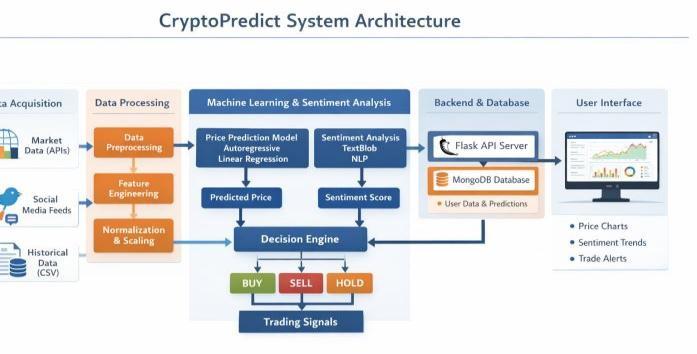
The proposed Crypto Predict system architecture represents a hybrid framework that integrates machine learning and sentiment analysis to predict cryptocurrencypricesandgenerateintelligenttrading signals. The architecture is divided into multiple layers, each responsible for a specific function in the overallpipeline.
The system begins with collecting data from multiple sources:
Market Data (APIs): Real-time cryptocurrencypricesarefetchedusingAPIs suchasAlphaVantage
HistoricalData(CSV):Pastpricedataisused fortrainingthemodel
Social Media Feeds: Textual data (tweets/news) is collected for sentiment analysis
This multi-source data collection ensures both quantitative (price) and qualitative (sentiment) inputs.
B. Data Processing Layer
Oncedataiscollected,itundergoespreprocessing:
Data Preprocessing: Removes noise, missing values,andinconsistencies
Feature Engineering: Generates technical indicatorslikeSMAandRSI
Normalization&Scaling:UsesMinMaxscaling tonormalizevalues
Thissteppreparescleanandstructureddataformodel trainingandprediction.
Thisisthecoreintelligencelayerofthesystem:
Price Prediction Model
a. UsesAutoregressiveLinearRegression
b. Takespreviouspriceandindicatorsasinput
c. Outputspredictedcryptocurrencyprice
Sentiment Analysis Module
d. UsesTextBlob(NLP)
e. Analyzessocialmediatext
f. Produces sentiment score (Positive/Negative)
Decision Engine The decision engine combines: Predictedprice
g. Currentmarketprice
h. Sentimentscore
Basedontheseinputs,itgeneratestradingdecisions:
a) BUY → Price expected to increase + positive sentiment
b) SELL→Priceexpectedtodecrease+negative sentiment
c) HOLD→Nostrongsignal
This is the key component that transforms predictions intoactionableinsights.
E. Backend & Database Layer
Backend(FlaskAPI)
• Handlesrequestsfromfrontend
• LoadstrainedMLmodels
• Performspredictionandsentimentanalysis
• Sendsresultsbacktouser
Database(MongoDB)Stores:
• Userdata
• Predictionhistory
• Generatedalerts
This layer ensures data persistence and system functionality.
F. User Interface Layer
Thefrontend(React-baseddashboard)provides:
• Pricechartsandtrends
International Research Journal of Engineering and Technology (IRJET) e-ISSN: 2395-0056
Volume: 13 Issue: 06 | Jun 2026 www.irjet.net p-ISSN: 2395-0072
• Sentimentvisualization
• Tradingsignals(BUY/SELL/HOLD)
Users interact with the system through this interface, makingituser-friendlyandinteractive.
The proposed system follows a structured methodology that integrates machine learning and sentiment analysis for cryptocurrency price prediction and trading signal generation.Themethodologyconsistsofmultiplestages, including data collection, preprocessing, feature engineering, model training, sentiment analysis, and decision-making.
A. Data Collection
Thefirststepinvolvescollectingbothhistoricalandrealtimedata:
Historical Data: Cryptocurrency datasets (Bitcoin, Ethereum, Dogecoin) are collected in CSV format containing attributes such as date, closingprice,andvolume.
Real-TimeData:Livemarketdataisfetchedusing APIs (e.g., Alpha Vantage) to ensure up-to-date predictions.
TextualData:Socialmediadata(tweets/news)is gathered to analyze public sentiment. This combination enables the system to use both structuredandunstructureddatasources.
B. Data Preprocessing
The collected data undergoes preprocessing to ensure qualityandconsistency:
Removalofmissingornullvalues
Noisefilteringanddatacleaning
Conversionintostructuredtime-seriesformat
NormalizationusingMinMaxscaling
This step ensures that the data is suitable for machine learningmodelsandreducesbiasandinconsistencies.
C. Feature Engineering
Feature engineering is performed to extract meaningful informationfromrawdata:
Calculationoftechnicalindicators:
SimpleMovingAverage(SMA-7,SMA-30)
RelativeStrengthIndex(RSI-14)
Creationoflagfeatures:
Previousdayclosingprice
PreviousSMAvaluesthesefeatures help capture trendsandtemporal dependencies in crypto currencyprices.
D. Model Development
The system uses an autoregressive Linear Regression modelforpriceprediction:
InputFeatures:Previousdayvalues(Close,SMA, RSI)
Output:Predictednext-dayclosingprice
Data Split: 80% training and 20% testing (without shuffling to preserve time order) the model learns the relationship between past and futurepricestogenerateaccuratepredictions.
E. Model Evaluation
The performance of the model is evaluated using standardmetrics:
MeanAbsoluteError(MAE)
RootMeanSquareError(RMSE)
R² Score (coefficient of determination) these metrics ensure the reliability and accuracy of thepredictionmodel.
F. Sentiment Analysis
To incorporate market psychology, sentiment analysis is performed:
TextdataisprocessedusingTextBlob(NLP) Sentimentpolarityiscalculated
Classifiedas: oPositive oNegative
This step helps capture investor behavior and market trends.
G. Prediction and Decision Making
Thesystemcombinesoutputsfrombothmodules:
Predictedprice(MLmodel)
Currentmarketprice
Sentimentscore(NLP)
Based on these inputs, a decision engine generates tradingsignals:
BUY: Predicted price increases with positive sentiment
International Research Journal of Engineering and Technology (IRJET) e-ISSN: 2395-0056
Volume: 13 Issue: 06 | Jun 2026 www.irjet.net p-ISSN: 2395-0072
SELL: Predicted price decreases with negative sentiment
HOLD: Nostrongindication
The methodology is implemented using a full-stack architecture:
Backend: Flask API for processing and prediction
Frontend: React for visualization and userinteraction
Database: MongoDB for storing user data and predictions
The proposed system demonstrates strong performance in short-term cryptocurrency price prediction using an autoregressive linear regression model. By leveraging historical data and technical indicatorssuchasSMA and RSI, the model effectively captures market trends and achieveshighaccuracy.Theevaluationmetrics,including Mean Absolute Error (MAE), Root Mean Square Error (RMSE), and R² score, indicate that the model performs reliably in predicting next-day prices. The integration of real-timedatafurtherenhancespredictionrelevanceand ensuresup-to-dateanalysis.
In addition to price forecasting, sentiment analysis significantly improves the system’s decision-making capability. By analyzing social media data, the model incorporates market psychology into predictions, enabling better interpretation of price movements. The combined approach of quantitative prediction and qualitative sentiment analysis results in more accurate trading signals such as Buy, Sell, and Hold. Overall, the system provides a comprehensive framework for cryptocurrency forecasting and demonstrates the effectivenessofhybridAImodels.

Fig. 1. CryptoPredictUserDashboardforCrypto currency PricePredictionandMarketAnalysis
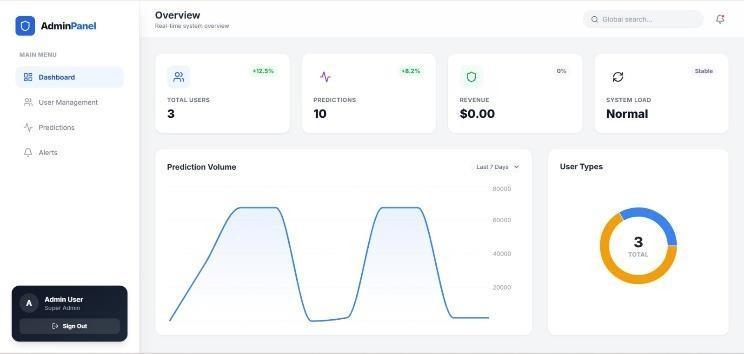
Fig. 2. AdminPanelDashboardShowingSystem Overview, UserStatistics,andPredictionAnalytics
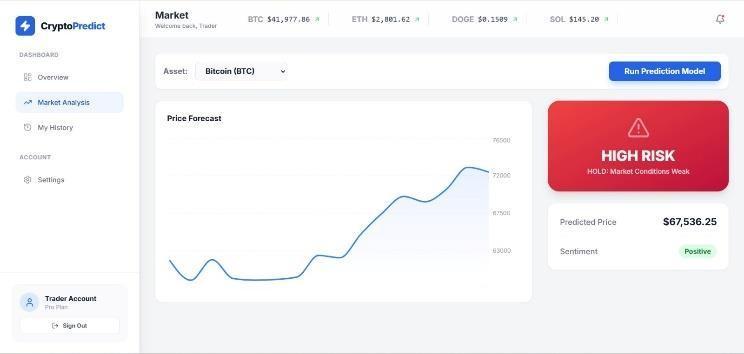
Fig. 3.MarketAnalysisInterfacewithPriceForecast GraphandRiskAlertSystem
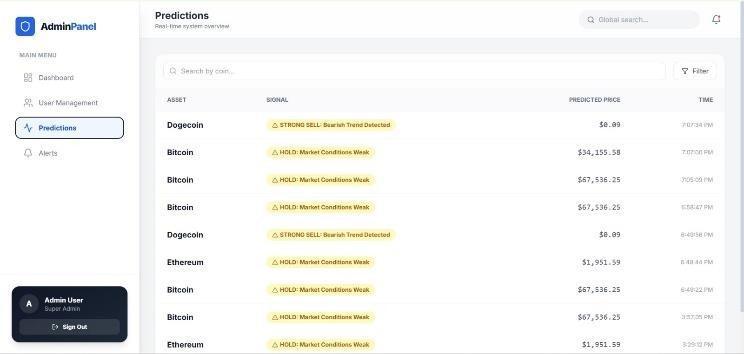
Fig. 4. CryptocurrencyPredictionDashboardDisplaying SentimentandPredictedPrice
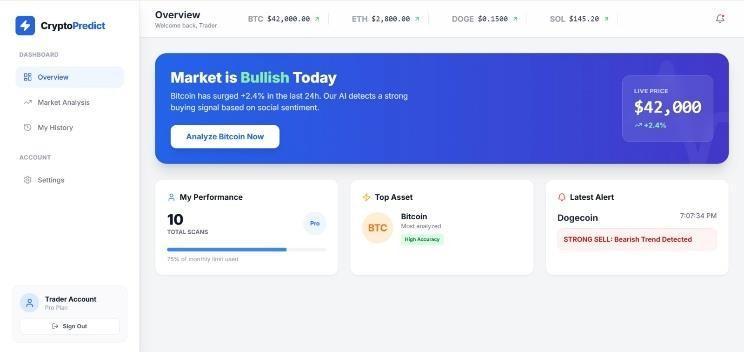
Fig. 5.SystemOverviewDashboardShowingMarket Trends,Alerts,andUserPerformanceMetrics
International Research Journal of Engineering and Technology (IRJET) e-ISSN: 2395-0056
Volume: 13 Issue: 06 | Jun 2026 www.irjet.net p-ISSN: 2395-0072
This paper presents Crypto Predict, an AI-powered system designed to predict crypto currency prices and analyse market sentiment using machine learning and natural language processing techniques. The system integrates historical price data, technical indicators, and real-timemarketinformationtogenerateaccurateshortterm predictions. By employing an autoregressive linear regression model, the system effectively captures temporal dependencies and achieves high prediction accuracy.Oneofthekeycontributionsofthisworkisthe integration of sentiment analysis with price prediction. By analysing social media data, the system incorporates investor behaviour and market psychology into the forecasting process. This hybrid approach enhances the reliability of predictions and provides more meaningful trading insights. The implementation of a smart alert system further improves usability by generating actionable signals such as Buy, Sell, and Hold. The fullstack architecture ensures scalability and user accessibility,withaReact-basedfrontend,Flaskbackend, and MongoDB database. Real-time data integration enables continuous updates, making the system suitable forpracticalapplicationsinfinancialdecision-making.
1) S.Nakamoto,“Bitcoin:APeer-to-PeerElectronicCash System,”2008.
2) S. M. Raju and A. M. Tarif, “Real-Time Bitcoin Price Prediction using Machine Learning and Sentiment Analysis,”arXiv,2020.
3) S. Bhatt, “Machine Learning-Based Cryptocurrency Price Prediction using Historical Data and Social MediaSentiment,”2023.
4) F. Valencia et al., “Price Movement Prediction of Cryptocurrencies Using Machine Learning,” Entropy, 2019.
5) A.Bouteska et al., “Cryptocurrency Price Forecasting Using Ensemble Learning and Deep Learning,” IRFA, 2024. [6] P. Boozary, “Forecasting Bitcoin Price using MachineLearningTechniques,”2025.
6) H. S. Htay et al., “Enhancing Bitcoin Price Prediction withDeepLearningandSentimentData,”MDPI,2025.
7) S. Gaur et al., “Sentiment-Driven Cryptocurrency ForecastingusingBiLSTMandNLPModels,”2025.
8) H. S. Jung et al., “Detecting Bitcoin Sentiment using NLPModels,”2025.
9) S.Arslanetal.,“BitcoinPricePredictionusingTwitter SentimentAnalysis,”2024.
10) Carosia, “Using Sentiment and Technical Analysis to PredictBitcoinPrice,”arXiv,2024.
11) Grubisic et al., “Bitcoin Price Prediction using SentimentAnalysis,”2025.
12) Feizian and B. Amiri, “Cryptocurrency Price Prediction Model Based on Sentiment Analysis and SocialInfluence,”IEEEAccess,2023.
13) R. Parekh et al., “DL-GuesS: Deep Learning and Sentiment Analysis-Based Crypto Prediction,” IEEE Access,2022.
14) M. Zubair et al., “Improved MachineLearning Models forCryptocurrencyPrediction,”2024.
15) Seabeetal.,“ForecastingCryptocurrencyPricesusing LSTMandGRUModels,”2023.
16) Girsang, “Hybrid LSTM-GRU Model for Crypto PredictionusingFinBERT,”IEEEAccess,2023.
17) M. Chen et al., “Deep Learning for Cryptocurrency PricePrediction,”2020.
18) D. Kraaijeveld and J. De Smedt, “The Influence of Twitter Sentiment on Cryptocurrency Prices,” 2020. [20] J. Bollen et al., “Twitter Mood Predicts the Stock Market,”JournalofComputationalScience,2011.
19) E. Hutto and C. Gilbert, “VADER: A Rule-Based SentimentAnalysisTool,”2014.
20) S.Loria,“TextBlob:SimplifiedTextProcessing,”2018.
21) J.Patel etal.,“PredictingStock MarketusingMachine Learning,”2015.
22) T. Fischer and C. Krauss, “Deep Learning in Finance,” 2018.
23) S. McNally et al., “Predicting Bitcoin Price using MachineLearning,”2018.
24) Abraham et al., “Cryptocurrency Price Prediction usingMachineLearning,”2018.
25) M.Mudassiretal.,“TimeSeriesForecastingofBitcoin Prices,” [29] S. Derbentsev et al., “Review of CryptocurrencyForecasting2020.Models,”2021.
26) P. K. Mallqui and R. Fernandes, “Predicting Cryptocurrency [30] Alpha Vantage, “Cryptocurrency APIDocumentation,”2024.PriceDirection,”2019.
International Research Journal of Engineering and Technology (IRJET) e-ISSN: 2395-0056
Volume: 13 Issue: 06 | Jun 2026 www.irjet.net p-ISSN: 2395-0072