International Research Journal of Engineering and Technology (IRJET)
e-ISSN: 2395-0056
Volume: 13 Issue: 09 | Sep 2026
p-ISSN: 2395-0072
www.irjet.net
COST OPTIMIZATION AND RISK MANAGEMENT IN LARGE SCALE CONCRETE INFRASTRUCTURE PROJECTS Ujjwal Kumar 1, Sayantan Ghosh2 1Master’s Degree Scholar, Department of Civil Engineering, Maharaja Agrasen University, Baddi (Himachal
Pradesh)
2Assistant Professor, Department of Civil Engineering, Maharaja Agrasen University, Baddi (Himachal Pradesh)
---------------------------------------------------------------------***---------------------------------------------------------------------
Abstract - Large-scale concrete infrastructure projects such as bridges, dams, tunnels, and foundations are capital intensive and
subject to significant uncertainty. This thesis develops an integrated framework for cost optimization and risk management, combining probabilistic risk assessment, life-cycle costing, optimization models, and practical construction strategies. Case studies demonstrate measurable reductions in expected cost and risk exposure when compared with conventional deterministic approaches. This research examines cost optimization and risk management practices in large-scale concrete infrastructure projects, with specific reference to the Chandigarh–Baddi Broad Gauge Railway Project. Using secondary data obtained from government reports, project documents, published literature, and industry case studies, the study evaluates key cost drivers, risk factors, and mitigation measures adopted during the project lifecycle. The findings reveal that inadequate risk identification during the planning phase, land acquisition delays, material price volatility, and contract management issues significantly contributed to cost escalation. The study demonstrates that integrating systematic risk assessment tools such as risk probabilityimpact matrices, value engineering, and life-cycle cost analysis can substantially improve cost control. The research concludes with practical recommendations for policymakers, project managers, and engineers to enhance cost efficiency and risk resilience in future large-scale concrete infrastructure projects in India. Key Words: Cost optimization, risk management, concrete infrastructure, probabilistic cost modeling, life cycle costing, value engineering, Monte Carlo simulation, construction risk.
1. INTRODUCTION This chapter introduces the background, motivation, objectives, scope, and structure of the research. Large-scale concrete infrastructure projects are essential to national development but are frequently affected by cost overruns and delays due to technical, financial, and environmental risks.
1.1 Background of the Study Infrastructure development is a fundamental driver of economic growth, social welfare, and national competitiveness. Largescale concrete infrastructure projects such as bridges, dams, tunnels, highways, ports, power plants, and urban masstransit systems form the backbone of modern societies. These projects enable mobility, water and energy security, industrial growth, and urbanization. Due to their scale, technical complexity, and long service life, concrete infrastructure projects typically require substantial financial investment and long planning, design, and construction periods.
© 2026, IRJET
|
Impact Factor value: 8.315
|
ISO 9001:2008 Certified Journal
|
Page 289
International Research Journal of Engineering and Technology (IRJET)
e-ISSN: 2395-0056
Volume: 13 Issue: 09 | Sep 2026
p-ISSN: 2395-0072
www.irjet.net
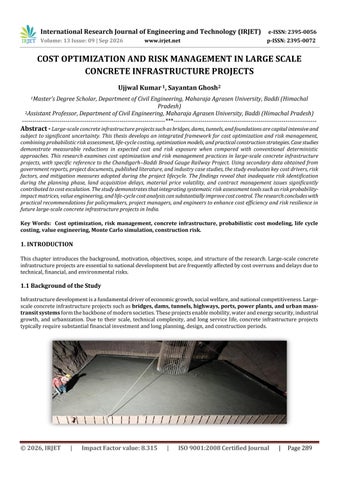
1.1 Bridge Work – Raft Foundation Concrete remains the most widely used construction material in infrastructure projects because of its versatility, durability, strength, and relatively low unit cost. However, when used in large volumes as in mass concrete structures, long-span bridges, and deep foundations concrete construction introduces significant technical, financial, and managerial challenges. Issues such as material price volatility, thermal cracking, curing control, reinforcement congestion, formwork complexity, and environmental compliance significantly influence project cost and risk.
1.2 Bridge Work – Pier Despite advances in engineering design, construction technology, and project management tools, large-scale infrastructure projects around the world continue to suffer from cost overruns and schedule delays. Numerous international studies have shown that a majority of megaprojects exceed their original budgets, sometimes by 20–50% or more. In developing economies, the problem is often more severe due to funding constraints, regulatory uncertainty, and limited risk management capability. A key reason for persistent underperformance is the separation of cost estimation and risk management. Traditional project planning often relies on deterministic cost estimates with fixed contingencies, failing to adequately account for uncertainty and interdependencies among risks. As a result, early decisions such as design alternatives, procurement strategies, and construction methods are made without a clear understanding of their long-term cost and risk implications.
1.3 Need for Cost Optimization and Risk Management Cost optimization in construction refers to achieving the required performance, safety, durability, and functionality at the minimum total cost, considering not only initial construction cost but also life-cycle costs such as operation, maintenance, and rehabilitation. In large-scale concrete projects, even small percentage savings can translate into significant monetary value due to the scale of investment. Several factors make cost optimization particularly critical for concrete infrastructure projects: 1. 2. 3. 4. 5. 6.
High Material Consumption Cement, aggregates, reinforcement steel, and admixtures constitute a major portion of project cost. Fluctuations in material prices can significantly affect budgets. Labor and Equipment Expenses: Concrete construction involves skilled labor, heavy machinery, transportation, and specialized equipment. Efficient planning and execution help minimize labor hours and equipment downtime. Strict Budget Constraints: Public and private infrastructure projects often operate under fixed budgets. Cost optimization helps ensure projects remain financially viable without compromising quality or safety. Sustainability Considerations: optimizing concrete mix designs, reducing material waste, and incorporating supplementary cementitious materials can lower both costs and environmental impacts, supporting sustainable infrastructure development. Resource Availability: Fluctuations in the availability and prices of raw materials and transportation costs can significantly affect project budgets. Cost optimization helps mitigate these risks through efficient resource management. Long Project Duration: Extended construction periods expose projects to inflation, interest rate changes, and market volatility.
© 2026, IRJET
|
Impact Factor value: 8.315
|
ISO 9001:2008 Certified Journal
|
Page 290
International Research Journal of Engineering and Technology (IRJET)
e-ISSN: 2395-0056
Volume: 13 Issue: 09 | Sep 2026
p-ISSN: 2395-0072
www.irjet.net
7.
Design and Constructability Constraints: Complex geometry, massive sections, and strict durability requirements often lead to conservative designs and higher costs. 8. Public Funding and Accountability: Many infrastructure projects are publicly funded, increasing scrutiny over cost efficiency and value for money. 9. Quality and Performance Requirements: Infrastructure projects must meet stringent structural, durability, and safety standards. Cost optimization seeks the most economical solutions while maintaining required performance and regulatory compliance. 10. Risk Management: Unexpected events such as material price increases, weather disruptions, design changes, and construction errors can escalate costs. Effective cost optimization includes contingency planning and proactive risk mitigation. Cost optimization techniques such as value engineering, constructability review, optimized concrete mix design, efficient sequencing, and digital planning tools offer opportunities to reduce unnecessary costs. However, optimization efforts that ignore uncertainty may lead to fragile solutions that fail under adverse conditions. Therefore, cost optimization must be closely integrated with risk management.
1.4 Importance of Risk Management in Large-Scale Projects Risk is inherent in all construction projects, but its magnitude and impact increase significantly with project size and complexity. In large-scale concrete infrastructure projects, risks arise from diverse sources, including technical uncertainties, geotechnical conditions, environmental regulations, contractual arrangements, market conditions, and stakeholder interactions. Key characteristics of risk in such projects include:
High uncertainty in early stages, when major cost-determining decisions are made Interdependence of risks, where one adverse event can trigger multiple impacts Asymmetric consequences, where downside risks often outweigh potential gains
Traditional risk management practices in construction often focus on qualitative risk registers and reactive mitigation. While useful, these approaches are insufficient to quantify the financial impact of risks or to support optimal decision-making. Modern risk management emphasizes probabilistic analysis, scenario modeling, and integration with cost and schedule control systems. Effective risk management enables project stakeholders to:
Identify and prioritize critical risks Allocate risks appropriately among parties Determine realistic contingencies Improve predictability of cost and schedule outcomes.
1.5 Integration of Cost Optimization and Risk Management Cost optimization and risk management are frequently treated as separate disciplines. Cost engineers focus on minimizing estimated costs, while risk managers focus on identifying and mitigating uncertainties. This separation often leads to suboptimal outcomes. For example, a design alternative with the lowest initial cost may carry high technical risk, leading to rework, delays, or longterm maintenance problems. Conversely, overly conservative designs may reduce risk but result in excessive cost. An integrated approach evaluates decisions based on risk-adjusted cost, balancing expected value with uncertainty and downside exposure. Integration can be achieved through:
Probabilistic cost estimation Monte Carlo simulation of cost and schedule Risk-adjusted optimization models
© 2026, IRJET
|
Impact Factor value: 8.315
|
ISO 9001:2008 Certified Journal
|
Page 291
International Research Journal of Engineering and Technology (IRJET)
e-ISSN: 2395-0056
Volume: 13 Issue: 09 | Sep 2026
p-ISSN: 2395-0072
www.irjet.net
Life-cycle cost analysis under uncertainty
Such approaches enable decision-makers to compare alternatives not only on mean cost but also on variability, probability of overrun, and worst-case outcomes.
1.6 Problem Statement Despite the availability of advanced analytical tools, many large-scale concrete infrastructure projects continue to rely on deterministic budgeting and fragmented risk management practices. This leads to:
Underestimation of project cost and schedule Inadequate contingency allocation Inefficient procurement and contracting strategies Poor resilience to unforeseen events
There is a clear need for a systematic, integrated framework that combines cost optimization techniques with quantitative risk management tailored specifically to large-scale concrete infrastructure projects.
1.7 Objectives of the Study The main objective of this research is to develop and demonstrate an integrated framework for cost optimization and risk management in large-scale concrete infrastructure projects. The specific objectives are:
To identify key cost drivers in large-scale concrete infrastructure projects To classify and quantify major risks affecting cost and schedule To evaluate cost optimization strategies applicable to concrete construction To develop a probabilistic cost–risk optimization model To apply the proposed framework to real-world case studies To provide practical recommendations for project owners, engineers, and policymakers
1.8 Scope of the Study This study focuses on:
Large-scale infrastructure projects where concrete is the dominant construction material Cost and schedule performance during planning and construction phases Financial, technical, environmental, and contractual risks with cost implications
The study does not explicitly address detailed structural design calculations or operational management beyond life-cycle cost considerations.
2. DISCUSSION OF RESULTS 2.1 Introduction This chapter discusses the results obtained from the probabilistic cost modeling, risk analysis, and optimization exercises presented in previous chapters. The discussion focuses on interpreting findings, comparing them with existing literature, and evaluating the effectiveness of the proposed integrated cost–risk framework for large-scale concrete infrastructure projects. The results are analyzed in relation to the research objectives, with emphasis on cost reliability, risk exposure, and practical decision-making implications.
© 2026, IRJET
|
Impact Factor value: 8.315
|
ISO 9001:2008 Certified Journal
|
Page 292
International Research Journal of Engineering and Technology (IRJET)
e-ISSN: 2395-0056
Volume: 13 Issue: 09 | Sep 2026
p-ISSN: 2395-0072
www.irjet.net
2.2 Comparison with Traditional Approaches The case study results clearly demonstrate the limitations of traditional deterministic cost estimation and optimization methods. Deterministic estimates consistently underestimated total project cost and failed to capture the variability inherent in construction activities. In contrast, the probabilistic approach provided:
A range of possible cost outcomes Explicit probabilities of cost overrun Confidence-based contingency estimates
These findings align with earlier studies by Flyvbjerg et al. and Touran, which highlighted the inadequacy of fixed-percentage contingencies in large infrastructure projects.
2.3 Effectiveness of Probabilistic Cost Modeling Probabilistic cost modeling proved effective in capturing the combined impact of multiple uncertain variables. The resulting cost distributions revealed significant right-skewness, indicating a higher likelihood of cost overruns than suggested by deterministic estimates. Sensitivity analysis consistently identified material prices, labor productivity, and project duration as the most influential variables. This insight enables targeted risk mitigation efforts, improving overall cost control.
2.4 Impact of Risk-Informed Optimization Risk-informed optimization resulted in solutions that balanced expected cost and risk exposure more effectively than deterministic optimization. Although some optimized solutions had slightly higher expected costs, they significantly reduced downside risk, as measured by CVaR and high-confidence cost levels. This trade-off is particularly important for critical infrastructure projects, where severe cost overruns can have substantial economic and social consequences
2.5 Integration of Cost and Risk Management One of the key contributions of this research is the integration of cost optimization and risk management into a unified framework. The results demonstrate that treating cost and risk separately can lead to suboptimal decisions. The integrated approach allows decision-makers to:
Evaluate alternatives on a consistent basis Align decisions with risk appetite Improve transparency and accountability
This supports more informed and defensible decision-making.
2.6 Implications for Project Stakeholders 2.6.1 Project Owners For project owners, the framework provides a more reliable basis for budgeting and contingency allocation. Confidence-based cost estimates improve funding decisions and reduce the likelihood of budget overruns.
© 2026, IRJET
|
Impact Factor value: 8.315
|
ISO 9001:2008 Certified Journal
|
Page 293
International Research Journal of Engineering and Technology (IRJET)
e-ISSN: 2395-0056
Volume: 13 Issue: 09 | Sep 2026
p-ISSN: 2395-0072
www.irjet.net
2.6.2 Contractors Contractors benefit from improved risk understanding and more realistic pricing strategies. Risk-informed optimization supports better resource allocation and construction planning.
2.6.3 Designers and Consultants Designers can use the framework to evaluate design alternatives based on both cost and risk, leading to more constructible and resilient solutions.
2.7 Alignment with Existing Literature The findings of this study are consistent with existing literature emphasizing the importance of probabilistic analysis and integrated risk management. However, this research extends previous work by focusing specifically on concrete-intensive infrastructure projects and demonstrating practical implementation through case studies.
2.8 Limitations of the Study Despite its contributions, the study has several limitations:
Reliance on expert judgment where historical data were limited Simplifications in modeling complex construction processes Limited number of case studies
These limitations highlight opportunities for further research.
2.9 Summary This chapter discussed the results of the proposed cost optimization and risk management framework. The findings demonstrate that probabilistic modeling and risk-informed optimization provide significant advantages over traditional approaches, particularly in improving cost reliability and decision-making quality. The final chapter presents conclusions and recommendations.
3. IMPLEMENTATION CONSIDERATIONS Successful implementation requires organizational capability, data governance, and training in probabilistic risk management.
3.1 Organizational adoption and change management Implementing integrated cost-risk practices requires organizational capability development, process changes, and buy-in from senior stakeholders. Pilot projects and capability building can accelerate adoption.
3.2 Data governance and analytics capability Robust data collection and governance are prerequisites for probabilistic modeling. Owners should invest in standardized data formats, lessons-learned repositories, and analytics platforms.
3.3 Legal and regulatory implications Contract language must reflect desired risk allocation, and regulatory frameworks may impact allowable contract forms, procurement practices, and contingency treatment.
3.4 Training, upskilling, and cultural shifts Training in probabilistic thinking, EVM, BIM, and collaborative contracting is necessary. Cultural shifts toward transparency and shared risk ownership are often required.
© 2026, IRJET
|
Impact Factor value: 8.315
|
ISO 9001:2008 Certified Journal
|
Page 294
International Research Journal of Engineering and Technology (IRJET)
e-ISSN: 2395-0056
Volume: 13 Issue: 09 | Sep 2026
p-ISSN: 2395-0072
www.irjet.net
4. CONCLUSIONS AND RECOMMENDATIONS The thesis concludes that integrating cost optimization with risk management leads to more resilient and economical infrastructure delivery.
4.1 Introduction This chapter presents the conclusions drawn from the research and provides recommendations for industry practice and future research. The study focused on developing and applying an integrated framework for cost optimization and risk management in large-scale concrete infrastructure projects. The conclusions are aligned with the research objectives and supported by the findings from probabilistic modeling, optimization, and case studies.
4.2 Summary of Research Large-scale concrete infrastructure projects are characterized by high uncertainty, complexity, and exposure to multiple risks. Traditional deterministic approaches to cost estimation and optimization often fail to adequately capture these uncertainties, resulting in cost overruns and budget unreliability. This research addressed these challenges by:
Identifying key cost drivers and risks specific to concrete infrastructure Developing probabilistic cost models using Monte Carlo simulation Integrating risk management with cost optimization techniques Demonstrating practical application through real-world case studies
4.3 Key Conclusions Based on the analysis and results, the following key conclusions are drawn:
4.3.1
Inadequacy of Deterministic Cost Approaches
Deterministic cost estimation methods underestimate true project cost by ignoring uncertainty and variability. Fixedpercentage contingencies are insufficient and often misleading for large-scale concrete infrastructure projects.
4.3.2
Importance of Probabilistic Cost Modeling
Probabilistic cost modeling provides a realistic representation of project cost risk by capturing uncertainty in material prices, productivity, duration, and external factors. Confidence-based cost estimates (P80, P90) offer a more reliable basis for budgeting and contingency allocation.
4.3.3
Integration of Cost Optimization and Risk Management
Cost optimization and risk management should not be treated as separate processes. Integrating these functions leads to better decision-making by balancing expected cost with risk exposure.
4.3.4
Effectiveness of Risk-Informed Optimization
Risk-informed optimization produces more robust solutions than deterministic optimization. Although such solutions may have slightly higher expected costs, they significantly reduce the likelihood of severe cost overruns.
4.3.5
Value of Early Risk Identification
Early identification and quantification of risks significantly improve the effectiveness of cost control measures. Decisions made during early project stages have the greatest impact on project outcomes.
© 2026, IRJET
|
Impact Factor value: 8.315
|
ISO 9001:2008 Certified Journal
|
Page 295
International Research Journal of Engineering and Technology (IRJET)
e-ISSN: 2395-0056
Volume: 13 Issue: 09 | Sep 2026
p-ISSN: 2395-0072
www.irjet.net
4.4 Practical Recommendations Based on the findings, the following recommendations are proposed for industry practitioners:
4.4.1
Adoption of Probabilistic Cost Estimation
Project owners should adopt probabilistic cost estimation methods for large-scale concrete infrastructure projects, particularly during feasibility and detailed design stages.
4.4.2
Risk-Based Contingency Allocation
Contingency should be determined based on quantified risk and desired confidence levels rather than arbitrary percentages.
4.4.3
Integration of Risk Analysis in Design
Design alternatives should be evaluated using risk-informed cost analysis to identify solutions that offer the best balance between cost, performance, and risk.
4.4.4
Use of Collaborative Contracting
Collaborative procurement approaches such as early contractor involvement and alliancing can improve risk sharing and reduce adversarial behavior.
4.4.5
Capacity Building and Training
Organizations should invest in training personnel in probabilistic analysis, risk management, and optimization techniques.
4.5 Recommendations for Future Research Future research may focus on:
Expanding the framework to include schedule and quality optimization Incorporating real-time data and digital tools such as BIM Applying the framework to a broader range of infrastructure types Developing standardized guidelines for implementation
4.6 Final Remarks This research demonstrates that integrating cost optimization and risk management provides a powerful approach for improving the performance of large-scale concrete infrastructure projects. By adopting probabilistic and risk-informed methods, project stakeholders can enhance cost reliability, reduce uncertainty, and achieve better project outcomes.
ACKNOWLEDGEMENT The author acknowledges the guidance and academic support provided by Mr. Sayantan Ghosh, Assistant Professor, Department of Civil Engineering, Maharaja Agrasen University, Himachal Pradesh, and the support of the Department of Civil Engineering.
REFERENCES [1] B. Flyvbjerg, M. K. S. Holm, and S. L. Buhl, “Underestimating costs in public works projects: Error or lie?”, Journal of the American Planning Association, vol. 68, no. 3, pp. 279–295, 2002. [2] B. Flyvbjerg, “What you should know about megaprojects and why: An overview,” PM World Journal, vol. 3, no. 2, pp. 1–10, 2014. [3] ISO 31000, Risk Management – Guidelines, International Organization for Standardization, 2018.
© 2026, IRJET
|
Impact Factor value: 8.315
|
ISO 9001:2008 Certified Journal
|
Page 296
International Research Journal of Engineering and Technology (IRJET)
e-ISSN: 2395-0056
Volume: 13 Issue: 09 | Sep 2026
p-ISSN: 2395-0072
www.irjet.net
[4] A. S. Akintoye and M. J. MacLeod, “Risk analysis and management in construction,” International Journal of Project Management, vol. 15, no. 1, pp. 31–38, 1997. [5] L. D. Miles, Techniques of Value Analysis and Engineering, McGraw-Hill, 1972. [6] M. Park, H. Lee, S. Kwon, and J. Yu, “Design cost optimization using value engineering,” Journal of Construction Engineering and Management, vol. 142, no. 3, 04015086, 2016. [7] P. E. D. Love, D. J. Edwards, and Z. Irani, “Moving beyond optimism bias and strategic misrepresentation: An explanation of social infrastructure project cost overruns,” IEEE Transactions on Engineering Management, vol. 59, no. 4, pp. 560–571, 2016. [8] A. Touran, “Probabilistic model for cost contingency,” Journal of Construction Engineering and Management, vol. 129, no. 3, pp. 280–284, 2003. [9] R. Flanagan, G. Norman, J. Meadows, and G. Robinson, Life Cycle Costing: Theory and Practice, Wiley-Blackwell, 2013. [10] D. Baccarini, “Estimating project cost contingency: A model and exploration of research questions,” Construction Management and Economics, vol. 23, no. 6, pp. 619–631, 2005. [11] P. X. W. Zou, G. Zhang, and J. Wang, “Understanding the key risks in construction projects in China,” International Journal of Project Management, vol. 25, no. 6, pp. 601–614, 2007. [12] PMI, A Guide to the Project Management Body of Knowledge (PMBOK Guide), 7th ed., Project Management Institute, 2021.
© 2026, IRJET
|
Impact Factor value: 8.315
|
ISO 9001:2008 Certified Journal
|
Page 297