
International Research Journal of Engineering and Technology (IRJET) e-ISSN: 2395-0056
Volume: 13 Issue: 02 | Feb 2026 www.irjet.net p-ISSN: 2395-0072
International Research Journal of Engineering and Technology (IRJET) e-ISSN: 2395-0056
Volume: 13 Issue: 02 | Feb 2026 www.irjet.net p-ISSN: 2395-0072
Mrs. P. Swathi1,G. Riya Reddy2 , J .Vaishnavi 3 , G.Rajalaxmi4 , A. Varshith5
1Assistant Professor, Department of IT, TKR College of Engineering and Technology, Telangana, India
2,3,4,5B.Tech Students, Department of IT, TKR College of Engineering and Technology, Telangana, India
Abstract - Recruitment has become a highlydata-intensive process, with organizations often receiving thousands of resumes for a single job opening. Manual resume screening is time consuming, inconsistent, and susceptible to human bias, highlighting the need for intelligent and automated hiring solutions. This project presents an advanced AI-powered resume screening and candidate evaluation system aimed at improving the efficiency, accuracy, and fairness of modern recruitment workflows. The proposed system automates the ingestion and parsing of resumes across multiple formats, extracting structured information such as personal details, educational background, professional experience, skills, and achievements. To move beyond traditional keyword based filtering, the platform employs a multi-factor evaluation framework that integrates semantic similarity analysis, TFIDF weighting, contextual embeddings, and experience based scoringto assesscandidatesuitabilityholistically.State-of-theart language models, including BERT and FLAN-T5, are finetuned for tasks such as resume classification, content summarization, and multi-label skill extraction, enabling deeper contextual understanding of candidate profiles
Keywords : AI-powered Recruitment, Resume Screening, Candidate Evaluation, Natural Language Processing (NLP), Resume Parsing, Semantic Similarity, TF-IDF, Contextual Embeddings, BERT, FLAN-T5, Skill Extraction.
The rapid growth of digital recruitment platforms has resultedinorganizationsreceivingthousandsofresumesfor asinglejobopening,makingmanualresumescreeningtimeconsuming, inconsistent, and prone to human bias. Traditional automated resume screening systems mainly relyonkeywordmatching,whichoftenfailstocapturethe true context, structure, and career progression of a candidate.Thesesystemsignoreimportantaspectssuchas resume layout, employment timelines, and the possibility that a candidate may be suitable for multiple roles simultaneously.Asa result,manyqualifiedcandidatesare overlooked, while irrelevant resumes may pass initial screening. To overcome these limitations, context-aware resumescreeninghasemergedasapromisingsolution.By integrating layout understanding, timeline analysis, and multi-label intelligence, modern systems can evaluate resumes more holistically and accurately. This approach enables recruiters to make better hiring decisions by
aligningcandidateprofileswithjobrequirementsinamore intelligentandfairmanner.
Layout intelligence plays a crucial role in understanding resumesbeyondplaintextbyanalyzinghowinformationis visually organized within the document. Resumes contain structured sections such as education, experience, skills, certifications, and projects, which are often represented usingheadings,columns,fontstyles,andspacing.Acontextaware system leverages layout analysis techniques to correctlyidentifyandseparatethesesections,ensuringthat informationisinterpretedinthecorrectsemanticcontext. For example, the same skill mentioned under a “Projects” section may carry different importance compared to one listedunder“WorkExperience.”Bypreservingspatialand structural relationships, layout-aware models reduce misclassificationerrorsandimproveinformationextraction accuracy.Thisintelligencealsohelpshandlediverseresume formats, templates, and design styles used by candidates. Ultimately, layout-based context understanding enables automatedscreeningsystemstoreadresumesinawaythat closely resembles human interpretation, leading to more reliableandmeaningfulcandidateevaluation.
Timeline analysis focuses on understanding the chronological progression of a candidate’s career by examiningemploymentdurations,gaps,roletransitions,and overlapping experiences. This temporal understanding allowsthesystemtoassesscareerstability,growthpatterns, andrelevanceofexperiencetoaspecificjobrole.Insteadof treatingallexperiencesequally,thesystemprioritizesrecent andlong-termrolesthatalignwiththejobrequirements.In addition,multi-labelintelligenceenablesthemodeltoassign multiple suitable job categories or skill labels to a single resume. This is particularly useful in modern job markets wherecandidatesoftenpossessinterdisciplinaryskillsand areeligibleformorethanonerole.Bycombiningtimeline insightswithmulti-labelclassification,thesystemprovidesa richerandmoreflexibleassessmentofcandidatesuitability. This approach improves shortlisting accuracy, reduces
International Research Journal of Engineering and Technology (IRJET) e-ISSN: 2395-0056
Volume: 13 Issue: 02 | Feb 2026 www.irjet.net p-ISSN: 2395-0072
unfair rejection, and supports recruiters in identifying versatileandhigh-potentialcandidatesefficiently.
The proposed system introduces an intelligent, contextawareresumescreeningframeworkthatintegrateslayout analysis,timelinemodeling,andmulti-labelclassificationto improve recruitment accuracy and efficiency. Unlike traditionalkeyword-basedsystems,thisapproachanalyzes resumes as structured documents, preserving visual, semantic, and temporal information. The system automatically extracts meaningful features from resumes, understands career progression, and maps candidate profiles to multiple relevant job roles. By combining deep learning models with document layout intelligence, the proposed system reduces bias, handles diverse resume formats,anddeliversmore reliablecandidateshortlisting. The overall architecture is designed to be scalable, adaptable, and suitable for real-world recruitment environments.
Thesystemarchitecturefollowsamodularpipelinedesigned forintelligentandcontext-awareresumescreening.Itbegins withaninputlayerthatacceptsresumesinmultipleformats suchasPDFandDOCX.Preprocessingtechniquesareapplied toclean,normalize,andconvertdocumentsintomachinereadable text. A layout analysis module identifies resume structure,sections,andvisualhierarchy.Contextextraction ensuresinformationisinterpretedwithincorrectsemantic sections.Extracteddataispassedtothetimelinemodeling module. This module analyzes employment dates, experienceduration,andcareergaps.Temporalfeaturesare combined with contextual features for enhanced representation. Feature engineering transforms raw data into structured vectors. A multi-label classification engine predicts multiple suitable job roles. The matching engine comparesresumeswithjobdescriptions.Relevancescores are generated for each candidate. Candidates are ranked basedonmatchingaccuracy.Resultsaresenttotheoutput layer. A recruiter dashboard displays ranked profiles and insights.Thearchitectureensuresscalability,accuracy,and efficienthiringdecisions.
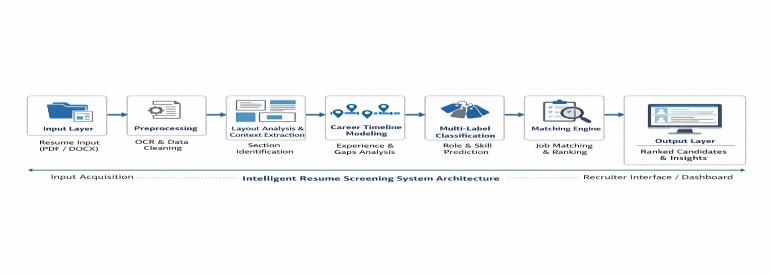
This module focuses on understanding the structural and visual layout of resumes to accurately extract contextual information. It analyzes document elements such as headings, sections, font size, alignment, and spacing to identifykeycomponentslikeeducation,skills,experience, and certifications. By maintaining spatial relationships between text blocks, the system ensures that extracted informationisinterpretedinitscorrectcontext.Advanced layout-awaremodelsenablethesystemtohandleresumes with multiple columns, tables, and custom designs. This reduceserrorscausedbymisplacingcontentunderincorrect sections.Themodulealsostandardizesextracteddataintoa unifiedformat,makingiteasierfordownstreamprocessing. Asaresult,thesystemachieveshigherprecisioninresume parsingandimprovesoverallscreeningreliability.
The timeline analysis component evaluates the chronologicalsequenceofacandidate’sprofessionaljourney. It extracts employment dates, role durations, career gaps, and overlapping positions to build a structured career timeline.Thistemporalmodelingallowsthesystemtoassess experiencerelevance,jobstability,andprofessionalgrowth patterns.Recentandlong-termexperiencesaregivenhigher importance when matching job requirements. The system also identifies career transitions and promotions, which provideinsightsintoskilldevelopmentandadaptability.By analyzingtimelines,recruitersgainadeeperunderstanding of a candidate’s background rather than relying solely on static skill lists. This module enhances fairness by consideringexperiencequalityandprogression,leadingto moreinformedhiringdecisions.
Theimplementationoftheproposedcontext-awareresume screeningsystemiscarriedoutusingamodularandscalable approach.ThesystemisdevelopedusingPythonasthecore programminglanguageduetoitsstrongsupportformachine learning and document processing libraries. Resumes are accepted in PDF and DOCX formats and processed using librariessuchasPyPDF2,python-docx,and OCR toolslike Tesseract for scanned documents. Preprocessing includes text normalization, noise removal, and tokenization to ensure clean input data. Layout analysis is implemented using layout-aware deep learning models that identify sections,headings,andspatialrelationshipswithinresumes. Contextual information is extracted and mapped to predefined categories such as skills, experience, and education.
Careertimelinemodelingisimplementedbyextractingdate entitiesusing natural languageprocessing techniquesand regular expressions. Employment durations, gaps, and
International Research Journal of Engineering and Technology (IRJET) e-ISSN: 2395-0056
Volume: 13 Issue: 02 | Feb 2026 www.irjet.net p-ISSN: 2395-0072
overlapsarecomputedand storedasstructuredtemporal features. Feature engineering combines layout-based, contextual,andtimelinefeaturesintounifiedembeddings. Forintelligentscreening,amulti-labelclassificationmodelis trainedusingdeeplearningalgorithmssuchastransformerbased encoders or neural networks. The model predicts multiple suitable job roles for each resume. A matching enginecomparesresumeembeddingswithjobdescription embeddingstogeneraterelevancescores.Finally,resultsare displayed through a recruiter dashboard showing ranked candidates, predicted roles, and key insights. This implementationensuresaccuracy,efficiency,andreal-world applicability.
Thesystembeginsbycollectingresumesincommonlyused formatssuchasPDFandDOCXthroughanonlineinterface. Thesedocumentsareconvertedintomachine-readabletext using document parsers and OCR techniques for scanned resumes.Preprocessingstepsincludetextcleaning,removal of noise, normalization, and sentence segmentation. Tokenizationandstop-wordremovalareappliedtoprepare dataforfurtheranalysis.Specialcharactersandformatting inconsistenciesarehandled carefully.The system ensures uniform data representation across resumes. This step improvesprocessingaccuracyinlaterstages.Preprocessed dataisstoredinastructuredformat.Thismoduleensures reliabilityandconsistencyininputhandling.
This module analyzes the visual and structural layout of resumestoidentifymeaningfulsections.Itdetectsheadings, subheadings, columns, and content blocks using layoutaware models. Text blocks are mapped to semantic categoriessuchaseducation,skills,andexperience.Spatial relationshipsbetweenelementsarepreservedforcontextual understanding. The system handles multiple resume templates and formats effectively. This reduces misclassification caused by unconventional layouts. Extractedcontextualfeaturesarestandardizedforanalysis. The module improves semantic accuracy of information extraction.Itcloselymimicshumanresumereading
Careertimelinemodelingfocusesonanalyzingchronological employment data within resumes. Date extraction techniquesidentifyjobstartandendperiodsaccurately.The system calculates experience duration, career gaps, and overlapping roles. Temporal features are generated to representprofessionalgrowthpatterns.Thesefeaturesare combined with contextual and layout-based features. Feature scaling and encoding are applied for model compatibility. The system prioritizes recent and relevant
experience.Thisimprovescandidate-jobalignmentaccuracy. Timelinemodelingaddsdepthtocandidateevaluation.
Thefinalmoduleperformsintelligentresumeclassification using multi-label learning techniques. Machine learning modelspredictmultiplesuitablejobrolesforeachresume. Thesystemcomparesresumefeatureswithjobdescriptions tocomputerelevancescores.Candidatesarerankedbased onmatchingaccuracyandconfidencelevels.Thisapproach avoidsrigidsingle-roleclassification.Recruitersgainflexible candidaterecommendations.Thesystemsupportsfeedbackdrivenmodelimprovement.Resultsarevisualizedthrough aninteractivedashboard.Thismoduleenhancesefficiency andfairnessinrecruitment.
The performance of the proposed context-aware resume screeningsystem wasevaluatedusing multiple metrics to assess accuracy, efficiency, and robustness. Experiments were conducted on a diverse dataset of resumes covering different formats,job domains,and experiencelevels.The evaluationfocusedontheeffectivenessoflayoutawareness, timelinemodeling,andmulti-labelintelligencecomparedto traditional keyword-based screening systems. The results demonstrate that the proposed approach significantly improvesresumeclassificationandcandidate-jobmatching accuracy.
The system achieved high accuracy in identifying resume sectionssuchaseducation,experience,skills,andprojects across different layouts. Layout-aware analysis reduced section misclassification and improved information extraction reliability. The system performed well even on resumes with multiple columns and customized designs. Compared to baseline text-only models, context-aware parsing showed noticeable improvements. Error rates in section identification were significantly reduced. This confirms the effectiveness of layout intelligence. Accurate context extraction directly improved downstream classification.Theresultsindicatestrongrobustnessacross diverseresumeformats.
Timelinemodelingeffectivelycapturedcareerprogression, experienceduration,andemploymentgaps.Candidateswith consistent growth and relevant recent experience were accurately prioritized. Temporal features enhanced the understanding of experience relevance. The system successfullydifferentiatedshort-termandlong-termroles. Comparedtosystemswithouttimelinemodeling,relevance
International Research Journal of Engineering and Technology (IRJET) e-ISSN: 2395-0056
Volume: 13 Issue: 02 | Feb 2026 www.irjet.net p-ISSN: 2395-0072
scoringimprovedsignificantly.Careergapanalysisreduced unfair penalization of candidates. Timeline features contributed positively to classification confidence. This analysishighlightstheimportanceoftemporalintelligencein resumescreening
The multi-label classification model demonstrated strong performance in assigning multiple job roles to a single resume. Precision, recall, and F1-score values showed consistent improvement over single-label classifiers. The system accurately identified candidates suitable for interdisciplinaryroles.Matchingaccuracyimproveddueto combinedcontextualandtemporalfeatures.Falserejection rates were reduced significantly. The ranking mechanism produced meaningful candidate ordering. This flexibility improved recruiter satisfaction. Overall, multi-label intelligenceenhancedscreeningfairnessandeffectiveness.
This work presented a context-aware resume screening systemthatintegrateslayoutintelligence,timelineanalysis, and multi-label classification to address the limitations of traditionalresumescreeningmethods.Byunderstandingthe structural layout of resumes and preserving semantic context, the system accurately extracts and interprets candidate information. Timeline modeling adds depth by analyzing career progression, experience relevance, and employment gaps, enabling fairer and more informed evaluation. The use of multi-label intelligence allows candidatestobematchedwithmultiplesuitablejobroles, reflecting real-world skill diversity. Experimental results demonstrate improved accuracy, reduced false rejections, andbettercandidaterankingcomparedtokeyword-based approaches. Overall, the proposed system enhances recruitment efficiency, minimizes bias, and provides a scalableandintelligentsolutionformodernhiringprocesses.
Futurescopecanbeextendedbyintegratingthesystemwith real-timeapplicanttrackingsystems(ATS)andjobportals for automated resume evaluation, enhancing semantic understanding using advanced language models, and improvinglayoutintelligencetoaccuratelyhandlecreative or non-standard resumes. Moreover, explainable AI techniques can provide transparent reasoning behind candidaterankings,increasingrecruitertrustandadoption. Incorporating feedback loops from recruiters and hiring outcomes can enable continuous model improvement. Deploying the system on cloud-based or distributed architecturescanenhancescalabilityandperformance.
Therearemanypeoplewhohelpedusdirectlyorindirectly inthesuccessful completion ofourproject,and wewould liketotakethisopportunitytoexpressoursinceregratitude toallofthem.Weareextremelythankfulandindebtedtoour project supervisor, Mrs. P. Swathi, Assistant Professor, Department of Information Technology, TKR College of Engineering and Technology, for her constant guidance, encouragement,andmoralsupportthroughouttheproject. We extend our heartfelt thanks to Dr. R. Muruganantham, Head of the Department, Department of Information Technology,forhiscontinuousencouragementandsupport. We are also sincerely grateful to Dr. D. V. Ravi Shankar, Principal,TKRCollege ofEngineering and Technology, for his timely support and valuable suggestions during the courseoftheproject.Finally,wewouldliketothankallthe faculty and staff of the Department of Information Technology, along with our parents and friends, who supportedusdirectlyorindirectlyincompletingthisproject successfully.
[1] C. Raffel, N. Shazeer, A. Roberts, K. Lee, S. Narang, M. Matena,Y.Zhou,W.Li,andP.J.Liu,‘‘Exploringthelimitsof transferlearningwithaunifiedtext-to-texttransformer,’’J. Mach.Learn.Res.,vol.21,no.140,pp.1–67,2020.
[2]W.Yu,N.Lu,X.Qi,P.Gong,andR.Xiao,‘‘PICK:Processing keyinformationextractionfromdocumentsusingimproved graph learningconvolutionalnetworks,’’inProc.25thInt.Conf.Pattern Recognit.(ICPR),Jan.2021,pp.4363–4370.
[3]T.M.Harsha,G.S.Moukthika,D.S.Sai,M.N.R.Pravallika, S. Anamalamudi, and M. Enduri, ‘‘Automated resume screenerusingnaturallanguageprocessing(NLP),’’inProc. 6thInt.Conf.TrendsElectron.Informat.(ICOEI),Apr.2022, pp.1772–1777.
[4] E. Almazrouei, H. Alobeidli, A. Alshamsi, A. Cappelli, R. Cojocaru,M. Debbah, É. Goffinet, D. Hesslow, J. Launay, Q. Malartic,D.Mazzotta,Noune,B.Pannier,andG.Penedo,‘‘The falcon series of open languagemodels,’’ 2023, arXiv:2311.16867.
[5]C.Gan,Q.Zhang,andT.Mori,‘‘ApplicationofLLMagents inrecruitment:Anovelframeworkforresumescreening,’’ 2024,arXiv:2401.08315.
[6]F.P.-W.Lo,J.Qiu,Z.Wang,H.Yu,Y.Chen,G.Zhang,andB. Lo,‘‘AIhiringwithLLMs:Acontext-awareandexplainable multi-agent framework for resume screening,’’ 2025, arXiv:2504.02870.