
International Research Journal of Engineering and Technology (IRJET) e-ISSN: 2395-0056
Volume: 13 Issue: 06 | Jun 2026 www.irjet.net p-ISSN: 2395-0072
COMPARATIVE STUDY ON HIGH PERFORMANCE CONCRETE WITH VARIOUS CEMENT REPLACING MATERIALS (SILICA FUME, FLY ASH, GGBS, AND METAKAOLIN
Prof. Nilima. S. Pote1 , Prof. Urmila Mahadik2 , Ganesh Kale3 , Vivek chavan4 , Rameshwar Darphe5 , Omakr Temkar 6
1,2Assistant Professor, Dept. of Civil Engineering, JSPM’s Rajarshi Shahu College of Engineering, Tathawade-411033, Pune, Maharashtra, India.
3,4,5,6Final Year Students, Dept. of Civil Engineering, JSPM’s Rajarshi Shahu College of Engineering, Tathawade-411033, Pune, Maharashtra, India.
Abstract -High Performance Concrete is widely used in construction because it is very strong and lasts a long time compared to regular concrete. The problem is that making cement is really bad for the environment. It also makes a lot of carbon dioxide. To solve these problems people use things like silica fume fly ash, Ground Granulated Blast Furnace Slag and metakaolin of cement. These things are used to replace cement in High Performance Concrete. This study looks at how these things work in High Performance Concrete. The cement was replaced with these things: silica fume was used for 10 percent of the cement fly ash for 20 percent Ground Granulated Blast Furnace Slag for 40 percent and metakaolin for 12 percent. Concrete cubes were tested to see how strong they were after 7 days and 28 days. Tests were also done to see how water the concrete would absorb, which shows how durable High Performance Concrete is. The results showed that the High Performance Concrete with metakaolin and silica fume was stronger than the High Performance Concrete without these things. The Ground Granulated Blast Furnace Slag also helped to make the High Performance Concrete more durable.It absorbed water Using these things makes the High Performance Concrete better. It also reduces the amount of cement that is needed which's good for the environment and it saves money. Overall using these things in High Performance Concrete makes it stronger and more durable. It reduces the amount of cement needed which is good, for the environment and saves money.
Key Words: High Performance Concrete, M60 Concrete, Silica Fume Fly Ash, GGBS, Metakaolin, Compressive Strength, Water Absorption, Supplementary Cementitious Materials
I. INTRODUCTION
Concrete is a popular material that people use to build things because it is strong lasts a long time and can be usedinmanydifferent ways..MakingOrdinary Portland Cement, which is a key part of concrete releases a lot of carbon dioxide into the air, which is bad for the environment. To solve this problem peoplehave started
using materials called supplementary cementitious materials to help make concrete. High Performance Concreteisakindofconcretethatisdesignedtobeeven stronger, last longer and be able to withstand different environmentalconditions.Tomakethiskindofconcrete people use materials like silica fume fly ash, Ground Granulated Blast Furnace Slag and metakaolin. These materials are used to replace some of the cement in the concrete. They help make the concrete stronger and moredurable. Whenwereplacesomeofthecementand fine aggregate with fly ash it makes the concrete easier to work with and stronger over time. It also makes the concrete last longer. Perform better than regular concrete. A study by M. A. Karim in 2025 found that using the amount of fly ash makes a big difference. Ground Granulated Blast Furnace Slag is another material that makes concrete longer and stronger but it canmakeit weakeratfirst andwehave touse the right amount of it. J. Ahmad and his team found this out in 2022. Fly ash is a material to use because it makes concrete stronger lasts longer and is better for the environment. It reduces the amount of cement we need touse, which meanslesscarbondioxide isreleasedinto the air. D.K. Nayak and his team wrote about this in 2022. Silica fume is a material that makes concrete stronger and lasts longer because it has a lot of activity and helps fill in the gaps. When we use the amount of silicafumewecanmakehigh-performanceconcretethat uses less cement and is better for the environment. Y.S. Wang and his team found this out in 2022. Metakaolin, silica fume and Ground Granulated Blast Furnace Slag are all materials that make concrete stronger and lasts longer because they have properties. When we use the amount of these materials wecan make concrete that is stronger lasts longer and is better for the environment. A.Ghoshandhisteamfoundthisoutin2022.Flyashisa way to replace some of the Portland cement we use which makes concrete stronger and reduces the cost of building things. It also helps the environment by using up waste materials and reducing the amount of carbon dioxidereleasedintotheair.Mr.VinodB.R.Andhisteam wroteaboutthisin2022.Manyresearchershavestudied how to use cementitious materials to make High
International Research Journal of Engineering and Technology (IRJET) e-ISSN: 2395-0056
Volume: 13 Issue: 06 | Jun 2026 www.irjet.net p-ISSN: 2395-0072
Performance Concrete stronger and more durable. They found that silica fume makes concrete stronger because it is very fine and has a lot of activity which makes the concretesstructurebetter. When wereplace10% ofthe cement with silica fume it makes the concrete stronger atfirst.Reducestheamountofwaterthatcangetin.Fly ashisamaterialtousebecauseitmakesconcreteeasier toworkwithandstrongerovertime.Researchersfound thatreplacing15-25% ofthecement withflyashmakes theconcretelastlongerandreducestheheatitproduces. Ground Granulated Blast Furnace Slag makes concrete more durable and resistant to chemicals. Studies show that replacing 30-50% of the cement with Ground Granulated Blast Furnace Slag makes the concrete stronger over time and reduces the amount of water it absorbs. Metakaolin is another material that makes concrete stronger both at first and over time. Researchers found that replacing 10-12% of the cement with metakaolin makes the concrete stronger and more durablethanconcrete.Fromallthesestudieswecansee that using cementitious materials makes concrete stronger more durable and better, for the environment.. Weneedtocomparethesematerialstoeachothertofind out which one is the best to use in High Performance Concrete.
2. OBJECTIVES
To examine the effect of fly ash, silica fume, GGBS and metakaolin on the fresh and hardened propertiesofhigh-performanceconcrete.
To evaluate the mechanical strength of HPC mixes usingdifferentSCMs.
To assess durability characteristics such as water absorption,permeabilityandchemicalresistance.
To determine the optimum replacement level for eachSCM.
To compare the cost of SCM-based HPC with conventionalconcrete.
To identify the most suitable SCM for producing economicalanddurableHPC.
3.
METHODOLOGY
The methodology includes the mixes with different materials to see how they worked. First we got the amounts of cement, aggregates and other materials. We mixed everything together to get a mix. Then we added waterandaspecialhelpertomakethemixeasytowork with. We put the concrete into special boxes that were 150×150×150mmbig.Wedidthisinthreeparts.useda special tool to get rid of any air pockets. After we filled the boxes we made the top surface flat and smooth. We left the boxes alone for 24 hours. Then we took out the blocks and put them in a special tank filled with clean water. We kept the blocks, in the water for 7 days and then for 28 days before we tested the concrete blocks.
We did this to see how the concrete blocks would do over time. The concrete blocks were made with materials so we wanted to see how the different materialswouldaffecttheconcreteblocks.
3.1 MATERIALS AND METHODS:
The materials used in this study were chosen based on Indian Standard rules. We picked these materials because we wanted to make sure the results were good and consistent. We used Ordinary Portland Cement as thebinder.ThiswasOPC53grade.Wealsousednatural river sand. Crushed coarse aggregates. We added some thingstothecementtomakeitstrongerandlastlonger. These things were silica fume fly ash, GGBS and metakaolin.Weusedthesethingstoreplacesomeofthe cement.Weusedwatertomixandcuretheconcrete.We also added a helper to make the concrete easy to work with.Thishelperwasasuperplasticizer.Ithelpedusget the concrete Right even when we used less water. All these materials together helped us make highperformanceconcrete,forourexperiment.
3.1.1
Cement
Ordinary Portland Cement, which is 53 grade was used inthisstudy.ItfollowstheIS12269:2013standard.This cement gives early strength. It also provides durability. That makes it good, for making high-performance concrete.
3.1.2
Fine Aggregate
Naturalriversandwasusedasanaggregate. Itfollowed the IS 383:2016 standard. The sand was, from Zone II grading.Itdidnothaveanyimpurities.
3.1.3
Coarse Aggregate
We used crushed angular coarse aggregate that was 20 mm, in size. This aggregate met the standards of IS 383:2016. The crushed angular coarse aggregate we used wasreallygood. We madesure the crushedcoarse aggregatewasproper.
3.1.4 Supplementary Cementitious Materials
The following materials were used to replace someofthecement:
Silica Fume –10%replacementofcement
Fly Ash –20%replacementofcement
GGBS –40%replacementofcement
Metakaolin –12%replacementofcement
These materials, like Silica Fume and Fly Ash and GGBS and Metakaolin were used to replace some of the cement. Silica Fume and Fly Ash and GGBS and Metakaolin make the concrete stronger and more durable. These materials, Silica Fume and Fly Ash and GGBS and Metakaolin make the concrete stronger and
International Research Journal of Engineering and Technology (IRJET) e-ISSN: 2395-0056
Volume: 13 Issue: 06 | Jun 2026 www.irjet.net p-ISSN: 2395-0072
more durable because they have properties that help themworkwellwiththecement.
3.1.5 Water
Potable water that meets IS 456:2000 standards was usedformixingandcuring concrete. Thewaterusedfor concrete was drinking water. It followed IS 456:2000 guidelines.
3.1.6 Chemical Admixture
A special kind of additive called High Range Water ReducingAdmixturealsoknownasSuperplasticizerthat meets the standards of IS 9103:1999 was added to the mix to make it easy to work with when the amount of water and cement were low. This High Range Water Reducing Admixture or Superplasticizer helped a lot, in gettingtheconsistency.
3.2 Mix Design (As per IS 10262:2019)
TheM60mixdesignwasmadefollowingtherulesofthe Bureau of Indian Standards IS 10262:2019. This was donebyreplacingsomeofthecementwithmaterialslike Silica Fume, Fly Ash, GGBS and Metakaolin. Concrete cubesthatwere150×150×150mm,insizeweremade usingthe rulesofIS 516.TheM60mix designandthese concrete cubes were used to see how these extra materialsaffectedthepropertiesandperformanceofthe M60mixdesignandconcrete.
Table 3.1 shows the percentage of cement that we replace with Supplementary Cementing Materials
partially replaced with SCMs. We use these varying replacement levels to evaluate the effect of SCM types and percentages on the performance of concrete, with cement and SCMs. The SCMs used are Silica Fume, Fly Ash, GGBS and Metakaolin. We check how well concrete workswiththeseSCMsandcement.
Table 3.2 : MixDesignDetailsofM60GradeConcrete Mixes
The table 3.1 shows the mix proportions of cement and supplementary materials or SCMs used in different concrete mixes. The Control Mix, M1 contains 100 percent cement. It does not have any SCM. In the modified mixes: M2 uses cement and 10 percent Silica Fume. M3usescementand20percentFlyAsh. M4uses cement and 40 percent GGBS. M5 uses cement and 12 percent Metakaolin These mixes are made to see how different types and amounts of SCMs affect performance.The cement in the modified mixes is
The mix design for M60 grade High Performance Concrete was done using the guidelines from IS 10262:2019.Youcanseethedetailsintableno3.2.This table shows the mix proportions of M60 grade concrete made with materials that replace some of the cement. We followed the rules from Bureau of Indian Standards IS10262:2019andIS456:2000.Wehadonecontrolmix, which's M1 and it only used ordinary Portland cement. The other mixes used things like Silica Fume in M2 Fly Ash in M3 GGBS in M4 Metakaolin in M5 and a mix of GGBS and Fly Ash in M6. For all the mixes we kept the water, aggregate and coarse aggregate the same.. The cement content was different because it depended on how much of the supplementary cementitious materials we used. The table shows that when we added these mineral admixtures the cement content went down but westill had binder content for M60 grade concrete. The M60gradeconcretemixdesignisimportant.Usingthese supplementary cementitious materials, like Silica Fume, Fly Ash, GGBS, Metakaolin and a combination of GGBS and Fly Ash helps to make the M60 grade concrete stronger.
Cube Casting Details
CubeSize:150×150×150mm
NumberofCubes:1permix
TotalMixes:5
TotalCubesCast:5cubes
The mix design for M60 grade High Performance Concrete wasdone. Wemadecube specimensthat were 150×150×150mm,insize.Theseweremadeaccording
Volume: 13 Issue: 06 | Jun 2026 www.irjet.net
to the rules of the Bureau of Indian Standards which're IS 516 and IS 10262:2019. We did this to see how good the M60 grade concrete is. For each mix of M60 grade High Performance Concrete we made one cube specimen. So we had a total of 5 cubes to test and see howtheyperform.
4 Experimental Procedures: -
4.1 Slump cone Test:
The slump cone test was done according to the rules of the Bureau of Indian Standards IS 10262:2019 and IS 1199. This test was to find out how easy it is to work withconcretemixes.Wemadefivemixes:
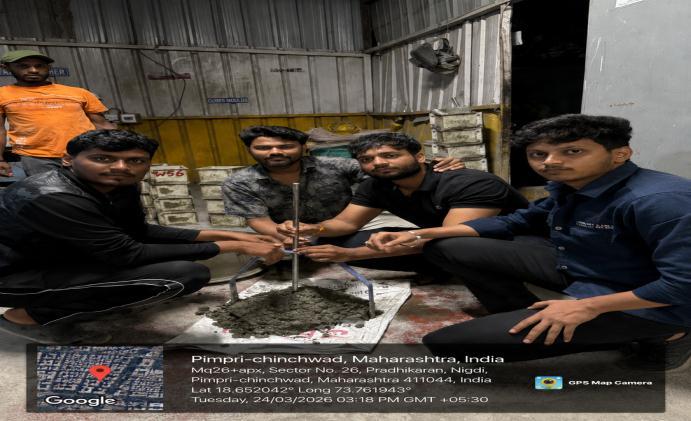
Fig 4.4.1 showstheconductionofslumpconetest
In which is the control mix, M2 which has 10 percent SilicaFume,M3whichhas20percentFlyAsh,M4which has 40 percent GGBS and M5 which has 12 percent Metakaolin.Weusedthesethingstoreplacesome ofthe cementinthemixes.Weputtheslumpconeonasurface that does not soak up water and filled it with fresh concrete. We did this in four layers. Pressed down on eachlayer25timeswithaspecialrod.Afterwemadethe top surface flat we lifted the cone up. Measured how much the concrete had sunk down. We call this the slumpvalueofthemixes.Weusedtheseslumpvaluesto see which concrete mix is the easiest to work with. The slump cone test is a way to compare the workability of differentconcretemixes,likeM1andM2andM3andM4 andM5.
4.2 Cube Casting Procedure
Concrete cubes were made for testing how strong they arewhensquished.Eachcubewas150×150×150mm insize.Themouldswerecleanedwell.Coatedwithoilso the concrete wouldn't stick to them. The concrete mix was put into the moulds in three layers. Each layer was tapped25timeswitharodtogetridofairbubbles. The top surface was then made smooth with a trowel. The moulds were left alone for 24 hours, at room temperature.Thisprocessisshowninfigure4.1.1.
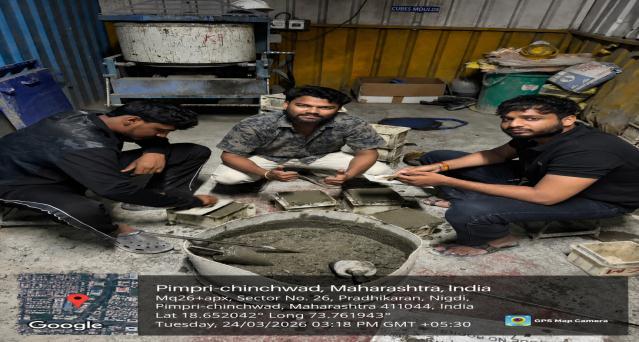
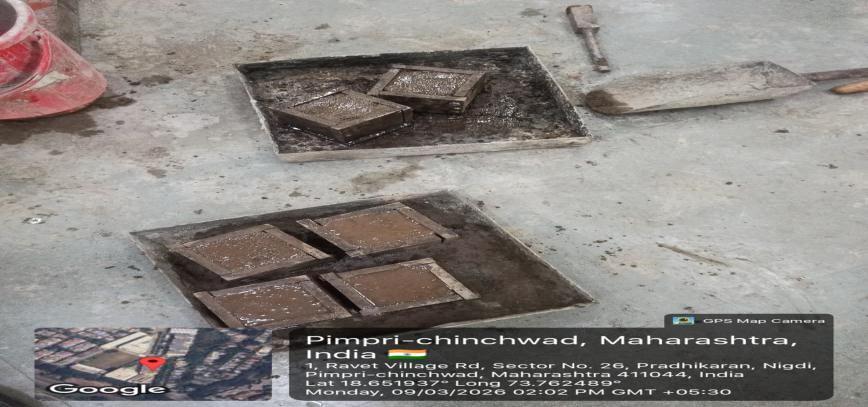
Fig 4.1.1 shows freshly cast concrete cube specimens Concrete cubes that are 150 millimeters by 150 millimeters by 150 millimeters were made for testing. Figure4.1.1showsthecubesrightaftertheyweremade and put in moulds at the site in Pimpri-Chinchwad, Maharashtra. The concrete cubes were made to check how strong and durable they are. We made sure the concrete cubes were filled and compacted properly and the surface was finished nicely before they were cured. Figure 4.1.2 shows the cubes in a special place where they cancure after they were made. Theconcretecubes were kept in a place, with the right amount of moisture so they can get stronger. After one day the concrete cubes were taken out of the moulds. Put in a big tank filled with clean water. The concrete cubes were cured for7days.Thenfor28daysbeforewetestedthemtosee how strong the concrete cubes are. We did this to see howstrongtheconcretecubeswouldbeaftertheywere curedforawhile
4.3 Water Absorption Test: -
The compressive strength test was done using a CompressionTestingMachineinlinewiththerulesofIS 516:2018.Aftertheconcretewascuredwedidthewater absorption test to see how durable the concrete is. We followed the procedure for this test. First we put the cubes in a hot air oven at a temperature of 105 to 110 degrees Celsius for 24 hours to get rid of the moisture. Then we let the cubes cool down. Weighed them to find out their dry weight, which wecall W₁. Next we put the
International Research Journal of Engineering and Technology (IRJET) e-ISSN: 2395-0056
Volume: 13 Issue: 06 | Jun 2026 www.irjet.net p-ISSN: 2395-0072
driedcubesinwaterfor24hours.Afterthatwetookthe cubes out of the water wiped them with a cloth to remove the water from the surface and weighed them again to find out their weight, which we call W₂. We calculated the water absorption of the concrete using a formula for the water absorption of the concrete. The water absorption of the concrete is a thing to know abouttheconcrete.Thewaterabsorptiontestisdoneto determine the durability of the concrete as, per procedureforthewaterabsorptiontest.
Water Absorption (%) =W1 / W2−W1×100……….. (2)
4.4 Compressive Strength Test:
-
Thecompressivestrengthtestwasdoneusingamachine called Compression Testing Machine. This test followed the rules in IS 516:2018. After curing the cubes were takenoutofthewaterdrier.
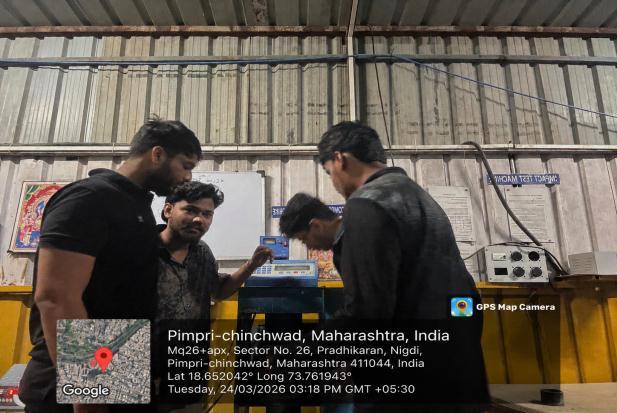
The test was conducted in the college laboratory, in which we have take the 5 tril mix samples cube and tested in the CTM machine which is shown in fig 4.2.1 The dimensions of each cube were checked before puttingtheminthemachine.Thecubewasplacedinthe middle on the base plate of the machine. The load was applied slowly until the cube failed. The maximum load, at failure was noted down. The compressive strength was then calculated using a formula. The compressive strength test results are based on the strength of the cubes.Thecompressivestrengthisafactor
Compressive Strength=Compressive Strength (MPa)=Area(mm²)/Load(N) ………….eq(1)
For150mmcube:
Area=150×150=22500mm
5. RESULTS
This is about the results of tests on high-performance concretemixes. Thesemixeshavethingslikesilica fume fly ash, GGBS and metakaolin added to the cement. We didteststoseehowstrong theconcreteis,howwaterit absorbs and how it does in a slump cone test. We compared these results to a concrete mix to see what happens when we add these extra materials to the cement. The results show that the concrete mixes are better than the old kind of concrete. They are stronger andlastlonger.Thenewconcretemixesalsoworkbetter whenweusethem.
The tests looked at high-performance concrete mixes withsilicafumeflyash,GGBSandmetakaolin.Theseare addedtothecementtomaketheconcretebetter.Wedid theseteststoseewhatthesilicafume,flyash,GGBSand metakaolindototheconcrete.Theresultsaregood.The high-performance concrete mixes with silica fume fly ash, GGBS and metakaolin are better, than the concrete mix.
-
5.1 Compressive Strength Results:
Thecompressivestrengthtestwasdonetoseehowload different concrete mixes could carry. We tested cube specimens at curing times using a special machine and the results were noted in MPa. These values helped us compare how well various cement replacement materials worked and find the mix. The compressive strength test resultsshowedus whichconcrete mix was thestrongest.Weusedtheseresultstopicktheeffective cementreplacementmaterial. Thecompressivestrength testwasreallyimportant,inmakingthisdecision.
Compressive Strength=Compressive Strength (MPa)=Area(mm²)/Load(N)
The table 5.1.1 shows the compressive strength results of concrete mixes. These results are for 7, 14 and 28 days. Cement was partly replaced with supplementary
International Research Journal of Engineering and Technology (IRJET) e-ISSN: 2395-0056
Volume: 13 Issue: 06 | Jun 2026 www.irjet.net p-ISSN: 2395-0072
cementitious materials. The results tell us that strength increased as the curing age increased for all mixes. Metakaolin 12% (M5) had the compressive strength at all ages. It reached 72 MPa at 28 days. Silica Fume 10% (M2)camesecondwith70MPa.GGBS40%(M4)andFly Ash 20% (M3) also did well. They attained 68 MPa and 65 MPa at 28 days. The Control Mix (M1) reached 62 MPa. In general using cementitious materials improved the compressive strength of the concrete. Metakaolin andsilicafumeshowedtheimprovement.
The use of Metakaolin and silica fume in mixes resulted in higher compressive strength. Metakaolin and silica fume performed better than materials. The results are based on strength of concrete, with Metakaolin, silica fume,GGBS,FlyAsh.
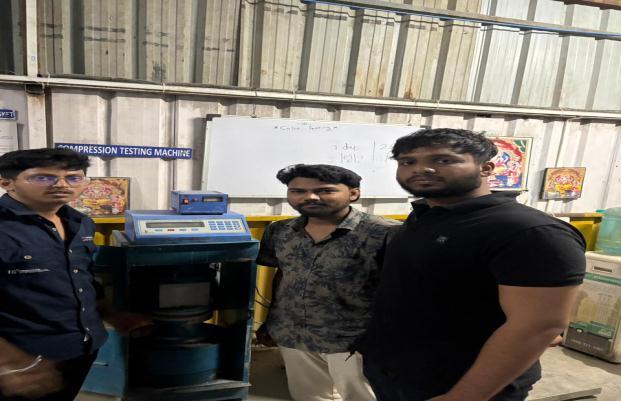
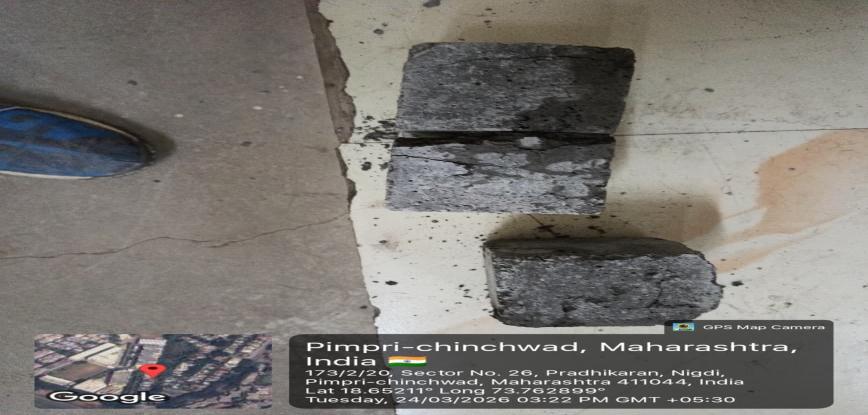
Failure
Fig5.1.1showshowwetestthestrengthofcubesusinga special machine called a Compression Testing Machine (CTM). We put the cubes in the machine. Slowly add more and more weight until they break. This helps us findouthowmuchweightthecubescanhandle.Fig5.1.2 showswhattheconcretecubeslooklikeafter theyhave been tested. You can see cracks and broken bits, which tells us how they failed when we added weight. We calculated the strength of the cubes using the results fromwhentheywere28daysold.
Table 5.1.2 LoadResistanceandFailureObservationof ConcreteCubes Mix
M1 1420KN 63.11Mpa Slight edge cracks observed
M2 1510KN 67.11Mpa Cuberemainedstable
M3 1565KN 69.56Mpa Minor surface cracks observed
M4 1630KN 72.44Mpa Goodloadresistance
M5 1685KN 74.89Mpa Highest compressive strength
1.M1=22500mm/1420KN=63.11Mpa
2.M2=22500mm/1510KN=67.11Mpa
3.M3=22500mm/1565KN=69.56Mpa
4.M4=22500mm/1630KN =72.44Mpa
5.M5=22500mm/1685KN=74.89Mpa
Thetestresultsshowthatalltheconcretemixesarevery strong and can be used for performance concrete jobs. Using materials like supplementary cementitious materials makes the concrete stronger. The metakaolinbased concrete M5, has the highest strength and can carry the most load compared to the other mixes. The metakaolin-based concrete M5 performed well in the tests.Itisclearthattheconcretemixes,M5aresuitable, fordemandingapplications.
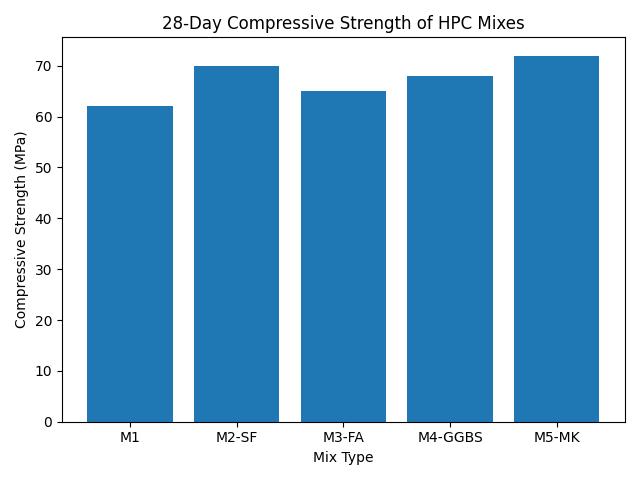
Fig 5.1.3 Classificationinformofgraph
The bar graph 5.1.3 shows the strength of HighPerformance Concrete mixesover 28 days. M5–MK mix hasthestrengthatabout72MPa.TheM2–SFmixcomes close with around 70 MPa. M4–GGBS and M3–FA mixes have strengths of approximately 68 MPa and 65 MPa. TheControl Mix(M1)hasthestrengthatabout62MPa.
International Research Journal of Engineering and Technology (IRJET) e-ISSN: 2395-0056
Volume: 13 Issue: 06 | Jun 2026 www.irjet.net p-ISSN: 2395-0072
In general the graph tells us that adding materials to concrete makes it stronger than regular concrete. HighPerformance Concrete with these added materials like M5–MK and M2–SF shows strength. The control mix, on the hand has lower strength. The use of cementitious materialslikeMetakaolin,SilicaFumeFlyAshandGGBS improvesthecompressivestrengthofHigh-Performance Concretecomparedtothecontrolmix.M5–MKmixhasa compressive strength, M2–SF mix also shows good compressive strength. M4–GGBSand M3–FA mixes have a compressive strength. The control mix has a compressive strength. The graph clearly shows that High-Performance Concrete mixes with added materials havecompressivestrength. Thecompressivestrengthof M5–MK mix is high and M2–SF mix also has strength. ThecompressivestrengthofHigh-PerformanceConcrete mixesvaries.Addingmaterials,likeMetakaolinandSilica Fumehelps.
5.2 Water Absorption Results: -
The barThe water absorption test was conducted to determine the durability and water permeability characteristics of mixes containing different supplementary cementitious materials. Concrete cube specimens of mixes M1, to M5 were cured in water before testing. The test results showed that the mixes containing Silica Fume, Fly Ash, GGBS and Metakaolin had water absorption compared to the control mix indicating improved durability and resistance to water penetration. Among all mixes the Metakaolin mix (M5) exhibitedthewaterabsorptionvalue.
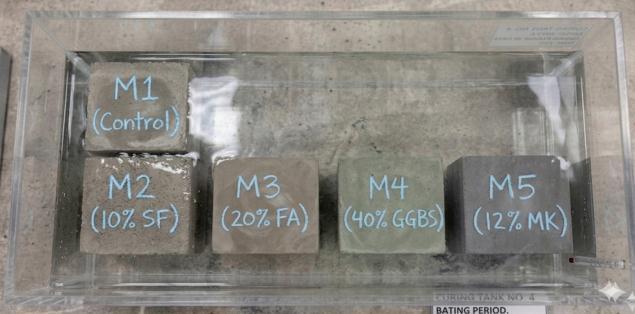
The figure 5.2.1 shows concrete cube specimens of mixes from M1 to M5 in a water tank where they are beingcured.Eachconcrete cubespecimenrepresentsa mix with different extra materials like silica fume fly ash,GGBSandmetakaolinaddedtotheconcrete.Thisis what the concrete cube specimens look like during the curingprocessbeforewedothestrengthanddurability tests,ontheconcretecubespecimens.
Table 5.2.1 Theresultsofwaterabsorption
Water Absorption (%) =W1 / W2−W1×100
The table 5.2.1 has the water absorption values of concrete mixes with various supplementary cementitious materials. The Control Mix, which is M1 had the water absorption at 3.5 percent. On the hand Metakaolin, which is M5 had the lowest water absorption value at 2.7 percent. This means that Metakaolinhasdurability.TheconcretemixeswithSilica Fume, which's M2 and Fly Ash, which is M3 and GGBS which is M4 had lower water absorption compared to the Control Mix. These mixes, including Silica Fume, Fly Ash and GGBS showed that they can resist water penetration better, than the Control Mix. The water absorption values of these mixes including Metakaolin, SilicaFumeFlyAshandGGBSareimportanttoconsider forbetterdurability.
5.3 Slump cone Test:
Theslumpconetestwasdonetoseehow well thefresh concrete mixes work and how consistent they are. We added things to the concrete like silica fume fly ash, GGBS and metakaolin. The slump cone test helped us understand how these things affect the flow of the concrete.Welookedattheslumpvalues,foreachmixto find out how silica fume, fly ash, GGBS and metakaolin changethewaytheconcreteflows.
Table 5.3.1 Theresultsof SlumpConeTest
International Research Journal of Engineering and Technology (IRJET) e-ISSN: 2395-0056
Volume: 13 Issue: 06 | Jun 2026 www.irjet.net p-ISSN: 2395-0072
The table 5.3.1 slump cone test results told us that the workabilityofconcreteisdifferentwhenweaddmineral admixtures. The control mix, which is M1 had a slump value of 75 mm. This means it had workability and the slumpwastrue. The Silica Fumemix, whichisM2hada slump of 60 mm. This mix had to medium workability and it also had a true slump. The Fly Ash mix, which is M3 had the slump value of 90 mm. This means it had mediumtoworkabilitywithatrueslump.Thishappened because the fly ash particles made the flow better. The GGBS mix, which is M4 had a slump of 85 mm and medium workability with a slump. The Metakaolin mix, which is M5 had the slump value of 55 mm. It had a shear slump. This happened because the concrete was not cohesive enough and it needed water. Overall the resultsshowedthatmineraladmixtureshaveabigeffect, on the workability and slump characteristics of fresh concrete. The mineral admixtures really changed the workability of the concrete The slump characteristics of theconcretealsochangedwiththemineraladmixtures
6. DISCUSSION
Thestudyfoundthataddingmaterialstocementmadea big difference in how strong, durable and easy to work with high-performance concrete was. The concrete got stronger as it cured over time. The Metakaolin mix, calledM5was the strongest at74.89MPaafter 28 days. This was because Metakaolin worked well with the cementandfilledinthegapsmakingtheconcretedenser and stronger. The Silica Fume mix or M2 also got much strongerbecauseitstinyparticlesandhighsilicacontent help. The Fly Ash mix, M3 and the GGBS mix, M4 took a bit longer to get strong. This was because they reacted slower with the cement compared to Metakaolin and Silica Fume. The results showed that Metakaolin, Silica Fume Fly Ash and GGBS all improved the concretes propertiesinways. TheMetakaolinmixstoodoutforits strength and the other mixes showed promise for specificusesOverallthestudyhighlightedthebenefitsof using cementitious materials to enhance highperformanceconcrete.Thefindingscanhelpinchoosing the materials, for concrete projects The use of these materialscanleadtomoredurableconcrete.
Table no 6.1 Classification of Materials Based on CompressiveStrengthTestResults
Thetable6.1showstherankingofmixes basedontheir 28-day compressive strength. Metakaolin with 12 percent mix, which's M5 got the highest strength of 72 MPaandrankedfirst.ItwasfollowedbySilicaFumemix, which'sM2andGGBSmix,whichisM4.TheControlMix, whichisM1hadthestrengthof62MPa.Thisshowsthat usingSCMsreallyimprovestheperformanceofconcrete The Metakaolin mix clearly performed better than the others.TheuseofSCMslikeMetakaolin,SilicaFumeand GGBS helped increase the strength. The Control Mix did not use SCMs. It had lower strength. This means SCMs arehelpful,inmakingconcrete.
Thetestresultsonwaterabsorptionshowedthatadding materials to cement made concrete more durable by reducing water penetration. The Metakaolin mix, also known as M5 had the water absorption of 2.7%. Silica Fume and GGBS mixes also had water absorption. This reduction in water absorption means the concrete microstructure became denser and had pore spaces due tosecondaryhydrationreactions.TheControlMixorM1 hadthewaterabsorptionof3.5%whichindicateslower durability. The slump cone test results showed that adding mineral admixtures affected how easily fresh concrete could be worked with. The Fly Ash mix or M3 hadtheslumpvalueof90 mm. Thiswasbecauseflyash particlesaresmoothandsphericalwhichimprovedflow and reduced friction inside the concrete. The GGBS mix also had workability. However the Metakaolin mix had the slump value. This was due to its particle size and highwaterdemand,whichresultedinlowerworkability and a shear slump pattern. Overall the study found that using cementitious materials improves concrete performance in terms of strength and durability. It also affects how easily the concrete can be worked with. Among all the materials tested Metakaolin showed the performance, for making strong and durable concrete. Metakaolin performed well in terms of strength, durability and workability The use of Metakaolin can leadtostrengthanddurableconcreteapplications.
7. CONCLUSIONS
The use of materials like silica fume and metakaolin in concrete is really good for High Performance Concrete. Based on what we found out from our experiments we cansaysomethingsforsure:
1. These extra materials make the concrete stronger andlastlonger.
2. When we add silica fume and metakaolin to the concreteitgetsmuchstronger.
3. We got the concrete with a strength of 72 MPa whenweusedmetakaolinandwaitedfor28days.
4.Themetakaolinmixwasalsoreallygoodbecauseit did not absorb a lot of water. 2.7 Percent, which meansitwilllastlonger.
International Research Journal of Engineering and Technology (IRJET) e-ISSN: 2395-0056
Volume: 13 Issue: 06 | Jun 2026 www.irjet.net p-ISSN: 2395-0072
5.UsingGGBSintheconcretemakesitmoredurable and less permeable which is a thing, for High PerformanceConcrete.
7. REFERENCE
1) Cement in Portland Cement Concrete Mixes M. A. Karim: https://www.mdpi.com/26734109/6/3/33MDPI
2) A Comprehensive Review on the Ground Granulated Blast Furnace Slag (GGBS) in Concrete Production J. Ahmad et al., Sustainability2022:https://www.mdpi.com/207 1-1050/14/14/8783
3) Nayak, D.K., Behera, R.N., & Mohapatra, S. (2022). Fly Ash for Sustainable Construction: A Review. Cleaner Materials (ScienceDirect). Wang, Y.S., et al. Mixture Optimization of Silica FumeConcrete.MDPI.
4) IJAResM. Study on Cement Replacement Using Metakaolin, Silica Fume & GGBS. International Journal of Applied Research in Engineering & Management.
5) IJTSRD.FlyAshasaCost-EffectiveSubstitutefor Portland Cement. International Journal of Trend in Scientific Research and Development.Indian Concrete Journal Misra V. N. (1984), Indian ConcreteJournal,Vol.58(8),pp.219–223.
6) American Concrete Institute Ahmed E. Ahmed and Ahmed A. EI. Kourd (1989), ACI Materials Journal,Jul–Aug,pp.417–424.
7) Langley W.S., Carette G.G., and Malhotra V.M. (1989), Structural Concrete Incorporating High Volumes of ASTM Class F Fly Ash, ACI Materials Journal,Vol.86,pp.507–514.
8) V. M. Malhotra (1990), Durability of Concrete Incorporating High-Volume of Low-Calcium (ASTM Class F) Fly Ash, Cement and Concrete Composites,Vol.12(4),pp.271–277.
9) Carette G., Bilodeau A., Chevrier R.L., and Malhotra V.M. (1993), Mechanical Properties of ConcreteIncorporatingHighVolumesofFlyAsh from Sources in the U.S., ACI Materials Journal, Vol.90,pp.535–544.
10) Naik T.R., Singh S.S., and Hossain M.M. (1994), Permeability of Concrete Containing Large Amounts of Fly Ash, Cement and Concrete Research,Vol.24(5),pp.913–922.
11) Naik T.R., Singh S.S., and Hossain M.M. (1995), Properties of High Performance Concrete Systems Incorporating Large Amounts of High Lime Fly Ash, Construction and Building Materials,Vol.9(4),pp.195–204.
12) Cao H.T., Bucea L., Meek E., and Yozghatlian S. (1996), Formulation and Durability of Fly Ash BlendedCement,CSIROReportBRE030,June.
13) Camoes, Aguiar B., and Jalali S. (2003), Durability of Low Cost High Performance Fly Ash Concrete, International Ash Utilization Symposium.
14) Atis C.D. (2003), High-Volume Fly Ash Concrete with High Strength and Low Drying Shrinkage, Journal of Materials in Civil Engineering, Vol. 15(2),pp.153–156.
15) Chindaprasirt P., Homwuttiwong S., and Sirivivatnanon V. (2004), Influence of Fly Ash Fineness on Strength, Drying Shrinkage and Sulfate Resistance of Blended Cement Mortar, Cement and Concrete Research, Vol. 34, pp. 1087–1092.
16) ACI Committee 211 (2008), Guide for Selecting Proportions for High-Strength Concrete Using Portland Cement and Other Cementitious Materials,ACI211.4R-08.
17) DinakarP.(2011),HighReactivityMetakaolinfor High Strength and High Performance Concrete, TheIndianConcreteJournal,April2011,pp.28–32.
18) CementinPortlandCementConcreteMixes M. A. Karim A Comprehensive Review on the GroundGranulatedBlastFurnaceSlag(GGBS)in ConcreteProductionJ.Ahmadetal.
19) Nayak D.K., Behera R.N., and Mohapatra S. (2022), Fly Ash for Sustainable Construction: A Review,CleanerMaterials,ScienceDirect.
20) Wang Y.S., etal.(2022), MixtureOptimizationof SilicaFumeConcrete,MDPI.
21) IJAResM (2022), Study on Cement Replacement Using Metakaolin, Silica Fume & GGBS, International Journal of Applied Research in Engineering&Management.
22) IJTSRD (2022), Fly Ash as a Cost-Effective Substitute for Portland Cement, International Journal of Trend in Scientific Research and Development. Camoes A., Aguiar B., & Jalali S. (DuplicateReference