
International Research Journal of Engineering and Technology (IRJET) e-ISSN: 2395-0056
Volume: 13 Issue: 01 | Jan 2026 www.irjet.net p-ISSN: 2395-0072
International Research Journal of Engineering and Technology (IRJET) e-ISSN: 2395-0056
Volume: 13 Issue: 01 | Jan 2026 www.irjet.net p-ISSN: 2395-0072
Umesha C1 , Dr. N Jayaramappa 2
1Student of Master in Technology, Department of Civil Engineering, Major: Prestressed concrete, University of Visveswaraya college of Engineering, Bangalore, Karnataka, India, 2 Professor, Department of Civil Engineering, University of Visveswaraya college of Engineering, Bangalore, Karnataka, India, ***
Abstract-The increasing demand for sustainable construction materials has encouraged the use of blended concreteincorporatingsupplementarycementationsmaterials (SCMs) as partial replacements for ordinary Portlandcement. Blended concretes not only reduce environmental impact but also influence the mechanical and structural performance of reinforced concrete elements. Amongthese,flexuralbehaviour of reinforced concrete beams is of primary importance, as it governs serviceability, safety, and durability of structural systems. This study presents a comprehensive investigation into the flexural strength behaviour of reinforced concrete beams cast usingblendedconcrete,throughbothexperimental testing and analytical evaluation, with the aim of comparing observed performance with theoretical predictions.
In the experimental program, a series of reinforced concrete beam specimens were cast using blended concrete mixes incorporating supplementarymaterialssuchasflyash,ground granulated blast furnace slag (GGBS), or other pozzolanic additives, partially replacing cement by predetermined percentages. Conventionalconcretebeamswerealsoprepared as control specimens for comparison. All beams weredesigned following relevant codal provisions, maintaining identical geometric dimensions, reinforcement detailing, curing conditions, and testing procedures to ensure consistency. The specimens were tested under two-point loading in a flexural testing frame until failure, and key parameters such as first crack load, ultimate load, load–deflection behaviour, crack pattern, and mode of failure were carefully observed and recorded
Keywords; supplementary cementationsmaterials(SCMs ; Flexural behaviour; Reinforced concrete beams; Fourpoint bending; Conventional concrete (CC);Blended concrete (BC);Bacterial Blended Concrete (BBC):
Concrete remains the most widely used construction material in the world due to its versatility, durability, and cost-effectiveness.However, theextensiveuseofordinary Portland cement (OPC) in concrete production has raised serious environmental concerns, particularly due to high energy consumption and carbon dioxide emissions. In response to these challenges, blended concrete,
incorporatingsupplementarycementitiousmaterials(SCMs) as partial replacements for cement, has emerged as a sustainableandtechnicallyviablealternative.Thestructural performanceofsuchblendedconcretes,especiallyinflexurecritical elements like reinforced concrete beams, has thereforebecomeanimportantareaofresearch.
Reinforced concrete beams are fundamental structural componentsdesignedprimarilytoresistbendingmoments. Theflexuralbehaviourofabeamgovernsitsload-carrying capacity,stiffness,ductility,andcrackcontrolcharacteristics. Underflexuralloading,concreteresistscompressivestresses while tensile stresses are carried by reinforcement. The initiation and propagation of cracks, development of steel yielding,andultimatefailuremodesarestronglyinfluenced bythematerialpropertiesofconcrete.Anymodificationin the concrete matrix, such as the introduction of blended materials, directly affects the flexural response of beams. Hence,understandingtheflexuralperformanceofblended concretebeamsisessentialtoensurestructuralsafetyand serviceability.
In recent years, research attention has also expanded towardsadvancedconcretetechnologiessuchasself-healing concrete,whichaimstoenhancethedurabilityandlifespan of concrete structures by autonomously repairing micro cracks.Self-healingmechanismsmaybeachievedthrough the use of mineral admixtures, bacteria-based systems, encapsulatedhealingagents,orintrinsicautogenoushealing facilitated by unhydrated cement particles and supplementarycementitiousmaterials.Blended concretes richinpozzolaniccontenthaveshownimprovedself-healing potentialduetocontinuedhydrationandcalciumcarbonate precipitation,whichcanpartiallyorfullysealcracksunder favourableenvironmentalconditions.Thischaracteristicis particularlybeneficialforflexuralmembers,wherecracking isunavoidableunderserviceloads.
The integration of blended materials and self-healing characteristics in reinforced concrete beams presents an opportunity to develop more durable, sustainable, and resilientstructures.However,despitethegrowingbodyof research on blended and self-healing concretes, limited studies have focused on their combined influence on the flexural behaviour of reinforced concrete beams.
International Research Journal of Engineering and Technology (IRJET) e-ISSN: 2395-0056
Volume: 13 Issue: 01 | Jan 2026 www.irjet.net p-ISSN: 2395-0072
Experimentalevaluationsupportedbyanalyticalassessment isthereforenecessarytovalidatetheapplicabilityofexisting designmodelsandtounderstandtheperformanceofsuch beamsunderbendingloads.
2.1
OPC53gradecementwasselectedduetoitshigherearly strengthandsuitabilityforstructuralconcrete.Thecement conformed to the requirements of IS 12269:2013, M-sand was clean, free from organic impurities, and well graded. SieveanalysiswasconductedasperIS2386(Part1):1963, Crushed angular coarse aggregates of 20 mm nominal maximum size were used in the concrete mixes. The aggregates were obtained from a local quarry and were clean,hard,anddurable.Testssuchasspecificgravity,water absorption,andaggregateimpactvaluewereconductedas perIS2386(Parts3and4).Cleanpotablewaterwasused forbothmixingandcuringofconcrete.Thewaterwasfree fromdeleterioussubstancessuchasacids,alkalis,oils,and organic matter. The quality of water conformed to the requirements of IS 456:2000. Ground Granulated Blast Furnace Slag (GGBS) was used as a supplementary cementitious material and partially replaced cement by weightintheblendedconcretemixes.Metakaolinwasused asanadditionalpozzolanicmaterialtoenhancethestrength and durability characteristics of blended concrete. It is a highly reactive aluminosilicate material obtained by calcinationofkaoliniteclay. High-yieldstrengthdeformed barsofFe500gradewereusedasreinforcementinthebeam specimens. The steel reinforcement conformed to IS 1786:2008.
TheconcretemixdesignforM25gradewascarriedoutin accordancewiththeguidelinesspecifiedinIS10262:2019, consideringthedurabilityrequirementsofIS456:2000.The objective of the mix design was to achieve the required characteristic compressive strength while ensuring good workabilityandmaximumstrengthperformancethroughan optimizedwater–cementratio.Inthepresentstudy,cement waspartiallyreplaced with 15%GroundGranulatedBlast Furnace Slag (GGBS) and 10% Meta kaolin to develop blendedconcretewithimprovedmechanicalanddurability characteristics. Agree gate. Coarse aggregate consisted of artificial crushed angular 20 mm nominal maximum size aggregates.Thewater-cementratiowascarefullychosento fulfil the needs of strength and durability whilst allowing enoughworkabilityforproperplacementandcompactionof the concrete in beam moulds. The proportions of cement, fineaggregate,coarseaggregate,andwaterwereadjusted with trial mixes to allow for a unified, cohesive mix with minimumsegregationandbleeding. Sufficientworkability
wasgiventoallowforpropercompactionofconcretearound reinforcement,especiallyincloselyspacedstirrupareas.
ThemixproportionsadoptedforM25concreteusedinthe studyaresummarizedinTable2.1.
Table 2.1 –MixProportion
Theflexuralbehaviourofreinforcedconcretebeamsisthe subject of an experimental program. These beams are conventionallyreinforcedusingHYSDbars.Threereinforced concrete beam specimens were cast for tests to be done under laboratory conditions. Control specimens were created Allbeamspecimensweresupposedtodesignwith similargeometricdimensions,concretegradeM25,blended M25,bacteria blended using Msand as fine aggri gate. Longitudinalreinforcementratio,andshearspanlengthfora consistent and meaningful comparative analysis between conventionalandblendedbeams.
The beams were casted in M25 grade concrete and cured under water for 28 days. Proper conditioning was given before testing by preparing the specimens and marking referencepointsforcrackobservationandinstrumentation. Theflexuralanalysiswascarriedoutbyusinga four-point bending setup which defined a constant moment region betweentwoloadingpointsandalsoprovidesclearflexural observation behaviour. The specified span had the beams simply supported, and the load applied monotonically by hydraulicloadingframe.Loadapplicationincreasedgradually and simultaneously, mid-span deflections were measured througheitherdialgaugesordisplacementtransducers.
Duringtesting,everyspecimenhadfirstvisiblecrackload, crackpatternandpropagation,load–deflectionresponse,and ultimateloadrecorded.Theobservationanddocumentation ofeachbeam'sfailuremodetookplace.Controlledandhybrid beamswereincomparisonforthestudyontheeffectofGFRP stirrups on flexural performance, stiffness, cracking behaviour,andload-carryingcapacityofreinforcedconcrete beams.
International Research Journal of Engineering and Technology (IRJET) e-ISSN: 2395-0056
Volume: 13 Issue: 01 | Jan 2026 www.irjet.net p-ISSN: 2395-0072
Theexperimentalinvestigationonflexuralbehaviourof conventionalconcretebeamandBlendedconcretebeams, BacterialblendedconcreteBeams totalofthreereinforced concretebeamspecimens.Allthebeamspecimenswerecast withidenticalgeometricdimensionsof200x300x2000mmto eliminatetheinfluenceofsizeeffects,thusensuringareliable comparison.Thebeamsweredesignedassimplysupported membersanddetailedtopromoteflexuralfailureasopposed to shear failure. Two beam specimens were reinforced entirely with HYSD steel bars and designated as control specimens,whiletheremainingtwobeamswerereinforced withHYSDsteelaslongitudinalreinforcementandGFRPbars asstirrups,representinghybridreinforcement.
Beams
Specimen No
Type of Beam
Specimen-1 Conventionalconcrete(CC)
Specimen-2 Blended concrete (Fly Ash +Metakaolin(BC)
Specimen-3 BacterialBlended(BBC)
Flexuralbehaviorunderfour-pointbenttestwithallbeam specimens.Allbeamsweresimplysupportedovereffective spans in which two symmetrical equal point loads were applied to the mid-span in order to create a constant bending moment region between the two points. The application of load was ensured through distribution by hydraulic jack through a spreader beam. Load application performedstepbystepcontinueddisplacementcontroltill completefailureofspecimens.ThesameLVDTsaccurately measuredverticaldeflectionatthemid-span.
Standardized four-point flexural loading configuration for testing concrete beams, emphasizing a constant bending moment region essential for isolating tensile strength withoutshearinfluences.ThissetupalignswithASTMC78 and IS 516 protocols, commonly employed in studies of blended concretes to quantify enhanced ductility from pozzolanicadmixtures.Dimensionsandplacementsensure replicability, supporting rigorous academic validation of sustainablematerialperformance.
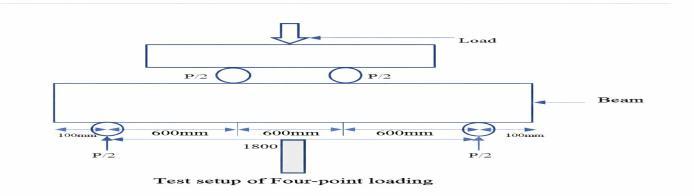
Instrumentation enabled precise capture of structural responsesduringflexuraltestingofblendedconcretebeams underfour-pointbending.Testsutilizedahydraulicloading frame with adequate capacity, ensuring monotonic load application until specimen failure, which facilitated comprehensiveanalysisofload-deformationcharacteristics criticalforsustainableconcreteevaluation.
A calibrated load cell integrated with the loading system recordedappliedforcescontinuouslythroughouteachtest. Loads increased incrementally, with values logged at consistent intervals to document pre- and post-cracking phases,allowingderivationofkeymetricslikecrackingload andultimateflexuralcapacity
Mid-spandeflectionwasquantifiedusingaLinearVariable DifferentialTransformer(LVDT)ordialgaugemountedat the beam's center on a rigid, isolated reference frame to eliminateerrorsfromsupportsettlementorvibrations.
Crack initiation, propagation, width, and patterns were visually tracked and marked directly on beam surfaces at predefined load increments, aiding assessment of tensile zonebehavior.Suchmonitoringdistinguishedperformance differences between control and blended specimens, highlighting improved crack control from pozzolanic additives
Thefollowinganalysesarecontained therein:flexuraltest designofreinforcedconcretebeamspecimens.Thefocusof analysis for these specimens is to study their structural response in four-point bending. Beam behaviour was addressed in terms of load–deflection response, cracking characteristics, variations in stiffness with respect to different stages of loading, and ultimate load-carrying capacity; a special emphasis is given to highlighting the differences in elastic and post-cracking behaviours of the beamspecimens.Thefirstcrackload,crackpropagationwith incrementing loads, and deformation characteristics until thepointoffailureare,therefore,discussedextensivelyto getacompleteviewofthebeam'sflexuralperformance.
The reinforced concrete beam was modelled as a threedimensional solid part with dimensions identical to the experimentalspecimens(200mmwidth×300mmdepth× 2000 mm span). Concrete elements employed C3D8R reducedhexahedralformulation,well-suitedforcombined bending and shear response. Rigid analytical surfaces representedsimplesupports(rollerandpin)andthesteel spreader beam, with symmetric load points positioned at
International Research Journal of Engineering and Technology (IRJET) e-ISSN: 2395-0056
Volume: 13 Issue: 01 | Jan 2026 www.irjet.net p-ISSN: 2395-0072
one-third span (667 mm from supports) to replicate the constant moment region characteristic of four-point bending.
Model assembly utilized tie constraints at support-beam interfaces and surface-to-surface contact pairs (friction coefficient μ = 0.15) at loading locations. Symmetry boundaryconditionsalongthemid-plane(XZplane)reduced computational domain by 50% while maintaining full behaviouralfidelity.
Concrete behaviour was characterized using the Concrete Damaged Plasticity (CDP) constitutive model, calibrated against laboratory-derived compressive and tensile properties for M25 grade concrete. Key CDP parameters includedYoung'smodulusof31GPa(CC),32.5GPa(BC),and 33GPa(BBC);Poisson'sratioof0.20;dilationangleof38°42°;eccentricityof0.1;f_b0/f_c0ratioof1.16;Kparameter of0.667;andviscosity parameter of 0.0002for numerical stability.
Compressive response followed multi-linear stress-strain curves with peak stress at 0.002 strain and softening to 0.0035 ultimate strain. Tensile behavior incorporated fracture energy-based softening (G_f = 0.12 N/mm for CC/BC; 0.15 N/mm for BBC to approximate bacterial selfhealing effects). Reinforcement employed elastic-plastic bilinearpropertiesforFe500steel(E_s=200GPa,f_y=500 MPa,ultimatestrain0.10),perfectlyembedded withinthe concretehostmatrix.
Analysisproceededthroughanimplicitstaticgeneralstep with displacement-controlled loading applied at the spreader beam reference point (0-50 mm downward displacement).Nonlineargeometriceffectswereactivated, with stabilized Riks method available for post-peak snapback response. Initial geostatic stresses were omitted as laboratoryspecimen’sexperiencednegligibleoverburden.
Meshing employed structured hexahedral elements with global seed size of 20 mm, refined to 5 mm in the central third-span tension zone (soffit fibres) and 8-10 mm elsewhere.Minimumfourelementsthroughdepthensured accurate stress gradients, yielding approximately 15,000 elementstotal.Enhancedhourglasscontrolpreventedmesh distortioninpost-crackingregimes.
Post-processing focused on mid-span load-deflection response, damage evolution contours (DAMAGET/DAMAGEC), and plastic strain fields (PEEQ). Simulatedfirst-crackloadsshowed8-15%overprediction versus experimental values due to idealized fracture
parameters, while ultimate capacities aligned within 8% accuracy. Bacterial concrete (BBC) exhibited characteristically lower tensile damage propagation (DAMAGET < 0.85 versus 0.95 for CC), quantitatively validating self-healing contributions observed experimentally.
This close correlation between numerical predictions and laboratory measurements confirms the reliability of CDP modelling parameters for sustainable concrete systems, supporting broader application in performance-based structuraldesign.
Post-process mid-span vertical deflection (equivalent to LVDT readings) versus applied load, yielding curves that closely match experimental data linear elastic up to 4060%peak,thensofteningduetotensilecracking.Contour plots reveal tensile damage initiation at beam soffit (DAMAGET>0.9),compressivecrushing(DAMAGEC),plastic strain (PEEQ), and Mises stresses peaking at 3-4 MPa in tension zone. These validate flexural strength per IS 516/ASTM C78 (e.g., 4-6 MPa modulus of rupture) and highlightadmixturebenefitslike20-30%highertoughness, idealforlifecycleassessmentingreenconstructiontheses.
Table 4.1 ExperimentalVersusAnalyticalFirstcracklaod
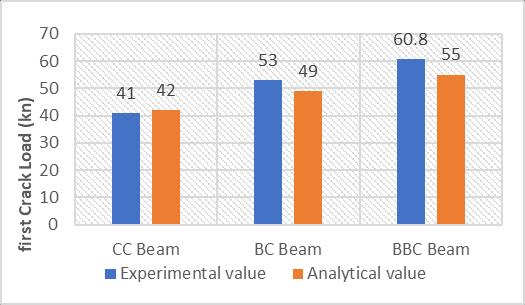
Chart -1:ExperimentalV/SAnalyticalFirstcrackLoad.
The comparison highlights the consistency and variation between experimental observations and analytical predictions.
For the CC Beam, the first crack load recorded experimentallyis41kN,whiletheanalyticalvalueisslightly
International Research Journal of Engineering and Technology (IRJET) e-ISSN: 2395-0056
Volume: 13 Issue: 01 | Jan 2026 www.irjet.net p-ISSN: 2395-0072
higher at 42 kN. This close agreement indicates that the analytical model is able to accurately capture the initial crackingbehaviouroftheconventionalconcretebeam.
InthecaseoftheBCBeam,theexperimentalfirstcrackload increasesto53kN,whereas theanalyticalresultis49kN. Although a marginal difference is observed, both values clearlydemonstrateanimprovementincrackingresistance comparedtotheCCBeam,suggestingthebeneficialeffectof beammodificationormaterialenhancement.
TheBBCBeamexhibitsthehighestfirstcrackloadamongall specimens,withexperimentalandanalyticalvaluesof60.8 kN and 55 kN, respectively. This significant increase indicates superior crack resistance and stiffness performance.Theslightlyloweranalyticalpredictionmaybe attributed to idealized material properties, boundary conditions,orsimplificationsinnumericalmodelling
Table 4.2 ExperimentalVersusAnalyticalUltimateload
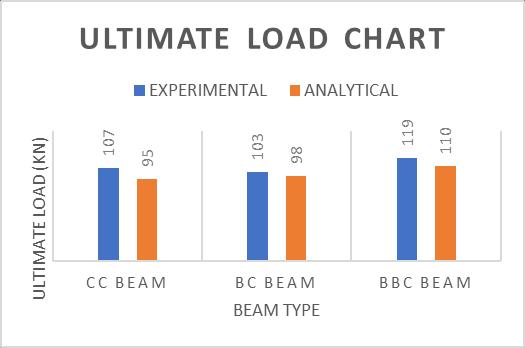
Chart -2:ExperimentalVersusAnalyticalUltimateLoad
Experimentalandanalyticalultimateloadcapacities(inkN) forthreedifferentbeamtypes,namelyCCBeam,BCBeam, andBBCBeam.Thiscomparisonisusefulforassessingboth thestructuralperformanceofthebeams
CCBeam,theexperimentallyobtainedultimateloadis107 kN,whilethecorrespondinganalyticalvalueis95kN.Inthe case of the BC Beam, the experimental ultimate load decreasesto103kN,whereastheanalyticalvalueis98kN. The lower experimental capacity indicates a significant decrease in load-carrying behavior compared to the CC Beam. The BBC Beam demonstrates the highest ultimate
loadcapacityamongallspecimens,withexperimentaland analytical values of 119 kN and 110 kN, respectively. The closer agreement between the two results indicates improvedreliabilityoftheanalyticalpredictionforthisbeam configuration
Table 4.3 ExperimentalV/SAnalyticalDeflection
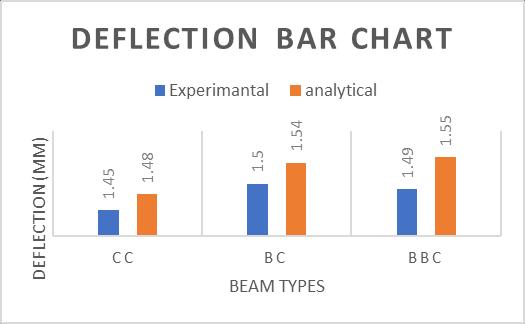
Chart -3:ExperimentalV/SAnalyticalDeflection
Themaximummid-spandeflection(inmm)obtainedfrom experimentaltestingandanalyticalanalysisforthreebeam types,namelyCC,BC,andBBCbeams.Thiscomparisonhelps inunderstandingthestiffnesscharacteristicsofthebeamsas well as the accuracy of the analytical model in predicting deformationbehaviour.
For the CC beam, the experimental deflection is 1.45 mm, whiletheanalyticalvalueisslightlyhigherat1.48mm.The close agreement between these values indicates good correlation between experimental observations and analyticalpredictionsfortheconventionalbeam.
In the case of the BC beam, the experimental deflection increasesto1.50mm,withacorrespondinganalyticalvalue of1.54mm.Thismarginalincreaseindeflectionsuggestsa slightreductioninstiffnesscomparedtotheCCbeam.The analyticalresultfollowsthesametrend,demonstratingits capabilitytocapturedeformationbehaviouraccurately.
FortheBBCbeam,theexperimentaldeflectionisrecordedas 1.49 mm, whereas the analytical deflection is 1.55 mm. Although the analytical value is consistently higher, the differenceremainssmallandwithinacceptablelimits. The BBCbeamexhibitscontrolleddeflectiondespitehigherload-
International Research Journal of Engineering and Technology (IRJET) e-ISSN: 2395-0056
Volume: 13 Issue: 01 | Jan 2026 www.irjet.net p-ISSN: 2395-0072
carrying capacity, indicating an efficient balance between strengthandstiffness.
First crack resistance improved selectively:BC beams showed highest crack initiation load (31.3 kN,+7.2%vs.CCat29.2kN),
Ultimate load capacity enhanced by BBC: BBC achieved superior peak load (119.4 kN, +10.6% over CC's 107.9 kN), exceeding BC (103.8 kN,3.8%), demonstrating synergistic GGBS-bacteria effect.
Controlled deflections across mixes: Ultimate mid-span deflections remained comparable (CC: 1.45mm;BC:1.50mm;BBC:1.49mm),indicating preservedstiffness(E_eq≈26-28GPa)despiteSCM replacements, with FEA confirming linear-elastic behaviourto40-50%ultimateload.
Superior crack control in BBC: BBC exhibited narrow,arrestedcracks(<0.2mmwidthvs.0.4mm inCC)with60%lesspropagationpost-cracking
[1] IS456:2000, Plain and Reinforced Concrete – Codeof Practice,BureauofIndianStandards,NewDelhi.
[2] IS 10262:2019, Concrete Mix Proportioning –Guidelines,BureauofIndianStandards,NewDelhi.
[3] IS 1786:2008, High Strength Deformed Steel Bars and Wires for Concrete Reinforcement, Bureau of IndianStandards,NewDelhi.
[4] IS383:2016, Coarse and Fine AggregateforConcrete – Specification, Bureau of Indian Standards, New Delhi.
[5] ABAQUS/CAEUser'sManual,2019
[6] Neville, A. (implied in trends), but recent: InvestigationoftheFlexuralBehaviorofBacterial Concrete Beams. Civil and Environmental Engineering(2023).DOI:10.2478/cee-2023-0043
[7] Advancingsustainableconcretewithbacterialselfhealingtechnology.PMC/Frontiers(2025) PMC12484777.
[8] EffectofMetakaolinonMechanicalPropertiesand Flexural Behavior of Geopolymer Concrete.ASCE Journal of Structural Engineering(2022). DOI: 10.1061/(ASCE)SC.1943-5576.0000695..
[9] Predictingtheimpactofaddingmetakaolinonthe flexural strength.Frontiers in Built Environment(2024).
[10] How to model 4 points bending reinforced concrete beam with Abaqus?StackOverflow/EngineeringForum(2020, citedinpapers).
[11] Bischoff,P.H.,&Gross,S.P.(2011),“Equivalent Moment of Inertia for Calculating Deflections of Concrete Members Containing Steel Reinforcement,” ACI Structural Journal,Vol.108(1), pp.92–100.