International Research Journal of Engineering and Technology (IRJET)
e-ISSN: 2395-0056
Volume: 13 Issue: 05 | May 2026
p-ISSN: 2395-0072
www.irjet.net
Comparative Seismic Performance Analysis of Rubber Bearing and Friction Pendulum Base Isolation Systems for G+10 R.C.C. Building Pranav Wasudeo Dayare1, Dr. Suchita K. Hirde2 1Student, M.Tech (Structural Engineering), Government College of Engineering, Amravati, Maharashtra, India
2 Professor & Head, Applied Mechanics Department, Government College of Engineering, Amravati, Maharashta,
India ---------------------------------------------------------------------***---------------------------------------------------------------------
Abstract - Base isolation is a critical seismic protection
advanced approach involves decoupling the structure from the ground or integrating energy-dissipating components at strategic locations within the framework. This method of seismic isolation provides greater protection and significantly reduces the potential for catastrophic structural loss. The necessity for such advanced mitigation strategies is underscored by the devastating impacts of historical earthquakes in India, including the 1950 Assam, 1991 Uttarkashi, 1993 Maharashtra, and 2001 Gujarat events. These disasters demonstrate that seismic forces remain a substantial threat to a nation's socio-economic stability. Consequently, there is an urgent demand for design solutions, such as seismic isolators and energy-dissipating devices, that can effectively dampen seismic energy and reduce the transmission of lateral loads to the upper storeys of a building.
strategy designed to decouple structures from hazardous ground motions by introducing flexible components at the foundation level. This study presents a comprehensive comparative assessment of the seismic performance of a G+10 storey reinforced concrete building. The investigation evaluates two distinct base isolation technologies. Rubber Base Isolation and the Friction Pendulum System (FPS) benchmarking their performance against a conventional Fixed Base configuration. The building model, characterized by a total height of 33 metres and situated in Seismic Zone V, was developed and analysed using the structural analysis software SAP2000. The research employs three rigorous analytical approaches to ensure a robust evaluation: Equivalent Static Method (ESM), Response Spectrum Analysis (RSA), and Time History Analysis (THA). For the dynamic time history simulations, two significant historical ground motion records the El Centro (1940) and Bhuj (2001) earthquakes are utilized to test the superstructure under varying frequency contents. Key structural response parameters evaluated throughout the study include base shear, lateral load distribution, storey shear, storey displacement, storey drift, fundamental time period, and natural frequency Key Words: Base Isolation, Rubber Base Isolation, Friction Pendulum System, SAP2000, Seismic Response, G+10 Building, Time History Analysis.
1. INTRODUCTION 1.1 General Overview of Seismic Protection
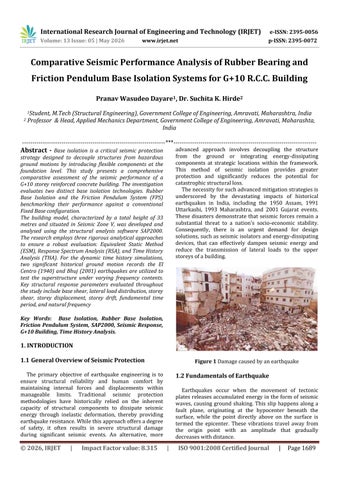
Figure 1 Damage caused by an earthquake
The primary objective of earthquake engineering is to ensure structural reliability and human comfort by maintaining internal forces and displacements within manageable limits. Traditional seismic protection methodologies have historically relied on the inherent capacity of structural components to dissipate seismic energy through inelastic deformation, thereby providing earthquake resistance. While this approach offers a degree of safety, it often results in severe structural damage during significant seismic events. An alternative, more
© 2026, IRJET
|
Impact Factor value: 8.315
1.2 Fundamentals of Earthquake Earthquakes occur when the movement of tectonic plates releases accumulated energy in the form of seismic waves, causing ground shaking. This slip happens along a fault plane, originating at the hypocenter beneath the surface, while the point directly above on the surface is termed the epicenter. These vibrations travel away from the origin point with an amplitude that gradually decreases with distance.
|
ISO 9001:2008 Certified Journal
|
Page 1689