
International Research Journal of Engineering and Technology (IRJET) e-ISSN: 2395-0056
Volume: 13 Issue: 04 | Apr 2026 www.irjet.net p-ISSN: 2395-0072
International Research Journal of Engineering and Technology (IRJET) e-ISSN: 2395-0056
Volume: 13 Issue: 04 | Apr 2026 www.irjet.net p-ISSN: 2395-0072
Mr. B.S. Swami 1
1 Lecturer in Mechanical Engineering Department, SPM Polytechnic, Kumathe, Solapur
Abstract - The increasing demand for energy, coupled with environmental concerns, has driven significantadvancements in power plant engineering. This paper presents a comprehensive study ofmoderndevelopmentsandsustainable practices in power generationsystems.It focuses onrenewable energy integration, efficiency improvement techniques, waste heat recovery, carbon capture technologies, and smart grid applications. The study also evaluates environmental impacts and proposes sustainable solutions for future power plants. The results indicate that hybrid systems combiningrenewable sources with conventional plants significantly enhance efficiency and reduce emissions.
Key Words: Power Plant Engineering, Sustainability, RenewableEnergy,EnergyEfficiency,CarbonCapture,Smart Grid
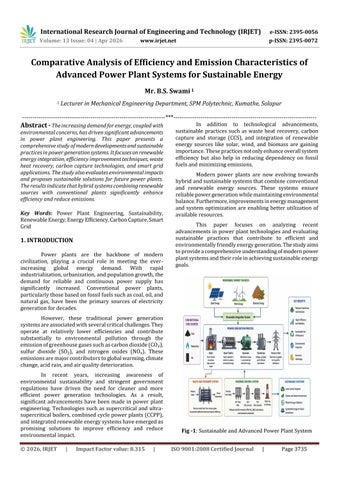
Power plants are the backbone of modern civilization, playing a crucial role in meeting the everincreasing global energy demand. With rapid industrialization,urbanization,andpopulationgrowth,the demand for reliable and continuous power supply has significantly increased. Conventional power plants, particularlythosebasedonfossilfuelssuchascoal,oil,and natural gas, have been the primary sources of electricity generationfordecades.
However, these traditional power generation systemsareassociatedwithseveralcriticalchallenges.They operate at relatively lower efficiencies and contribute substantially to environmental pollution through the emissionofgreenhousegasessuchascarbondioxide(CO₂), sulfur dioxide (SO₂), and nitrogen oxides (NOₓ). These emissionsaremajorcontributorstoglobalwarming,climate change,acidrain,andairqualitydeterioration.
In recent years, increasing awareness of environmental sustainability and stringent government regulations have driven the need for cleaner and more efficient power generation technologies. As a result, significant advancements have been made in power plant engineering. Technologies such as supercritical and ultrasupercriticalboilers,combinedcyclepowerplants(CCPP), andintegratedrenewableenergysystemshaveemergedas promising solutions to improve efficiency and reduce environmentalimpact.
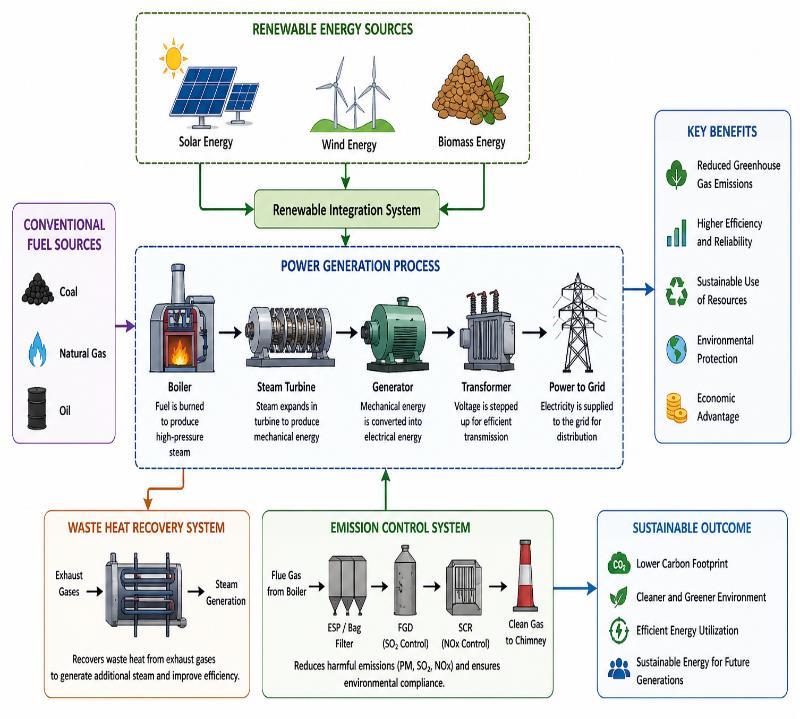
In addition to technological advancements, sustainable practices such as waste heat recovery, carbon capture and storage (CCS), and integration of renewable energy sources like solar, wind, and biomass are gaining importance.Thesepracticesnotonlyenhanceoverallsystem efficiency but also help in reducing dependency on fossil fuelsandminimizingemissions.
Modern power plants are now evolving towards hybridandsustainablesystemsthatcombineconventional and renewable energy sources. These systems ensure reliablepowergenerationwhilemaintainingenvironmental balance.Furthermore,improvementsinenergymanagement and system optimization are enabling better utilization of availableresources.
This paper focuses on analyzing recent advancementsinpowerplanttechnologiesandevaluating sustainable practices that contribute to efficient and environmentallyfriendlyenergygeneration.Thestudyaims toprovideacomprehensiveunderstandingofmodernpower plantsystemsandtheirroleinachievingsustainableenergy goals.
International Research Journal of Engineering and Technology (IRJET) e-ISSN: 2395-0056
Volume: 13 Issue: 04 | Apr 2026 www.irjet.net p-ISSN: 2395-0072
i)Tostudyandanalyzerecentadvancementsinpowerplant technologies,includingsupercriticalandultra-supercritical boilers,combinedcyclepowerplants,andmodernthermal systems, with emphasis on their working principles and performanceimprovements.
ii)Toperformdetailedefficiencycalculationsfordifferent typesofpowerplantsbyapplyingthermodynamicconcepts suchasthermalefficiency,heatrate,andenergybalance,and to compare their performance under various operating conditions.
iii)Toanalyzeemissionreductiontechniquesusedinpower plants, such as carbon capture and storage (CCS), electrostatic precipitators, flue gas desulfurization (FGD), and low-NOx burners, and evaluate their effectiveness in reducingenvironmentalpollution.
iv)Toevaluatesustainable practicesinpowergeneration, including integration of renewable energy sources (solar, wind,biomass),wasteheatrecoverysystems,andenergyefficienttechnologiesaimed atreducing fuel consumption andenvironmentalimpact.
v)Tocompareconventionalandadvancedpowergeneration systems in terms of efficiency, fuel utilization, emission levels, and operational performance using theoretical analysisandliterature-baseddata.
vi) To assess the environmental and economic benefits of sustainable power plant practices, including reduction in greenhousegasemissions,improvedenergyefficiency,and long-termcostsavings.
vii)To identifychallengesandfuturescopeinsustainable power plant engineering, focusing on technological limitations,implementationbarriers,andopportunitiesfor furtherdevelopment.
Thestudyisbasedon:
i)Comparativeanalysisofconventionalandmodernpower plants.
ii)Datacollectionfromjournalsandtechnicalreports.
iii)Performanceevaluationusingefficiencyparameters.
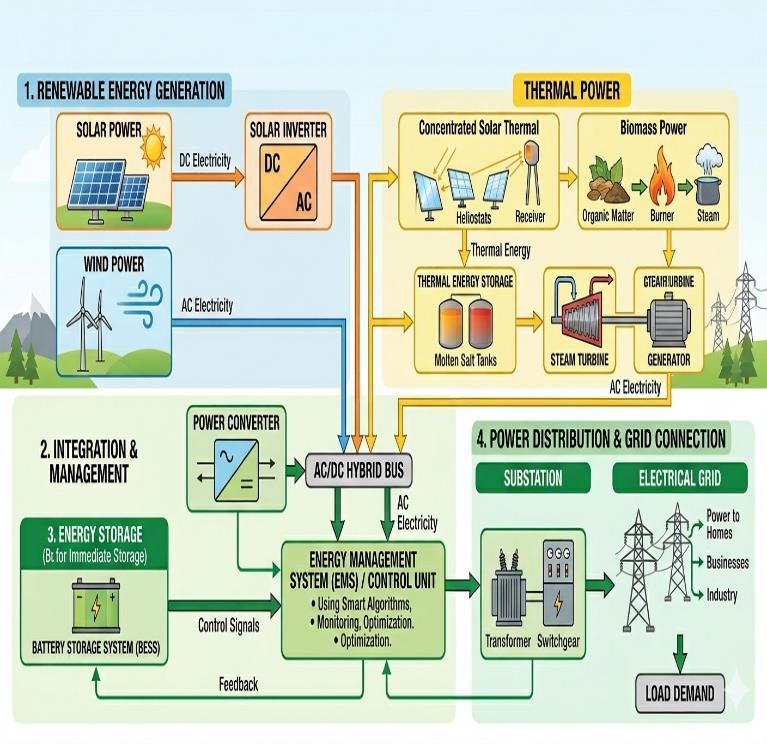
Theblockdiagramillustratesamodernapproachtopower plantengineering,movingawayfromcentralized,fossil-fueldependent systems toward Integrated Hybrid Renewable Systems (IHRS). This transition is a cornerstone of sustainable engineering, focusing on reliability, carbon neutrality,andefficiency.
Hereisananalysisofthediagrambasedonadvancements andsustainablepractices:
Advancement: Traditionalengineeringreliedonsingle-fuel sources(coalorgas).ThishybridmodelintegratesSolarPV, KineticWindEnergy,andThermal/Biomass.
Sustainability: By combining these sources, the plant overcomesthe"intermittency"problemofrenewables.For instance,solargeneratespowerduringtheday,whilewind oftenpeaksatnight,andbiomass/thermalprovidesasteady "baseload"thatcanbeadjustedbasedondemand.
Advancement: Unlike standard solar panels, the ConcentratedSolarThermalsectionusesheliostatstofocus sunlight tocreate heat. The inclusion ofMolten Salt Tanks (ThermalEnergyStorage)isasignificanttechnologicalleap.
Sustainability: Moltensaltscanstoreheatforhoursoreven days. This allows the plant to generate steam and turn turbines even after the sun has set, making solarenergya dispatchableresourcesimilartotraditionalpowerplantsbut withoutthecarbonfootprint.
Advancement: The Biomass Power block represents the conversionoforganicmatterintosteam.
Sustainability: Thispromotesacirculareconomybyusing agricultural or organic waste as fuel. When managed correctly,biomassisconsideredcarbon-neutralbecausethe CO2 released during combustion is offset by the CO2 absorbedbytheplantsduringtheirgrowth.
Advancement: The "brain" of the plant is the Energy ManagementSystem(EMS).Modernpowerplantengineering usesAIandsmartalgorithmstomonitorweatherpatterns, predict load demand, and decide in real-time whether to storeenergyintheBatteryStorageSystem(BESS)orsendit tothegrid.
Sustainability: This optimization ensures minimal energy wastage. The AC/DC Hybrid Bus allows for seamless conversion between the different types of electricity produced by solar (DC) and wind/turbines (AC), reducing transmissionlosses.
Advancement: Thediagramconcludeswithasophisticated SubstationandSwitchgearsetupconnectedtoasmartgrid.
Sustainability: Sustainable engineering aims to make the gridmore resilient.Byhavingstorage(BESS)andmultiple generationpoints,thisplantcanprovide"ancillaryservices," suchasfrequencyregulationandvoltagesupport,whichare
International Research Journal of Engineering and Technology (IRJET) e-ISSN: 2395-0056
Volume: 13 Issue: 04 | Apr 2026 www.irjet.net p-ISSN: 2395-0072
vital for maintaining a stable electrical gridas more green energysourcesareadded.
6. Environmental Impact Mitigation
Sustainable Practice:Byreplacingtraditionalhigh-emission combustionwithamixofwind,solar,andcontrolledbiomass, theplantsignificantlyreducesSulfurOxides(SOx),Nitrogen Oxides(NOx),andparticulatematter.Thisalignswithglobal ESG (Environmental, Social, and Governance) goals and internationalclimateagreements.
3.1 Main AdvancementsinPowerPlantEngineering
a) Supercritical and Ultra-Supercritical Technology: These technologies operate at higher temperatures and pressures, improving efficiency and reducing fuel consumption.
b) Combined Cycle Power Plants:
Combinedcycleplantsutilizebothgasandsteamturbines, achievingefficienciesabove60%.
C) Smart Grid Integration:
Smartgridsenhancepowerdistributionefficiencyandenable real-timemonitoringandcontrol.
3.2 Sustainable Practices
a) Renewable Energy Integration
Integration of solar, wind, and hydro energy reduces dependencyonfossilfuels.
b) Waste Heat Recovery
Wasteheatrecoverysystemsconvertunusedheatintouseful energy,improvingoverallefficiency.
c) Carbon Capture and Storage (CCS)
CCS technologies capture CO2 emissions and store them underground,reducingenvironmentalimpact.
3.3 Efficiency Calculation
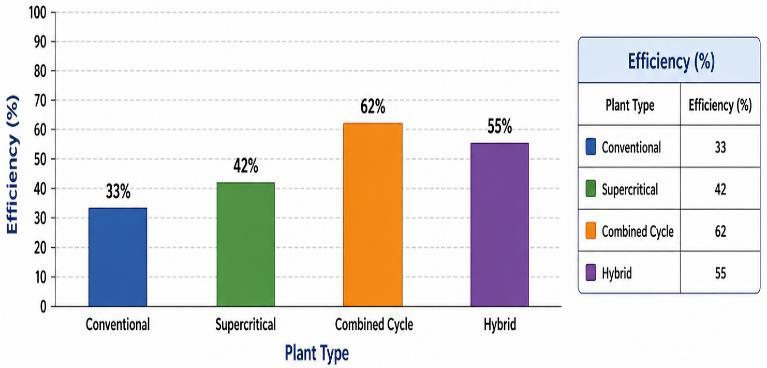
Thermalefficiencyisdefinedas:
η=(OutputPower/InputHeatEnergy)×100
Case 1: Conventional Power Plant
PowerOutput=500MW
HeatInput=1500MW
η=(500/1500)×100=33.3%
Case 2: Combined Cycle Power Plant
PowerOutput=750MW
HeatInput=1200MW
η=(750/1200)×100=62.5%
Case 3: Hybrid Power Plant
PowerOutput=600MW
HeatInput=1100MW
η=(600/1100)×100=54.5%
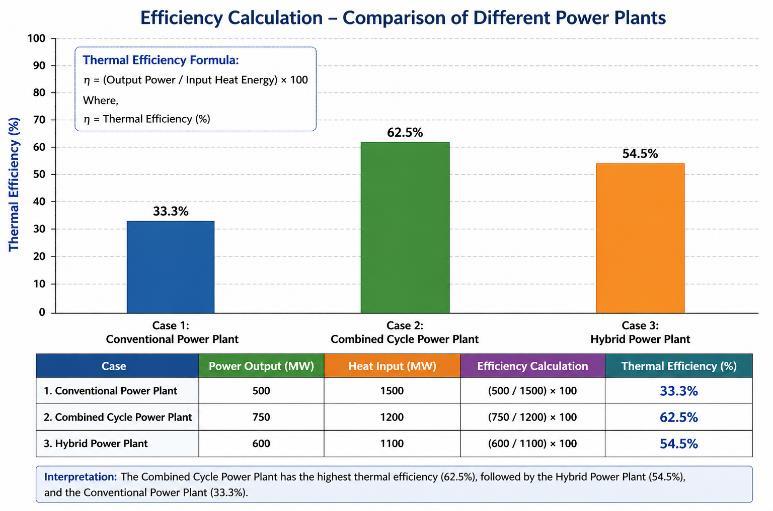
-3: Comparisonandanalysisoftheirthermal efficiencies.
3.4 Emission Calculation
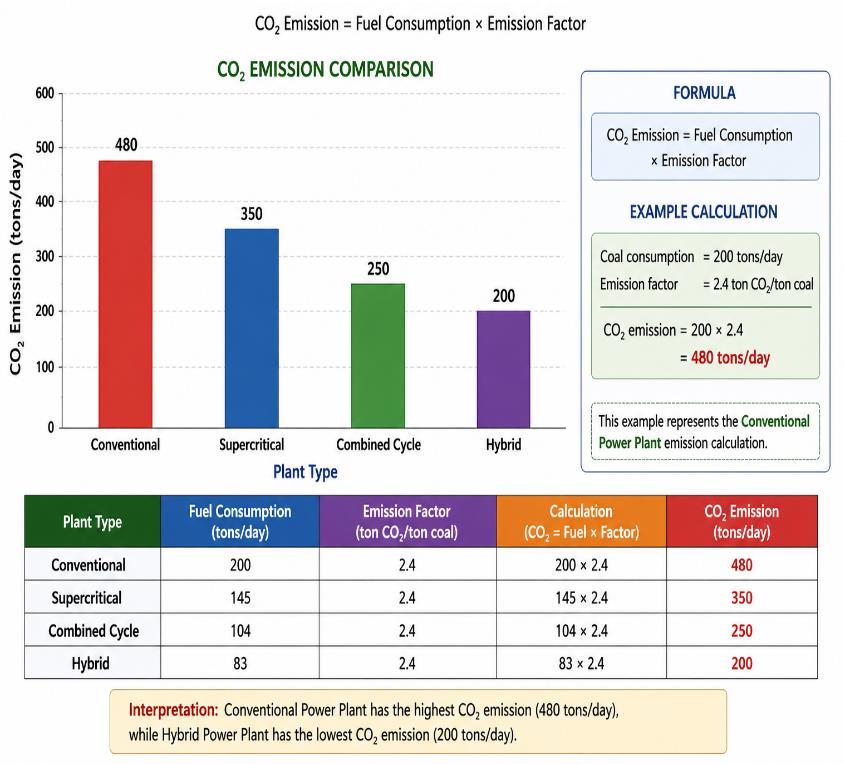
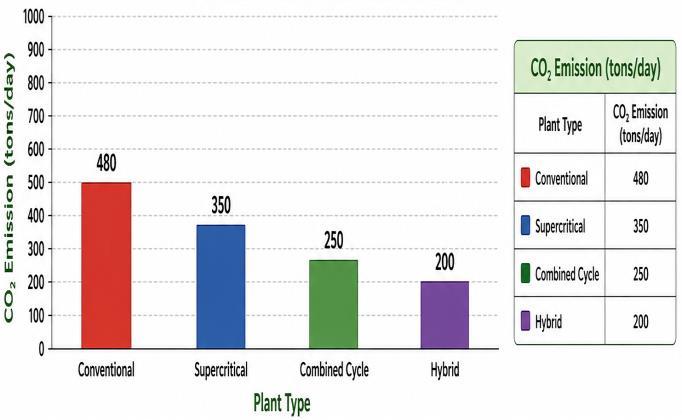
CO₂emissionsarecalculatedusing: CO₂=FuelConsumption×EmissionFactor
ExampleCalculation:
Coalconsumption=200tons/day
Emissionfactor=2.4tonCO₂/toncoal
CO₂emission=200×2.4=480tons/day
International Research Journal of Engineering and Technology (IRJET) e-ISSN: 2395-0056
Volume: 13 Issue: 04 | Apr 2026 www.irjet.net
5. CONCLUSIONS
This study highlights that advancements in power plant engineering are essential for achieving sustainable and efficientenergysystems.Theanalysisclearlydemonstrates thatmoderntechnologiessuchascombinedcycleandhybrid powerplantssignificantlyoutperformconventionalsystems in terms of efficiency, fuel utilization, and environmental impact.
Combinedcyclepowerplantseffectivelyutilizewasteheat, resultinginhigherthermalefficiency,whilehybridsystems integrating renewable energy sources contribute to substantialreductionsingreenhousegasemissions.These advancementsnotonlyenhanceoverallplantperformance but also support global efforts toward reducing carbon footprintandpromotingcleanenergy.
International Research Journal of Engineering and Technology (IRJET) e-ISSN: 2395-0056
Volume: 13 Issue: 04 | Apr 2026 www.irjet.net p-ISSN: 2395-0072
Furthermore,theadoptionofsustainablepracticessuchas waste heat recovery, emission control technologies, and renewableenergyintegrationplaysavitalroleinminimizing environmental degradation while ensuring reliable power generation.
Inconclusion,thetransitionfromconventionalpowerplants to advanced and sustainable systems is imperative for meeting future energy demands. Continued research, technological innovation, and implementation of efficient power generation methods will be key to achieving longtermenergysustainabilityandenvironmentalprotection.
[1] InternationalEnergyAgency,“WorldEnergyOutlook,” 2023.
[2] P.K.Nag,PowerPlantEngineering,McGrawHill,2019.
[3] A.Kumaretal.,“RenewableEnergyIntegration,”Energy Journal,2022.
[4] S. Rao, “Thermal Power Plant Analysis,” IEEE Transactions,2021.
[5] IPCCClimateChangeReport,2023.
[6] J.Smith,“CombinedCycleTechnology,”Elsevier,2020.
[7] R.Gupta,“CarbonCaptureMethods,”Springer,2021.
[8] M. Elwardany et al., “Advancing sustainable thermal power generation: insights from energy and exergy analysis,”ProcessSafetyandEnvironmentalProtection, 2024.
[9] A. Khalid and M. Ahmad, “Advances in Sustainable EngineeringPractices:AReviewofRecentInnovations,” ResearchCorridorJournalofEngineeringScience,2024.
[10] B.Shuklaetal.,“InnovationsinSustainableEngineering: A Review of Green Technologies,” Educational AdministrationTheoryandPracticeJournal,2024.
[11] Y.Yuetal.,“Advancementsinsustainabilityinthe21st century: Solar power applications,” Energy Reports, 2025.
[12] M. A. Eleiwi and L. J. Habeeb, “Strategic Engineering ManagementforRenewableEnergyProjects,”Al-Noor JournalofEngineeringManagement,2025.
[13] M. A. Suryawanshi et al., “Sustainable solutions using process intensification and green technologies,” EnvironmentalClaimsJournal,2025.
[14] G. Panda et al., Sustainable Energy and Technological Advancements,Springer,2023.
[15] P.Debiagietal.,“Ironasasustainableenergycarrierfor retrofitting coal-fired power plants,” Energy Systems Research,2022.
[16] J. Zhang and Y. Wang, “Energy and exergy analysis of thermal power plants: A review,” Energy Conversion andManagement,2023.
[17] D.DincerandM.Rosen,Exergy:Energy,Environment andSustainableDevelopment,Elsevier,2021.
[18] A. Bejan, Advanced Engineering Thermodynamics, Wiley,2016.
[19] International Renewable Energy Agency (IRENA), “RenewablePowerGenerationCosts,”2023.
[20] World Bank, “Sustainable Energy for All (SE4ALL) Report,”2022.

Mr.B.S.Swami (Lecturer in Mechanical EngineeringDepartment) SPM Polytechnic, Kumathe, Solapur